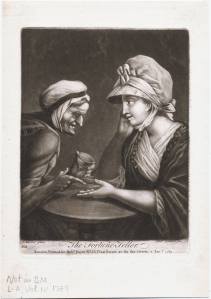
The Fortune Teller, 1789. Lewis Walpole Librray. 789.1.2.1
I like hats; I think it’s been made clear here before that I have a bit of a bonnet problem. As it stands, I have something in the neighborhood of a dozen bonnets, and really need to get my Etsy store up and running…
But as in life as in the Richard Scarry story, there’s always room for one more, and more to learn, so my collection hasn’t stopped me. I blame my Grandmother Elsa, who owned a dress shop, collected shoes, and had a particular face for trying on hats.
Black silk bonnet, 1770*1780. Colonial Williamsburg 1993*335
I’ve been thinking about bonnets because I lately came across some engravings showing what might be called baleen bonnets. At left above, a bonnet that is clearly reminiscent of the bonnet in the Colonial Williamsburg collection on the right. The CW bonnet (1993-335) has seven baleen bones, and a baleen rib around the bonnet brim.
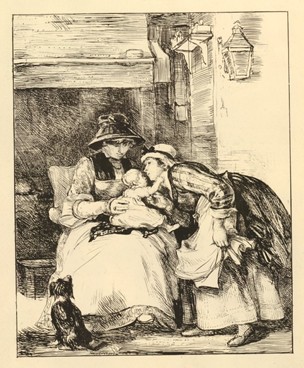
It is strikingly similar to the bonnet in the 1789 engraving, down to the decoration. In “Kissing the Baby,” a lithograph in the collection of the British Museum, the older woman appears to be wearing a ribbed black bonnet in the style my friend calls “lampshade,” and that others call “bucket.”
Kissing the Child. Lithograph by David Wilkie, 1800-1841. British Museum, 1852,1211.134
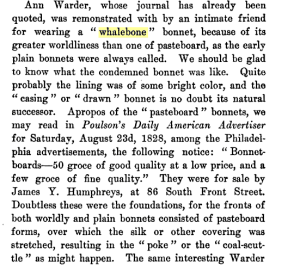
There are more bucket or lamp-shade-like bonnets depicted in engravings and paintings, and it is possible that flamboyant style was the one that got Ann Warder in trouble in 1788. I remembered this passage on page 223 of Amelia Mott Gummere’s book, The Quaker, A Study in Costume,:
Whalebone bonnet? Interesting… so, having an interest but no whalebone, I send the Young Mr to the basement for the remaining stock of caning I’d used for stays, and came up with a plan to replicate a “whalebone” bonnet, which I will describe and show you next time!
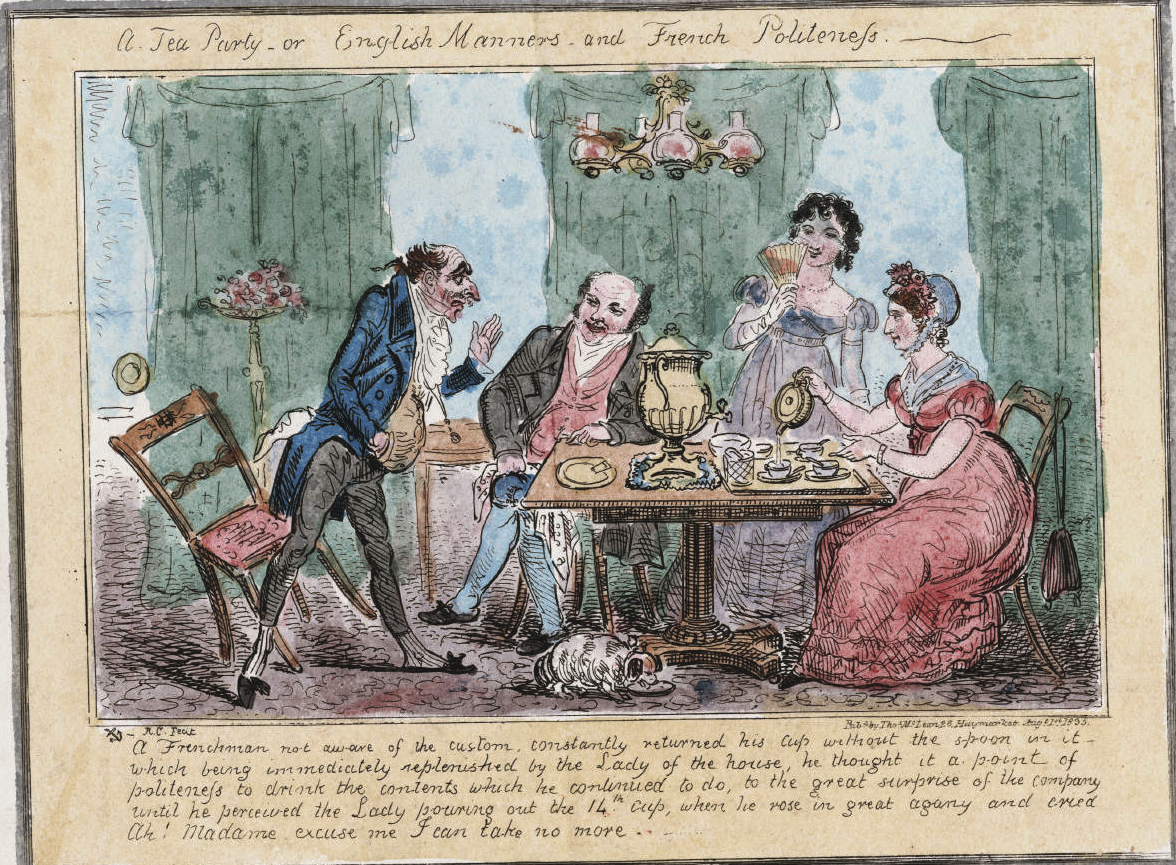
A tea party, or English manners and French politeness. Hand-colored etching on laid paper by Robert Cruikshank, 1835. Lewis Walpole Digital Library, 835.08.01.19
The story of the Frenchman who did not know the customs for refusing more tea may well be apocryphal. I cannot find the citation for the “French officer” whose cup was continually refilled by an 18th-century Providence hostess, but did find this cartoon from 1835 illustrating the same trope. Cliches and stereotypes, always with us. If there’s a lesson in here, it may well be, Don’t believe everything you remember.
Les Oublies. Le Bon Genre Plate 79: three ladies and a child look at a sundial in a garden, watched by a man. August 1815 Hand-coloured etching. British Museum 2003,U.14
I was first attracted to this image by the gentleman and his shapely legs, as you might expect, since tight buttoned gaiters or overalls do turn my head. This plate doesn’t make much sense to me: I can’t really grasp the satire, I can only guess. The explanation given for the series doesn’t help immensely. “The series is devoted to costume, mostly set in fashionable interiors, but the plates are treated in a semi-caricatural, humorous way that links them with French social satire.”
My best guess is that this plate from 1815 is showing off the latest filmy white fashions and tiny pink Spencers in contrast to the forgotten origins of the classical influence, personified by the gentleman in common dress at left. His hat and the gaiters suggest the French revolution, now forgotten (see “oublier” though the reference is also to the small cakes being eaten by the woman under the tree). The clock provides a reference to the passing of time, and forgetting, but I don’t think it is actually a sundial. The strap makes it look as if the man can carry it, and that’s a needle, not the fixed vane of a sundial.
Whatever it all means, I do find this more interesting for the man’s clothing than the women’s; after a while, the subtle differences between white columns is lost on me, but that’s a pretty interesting buff-colored waistcoat.
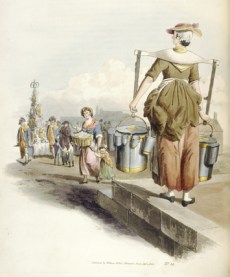
Sandby: A Milkmaid. ca. 1759, YCBAPyne: Milk Woman, 1805, MoL
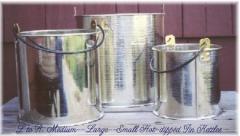
What do pewter and tin have to do with costuming? Well, aside from the many expensive buttons Mr S and the Young Mr wish to sport, I got interested in the milk maids’ pails because of their similarity to the tinned kettles used by RevWar reenactors. The uses converged in December in a conversation I had with a colleague about Carl Giordano’s beautiful kettles. (He made my wash basin, but my kettles came from Missouri because I needed them very quickly; the fur trade & rendezvous reenactors have similar material culture interests and needs, because of time period & culture overlap.)
Milk Below Maids, 1793, V&A
The milk pails look like tin, don’t they? One from ca. 1759, the other from 1805, and both appear to be carrying shiny, seamed metal buckets with brass details at the base and rim. The captions call them pewter, though. So I went to the V&A and the Museum of London looking for pails, but only found more milk maids.
I began to wonder: if the pails were really made of pewter, wouldn’t they be awfully heavy? And wouldn’t there be extant examples? Pewter is highly collectible. There’s a George II pewter milk pail on Worthpoint, but it looks nothing like the pails in the images. Is pewter ever so…shiny? And I’ve never seen seams in pewter the way they appear in the Pyne illustration.
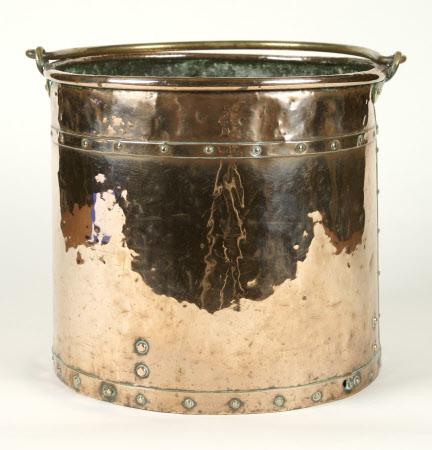
Here’s something that reminds me of that George II milk pail. I think I trust the Met more than I trust an online seller. On the right is a “bucket carrier” from the National Trust (UK) Collections.
Mid-18th century dinner pail with cover, MMAMid-19th century bucket carrier, NTC (UK)
Google defines pewter thus:
pew·ter
/ˈpyo͞otər/
Noun
A gray alloy of tin with copper and antimony (formerly, tin and lead).
Utensils made of this.
Synonyms
tin
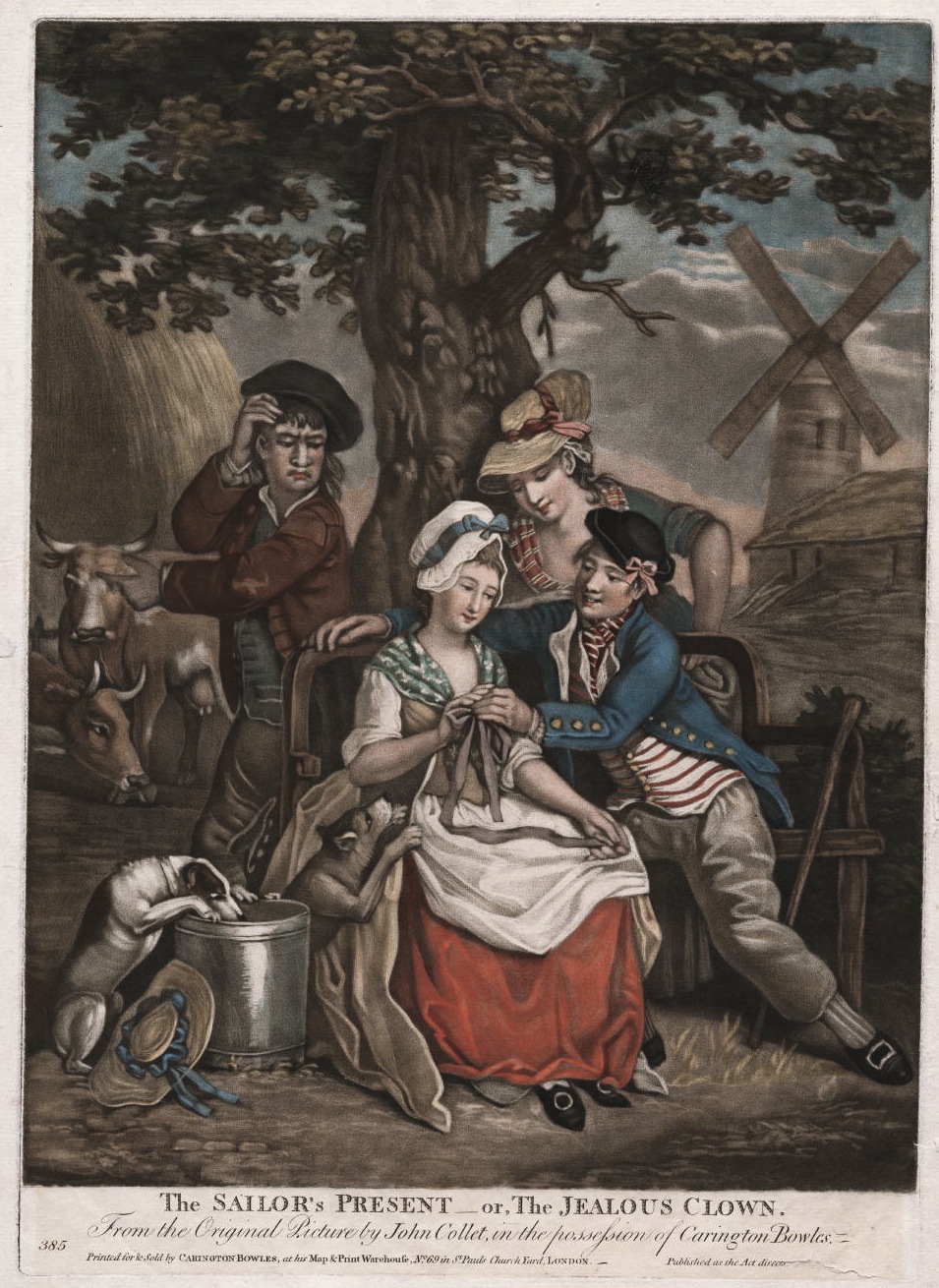
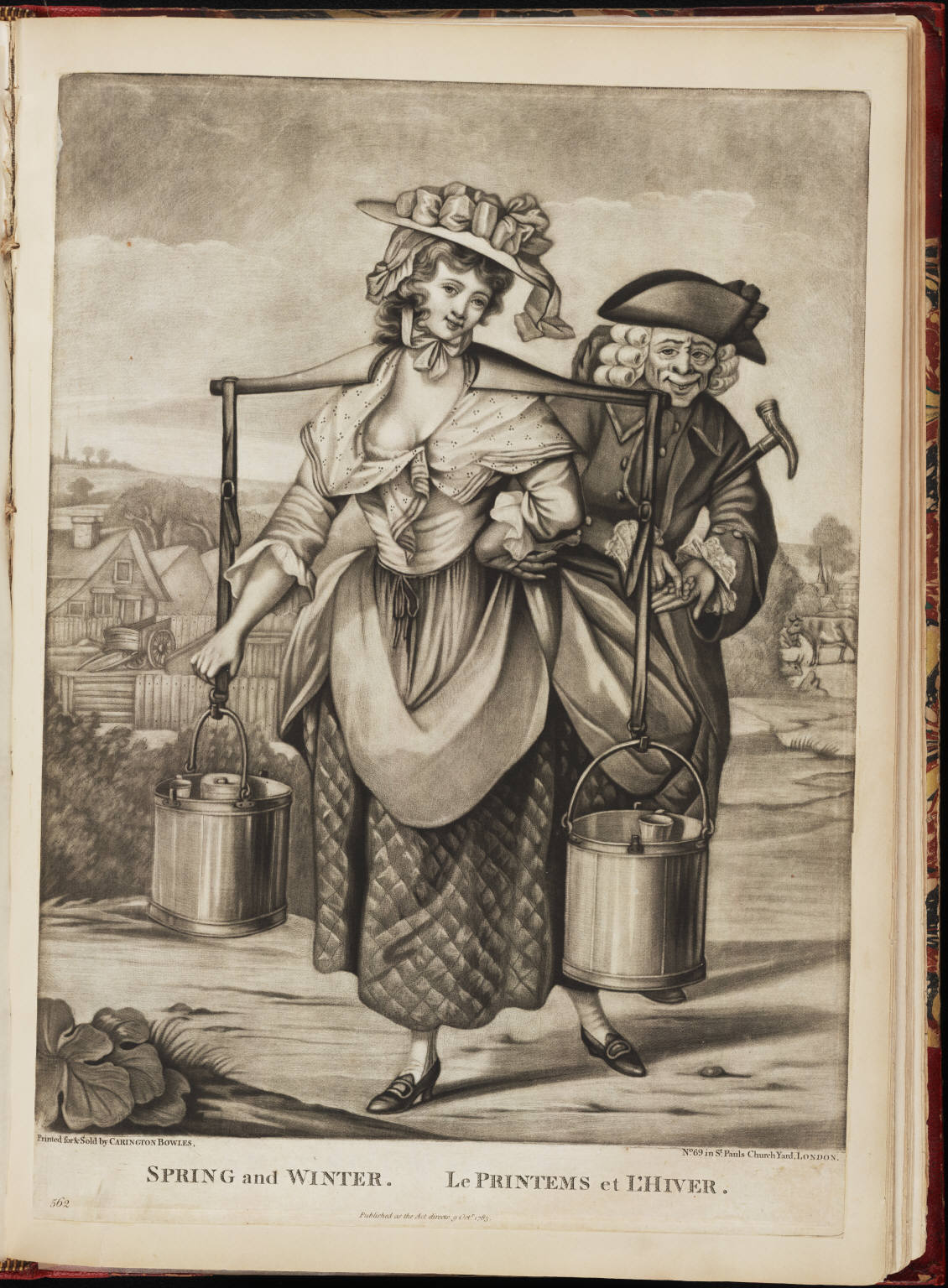
178, Collet: The Sailor’s Present, LWL1785: Spring & Winter, LWL
Synonym: tin? That’s pretty interesting, even though I don’t trust Google with etymology. But don’t these tin kettles look a great deal like the milk maids’ buckets?
Carl Giordano Tinsmith: Kettles
The Giordano tin kettles can be made with brass ears (that’s the part the bail, or handle, goes through). Look at the ears in the photo, and at this detail from “Spring and Winter:”
Detail, Spring & Winter, 1785, LWL
The ears may be the best lead to follow. There are plenty of ears (handle attachments) if you search the Met for bucket or pail and limit the search the metalwork… but they’re bronze, and Roman. The National Trust (UK) doesn’t turn up much, or the Museum of London (yet).
ca. 1750: Silver cream pail, MFA
There’s a silver cream pail at the MFA, and it sort of looks like its handle attaches with ears, but not in the riveted-on kind of way, but in a purposeful and elegant way. This is just about where I start to ask myself why I care, but then a number of other questions present themselves, like:
Where are the milk pails? Are there really no milk pails in museum collections? (Yes, this could be true)
Was this pewter milk pail with attached measures specific to London, as my colleague thinks?
How does milk taste when it spends quality time in pewter (or tin)?
How heavy would a pewter milk bucket be?
Things to ponder as we prepare for heavy snow… In this state, that means dashing out for “French toast supplies.” I’m not originally from here, and I solemnly swear we are legitimately out of bread, eggs, and milk.







 Kirsten Hammerstrom
You must be logged in to post a comment.