A companion pl. to BMSat 9813. A pretty young woman wearing a décolleté négligé, stands with her back to the fire, her gown raised to leave her posterior naked. She holds a book: ‘The Monk – a Novel by M’ [‘G. Lewis’, cf. BMSat 9932]; another is open on the floor: ‘Œconomy of Love by Dr Arm[strong’, 1736]. A cat rolls on its back. On a table are a decanter of ‘Creme de Noyau’, and an open book: ‘The Kisses’. On the mantelpiece are flowers and an ornate clock with embracing cupids. A picture partly covered by a curtain represents Danaë receiving the golden shower. The room, apparently that of a courtesan, is luxuriously furnished. 26 February 1801 Hand-coloured etching, British Museum, 1935,0522.7.12
I’ve left that caption intact, though it seems quite long enough for a blog post itself. This image turned up on Twitter (you can follow me there @kittycalash, expect randomness) and delighted me at the end of a long, tough week. I’m particularly taken with the cat, which resonates with an lolcat that floated about the interwebs last winter. The interwebs can be a strange place…
But aside from that silly cat, there are a wealth of details in this image, some of which are explicated in the caption.
What struck me- after the cat– was the slipcover on the sofa. How lame is that– but it’s true. Floral print, I suspect, but possibly woven, it’s loosely draped and long. I’m more familiar with the checked linen slipcovers seen in representation of New England interiors, so the floral really struck me. I suppose those linen checks symbolize all the puritanical uprightness and restraint of early Federal New England dons (if you believe in that kind of thing), while the loose floral print drapery tells you everything you need to know about our Rumpford friend.
We all see what we want to see…cats, slip covers, or courtesans.
The Frail Sisters, 12 May 1794. British Museum, 2010,7081.1077
Here’s the British Museum’s description of this print: “Two young women dressed in fine clothes in a room with decorated wallpaper, one sitting in front of the window looking onto the street, with a pet squirrel on her lap, turning to smile towards the viewer and pointing at herself, while the other stands behind her chair on the right. 12 May 1794.” It’s good to get the pet squirrel question out of the way.
This is another print that’s hard for us to read completely: you might wonder why they’re called the Frail sisters. Is Frail a proper noun, an adjective, or something else? It’s probably code: frail here may well refer to the strength of their morals rather than their biceps.
There’s another Frail Sisters drawing, also 18th century, probably late 1780s-early 1790s. This is appears to be a ‘straight’ drawing, but I don’t know: it could be an artist’s portrait of three prostitutes at play. Or it could be actresses (they weren’t so very far from prostitutes and courtesans).
Mrs Frail appears in William Congreve’s Love for Love; do these images also reference characters first seen in Restoration comedies? This is stuff I haven’t thought about in a long time, so I can’t yet unpack how the title and meaning of the print relate to what the women are wearing. And I might be over-thinking things a bit, so let’s step back and just look.
What is the standing sister wearing?
A half-robe, indoors. Time of day, indeterminate, but perhaps morning.
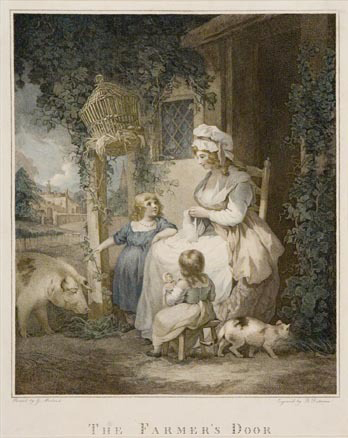
The Farmer’s Door. George Morland, London: Published by J. R. Smith, King Street, Covent Garden, Aug. 4, 1790
A somewhat easier image to read is the print after George Morland’s The Farmer’s Door, from 1790. This genre painting presents the romanticized vision of humble life, with the farmer’s wife and her children (note the blue stays on the seated child).
Is the farmer’s wife wearing a half-robe over a quilted petticoat and apron? The quality of the images I can find is poor, and the coloring questionable.
In another version here, the kerchief is clearer and seems to go over a long-sleeved garment with a short skirt.
Selling Carrots by George Morland Date painted: 1795 Oil on canvas, 76 x 63.5 cm Collection: Brighton and Hove Museums and Art Galleries
In Selling Carrots, there is another short-skirted garment with long sleeves worn over a petticoat and with a kerchief.
Without getting overly distracted by titles and meaning, I think there are clues to how these half-robes or jackets are worn by women of different classes, aspirations, and locations. For rural women who are not gentry, these appear to be comfortable working clothes worn all day. For urban women, they seem to be worn early in the day, and sometimes out of doors, perhaps even to the lending library.
Plate 11, Twenty-four Subjects Illustrating the Costume of Paris
Like most humans, I have whimsical tastes and occasional outbreaks of covetousness. Today, while looking for images of milliners, I found this book for sale online, and while I cannot dream of owning it, I am delighted by this image, and by the others shown on the bookseller’s site. The British Museum has a copy, but only a few images online; Yale has a copy at the Center for British Art, but no images online.
John James Chalon, (more images here) who made this engraving, also made the classic image of the milliner’s shop, and that was where my search began.
La Marchande des Modes
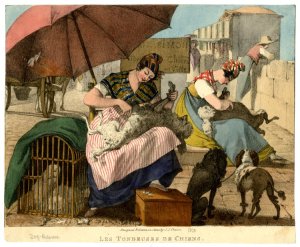
Searching a little more only improved the results… Dog groomers! I have got to get hold of this book.
Les Tondeuse de Chiens
While these engravings satisfy my delight with the absurd, more seriously, they provide some insights into daily life in the 1820s. It’s not the United States, but it’s a helpful place to start, because despite the humour in these, there isn’t a layer of satire that has to be peeled off before we can begin to understand the image.
Full-on satires, like those of Hogarth, Rowlandson and Gilray, can be hard for us to interpret: we’re so far away, we no longer get the joke, so the joke is now on us if we take what is shown for exact truth. The prints in “Twenty-four subjects exhibiting the costume of Paris” have a gentler humour.
I don’t think I’m ready to portray a 19th century dog groomer, but I am stunned that I never considered how long they’ve been around. How many other everyday occupations do we overlook when we think of the past?
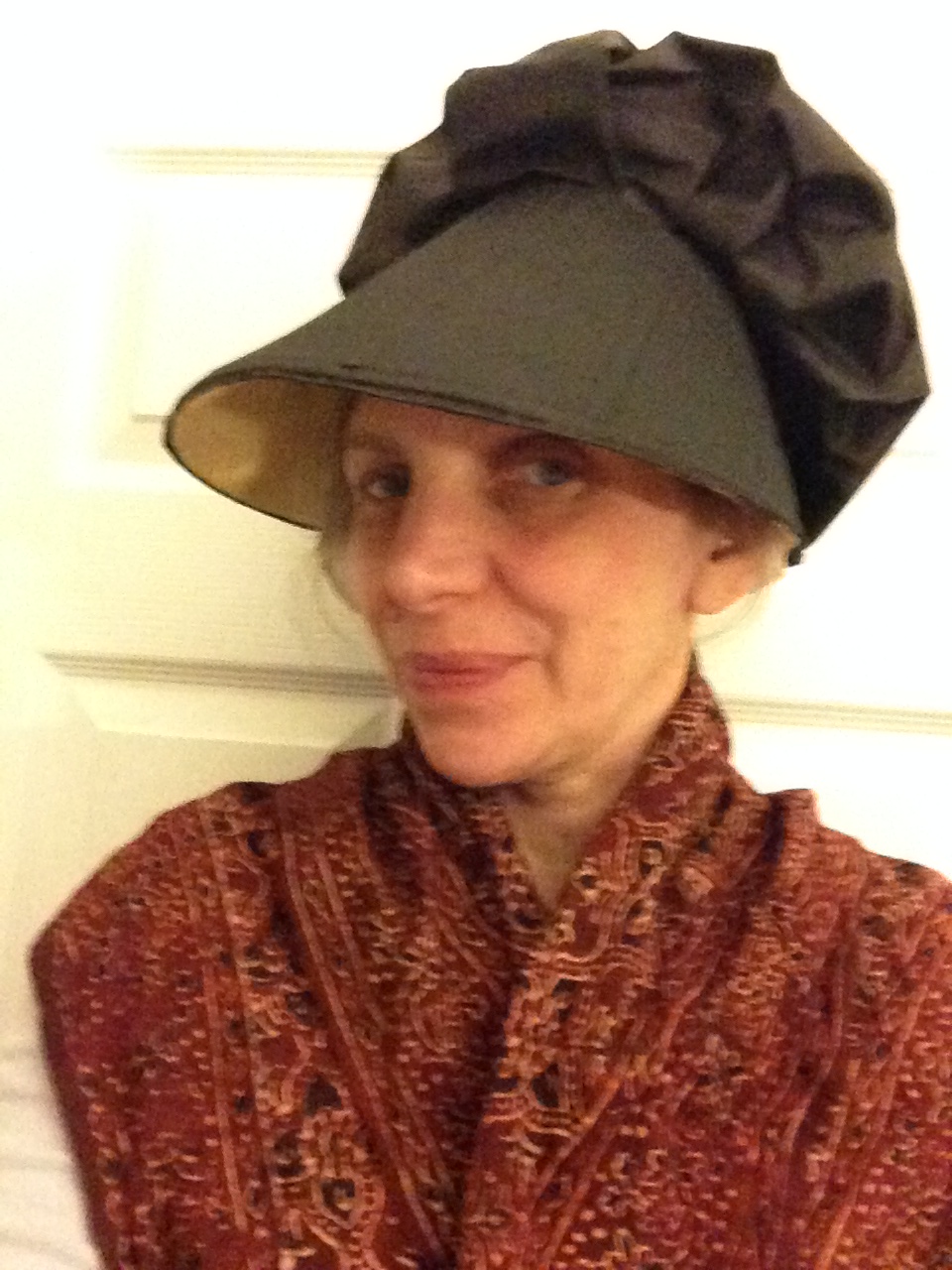
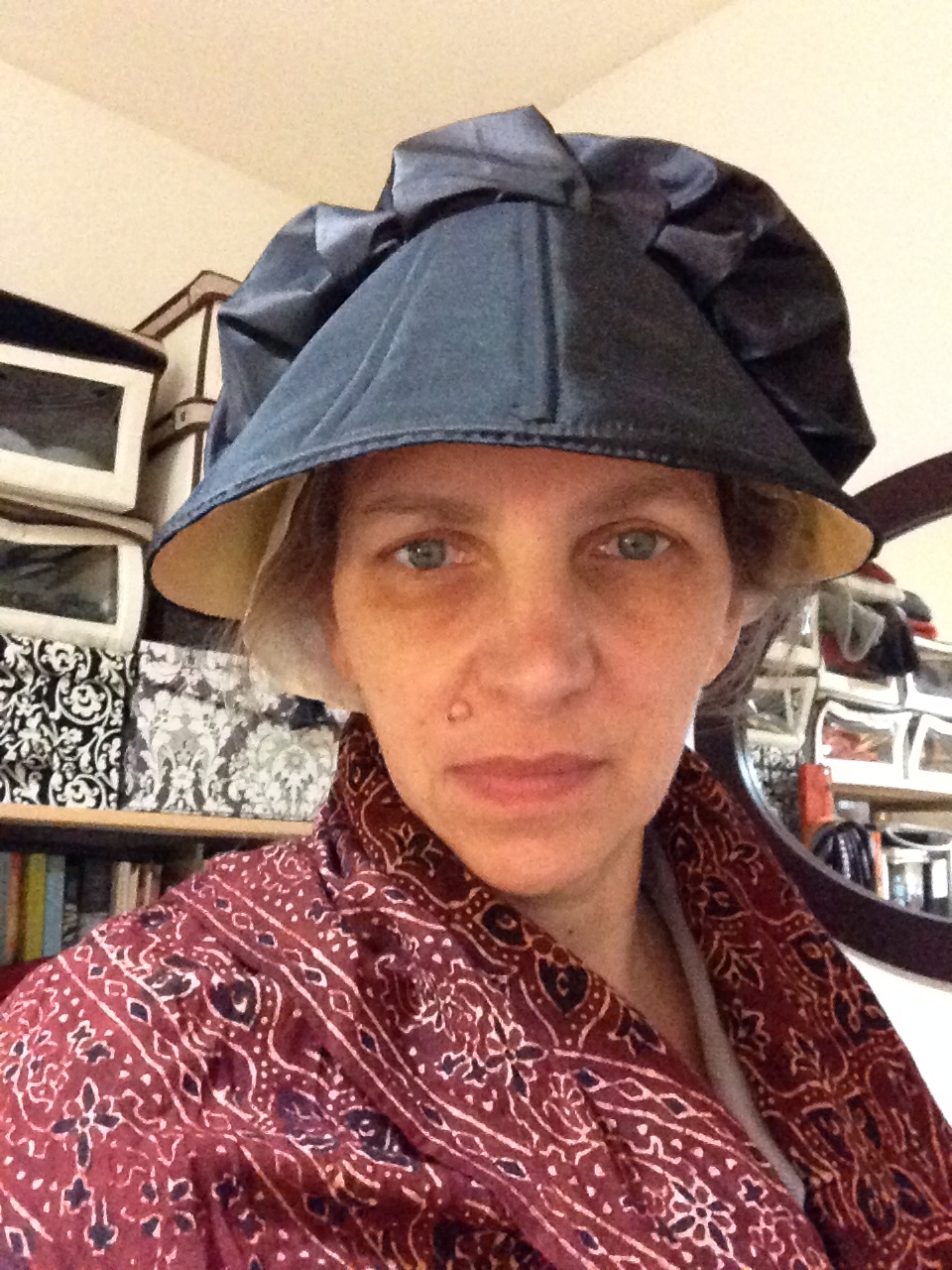
As promised, my interpretation of the ribbed bonnet in the 1789 engraving. There are a few problems with this beyond the model. (Which is not to say that I don’t like this bonnet– I do!)
I used the Kannik’s Korner bonnet pattern (view F, I think) as the basis for this because I already had a brim, lining, and caul cut and in a drawer. Given my current medicated state, using something pre-cut seemed advisable. That means I didn’t play with the brim to create the line of the Williamsburg bonnet, or the curve of the brim in the “Fortune Teller” engraving.
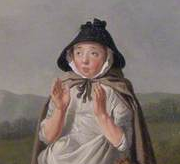
Detail, The Marquis of Grandby
Is this style acceptable for the period I typically interpret (1775-1783)? Well… there are other examples of the lampshade-style bonnet, as in the Edward Penny painting of the Marquis of Granby. This painting is dated “after 1765” so there’s some room for interpretation there…too much room. But if that’s 1765-1770, and the “Fortune Teller” is 1789, I think we have comfortably covered the 1775-1783 time frame, even if it is a bit like a queen-sized blanket on a twin bed.
Front view: more lamp-shade like.
As you can see, the bonnet does have some lamp-shade-like tendencies on my head, which I consider a benefit. I like the way the ribs are visible, even if I remain unconvinced by the caning. I think it’s a little too wide, and lacks resiliency, though to be honest, I have only felt baleen at the New Bedford Whaling Museum, where there is a large sample on the second floor.
To compensate for the disappointing cane in the brim, I slipped a piece of millinery wire into the pocket underneath the cane. The layers in the brim are:
black taffeta
horsehair canvas
linen buckram
yellow taffeta
The channels are all hand-sewn, and then the cane was slipped in. I stitched the black taffeta caul to the first three layers, and then lapped the yellow taffeta over the raw edges and stitched it down to finish the brim/caul seam.
No, I didn’t take any in-process pictures…probably because this took considerable snake-eyed concentration last weekend.
Usually, I line the cauls of my bonnets, but through shear laziness or distraction, I opted not to this time, and I think I’ll leave it this way for a while. You will also note that I have not trimmed this: I have some black silk ribbon coming, and I may try that. I don’t have enough black taffeta left to cut self-fabric ties, and there do seem to be some plain examples. A plainer, lamp-shade-like bonnet may be just the ticket for Bridget.
What would I do differently? Next time I would definitely play with the brim shape using a paper template. I’d like a lower, curvier, brim. Once I had the shape worked out in paper, I would use that as a template to cut the taffeta and horsehair or light buckram layers.
The Edenton Tea Party
I’d also try zip ties. I know: not period correct! But short of risking federal prosecution resulting from a trip to New Bedford with some shears, I’m not sure that anything other than plastic will have the resiliency and spring that baleen has, and that made these bonnets so special. I thought of them while making this bonnet, but I think Mr S used them all at work in the past two months. A Facebook friend has been thinking of zip ties, though, and has a hankering for one of these bonnets. I can’t say that I blame her– and honestly, I think I might join her.

![A companion pl. to BMSat 9813. A pretty young woman wearing a décolleté négligé, stands with her back to the fire, her gown raised to leave her posterior naked. She holds a book: 'The Monk - a Novel by M' ['G. Lewis', cf. BMSat 9932]; another is open on the floor: 'Œconomy of Love by Dr Arm[strong', 1736]. A cat rolls on its back. On a table are a decanter of 'Creme de Noyau', and an open book: 'The Kisses'. On the mantelpiece are flowers and an ornate clock with embracing cupids. A picture partly covered by a curtain represents Danaë receiving the golden shower. The room, apparently that of a courtesan, is luxuriously furnished. 26 February 1801 Hand-coloured etching, British Museum, 1935,0522.7.12](https://kirstenhammerstrom.com/wp-content/uploads/2023/03/0cd30-rumpford.jpg?w=640&h=898)






 Kirsten Hammerstrom
You must be logged in to post a comment.