This is That

Mark Rothko: another suicidal abstract bad-boy painter from the middle of the last century, so what?
This is what: a day at the museum when then the last painting in the Napoleon exhibit is presented in such a way that it was, in effect, the same as the last painting I happened to see.

Rothko wasn’t one of my top-ten favorite artists, but he was the top of the list of color-field painters I liked when I was studying art. He’s the kind of artist who grows on you as you mature, the way eating habits change with experience. The article I’m reading now compares his work to Roman villa murals, and that makes sense when you encounter his work. It’s color and not color, depth and surface, immersive. Simply immersive. Rothko creates a world that exists within your own head; his paintings invite you into his mind, which then occupies yours. It’s not always comfortable, given Rothko’s own dark visions. It remarkably effective in its apparent simplicity, the colors hovering over one another, creating depth with saturated color.

The first Rothko I saw must have been in Chicago, though the first one I remember is Red, Orange, Orange on Red in St. Louis; I must have seen the Albright Knox’s not long after they acquired it– the red and black are more familiar and more comfortable, in a way, than the orange and red.

But this is a history blog, you say, a costume blog. Why are we talking about Rothko? We’re talking about Rothko because seeing a Rothko– standing in front of an actual Rothko, taking a breath and looking— is an experience. An emotional experience. Reader, I wept.*

Just as the projected waves washed the walls of the final gallery in the Napoleon exhibit, so too did the blues of this untitled painting move. They vibrated with emotion, and I was immersed in blue, a kind a symphony of color, as close as I will ever come to synesthesia.

And that’s what good exhibits do, what good history does, what accuracy does. It renders the past visible, tactile, sensible, immersive. It catches us, and we fall down. Art, history, culture: if we are sucked into that otherness, hooked by feeling, we are more likely to learn something.

As stood before the Rothko, I noticed a Cornell– and a teenager noticing the Cornell. Joseph Cornell’s boxes were my first obsession, when I skipped school to go to the Art Institute of Chicago to spend my day surrounded by Cornell’s tiny universes, transported to another place.
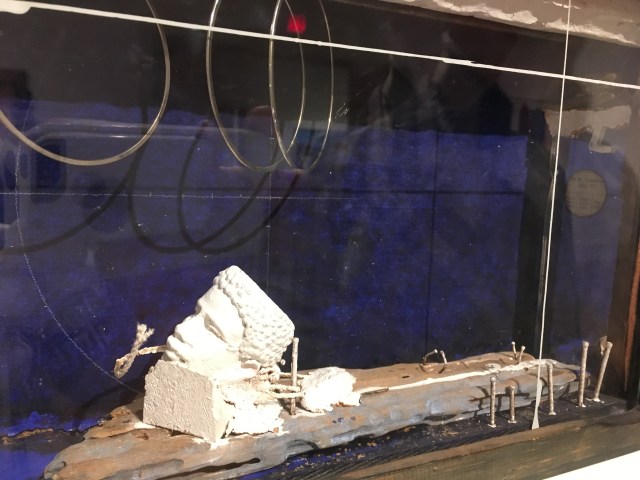
Untitled (Primary Title), painted and papered wood and glass box, with wood, plaster pipe, metal rings, nails, and string by Joseph Cornell, probably 1950s. Virginia Museum of Fine Arts, 96.41

Isn’t that what we’re trying to do, every time we dress in these funny clothes, visit historic sites, reenact the past? Aren’t we all seeking some sublime moment, when this solid present becomes the ether of the past? Sometimes the way to understand that most readily is to study something else entirely– like a Rothko. Or a Cornell. Sometimes the way into a thing is sideways, when understanding and inspiration come from an unfamiliar place, when me make connections we don’t expect.

L’Empereur Napoléon Ier sur son lit de mort, oil on panel by Denzil O. Ibbetson, 1821.

Death and Napoleon and Rothko and Cornell all seem obviously connected to me– and not just through the symbolism of the rich cobalt blues.

*I do this in museums: when I walked into the Kaufman Gallery at the NGA, tears welled in my eyes at the sight of so much beauty.
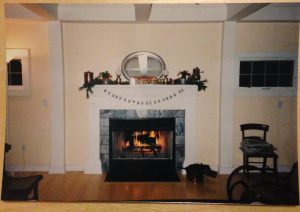
Staging Christmas

The house on High Street, Noank CT, 2000

It’s pretty stagey to begin with, isn’t it? Full of ritual, some so old we don’t know why we still perform them. What I like best is the food, not the cakes and cookies, delicious as they are, but savory meals and the warmth of a full table. Second to that, decorating.

The past year has given me opportunity to reflect on the tasks I love, and why, and the basis for the work I’m passionate about. Curiously, it began in high school, as the props mistress for drama productions, morphed into installations, performance art, and site specific sculpture in college, before metastasizing into exhibition development, installation, and historic house interpretation with a side line in living history because, you know, costumes. Things and I go way back, and thinking about that made getting ready for yet another Christmas more fun.

Providence, 2016
Providence, 2016

Embracing the staginess makes the sometimes uncomfortable family closeness easier; I have proposed celebrating by reenacting a Don Draper Christmas, as long as someone else does the driving. Adding a layer of actual performance somehow made it easier to understand, a phenomenon opposite to what happens when you write a word over and over until it makes no sense. It’s the same distance you feel when you really try to understand someone’s past, and how they think. It’s familiar, but somehow unrecognizable.

This is probably the last Christmas in this apartment, which adds a poignancy to the proceedings, and it’s the first interactions for some participants, so, as with What Cheer Day, I’ve set a stage and we’ll see what happens.

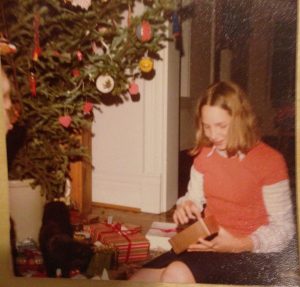
Christmas with Katie, Chicago.
Christmas with Katie the Cat, Chicago, ca 1978

Every year, some things are the same: a balsam fir, candles, apples, cats. The characters and locations ebb and flow, with some consistency. Cats come and go, the boy grows. The love remains the same.

What Cheer Day: Emotional Goals and Historical Content

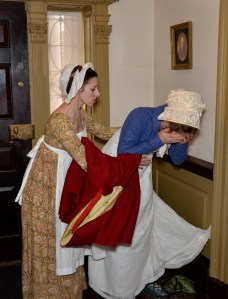
Petulant Alice faces her first hurdle, Kitty and Goody Morris. Photograph by J. D. Kay

I think about three or four things most of the time: food, sex, museums, and clothes. That seems pretty adequate, but from time to time I am forced to consider intersections between these rather broad topics. The intersectionality of clothing and museums seems pretty obvious: from accurate costumed interpretation to proper packing and storage, easy. Food and museums will be much on my mind in the coming year, as we work on “Relishing Rhode Island,” and I’m continually harping on how eating locally and seasonally is the core of eating historically. Sex and museums is a little harder (yes, I know about the Museum of Sex), though one gets a chance even in a historic house museum, and really, it’s not just about the act: it’s about the feels.

Mary assists Alice in the hallway as she prepares to face her mother. Photograph by J. D. Kay

In the main, I am not particularly good at the feels aside from some very hands-on experience with anxiety, but a number of things have coalesced recently to make me reconsider the intersection of emotions, museums, and history.

Hamilton is one, and if you read this, you probably watched the Hamilton’s America documentary  on PBS last Friday. If you didn’t, go do it now. Really: I can wait. And here’s why:

In the thinking I’ve been doing for some time about Hamilton,* I’ve reached the conclusion that what makes it so damn good (aside from the brilliant writing) is how Lin-Manuel Miranda has captured the emotions. The quotes I wrote down from the documentary are about emotion and drama, because I’m looking for them (confirmation bias for the win) but here they are:

“Each piece of music is specific to an emotion and a character”

“I got into the history through the characters”

“Research is over and you write the character defined by history”

“Write the parts you think are a musical”

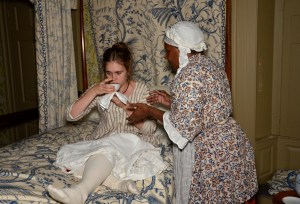
Goody Morris helps Alice drink lemon water to soothe her stomach. Photograph by J. D. Kay

What is a museum exhibit but “the parts you think are a musical?” While Our Girl History struggled with being Alice (I know a bit about the part where your ego gets connected to a character), she had to portray a character defined by history, but also by emotion. And in thinking about Hamilton, about What Cheer Day, and about the exhibits that give me pleasure, and art that brings me joy, I have reached a couple of conclusions.

I believe that museums, where we currently set educational and interpretive goals, and increasingly experiential goals, need to begin setting emotional goals for their programs and exhibitions. You could argue that experiential and emotional goals are the same, but I disagree: I believe that interpretation helps define the experiences that create emotional responses, and within the intersection of experience and emotion we will find the educational goal revealed, because we are always working within a content-driven context.

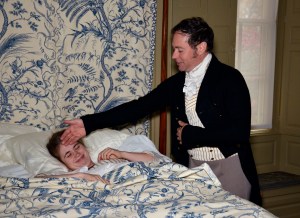
James checks on sister Alice. Photograph by J. D. Kay

I also believe the reason gun-based reenactments retain their popularity is their easy emotions. “Boom!” is exciting anywhere: there’s an immediate reaction of shock, surprise, a mild fear, and excitement. Traditional reenactments have those “boom!” emotions embedded within them, which is how they retain their potency. Until we locate the emotion within the everyday– and trust me, it’s there– we will not see the primacy of non-military reenactments and living history.

*Yes, I was aware of it when it was in previews at the Public Theatre. I am *that* kind of hipster, but really, it was because Oscar Eustis went from Trinity Rep here to the Public and there’s a PVD-NYC theatre connection.