
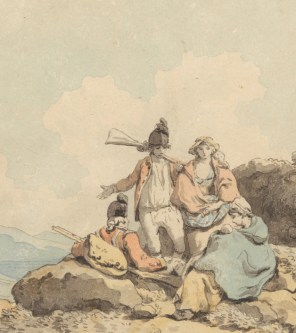
The Shurts off there Backs

Francis Wheatley, 1747-1801, British, Soldiers and Country Women, undated, Pen and black ink with watercolor on medium, smooth, cream wove paper, Yale Center for British Art, Paul Mellon Collection

Among the things I wondered about Bridget Connor and her court martial was from whom she’d bought that “publick shurt.” Why would a soldier have an extra shirt, or be willing to sell an extra shirt?

There are some circumstances in which it is plausible.

ClothingRegs1776_77

While shirts could have been sent from home,  regulations established in 1777 called for soldiers be issued two shirts, or an equivalent bounty. A soldier who wanted cash for alcohol or other non-regulation and non-issued goods or services might sell his second shirt, or steal a shirt to sell.

With the context of what soldiers should have been issued, we can  begin to tease the story out of the orderly books.

Regimental Orders July 15th 1782

At a Court Martial whereof Capt Dean was pre
sident, was tried Paul Pendexter & Titus Tuttel
soldiers in the 6th Company 10th Massachusetts Regt
For Stealing a Shurt and Disposing of the Same
ware Both found Guilty and Sentancd to Sixty Lashes
on there Naked Backs—the Colo approves
the opinion of the Court and orders it to
take this Evening and the prisoners to Return
to Duty——-The Court Martial of
which Capt Dean is president is Desolvd

The quote above is a full seven days before Bridget appears at her own Regimental Court Martial “for purchasing a publick Shurt from a Soldier.”

Paul Pendexter and Titus Tuttel were just the guys to get caught, until Bridget was discovered. It does make me wonder if there was an extensive ring for black market shirts (and where did they go once Bridget had them? Did she try to sell them back into the public stores, i.e. the quartermaster)?

Criminal masterminds these people weren’t, but it does seem possible that the Shirt Ring was fairly busy before it was collared.

Once Upon A Time…

Betsy Ross and friends: A Child Guidance Educational Activity

This is the third set of these paper dolls (Educational Activity) I have owned. The very first set was given to me by my mother, Lo, at the Dawn of Time, in the Dark Ages known as the 1970s.

I wore them out.

A new set was purchased, probably once again at Marshall Field’s, possibly in the book department. They now reside in an attic outside Philadelphia (how appropriate).

From this Educational Activity flowed many more home-designed outfits and home-made paper dolls of historical and literary origins, which have led to this moment, when I make myself and my family into historical characters, make us outfits, and set us in motion with friends and colleagues in scenes of historical play-acting, by which I mean Educational Activity.

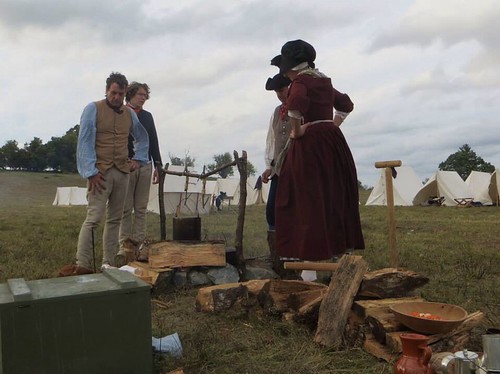
Cooking at Saratoga: very Educational. Photo courtesy D Molly Ross.

I like to think that the clothing we wear is more correct than the “Authentic Costumes” advertised on Betsy Ross’s box, but there is always more to learn. I am in no way denigrating Betsy Ross, or paper dolls, or suggesting that I see my family, friends and colleagues as paper dolls. But I do know that as long as I have been playing, I’ve been playing history and reading history, and drawing history, and using books and paintings and yes, even paper dolls, to figure out the world present and past.

If January Jones played Betsy Ross...
If January Jones played Betsy Ross…

Even though I always thought I wanted Betsy’s birthday cake gown, the one I really liked was the work gown. The “construction” of her garments confused me even as child: how the heck does that kerchief work? And the bodice front? Never mind, have a slice of dress, I mean cake. (Field’s had a cafeteria that served slices of pink-iced layer cake that I somehow conflated with the paper dolls, thanks to the shopping trips my mother and I made.)

Memory and fact, impression and citation: when we reenact the past as an Educational Activity, we should remember that some will walk away enlightened, and others will walk away thinking about birthday cake. Our job, beyond getting the facts right, is to engage our visitors, to interest them, and to excite their imaginations. What they do from there is up to them, but we will know that we have done our best to present them with a scene that can take them one step closer to being there.

The Birth-Night Ball (a preview)

Fully done up.

Photos by a real photographer won’t be available for another two weeks (patience, Iago, patience) but  Mr S and I had a lovely time, high-heeled shoes excepted. The gowns were dramatic, the gentlemen dandy, and the dancing elegant, if bumpy at the start. There are some videos here, both of the assembled company dancing, and of the lovely minuet demonstration.

Selfie, and ready for bed!

I managed a phone photo just before I crashed into bed, and am generally satisfied with how the dressed-up laundress appeared. Clearly my laundry business is doing very, very well, or I have liberated some earrings from a client. One of the most challenging things about this event (aside from my over-thinking freak outs) was not having a persona to hold onto. We started reenacting as lower-class 18th century types, and spent some time as tenant farmers and maids. Mr S and I do not have clothes for the gentry, but can inch into the middling sorts when we want to.

That’s fine, and it’s comfortable– we’ve not yet really reached all the way down the lower sorts, either–but it does mean that when we’re presented with the opportunity to dress above our station, the need to really understand the new station kicks in, and delays the process.

I’ll finish that silk sacque someday, and sooner rather than later, but I’m glad I held off so I can really get the gown right, as well as the shoes, hair style, and other accessories.

Consider the Collar

The Newport dresses seemed a little strange to me, in that the collar treatment was more like what I would expect to see on a pelisse than on a gown. But I am willing to be wrong, and delighted to be wrong if that’s how I will learn something.

@silkdamask (that’s Kimberley Alexander’s twitter handle; she has a blog you might want to follow if you don’t already) posted a photo of the dress (above left) she imagined a young woman she’d been writing about might have worn. Housed at the Met, this embroidered American cotton and wool gown ca. 1806 has a cross-over bodice and collar.

Another day dress from the Met (above right) has a ca. 1820 date, but looks very much like the gown worn by Mrs Amelia Opie (she was a British Quaker) in this engraving after an 1803 portrait. (Other, similar gowns and portraits are pinned here.)

Amelia Opie (1769-1863). Engraving by Ridley after painting by [John] Opie, 1803. Massachusetts Historical Society, Photo. 81.490

Nantucket and New Bedford  both hard large Quaker populations (remember Moby Dick?), and the Williams family in Newport had connections to New Bedford, so I looked in collections in Nantucket and New Bedford as well.

The gown below, now in the collection of the New Bedford Whaling Museum, was worn by Susan Waln Morgan Rodman (Mrs Benjamin Rodman), while pregnant; using a genealogy, we can establish pretty solid date ranges for the dresses at New Bedford Whaling Museum. It looks 1820s in style, and her first two children are born in 1821 and 1822.

Maternity gown worn by Susan Waln Morgan Rodman (Mrs Benjamin Rodman). New Bedford Whaling Museum, 1991.45.5.

A date range of 1820 to 1822 seems plausible. Susan Waln Morgan Rodman would have been about 20 with her first pregnancies. (Genealogies are on Google books.)

She seems to have kept up with style and to have liked clothes; a search for her name in the NBWM catalog returned some interesting items, though the catalog does not allow for linking to item records or searches. Mrs Rodman’s appears to have kept pace with style changes; that is, her wardrobe did not ossify in 1820-something, but evolved as fashions changed, and was appropriate for different situations.

Does that mean that all Quaker women kept pace with style changes? It’s hard to say; each of us today updates our wardrobe according to our fancy, our purse, our inclinations and our age. Are those Newport gowns going to turn out to look more like the Met gowns than I imagine? I don’t know, but it seems possible.