1813 Bonnet of untrimmed velvet, Redingote of Merino
1817 Velvet bonnet and broadcloth coat
I cannot manage to find the button I need to sew onto my real-world everyday winter coat, but I’m pondering and plotting how much broadcloth a Redingote (Redingcoat or Redingcote) would require, and internally debating the merits of red versus green.
Greatcoats have their attractions, and while Mr S would undoubtedly enjoy the warmth of a greatcoat, with a February 14 program in the offing, I am pondering a greatcoat of my own.
I can rationalize [almost] anything, but a Redingcote is a stretch even for me, despite that February program (indoors). I suppose the real appeal of one of these coats, aside from the pleasure of handling delicious green or red wool, is the challenge of making one. I have even found a front view to aid in the patterning.
1813 Hat of velvet and broadcloth coat
What stops me? Some unfinished projects, and a certain feeling of unease about buying quantities of expensive wool. I have two yards of dark green broadcloth, but I’m pretty certain that I will need three to make even the shorter red coat. Without making a firm resolution, I had determined that I wanted to sew down my stash–and I suppose the answer is to sew it down, or put it on Etsy. Or to buy the wool, make the coat, and wear it in the winter. It would be a spur to winter program ideas, after all.
Now, if only I could find the missing button from my winter coat…
On Saturday, I got a very nice piece of wool from Mr C’s Strategic Fabric Reserve, just the color and weight I’d been looking for to make a Very Specific Spencer. The VSS is not a replica, but rather specific to a gown: I want it to go with a 1797 V&A print.
Did women wear Spencers in 1797-1800 Providence? At least one tailor, Joseph Taber, advertised that he made Habits and Spencers, but as far as I know, there are no extant Rhode Island Spencers. Given how few collections are fully online here, and how few Spencers survive anywhere, I’m not too surprised. Julia Bowen’s diary covers Spring and Summer, when she’s quilting (mighty lazy work, she says), but she doesn’t say much about outerwear.
Providence Journal, 11-13-1799
I’ve been on the fence about how common Spencers were– after all, the drawings in Mrs Hurst Dancing show women clearly wearing red cloaks– but might a Spencer and cloak combination have been just the thing to keep warm on a raw October day? With a wool petticoat and long wool stockings, you could be fashionable and warm.
There’s no firm documentation of any of that– which does not mean, as I once muttered in the general direction of some recalcitrant docents, that rich people in Providence hunkered naked in cold corners of curtain-less rooms gnawing on raw meat.** What it does mean is that much of what we make and wear is conjecture, based on examples from the same time period in other geographic areas.
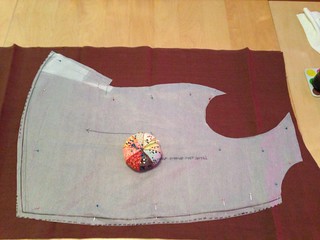
Can I have a Spencer in New England? I’m not sure, but I’ve made another one anyway, and here it is, still underway. (The thing about Cassandra is that while she is a very patient model, she has terrible posture. I can verify the back fits me a great deal better than it fits her.)
Cassandra’s posture is very different from mine. She will not pull her shoulders back!
This wool is buttery and soft, and takes the needle well. Waxed thread glides through it and grips. It does have a tendency to fray a bit at the cut edges, but has a good pinked edge, and there are examples of pinked-edge facings in extant men’s wear. Sweet, right?
I’m not showing you this to boast about my skills, but to show off an dandy mistake. In working the folded edge of the collar, I trimmed a bit too much at the neck edge, and found the collar a bit small when I basted it in. Of course I removed it, and started again, easing a bit more as I went: Huzzay! It fit!
Really, I’m not sure how this happened. But there it is: upside down.
Oh, reader: rejoice not. I backstitched that bad boy on upside down. Expletive deleted! Mad Skillz: I even managed that bit of genius before my pre-work panic attack.
I took the garment in to work to seek council from my tailoring-class-educated friend who possesses native common sense and Yankee practicality. It came down to this: is it worse to have the collar upside down, or to have it not fit as well right side up? Decide with the knowledge that working the fabric more will affect the cut edge badly. My friend suggested stitching in the ditch with contrasting thread to make this flaw an Intentional Design Element.
Black trim on a Spencer?
That is a good idea, but I thought the flaw will still be too noticeable. Then it came to me: trim. Just as the construction guys are spreading drywall mud in the chinks around the window frames, I can spread some wool braid love around this collar. There’s certainly evidence for trim use on Spencers in fashion plates, and trim would push the men’s wear aspect of this garment even farther. As soon as I got home, I double-checked extant garments and fashion plates, Roy Najecki’s lace page, and measured my edges.
Four yards of quarter-inch black mohair braid should do the job, stitched around the edge of the collar and lapels, the cuffs and possibly the hem edge.
Do I run the chance of looking like a black-outlined cartoon drawing? Yes.
Did I just buy endless hours of tiny stitching? Yes.
This is a crazy, work-making solution that may leave me with a garment not suited to my class in early Federal Providence. But I think it’s going to look amazing when it’s finished.
**(The docents argued that textiles were SO RARE and SO PRICY in late 18th century RI that NO ONE in Providence had curtains. NO ONE. The lack of fire was my own bitterness coming out at this Great Curtain Kerfluffle which took place at a public lecture I gave explaining what we knew about the use of textiles to furnish Providence homes of people who would be as rich as Bill Gates today.)
And happy not to be walking to Walloomsac, since we can’t leave till Friday.
Before we leave, there’s plenty to done, of course, and most of it in men’s wear.*
The first piece on brown linen
The Young Mr needed a new jacket, a proper one, with pockets and everything, correct for a scalawag. So that meant patterns and muslins and fittings and questions, until neither of us could really stand the other and his father called me an ambush predator of fittings. The only way to fit these wily creatures is, as they amble through the room, to leap out and toile someone.
With the pattern more-or-less fitted to the wiggly Young Mr, I cast about for fabric: there was not enough of a striped piece for both waistcoat and jacket; waistcoat won, because matching stripes on a jacket seemed too risky in this great a hurry. Instead, I sacrificed the last yardage once meant for a gown.
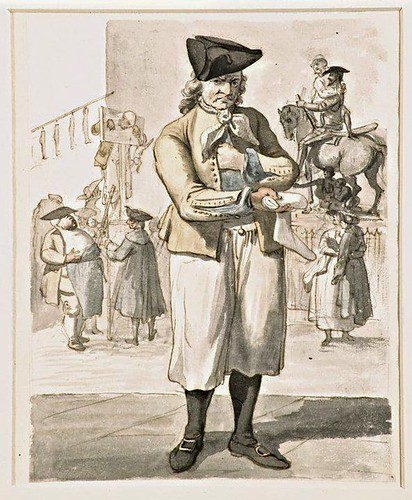
The Stocking Seller, by Paul Sandby, 1759
This is the inspiration for the kid’s new garment, along with Sandby’s fish monger. It seems a plausible garment to work from, and the brown linen is in keeping with the brown linen jacket at Connecticut Historical Society and the unlined linen frock coat recently sold at auction. It will also match his trousers, but this is what happens when you sew from the stash.
One pair of breeches altered, one waistcoat wanting the last seven newly-made buttons, one waistcoat in production, one jacket in production: you’d think that would be enough to get done. But I’m also working to expand my cooking repertoire, as bread and cheese gets tiresome and scrounging broken ginger cakes from the Sugar Loafe Baking Co.— while potentially good theatre–is not a solid plan for sustenance.
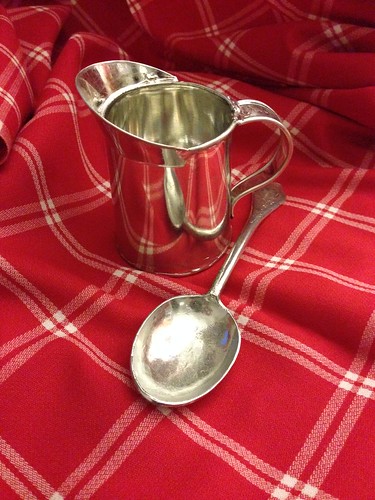
Half-pint and spoon
Boiling food in summer- sounds awful, right? But it’s an easy and correct way to cook,once you translate recipe measures and control the amount you’re making. I like to use Amelia Simmons’ cookbook, because it is specifically American, and my more skillful friends cooked from it at the farm.
From Enos Hitchcock’s diary, I know that he ate a boiled flour pudding with some venison stew (near the Saratoga campaign, I think) so I consider this a plausible recipe for the field, pending eggs, of course.
A boiled Flour Pudding.
One quart milk, 9 eggs, 7 spoons flour, a little salt, put into a strong cloth and boiled three quarters of an hour.
Simple enough, though Simmons later corrected the receipt to 9 spoons of flour, and boil for an hour and a half. I got out the spoon, and looked online at modern boiled pudding recipes, and will give a modified version a whirl sometime this week (always better to fail at home than in the field). Boiling the pudding in a linen cloth in a stew would make a savory bread substitute…and I really liked the one we had at the farm. Will the gentlemen at Bennington like it? Perhaps we’ll find out. If we’re not cooking with hosewater, almost anything should be edible.
*Yes, it’s a terrible and terribly dated show, but I always hear this in Mr Humphries‘ voice from Are You Being Served?
In the few short years I have been doing costumed interpretation and living history, I have made three shifts and four shirts and am making up a fifth shirt, with a possible sixth needing to be made, as well as four aprons. I’m not crazy, I just sew that way…for three people (one still growing) who dress for the decades between 1763 and 1812.
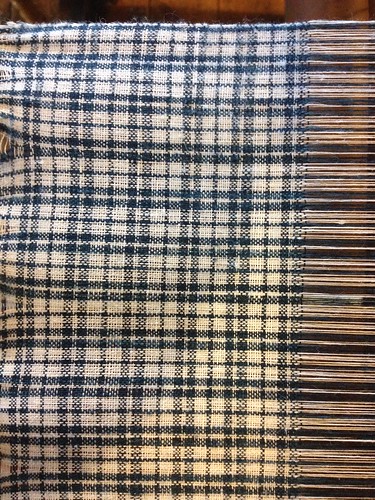
Hand-woven linen: the top edge is the selvedge
There are several annoying factors when sewing historic clothing with modern materials– mostly that the modern materials aren’t quite right, and can be quite wrong. As Sharon Burnstonexplains on her website, much of this has to do with selvedges— which are not hard, and rarely tucked, now. The other trouble is width: many fabrics now come 54 to 60 inches wide, which means that you have to cut them down when making shift.
There is a solution: hand-woven, period-correct linen, available now by subscription from Justin Squizzero [email to order: justin(dot)levi(at)ymail(dot) com].
Mr Squizzero will weave both plain and check to the width you want: 3/4 (27″), 7/8 (31.5″) and yard (36″) widths, perfectly correct for period clothing.
Hand-woven checked linen
The prices are $130/yard for plain bleached, $160/yard for checks– and what checks! Indigo dyed blue and white check in a pattern documented to New England at the turn of the 19th century? Oh, yes, please: I must save my allowance and sew only from my stash.
Although we debated fabric weights this past weekend, here’s what I think, and have found through wearing: shirts for soldiers and artisans– but not the elite–can certainly be made of the white and the check; I would made a shift from the white, but I prefer how my heavier shift body feels and behaves under stays. The check would be ideal, too, for an apron, which would require only one yard.
If you’re wearing a coat made from $120/yard wool dyed with documented colors, shouldn’t you wear the most correct shirt possible underneath? Entirely hand-woven (and hand-dyed in the case of the checks), you’re buying art– but isn’t that what you’re making and creating when you hand-sew your clothes and step into the past?




 Kirsten Hammerstrom
You must be logged in to post a comment.