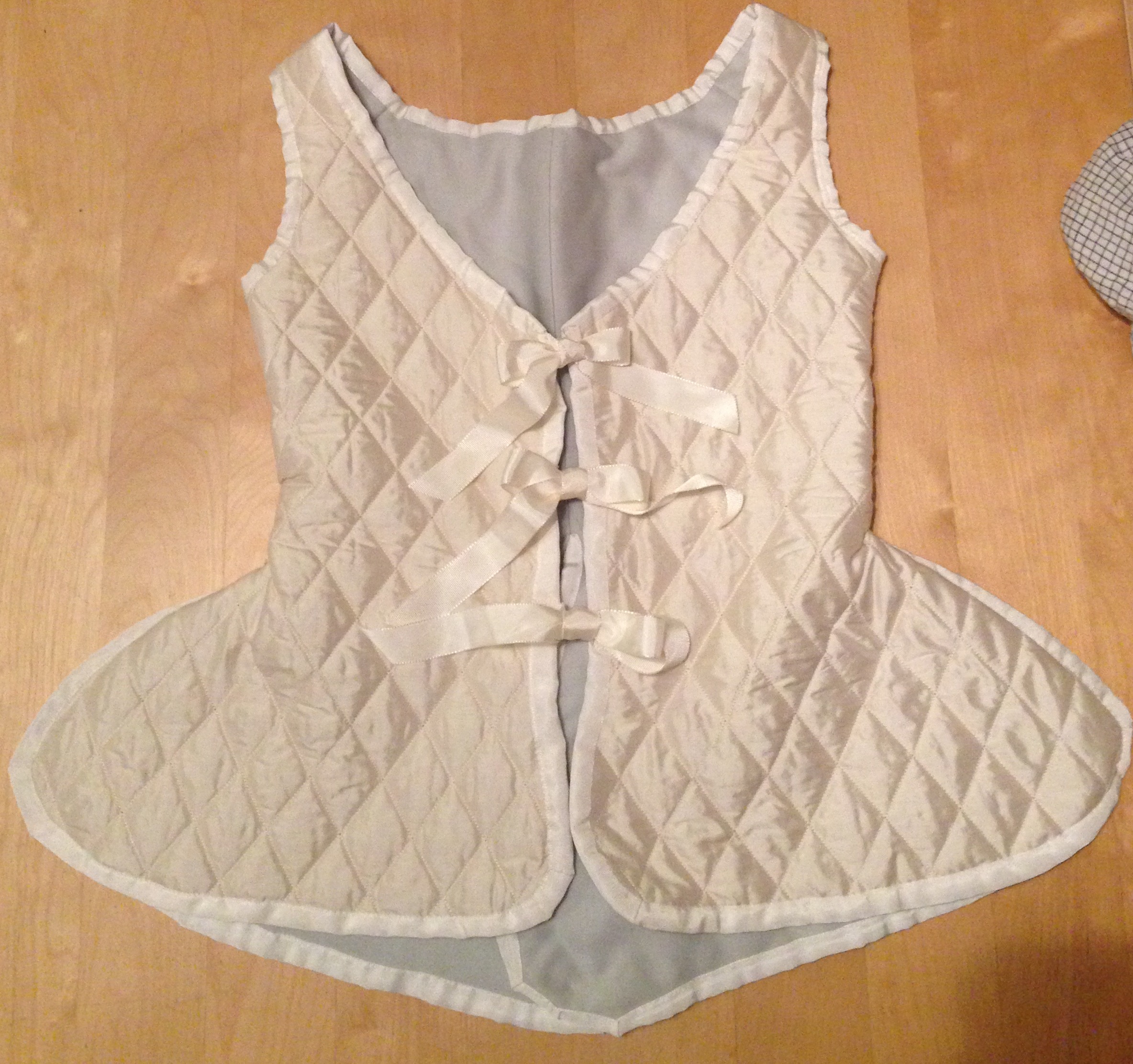
No, I did not take a notion to jump in the river, but I did take a notion to sew slightly more than the quilted waistcoat.
I couldn’t resist.
I got this unshakable great notion, you see, about some wool from the remnant table in Framingham. It was a lovely olive color, and paired up with some plain weave I already had, it reminded me strongly of World War II-era Army uniforms from the ETO, which I had been packing recently in Rhode Island’s alpine north. And yes, if I find a pinker tan for a petticoat, I will procure it.
Since I already have an olive wool petticoat that will also work for this notion, I started on the gown last week, cutting it out on Wednesday night so the table would be clear for Thanksgiving dinner.
The wool was a little slippery to pleat, and the twill slightly dazzling with its sheen. Let’s pretend it’s shalloon, shall we?
First the back
and then the sides.
A week into the project (after a brief annoying detour attempting to correct my mitt pattern), I have only half the hem and the bottom of the robings to finish. Not too shabby, thanks to a holiday weekend and hours of The Pacific, Band of Brothers, and The Purple Plain. Homage to the color, I suppose.
I’m never not smirking, so thanks for not smacking me.
It fits– which always seems like a miracle, even with a tested pattern– and better yet, it fits over that plush waistcoat.
The rustle of the silk and the swish of the wool are unlike anything I’ve ever worn. I think I shall feel quite fancy– let us hope I shall also feel quite warm.
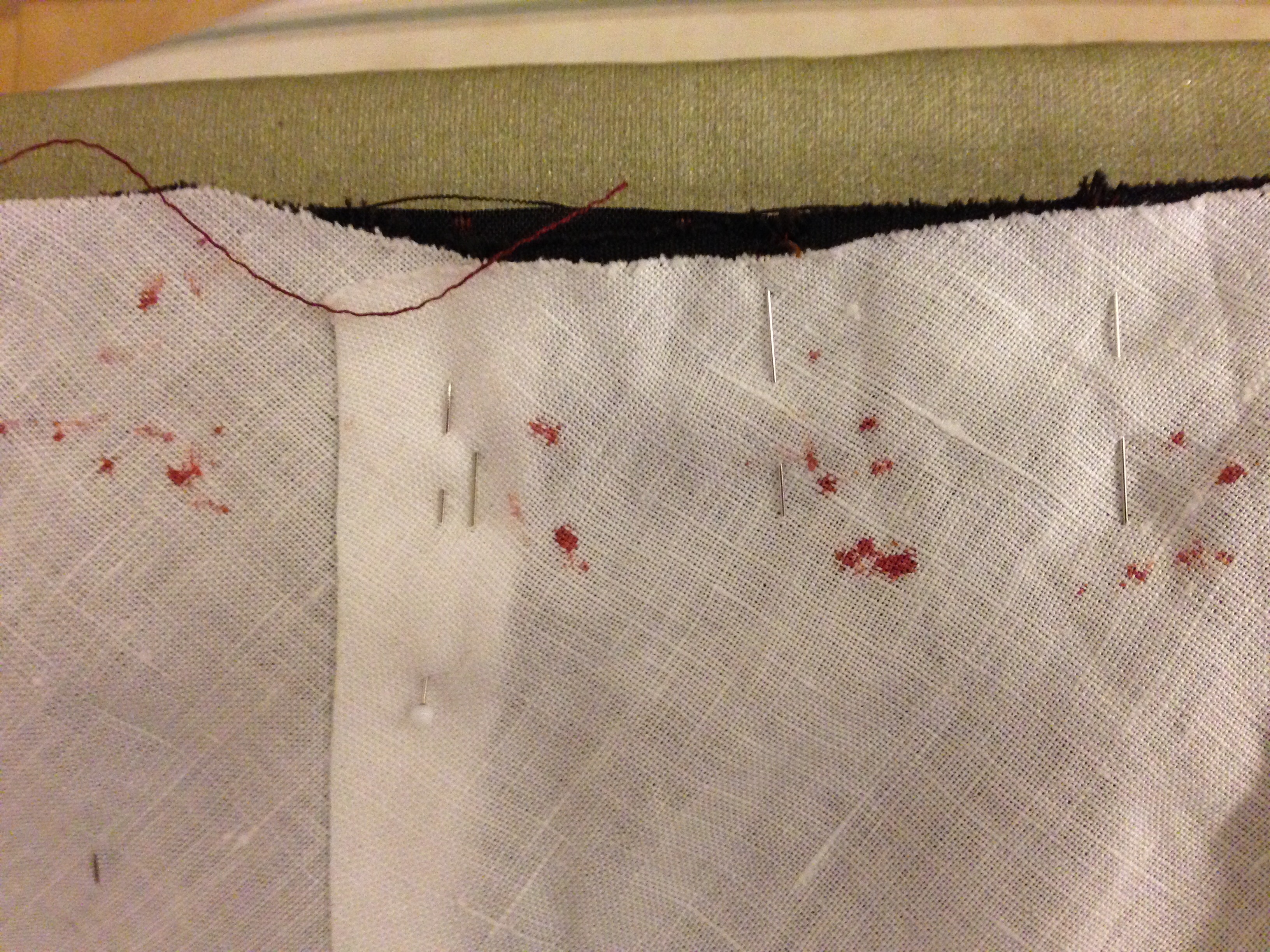
If it bleeds, it leads. Waistband pinning is surprisingly dangerous.
Sometimes you end up doing things for reasons you don’t entirely understand. Remember that brief flirtation with the 1830s? Well… we met again, and this time, I said yes to the dress.
Gentle reader, it gets worse. While I had not planned to dress, I rethought this choice last week. Awake in the early morning hours of November 11, I thought about dress patterns, wool petticoats, and the contents of the Strategic Fabric Reserve. One of my wool petticoats fit the waistline of my 1820s dress better than the 1800 dress I made it for, so I figured I was on my way towards being warm outdoors in November.
Spot the error. It’s the dyslexic ’30s.
I have 1830s patterns, and a muslin was quick to make. Worse yet, once the muslin was made up and tried on over stays, it needed no alteration beyond a slight shoulder seam adjustment. Can you imagine? That hideous decade fits me? Doom or destiny, you be the judge: I had enough striped wool blend to cut a dress and a pelerine… so I did.
The other sleeve’s stripes are just slightly off.
The bodice went together quickly, and the sleeves were fairly easy at the shoulder and arm scye (I really enjoy setting sleeves). It was the length and width along the forearm that threw me, and I ended up having to piece on the lower sleeve. Twice.
The sleeves are where the meat comes in: you say pork chop, I say leg of lamb, the fashion plate saysgigot. I did reduce the arc a bit, which makes this a more late-1820s style than firmly mid-1830s. Since some of the folks I’m going with will be wearing a mix of late 1820s and 1830s styles, slimmer sleeves seemed reasonable.
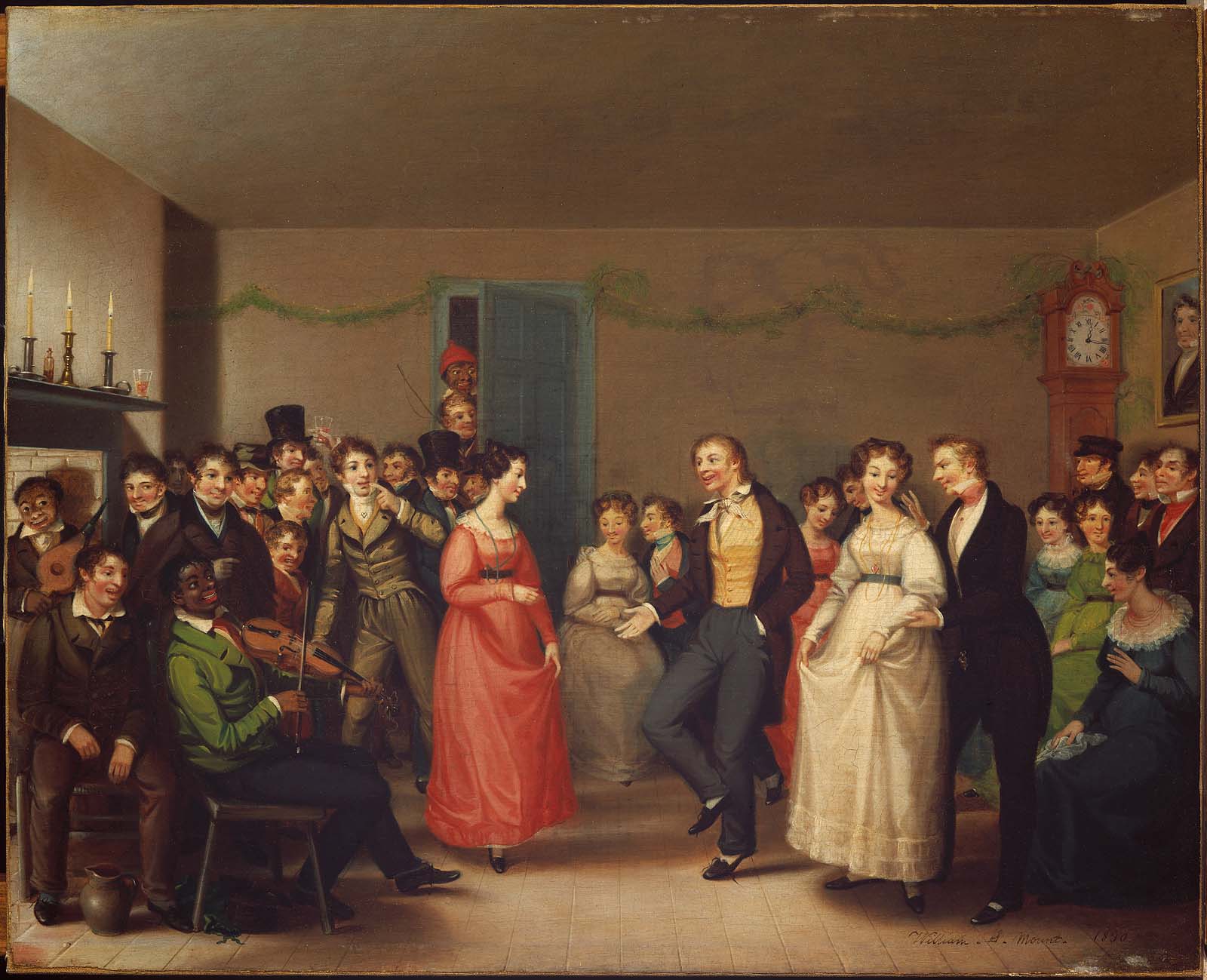
Rustic Dance After a Sleigh Ride, 1830. William Sidney Mount MFA Boston 48.458
More seriously, I’m taking cues from the William Sidney Mount painting I’m so fond of. The women in this 1830 painting have less flamboyant sleeves and possibly achievable hair. Honestly, the things I get into when I lie awake and think. I ought to know better by now…but every decade is a new adventure.
What remains to be done? Backstitching the waistband and waistband lining, hooks and bars at the back closing, the ever-popular hem of enormity, and a final pressing. Achievable, I think, with focus and some lunchtime sewing.
Mercury is retrograde and the schedule is tight, even for me, as I made the plans I’ll put into action at the end of this week: a special event Thursday night at work, followed by mad packing and a drive pretty far into New York.
I did say sheer.
Yes: I am going to Genesee. It’s a long drive from here, so I’m happy to be picking up some friends in Albany (neither of whom live there) for company and some relief behind the wheel. Of course we’re taking our car: it’s the Quartermaster cart.
Yes, I am a little crazy, but it does make life interesting.*
Finished –even hemmed– days before the event!
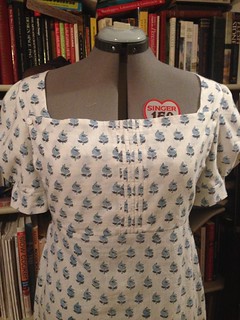
The gown is made from fairly sheer block-printed Indian cotton found on eBay. The pattern is based on one in Nancy Bradfield’s Costume in Detail with a bib front and tucks in the center back. To help with measurements, I also referred to the bib-front dress in the back of Bradfield’s book, as patterned on the fabulous 19th US site, as well as Janet Arnold.
The first bib-front gown I made ended up a little slanted: your mileage may vary, but I find patterning on opioids is not recommended (I sewed while recovering from hip replacement surgery). This one seems a little better, though the fabric came in for some commentary when I was working on this in a room full of light infantry “men.” We devolved from “chicken on flower” to “Seagull on a bush” in describing this buta-like shape. I only bled a small amount on the tucks, despite texting while sewing.
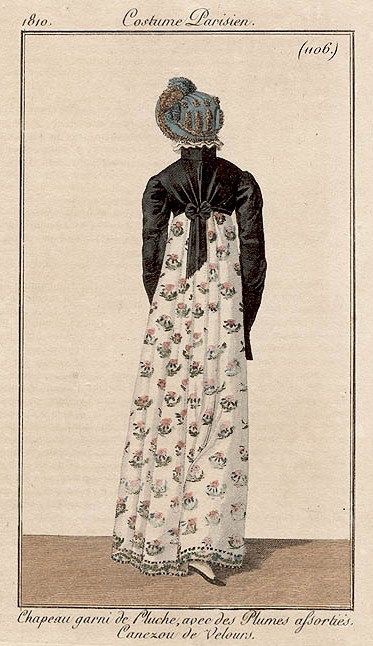
Canezou de Velours, 1810
Inspired by this 1810 fashion plate, I made a black velvet Spencer as well. That’s finished, save for the buttonholes, though there will be no texting while button holing.
Men’s waistcoats often have cotton or linen at the CB neck.
It got pretty matchy-matchy when I did the lining.
You will note that the plate describes a “Canezou de Velours.” Canezou was new to me, and while I don’t trustthe internet too much, here we are with Larousse:Vieux. Corsage de femme en lingerie.
Huh. It seems to be a lightweight-bust length garment for women.
Here’s the OED:
Oxford English Dictionary
canezoucanezouHist.
(ˈkanzu)
[Fr., of unknown origin.]
A woman’s blouse-like garment of muslin or cambric. Also attrib.
1827Lady’s Mag. Sept. 510/2 A canezou spencer of embroidered muslin. Ibid. 511/1 Muslin canezous over high dresses. 1893 G. Hill Hist. Engl. Dress II. 241 A cambric canezou..with sleeves full to the elbow. 1898Daily News 26 Sept. 6/4 When the Restoration came in 1815,..Fleur-de-lys appeared on everything… The canezou replaced the hideous spencer.
Ah, the hideous Spencer. I rather like them, myself.
*A very long time ago, I had a drawing teacher who said there is never an excuse for being bored. There is always something to do, to see, to observe. That was my first lesson in being present. Perhaps I take this statement a bit too literally.
Spencers. hand-colored etching published by S W Fores, 1796. British Museum, 1851,0901.782
Spencers were clearly the rage for well over a decade, turning up in satirical prints from at least 1796 (We’ll get to that satire soon). I was wrong when I questioned the Maine catalog record that called a man’s short coat a Spencer: there were Spencers for men.
Here, everyone is wearing a Spencer down to the monkey and the dogs. What I find particularly interesting is that the short Spencer jacket is worn over the men’s coats– this is an entirely new concept to me. Yet, here it is again, in the “Pupils of Nature” print.
Pupils of Nature.hand-colored etching published by S W Fores after Maria Caroline Temple, 1798. British Museum, 1867,0713.409
Were Spencers were the 18th and early 19th century equivalent of Members Only or Barracuta jackets? (You will know a red Barracuta–even if you think you don’t.) Perhaps. They do seem to be a splashy unisex fad in the late 1790s that gives way to women’s wear, but that’s a thesis in need of more research than Frivolous Friday demands or permits.








 Kirsten Hammerstrom
You must be logged in to post a comment.