A Saturday in Salem : Jane Austen Ball

Closure: green silk satin ribbon.

With many thanks to the Quintessential Clothes Pen, I was not dancing with myself Saturday last at the Jane Austen Ball in Salem. I was there on a bit of a whim, knowing that the ball happened in February and looking for something to do on a winter weekend– and, as it happened, I actually had a dress to wear. Of course, it wasn’t finished until Friday night, although I had worn it in December for a photoshoot.
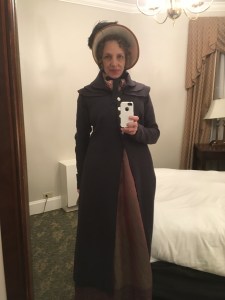
Dressed for the weather: I only seem to wear this pelisse in February.

In the past year+, I’ve been trying to do more and regret less, which seems a bit contradictory: if you do more, might you regret more of what you do? The trick for me, especially in dealing with my baseline high-anxiety self, is to do more things that seem scary but are actually fun.* That’s how I found myself traveling up to Salem between snowstorms to stay in a tiny little room in a historic hotel. It’s a pretty quick ninety-minute trip on a good day, but I know myself well enough now that staying overnight is the safer, less-stressful option for an excursion like this.

Salem on a snowy Saturday was busy, streets crowded with people as I walked to the old Town Hall, feeling very much like a character in a novel. (Having just finished Remarkable Creatures, the scenes of Elizabeth Philpot walking in alone London came to mind as I did attract some attention in my pelisse and bonnet.)

The Town Hall was crowded; I arrived a little late, as dancing was beginning under patient and direct tutelage, so I had the pleasure of watching several dances before I joined in. While not everyone was wearing early-Federal/Regency clothing, the crowd still provided an excellent sense of the social mixing and festivity of a scene from the past.

Unforgivable hotel room selfie to record the dress

Joining in was even better, to be in the swirl of people and skirts, to pay attention to my feet– my shoes were a little slicker than I would like– and to count the rhythm of the music. While I spent years in ballet class, it is true that those years were surpassed by years in mosh pits and on dance floors of questionable clubs. Country dances made me think of four-dimensional math, with the patterns made by the combinations of active and helper couples, the reversals of direction, and the changing positions of partners: it was like being a living fractal.

*With some exceptions including rollercoasters and sky diving.

Mrs Pabodie, I presume?

Mrs William (Jane) Pabodie. oil on canvas, 1813. RIHS 1970.60.2

Remember Mrs Pabodie? She appeared a week ago today in Providence after an intense sewing effort left your author with numb fingers. The process was as straightforward as these things ever are, manipulating fabrics to do your bidding once you think you have the right materials.

It took more rounds of white muslins from Burnley and Trowbridge than I care to count, and a variety of book muslins from Wm Booth Draper, just for the chemisette and cap. The laces came from Farmhouse Fabrics in the most expensive small package I’ve yet ordered that did not contain antique jewelry.

Mrs Pabodie attempts to remember when she was born (1771). Photo by J. D. Kay

The gown is a wool and silk blend remnant from Wm Booth Draper, just enough to make a gown (even at my height) though I admit the front hem will need some piecing or a ruffle to give it the proper length. Still, the thing more or less works, though as I compare the details to the original painting, I admit we’re still in beta.

I was joined by three friends from different eras (because you know me: if it’s not didactic, we’re not doing it): a sailor who on the run from a Newport press gang in 1765; Reverend Enos Hitchcock of the Beneficient Congregational Church in 1785; and Sissieretta Jones, soprano of Providence, around 1880. Each of the characters described their lives and their clothing, and I will admit that the Annual Meeting audience may not have been fully prepared for some of what they heard– I’m not certain they had ever considered how apt “balancing a sheep on my head” might be in describing Reverend Hitchcock’s wig.

Mrs Pabodie points out East Side landmarks to a visitor examining the theatre curtain backdrop painted around 1810. Photo by J. D. Kay

In the end, they were entertained, and may even have learned something, as we celebrated 2016’s interpretive theme, Fashioning Rhode Island.

Hell is a Hand Basket

Gentle Reader: Remember the post on semiotics? We need to go back to that once more.

Just what are we looking at here?
copley_john-singleton-mrs-daniel-rogers-middleton-collection

John Singleton Copley.
Portrait of Mrs. Daniel Rogers (Elizabeth Gorham Rogers), 1762
50 X 40, oil on canvas.
Middleton Collection, Wake Forest University
HC1991.1.1

Hmm…. 1762. Does that dress look like 1762 to you? Or does it resemble a 17th century garment? Check out those sleeves: scallops. The shift sleeves: super full. The line of the gown at the neck: a shallow scoop. The front of the bodice: closed.

Are those the hallmarks of a typical 1762 gown in New England, England, or France? You are correct, sir: They are not.

What’s happening here? What is Copley doing, and why?

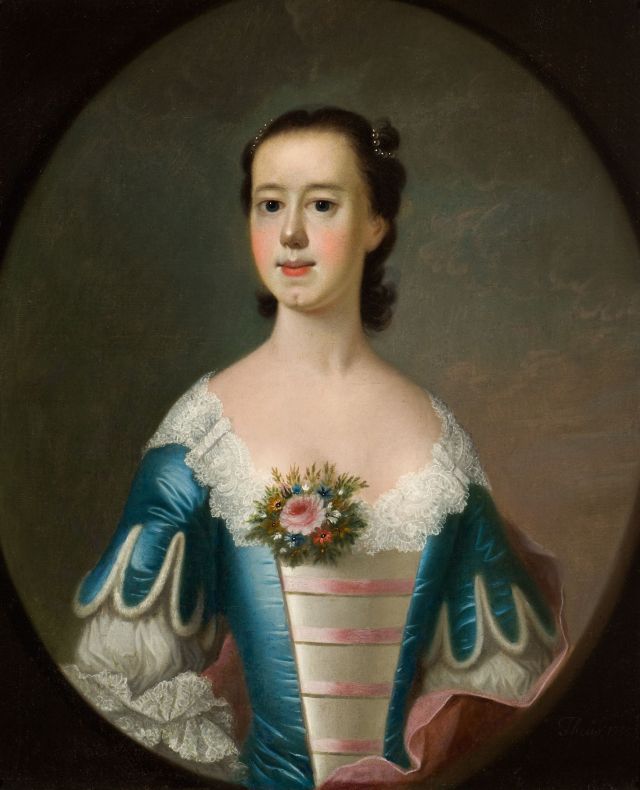
He’s making his subject look good, reflecting her wealth and status. He’s flattering her by painting her in a faux-17th century gown, a “Vandyke costume, a popular artistic convention in England related to the vogue for fancy dress and masquerade.”* 1762 seems a trifle late for this convention, but in 1757, James McArdell produces a mezzotint of Thomas Hudson’s portrait of the Duchess of Ancaster. Henry Pelham wrote to Copley in 1776 that he had purchased one of those mezzotints, suggesting their use as references for Colonial American painters. Reynolda House has a nice explication of this style of dress in the Thëus portrait they own of Mrs. Thomas Lynch, shown below.

Mrs. Thomas Lynch, oil on canvas by Jeremiah Thëus, 1755. Reynolda House, 1972.2.1

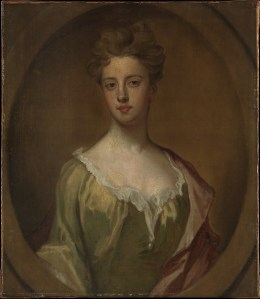
There was also a convention of portraying women in “timeless draperies,” following the school of Peter Lely and Godfrey Kneller, both late 17th-century English painters who produced portraits with generalized costumes.

Lady Mary Berkely, wife of Thomas Chambers. oil on canvas by Sir Godfrey Kneller, ca. 1700. Metropolitan Museum of Art, 96.30.6

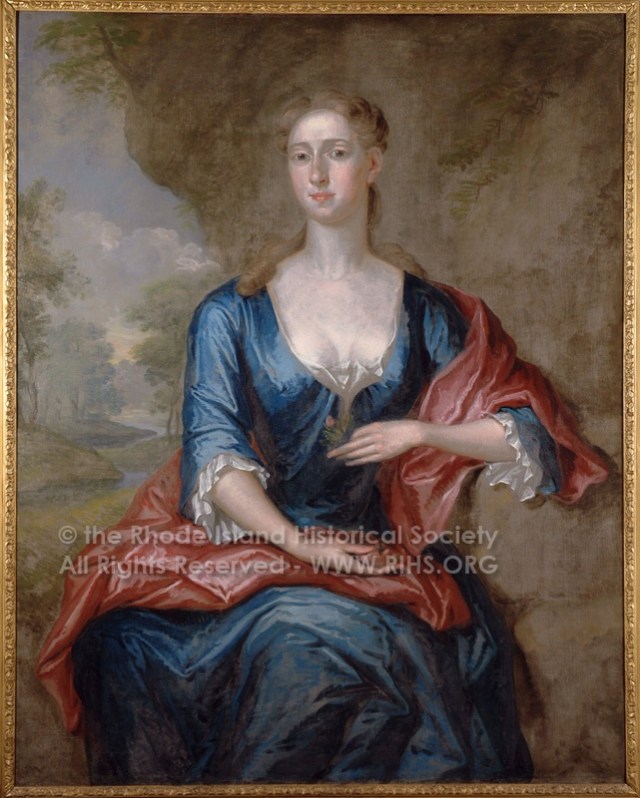
This portrait by Kneller (born in Germany, he worked in England) explains a lot, doesn’t it? And this timeless convention persists for some time, and the stylization of the facial features and hair is copied by English and colonial American painters. John Smibert, long familiar to many of you, was a leading practitioner of this style of portrait, and his work would have been well known to Copley and his sitters.

Mrs Samuel Browne by Smibert, RIHS 1891.2.2

Blackburn’s portrait of Mary Sylvester adopts two conventions at once, in a way: she’s in timeless-style drapery and fancy dress as a shepherdess. Let’s remember, too, that there’s symbolism in the shepherdess imagery, referencing pastoral innocence and Mary Sylvester’s unmarried, presumably virginal, status. Don’t believe me? Read the catalog entry, written (at the very least) under the supervision of actual, degree-toting art historians.

Mary Sylvester, oil on canvas by Joseph Blackburn, 1754. Metropolitan Museum of Art, 16.68.2

Where does that leave us with Mrs. Rogers? She’s portrayed in what is essentially fancy dress, holding her straw hat in her left hand (much as Mary Sylvester is) with a basket over her right forearm. You will note the open work of the basket, the delicate arches and the fineness of the base. What’s in it? Something gauzy, as light as the drape around her shoulders, with a square of dark blue silk and a fine white silk ribbon. Honestly I am not entirely certain — the resolution of the image is dreadful.

But what’s NOT in the basket? A redware or pewter mug, sewing, keys, bottle, food, candy, toys, or, really, anything of a very concrete or practical nature.

Is this image a justification for carrying a [nearly empty ] basket on the streets of Boston? Of course it is–as long as you justify walking the streets of Boston in imaginary or fancy dress.

*p.106, Ribeiro, Aileen. “‘The Whole Art of Dress’: Costume in the Work of John Singleton Copley.” John Singleton Copley in America, Metropolitan Museum of Art, 1995.

Making up Monday

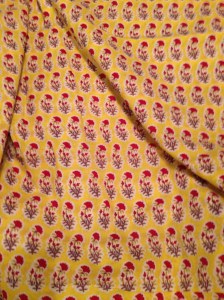
From Jaipur, darling.

Sometimes you’re a jerk without meaning to be, usually because you can’t see past your own limited self. I was that jerk on Friday, when my obsession with a missing package led to unfortunate words with both a supplier and worse, my sweetheart, about an unexpected length of fabric lately arrived from India. Would that my brain would work faster, for by the time I’d figured out what to make of it, the conversation had turned, and an additional 300 miles lay between me and the recipient of my confusion and dismay.

Despite my best intentions and resolve, I am a sentimentalist. This instinct sometimes conflicts with a devotion to honesty, for kindness often lies in elision. Confused? Short story: I don’t wear yellow, but a package arrived Friday with a dress length of printed Indian cotton, red and green flowers on a yellow ground.

“But Kitty,” you say, “Don’t you crave the hideous, the clashing, and the correct? You applaud Our Girl History’s choice of 1770s fashionable pink, though she prefers blue. Yellow is the haute couleur of the 18th century, fashionable everywhere, even in North America. You should leap at the chance to wear it.” (I was not thinking fast at all on Friday evening.) What made me bend my resolve– what will always makes me bend my resolve?

Petticoat fragment. Note yellow, with crudely printed lining. Wintherthur Museum 1959.0118.004
Petticoat fragment. Note the bright yellow, with crudely printed lining. Wintherthur Museum 1959.0118.004

Sentiment, of course, backed by research.

April, that cruel month, brought obsessive searches for Indian cotton print appropriate for the 18th century, as I looked at sample books and extant garments, searching for material to create frankly annoying clothing. Orange and green check with clashing Spencer and bonnet lining isn’t enough: I want to push my representation of the fashion sense of the past closer to truth. People in the past weren’t as matchy-matchy as we are, and their ideas of stylish, attractive, and fashionable were very different from ours. Loud was ladylike, and that’s a style statement I can get behind. Along the way, I ordered fabric in a pink and green (a departure itself) floral print on white ground, yardage now long overdue.

Textile Sample Book, British, 1780. MMA156.41 P34

A friend has been dabbling in these same waters, and made up a new gown for Mount Vernon, satisfyingly loud and clashing with our modern sensibilities about the past. Our mutual friend, also at Mount Vernon, assisted her in choosing a dress length for me, and reader, I was confused and lacking when it arrived. But like any good curator in a social history museum, it was the story that got me. How can I resist a gift from a fellow enthusiast in a pattern chosen by my sweetheart, on the grounds that I don’t wear the color? Reader, I cannot.

Think of Cranford, of lengths of dress muslin requested and never received, and the sentiment embodied in that fabric. Think of women in Providence craving an India print gown, of lovers, husbands, sons, ordering dress lengths at trading ports thousands of miles and long months from home. Think of the affection and thoughtfulness embodied in textiles brought back months after they were requested. Complex meaning is woven into that cotton, giving this dress length interpretive meaning before it is even a garment.

Now what? Now I have to decide which century/event this gets made up for: 1812-1817, 1778, 1804, 1768. There are many choices, but with the meaning embedded in the fabric, I’m most inclined to make something I’d wear often– not that this is particularly housekeeper-appropriate.

And about the research you ask? Yes, small floral print on colored ground is documentable to the 18th century. While early and European, here’s an example of an Indian motif translated by Dutch makers for printing in Sweden. Rhode Island merchants traded in the Baltic, so given the early date of this fabric sample, its arrival in North America could predate 1788 and John Brown’s first ship to China and the far east trade. Possible? Yes. Probable? We can have a lively discussion, in which I will point out the Brown’s love of all things French and French translations of bright, small motif print patterns. The printing factories in Sweden ran until 1771 and produced at least two relevant prints. Would my successful Presbyterian farmer have bought something like this for me in New York or Philadelphia? Would I have worn something so bright and loud? Am I overthinking this? Perhaps, but yellow is a new thought for me.

With especially fond thanks to Miss N and Drunk Tailor, to whom I also owe an apology.