Sandby’s Women

20130109-061710.jpgSara Hough’s date of ca. 1805 piqued my curiosity and Cassidy was suspicious, too. So I went looking into Paul Sandby a little bit more.

Many of us know him for the sketches and watercolors of working people in mid-18th century England. They’re oft-used references for people doing Rev War reenacting as they’re full of the kinds of details seen in the watercolor of Sara Hough. I hadn’t thought of Sandby for later 18th century references, which shows how little I was thinking.

Sandby: Figure with Lute & Tamourine, YCBA

Thanks to the 18th Century Material Culture Resource Center, I found the Sandby “People and Places” presentation, which led me back to the Yale Center for British Art, and this image of musicians, horses and women. There’s no date in the record, though the presentation calls it ca. 1785. There seems to be a series or portfolio of Sandby sketches similar in size and type from about 1785, so it’s a reasonable assumption…with the usual caveat about assumptions, but no aspersions on the compiler of the presentation.
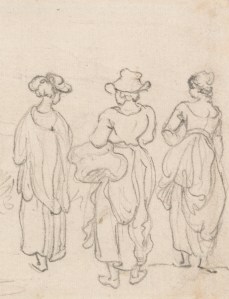
Sandby, detail, YCBA
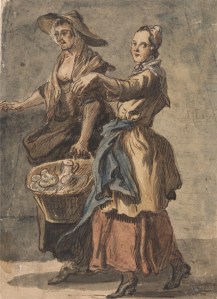
Sandby: Two Women and a Basket, YCBA
Sandby: Two Women and a Basket, ca. 1759 YCBA

Let’s look at a detail of the women in the drawing. Their waists are higher than we see in earlier Sandby drawings, and their profile slimmer, more classical, particularly the figure on the far right. Her bodice looks to me like a late 18th-century bodices.
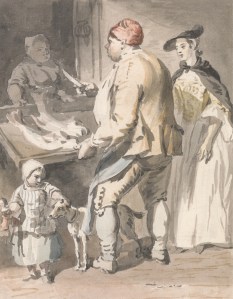
Sandby: A Fishmonger, YCBA
Sandby: A Fishmonger, ca. 1759 YCBA

Sandby had the skill to depict clothing with minimal gestures, as he does below in A Fishmonger, part of the London Cries series.

It’s that circa that gets you. I believe it for the ca. 1759, all the way. The figures fit into the visual continuum of Sandby’s mid-century work as I know it. (You’ll just have to trust me that I have a visual memory, and that, for once, the years of art school matter.)

And I kept wondering if he really had worked late into the 18th century, and then I found this:
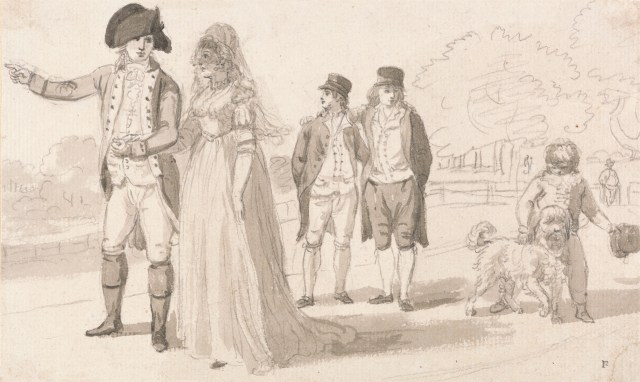
Sandby: Family in Hyde Park, YCBA

Again, no date, but there are distinctive markers to tell us this is post-1780, even inching to the early 1790s. The waistcoats on the adolescent boys are shorter and double-breasted. The shape of the boy’s hats has changed: these aren’t cocked hats, and they’re not soft round hats. But look even closer and you’ll see the ties at the knees of their breeches, very typical and fashionable for the 1790s. All this before we’ve even gotten to the woman! Look at what she’s wearing: that’s certainly a plausible ensemble for 1794, isn’t it? The waist has moved up, the skirts are lighter, likely mull or muslin, and the skirt of what I interpret as an open robe, much like Sara Hough‘s, is trained on the ground. If this is a Sandby drawing, which I don’t doubt, then I think we definitely see him working into the mid-1790s.

And just for one final kick, I checked the Met again, where they have a Paul Sandby drawing dated 1798-1799. I wonder…but the coat collar and waistcoat might have it.

Sandby, Group of 4 Children and a Dog, MMA

I’m still not sold on ca. 1805 for Sara Hough (why no ‘h’ on Sara when the drawing is inscribed by Sandby, “Sarah Hough…”?) but I’d endorse 1795. The tricky part, as always, is the circa: so much depends on how a museum interprets ‘circa.’ For some, it’s 5 years either side of the date; for others, it’s 10. When I see a circa date, I get skeptical, and start doing math.

Dresses and Evidence

Sandby: Sara Hough, YCBA

Here is Sara Hough, Mrs. T. P. Sandby’s Nursery Maid drawn by Paul Sandby ca. 1805, from the Yale Center for British art. She’s rather lovely, and though I’d tend to put her date earlier than 1805 based on the clothing, I don’t know enough (anything) about the Sandbys, and it may be that the dates of Sara’s employment fixed the date of the drawing. But doesn’t that robe and train look distinctly 1790s?

What I like about it is that here is a maid wearing an open robe and train–how impractical, especially in a nursery–so the drawing makes a third kind of evidence in addition to fashion plates and extant examples.

1794, V&A
1794, V&A
1795, MMA
1795, MMA

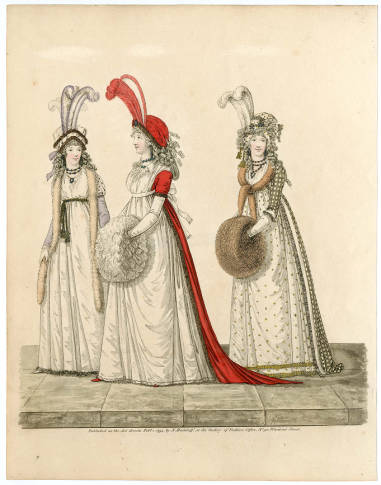
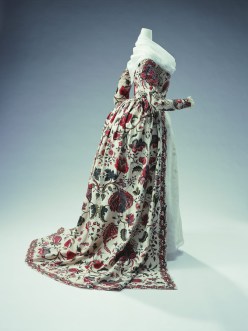
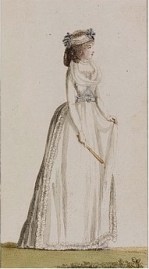
1794 and 1795 fashion plates from the V&A and the Met show similar robes, though the V&A is described as a walking dress, and the Met’s plate shows evening dress. Extant examples include the Kyoto chintz gown, and this chintz gown at the V&A.

1795-1800, V&A
1795-1800, V&A
1780s, KCI
1780s, KCI

I like how art once again blows up my expectations and makes me think more about the time frame when styles can be worn, and why: maids lag mistresses in style? Comfort and personal taste? or is the assigned date just not right? It’s an evasive “circa,” which can wiggle 5 to 10 years either way, depending on the collection’s standards. The drawing could be 1795, and it’s not later than 1809, when Sandby died.

Aside from the questions and quibbles over the date, the image gives us great information about how to wear an open robe with an apron, how to carry scissors, what watering cans looked like around 1800, the profile of shoes and caps, and how hair might be styled.

Smibert Smitten

John Smibert made me laugh. He’s been dead since 1751, so it wasn’t easy.

The day I went to the MFA and walked into the gallery with Mrs Tyng on wall, I laughed, and said, “I know her!” while my son died a small interior death. Then I pulled up the record and image for Mrs Browne, and showed him how I knew Mrs Tyng.

Follow Smibert’s pictorial advice if you’re reenacting an American woman of means between 1729 and 1732, and you’re wearing blue silk. You may have a red silk wrapper/shawl. Your shift will show at the center front and sleeves to show off your fine linen. You look like you might be a little cold, but perhaps that explains the “I store oranges in my bodice” look.

See for yourself:

MMA, Mrs Brinley & her son
MFA, Mrs MacSparran
RIHS, Mrs Browne
MFA, Mrs Tyng
MFA, Mrs Dudley
Smith College- Mrs Erving


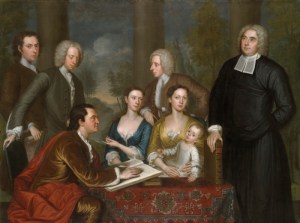
Yale- The Bermuda Group

After a while, you start to wonder if there was only one woman in the colonies in 1730… And then you wonder how she got into every painting

I know, style and conventions helped create these portraits as much as Smibert’s skill. And the portraits only get weird when you do the thing that was never supposed to happen. We were never meant to see all of these portraits all together, all at once, anywhere.

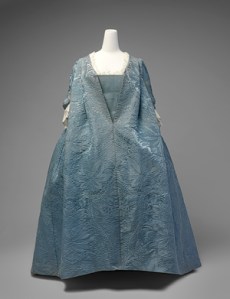
h2_2010.148-1 So, what’s she wearing? Probably this dress. No, not this exact dress, though if it was same woman in all those paintings, maybe the Met does have her actual dress. (Sometimes I have these weird museum-y ideas, and that’s generally when I need a vacation or come up with a new program idea.)

The robe volante shows up in paintings of women dressing, and in informal scenes, as below. She’s clearly wearing stays, which is helpful to know, because while I knew the women in the Smibert paintings ought to be wearing stays, and they had conical torsos, the orange-smuggling look was confusing.

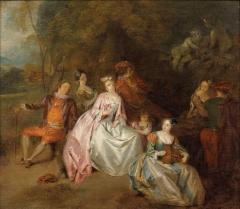
Galerie Dreyfus- Scène galante dans un parc, ca 1725

In fact, it confuses me still.

Seriously, the 18th century was a pretty sexy place, if you like oranges and silk.

Yale- Mrs Tyng
Yale- Mrs Tyng

Look, there’s Mrs Tyng again! She’s left the MFA and taken a chair at Yale.

Night Lights and a Book

DSCN3605Last night, I went to a meeting downtown for my boss, and chose to walk instead of drive. I took some blurry photos along the way as evening became night and the city became more and more like Busy Town. The skill level of local drivers is not too different from Richard Scarry’s drivers…and the hills and the way the houses stack up, and the way we recognize or know each other here reminds me of Scarry’s books.

Walking back to the museum, I stopped at one of my favorite bookstores, where the selection runs from the perverse to the erudite.  I picked up many books and limited myself to three, including Very Vintage. (Did I mention Symposium’s remainder table pricing? Ah, yes: that’s why three books were possible.)
The text could have been edited a little more carefully and I am a fan of the endnote (not present here). But there are excellent photos I have not seen before and diagrams patterning garments. Now you see why I bought this: where else will I find diagrams of aTeddy Boy Jacket and a 1960s Bellville Sassoon-inspired evening dress?
dress2dress