Newport Friends

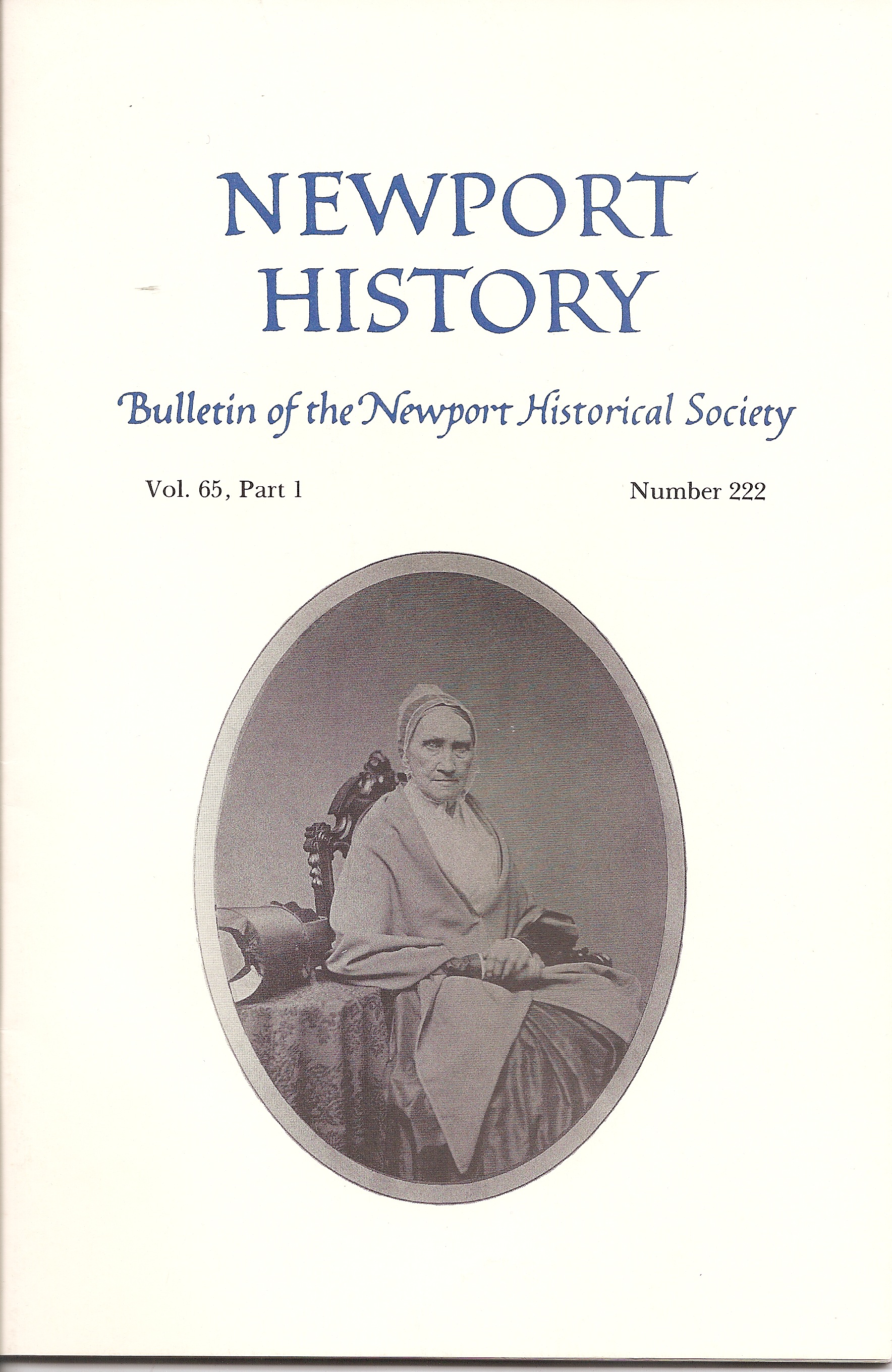
Newport History, V 65, Part 1. Number 222.

I had a bit of a surprise when details emerged about the program Sew 18th Century and I will be doing in early March at her workplace. I’ve known about this since late October, but only started focusing on this last weekend, when I realized just how close March really is, and how much time I’ll be spending on well-chlorinated pool decks in February. I’m so glad I asked, because it turns out that we’re reading letters from a family of Quakers. I was not expecting Quakers, and had what is probably a completely inappropriate fabric in mind! (Off-white meandering red floral vines, to mimic a V&A gown.)

Still, there is no surprise that cannot be managed by research. There is an article about the family in Newport History, and they were kind enough to send it to me, and it arrived yesterday. Yay, mail in a small state! The article is helpful in providing context and family history, and there is even a photo, probably from a daguerreotype, of one of the women in the family.

Ruth Williams silhouette, Newport Historical Society, 91.14.4

So, what did Quaker women in Newport wear between 1800 and 1820? Lappet caps, for one thing. Lappet caps appear to have been a common cap in late 18th and early 19th century Rhode Island, and Ruth’s silhouette seems to bear that out.

These caps are also seen in many images of Quaker women, and borne out by the images in the collection where I work (sadly not appearing the catalog record, but still stable in the blog post on caps).

I can’t read letters in just a cap and a shift (it’s not that kind of event), so I need a dress. Newport Historical Society has two possibly Quaker gowns from the early 19th century, and they seem like plausible models.  But they raise questions quite aside from what you might find out by digging into provenance. What’s up with collars?
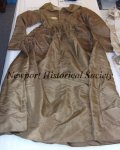
The form, a brown or drab front-closing, high-waisted (but not too high) gown, with long sleeves and a pieced, shaped back, is consistent with images of Quaker women from the first quarter of the 19th century. The color and material (brown silk) is consistent with those images, and with earlier im,ages of Philadelphia Quaker women, and that all matches up with a gown that was worn by Sarah Brown of Providence. But the collar is curious, and without putting the garment on a dress form, it’s hard to tell exactly where the collar would fall, and how it would lie.
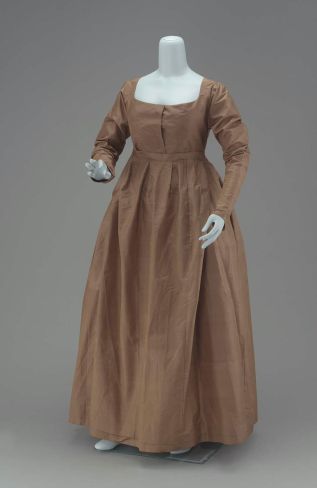
A Quaker's dress of greenish-brown taffeta American, Early 19th century. MFA Boston. 52.1769
A Quaker’s dress of greenish-brown taffeta
American, Early 19th century. MFA Boston. 52.1769

This gown at the MFA seems iconic to me, and I can imagine it underneath the white linen, cotton or silk kerchiefs and shawls of the portraits.

To learn more about Quaker aesthetics, I’ll be taking a trip down the hill to the RISD Library sometime this week, to look at books and articles. of particular interest is Quaker Aesthetics: Reflections on a Quaker Ethic in American Design and Consumption, 1720-1920. I’m also interested in an article by Deborah Kraak, Variations on ‘Plainness’: Quaker Dress in 18th Century Philadelphia. It’s not Newport, but at least it’s this continent.

I have read The Quaker: A Study in Costume, by Amelia Mott Gummere, and found it to be a pretty challenging work. It is possible that paint fumes made the writing seem more disjointed than it is, but I thought Gummere’s time-skipping references made it hard to follow the changes in Quaker dress in America, beyond what I do expect from a book published in 1901.

Temporal Anxiety

First draft, heading towards a Pierrot jacket.

I like to have a selection of things to wake up and panic about at 4:00 AM, don’t you? If it isn’t sewing, it’s some weird noise I think the car is making, whether the post office has lost a package, or if that noise is not the cat but instead a pending disaster. My brain generously provides me with a Whitman’s Sampler of anxieties.

To start with, that ball. For one thing, Mr S will probably have to wear his Saratoga coat, which means anything nice that I have won’t match him, temporally. For another, anything nice I think I could make in time is French and not American. So I have temporal and geographic anxiety disorder about something that is supposed to be fun. But there is this jacket I think I could make (and want to make), so I started playing with the pattern in my “sketching in muslin” method.

I haven’t got a lot of the purple, but I might have enough.

I know this is not party wear. I know KCI says jackets like this were worn with white muslin petticoats. But I note that this woman in a Pierrot is not wearing a white muslin petticoat, and I carry on. My other option is my brown wool gown, and perhaps I will wear that.

Mr S still needs a frock coat, so that has to be patterned and fitted; his breeches are still being sewn. He’ll need a wool coat no matter what, but whether it will be done by February is up for grabs.

The last two parts of my current crazy are a program in Newport on early March, with an early date of 1813, and programs in late March in Providence, which I have yet to develop. At least in Newport I don’t have to create the program, just dress and deliver.

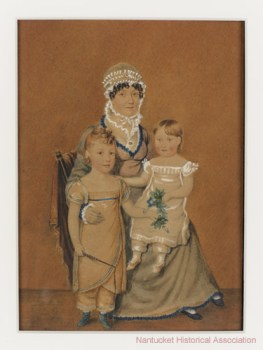
Portrait of Sarah Comstock Coffin and Children, ca. 1815. Nantucket Historical Association, 1917.0034.001

1813 is a fun place to start, and I have been looking at images for inspiration.

At right, Mrs Coffin  is a nice example of a New England woman in 1815, wearing the kind-of cross-over, v-neck, apron-front gown I’m thinking of making. I have some fabric reminiscent of a gown at the V&A, and I have some purple sheer cotton, as well as some green silk, so there’s a whole set of what-ifs? to enjoy.

Because that’s the rub: I enjoy all this planning and fretting and picking over details. I just wish it let me sleep a little longer some days.

“All sorts and conditions of women”

img094

Ever on the track of laundresses and working women, I came upon The Project Gutenberg EBook of The History of Modern Painting, Volume 1 (of 4), by Richard Muther. I was rewarded with  a laundress and a cook holding a spider. Daniel Chodowiecki, a German artist, seems to have been as drawn to the common people as Paul Sandby. The caveat of course is that is he German, so details may not always be correct for American interpretations (pinner aprons, for example).

Still, we have the classic washtub-on-a-table set up, and the laundress is barefoot, which makes very good sense, though my feet hurt just from thinking about standing barefoot on the stubble of the field at Saratoga.

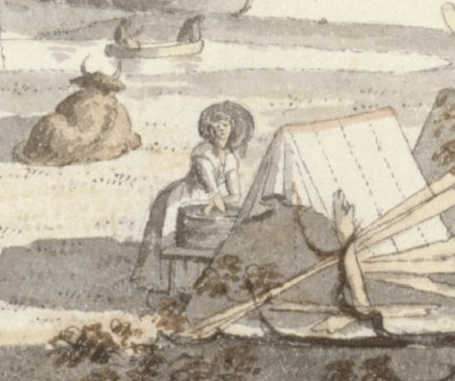
Encampment of the Loyalists at Johnstown, a New Settlement, on the Banks of the River St. Lawrence in Canada, taken June 6th 1784, James Peachey.

Laundresses come with style, too, though I am asking myself, “Is that a fabulous hat, or is your head just in front of some balled-up, sleeping livestock?” Was is discernible is that her hair is down, and she is leaning on the washtub. The tent seams are also clearly visible, and she does have the iconic washtub on a table set up.

Encampment of the Loyalists at Johnstown, a New Settlement, on the Banks of the River St. Lawrence in Canada, taken June 6th 1784. James Peachey

In another detail of the same image, we have a woman who is clearly wearing a black bonnet, tending a kettle on a fire. Here’s yet another piece of evidence for the three sticks-two kettles-no matches set up, and for the tinned kettles being left to get black on the outside.

What is she wearing on her body? There’s a white (or a least white-grounded) kerchief, and what looks like a grey or drab petticoat. But is that a short gown, jacket or bed gown? I’d say jacket, mostly because of the fit, but it’s hard to say at this distance. Whatever word you care to use, she’s wearing a reddish-brown garment fitted to her torso that appears to have a side-back seam.

Once again, tent seams are visible. This tent, just like the one in the other detail, also has some large off-white item thrown over the end. Could it be a blanket, out to air in the sun?

I do also appreciate the short blue jacket/white trousers of the man or boy to the left of the woman, since I know a guy who possesses those clothes and prefers trousers to breeches. He appears to be drinking from a cup as he carries a kettle, presumably of fresh water.

Encampment of the Loyalists at Johnstown, a New Settlement, on the Banks of the River St. Lawrence in Canada, taken June 6th 1784, James Peachey.

The entire view of the Loyalists’ camp is here, with a zoomable image. The drawing is full of details applicable to camp life interpretations, from women’s bonnets to fishing rods.

As I contemplate the troublesome Bridget Mahoney, I find the detail below of a solder and a woman rather pleasing.

Does she solemnly swear she is up to no good?

HSF # 26: Celebration Spencer

Cassandra in her new Spender.
Cassandra in her new Spencer.

This was supposed to be for #25: One Metre (yard) but things went awry. now it’s cause or #26, Celebration.

Make something that is celebration worthy, make something that celebrates the new skills you have learned this year, or just make something simple that celebrates the fact that you survived HSF ’13!

Heck, I survived the last two weeks of 2013, and that’s reason enough to celebrate. Water at work, relatives at home, high-stress holidays: if you can’t say anything nice, don’t say anything. So on to those pesky facts!

The Challenge: #26, Celebration! with a backward glance at #25, One Metre

Fabric: 34 inches of double-faced Italian wool, bought at Apple Annie Fabrics as a 50% off remnant after she found it in a pile. The collar is lined with black silk taffeta and interfaced with buckram. The sleeves are lined with black silk Persian from Wm Booth Draper, but I used taffeta on the bodice to give it more body. Technically, that’s almost two yards because it’s two kinds of fabric. Initially I didn’t plan to line this, but the edge did not hold as well as expected so I ended up breaking the rules in order to make a better garment. Celebrate rule breaking! Also, better sewing skills!

The pattern pieces on 34 inches of fabric. One cuff is pieced.

Pattern: My own, mostly. I started with the Sense & Sensibility pattern, and then modified it to make the first Spencer, working my way towards the double-breasted broadcloth of the Swedish Spencer. I first modified the lapels, and then, in order to match the arm scye to the sleeve correctly, modified the bodice at the side, and at the shoulder point. I used the Janet Arnold Spencer/riding habit as a reference, and then measured up the Leloir pattern to check my work. The two-part sleeves are borrowed from Henry Cooke’s 1770s man’s frock coat pattern taken from that extant suit; the collar and cuffs came from the same place.

Once I reshaped the sleeves from the elbow to the wrist (as I do not have a gentleman’s forearms of steel), I concentrated on adapting the bodice to make the seam sit properly on the shoulder line. Watching Mr Cooke manipulate Mr S’s garments made this a lot easier to do.

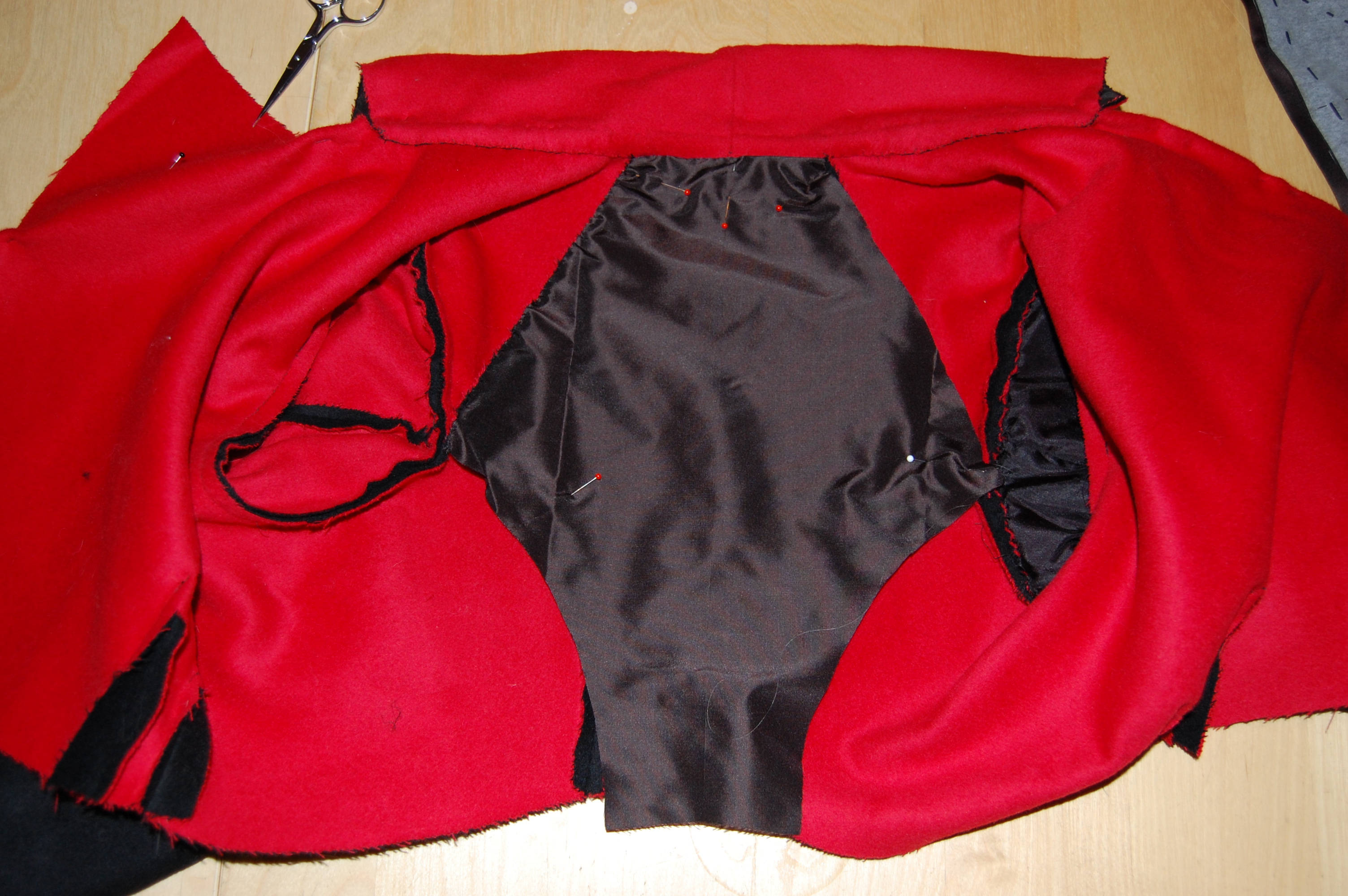
Inside view in progress.

My theory was that if you thought of a Spencer as a miniature frock coat, starting with a man’s pattern might be the way to go. I played with that in a theoretical way, but did not pursue it fully, as I was committed to the double-breasted look.

Year: 1797, if you take the Amazon as the inspiration and marker, which I do. This style, and even the revers, persists for a while, at least in fashion plates. 1797-1800 seems about right. (See the expanded Pinterest board for examples)

Notions: Thread counts, right? Also button molds. But that was it.

How historically accurate is it? This is always the toughest part! I have verified the revers, the style, the fit, and the pattern pieces. The garment is entirely hand-sewn of the most period-appropriate materials I could find. I found reference to a very similar example in a Danish museum; if I had possessed enough fabric for a cape, I would have made one. The inaccuracies will be in details of techniques and the lining materials, which were chosen to ameliorate the very snug fit. Is it 90%, with points off for not being able to time-travel back to buy my fabrics from Providence merchants in 1797? Aside from the Andes Candies coat, I think this is the most accurate and nicest thing I’ve made yet.

The shaped back piece.

Hours to complete: 12 to 18 for the pattern and muslins. Each sleeve took 30 minutes to pin and stitch into the armscye, but the long seams were more time consuming. 12 hours of sewing, perhaps? It seems like more than 30 hours, but once the pattern was done, parts of this moved quickly. (Personally, I love setting sleeves and sewing curvy back pieces.)

First worn: Not yet. As soon as I can talk Mr S into taking photos, I’ll wear it, but right now I have no firm plans for wearing it, which makes me sad. Wouldn’t it be a fun thing to ice skate in? Except for the very authentic way it pulls your shoulders back, which could compromise your balance.

Total cost: $15 for the wool, $6.50 for thread, and $2.80 for button molds; $8 for the amount of silk Persian for the sleeves, the taffeta was in the stash, so $24.30.