Smells Like Money: Must be Auction Season

There’s nothing like a little frivolity to lighten your day when you’ve been pondering some really serious and stomach-churning topics. Hail, then, the arrival of the Sotheby’s catalog and the momentary dropping of all material culture pretenses.

This time, it’s Private Collections.  You say Private Collections, I say Disturbing and Hyper-Overpriced Gift Shop. But what does Snarky Duck say?
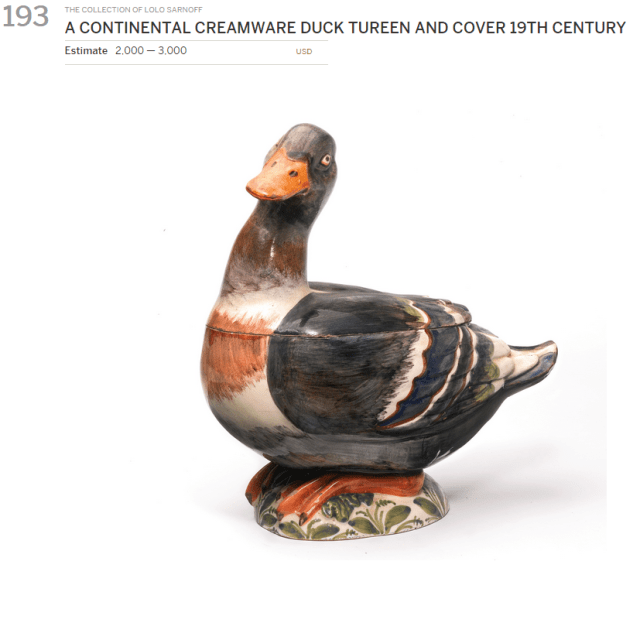
A Continental creamware duck tureen and cover.  Duck ways, no more hot soup, please.
A Continental creamware duck tureen and cover. Duck says, No soup for you.

Poor Strangled Parrot: I don’t think he can say much.

A Holitsch parrot-form jug and cover ca. 1760.

And these guys, described as playful dogs, look more like dyspeptic pugs to me.

A pair of Hochst fayence figures of seated pugs ca 1770.

It is amazing what people will make and buy (which delights me), and I’m certain that things I own would astonish and appall someone with different taste. But animal effigies always intrigue me, and (aside from Snarky Duck, our 19th century friend) figures like these could have graced the mantels and tables of the finest homes of the 19th century. It would have been a crowded and raucous world.

Here’s the whole catalog, should you care for some ormolu chairs or Aubusson drapes (which I did not know existed until today).

Frivolous Friday: Puppy in a Poke (bonnet)

Plate 11, Twenty-four Subjects Illustrating the Costume of Paris

Like most humans, I have whimsical tastes and occasional outbreaks of covetousness. Today, while looking for images of milliners, I found this book for sale online, and while I cannot dream of owning it, I am delighted by this image, and by the others shown on the bookseller’s site. The British Museum has a copy, but only a few images online; Yale has a copy at the Center for British Art, but no images online.

John James Chalon, (more images here) who made this engraving, also made the classic image of the milliner’s shop, and that was where my search began.

La Marchande des Modes

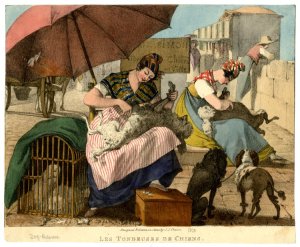
Searching a little more only improved the results… Dog groomers! I have got to get hold of this book.

AN01035992_001_l
Les Tondeuse de Chiens

While these engravings satisfy my delight with the absurd, more seriously, they provide some insights into daily life in the 1820s. It’s not the United States, but it’s a helpful place to start, because despite the humour in these, there isn’t a layer of satire that has to be peeled off before we can begin to understand the image.

Full-on satires, like those of Hogarth, Rowlandson and Gilray, can be hard for us to interpret: we’re so far away, we no longer get the joke, so the joke is now on us if we take what is shown for exact truth. The prints in “Twenty-four subjects exhibiting the costume of Paris” have a gentler humour.  

I don’t think I’m ready to portray a 19th century dog groomer, but I am stunned that I never considered how long they’ve been around. How many other everyday occupations do we overlook when we think of the past?


“Unsuspected Cat”

Squatting plump on an unsuspected cat in your chair!! George Cruikshank [1800]. Lewis Walpole Library, Image ID lwlpr09721 Call Number 800.00.00.176+

The Lewis Walpole Library provides endless amusement, and searching by subject yields some fun. People have had curious relationships with domestic pets for a centuries, and thank goodness cats invented the interwebs so we could get real perspective on this.

Quite aside from the minor domestic comedy of this engraving (I dislike the dark of winter and take my fun where I can), we can learn a lot. The domestic comedy itself helps remind us that while the people of the past saw the world differently, they were as foolish, bawdy and rude (or more so) than we are.

From a material culture perspective, we have (among many things):

  • a geometrically-patterned floor covering, probably a carpet but possibly painted.
  • floor-length curtains
  • looking glasses, paired
  • a slip-covered easy chair, matching the curtains and the cat’s cushion
  • two candles (only two!)
  • glasses with the characteristic straight temple pieces that end in loops
  • a colored open robe over a white muslin petticoat
  • a young gentleman in trousers, an old gentleman in breeches

I can imagine this depicting Emma and Mr Knightley (after their marriage) at home after dinner with her father and their young son: Mr Woodhouse in his nightcap and banyan, reading; Mr Knightley upset by the cat, while the Spaniel barks at the excitement.  All in all, highly satisfying.

Dogs in Coats

[An amazonian dress]. London : Pubd. May 26, 1797, by G.M. Woodward, Berners Street. Lewis Walpole Library Image Number lwlpr08972, Call Number 797.05.26.02
[An amazonian dress]. London : Pubd. May 26, 1797, by G.M. Woodward, Berners Street. Lewis Walpole Library Image Number lwlpr08972, Call Number 797.05.26.02

I was wondering about contrast revers on women’s clothes, and if I could really get away with such a detail on a Spencer, when I happened upon this image on Pinterest. Well found indeed from 1797, and very nice hat as well. Bonus: Giant Muff.

The dog has a coat, too, and now that it’s cold in New England, the local whippets are turning out in their winter coats. Mr S and  I had a slightly crazy notion to dress a dog we know in a canine-scaled replica of a certain very special coat, but would need access to the hound (for measurements) and a particular scrap pile. With those circumstances not in the offing, let’s just be delighted that dogs in 1797 wore coats, and had bows in their topknots, which means that the end of civilization has been coming for a lot longer than previously thought.

Of course it may be that the dog has to dress as a human to keep from being eaten by the ENORMOUS and possibly carnivorous MUFF of DOOM. I think you could make one from the sheepskins at Ikea, if you could settle for white.