Without wading into the murky waters of canceled reenactments (not my time periods– yet!) and the politicization of historical facts, I advocate the recreation of the “bad” people of history. Not the Hitlers and Himmlers and Stalins and Amins, but the everyday bad. The lazy. The feckless. The annoyed. The I’m-just-now-waking-up-to-the-bad-choice-I-made.
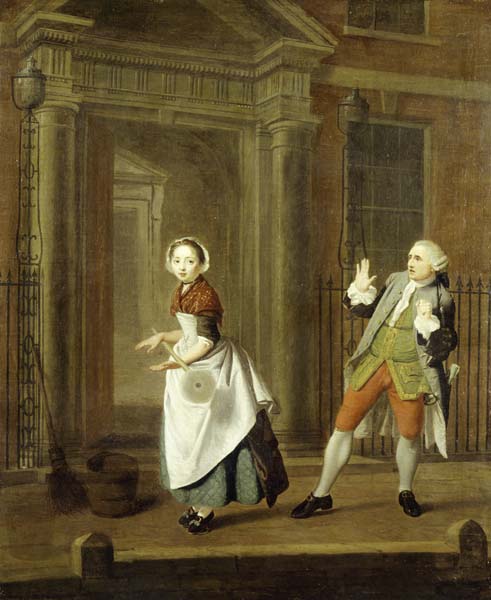
The Female Orators. Printed for Jno. Smith, No. 35 Cheapside, & Robt. Sayer, No. 53 Fleet Street, as the act directs, Novr. 20, 1768.
I think about these people– the ones who slack off while working, the ones who steal shirts, assault officers, throw bones out of barracks doors— periodically, especially when an event is being planned. It’s not that I don’t want to work, mind you: I enjoy working, even the cleaning and scrubbing of history. But it strikes me, especially in summer, that we approach the recreation of history with such excellent intentions. We will Do Our Best. We will Lend A Hand. We will be Always Cheerful.
Why? Why do we not represent the people who shirked? Why do we not represent the people who resented being told what to do, and when? Why do we not take into account our industrialized notions of labor (shifts, clocks, production levels( when we step backwards into a period where there was no factory whistle to set the pace?
The Miseries of Idleness. Oil on canvas by George Morland ca 1788. National Gallery of Scotland, NG 1836. Presented by Alexander and Lady Margaret Shaw, later Lord and Lady Craigmyle 1935
Granted, within a military environment, there are rules, regulations, clocks, and enforcers. But I cannot help thinking that the pace of labor, the speed and drive with which people tackled tasks, was different one hundred, two hundred, three hundred, years ago. Of course there were strivers and doers: the American army in the Revolution was populated by adherents to piety and discipline. But it’s clear from the orderly books that there were miscreants and slackers, too.
The Comforts of Industry. Oil on canvas by George Morland, before 1790. National Gallery of Scotland, NG 1835. Presented by Alexander and Lady Margaret Shaw, later Lord and Lady Craigmyle 1935
And I’m not saying everyone should be a slacker, but you know as well as I do that every workplace today has a slacker or two: the long-term federal employee who watches football at work; the retail clerk whose breaks last a little longer every time; the shelver in the library who catches a nap whilst shelf reading. There are consequences (usually) for those (in)actions, and that’s kind of the point. The slattern and the slacker of history throw into higher relief the purpose of the discipline an army (or housekeeper or master cabinet maker) is trying to maintain. When we all strive to do our best, we lose the depth of interpretation that doing “bad” history can provide.
A Female Philosopher in Extasy at Solving a Problem. London, England; about 1770 Mezzotint and engraving with watercolor on laid paper Colonial Williamsburg Foundation
Scandal and outrage rock the reenacting world as reading comprehension lags and The Gentle Author is accused of presentism– or, at least, that’s the most reasonable translation I have for comments made about me last night on social media, including:
Yeah- she’s got great stuff. But I feel awful that she fell into a modern-think trap.
and, my favorite,
I’d say its a post modern Critical Theory think trap. Frankfort [sic] School is gushing from the pores.
Let’s take this apart, shall we? The Frankfurt School (not this place) was a social and political movement based in Frankfurt am Main in the immediate post-World War I years. After 1933, the school, formally known as the Institute for Social Research, moved to Columbia University in New York city. Being insulted by association with the likes of Walter Benjamin and Theodor Adorno is a new experience for me; I’m more usually associated with the ideas of Mary Daly and Jacques Derrida but I’ll take backhanded intellectual flattery where I can get it. (Also, thanks for thinking of me, but Kitty does not require your pity.)
More seriously, the postings last night (which happened while I was in class and have been deleted) brought to mind two powerful issues in living history and the reenacting community: Presentism and Feminism (with its unholy shadow, mansplaining).
Let’s go over these:
Presentism:uncritical adherence to present-day attitudes, especially the tendency to interpret past events in terms of modern values and concepts.
Feminism: The radical notion that women are people. the theory of the political, economic, and social equality of the sexes.
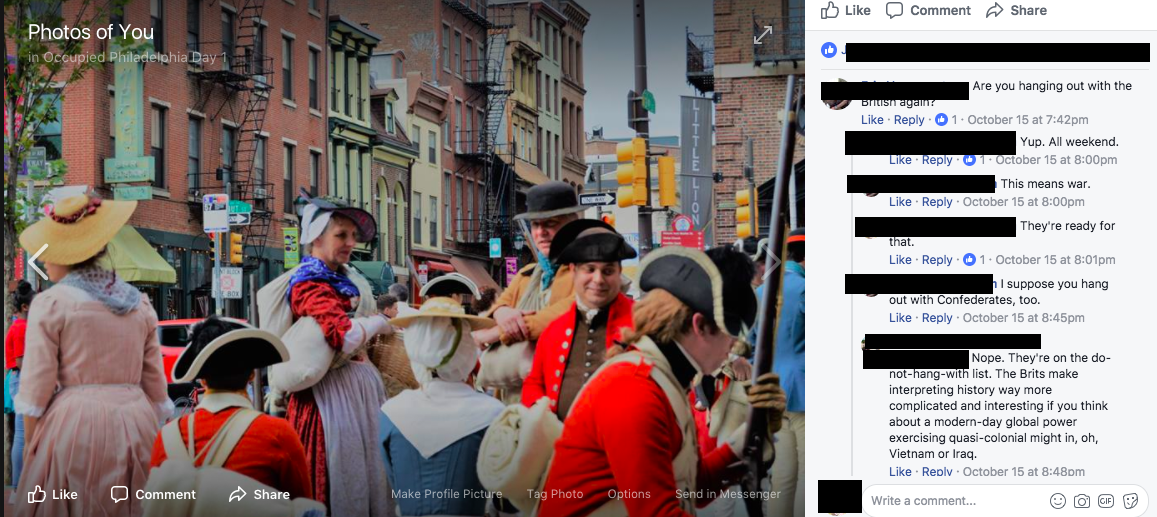
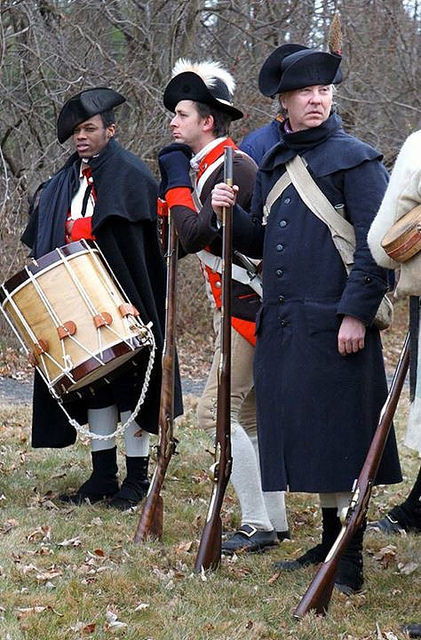
Images were posted to Facebook, and I was tagged in one that showed me in the midst of a crowd that included members of the 17th Regiment of Infantry, one of the forces that occupied Philadelphia in 1777. My cousin, ever the wag, commented:
click to enlarge in a new window
“I suppose you hang out with Confederates, too,” had some bite. What surprised me was my well-educated and thoughtful cousin’s facile conflation of Confederates and British. Is the world that easily black-and-white, good-and-bad, Manichaen? Not usually, and certainly not usually to my cousin. Explanations seemed in order. Why had I done what I did, and what did I do? What was Occupied Philadelphia about?*
To me, it offered the chance for some complicated interpretation that’s more readily accessible via living history than by exhibit panel, or at least significantly more engaging than text. How do you elucidate the complexity of the American Revolution? How do you get people to think about the past in the past’s terms? How do you get them to query and interrogate their accepted understandings of history?
Apparently that position towards living history– that it is complicated, worthy of criticism, can be used to create a complicated look at the past, and can be understood through cultural criticism– is deserving of the dog-whistle scorn of men hiding behind false names on social media. It elicits from them suggestions for interpretation that include impressions already being done, and referenced in the original post. It elicits suggestions based on 1811 paintings of Philadelphia, because of course, nothing helps illuminate 1777 Philadelphia like a genre painting made 34 years later.
If anything, I was suggesting that complicated interpretations (that is, showing how an “occupying force” might be “good” for the population) can further an understanding of the past that helps us understand the present. Isn’t that the mission of most history organizations? Understanding the past to illuminate the present and shape the future? It’s unsettling to realize so immediately how people who practice history use it to reinforce the status quo, and use misreadings of interpretation to further their own sense of superiority.
That’s where feminism comes in: suggesting “new” roles for women in living history (Laundry? How ’bout being a Quaker?) on a page dedicated to women’s history is a dizzying feat of sexist thinking. It is particularly delightful given that the Gentle Author and her associate, Our Girl History, are among the people who have suggested new roles for women, and have organized events that included suggested roles, and in fact required them. But please, tell me what to do. Belittle me by association with some of the leading critics of the 20th century. Because when you do, you reveal yourself not only to me, but to others.
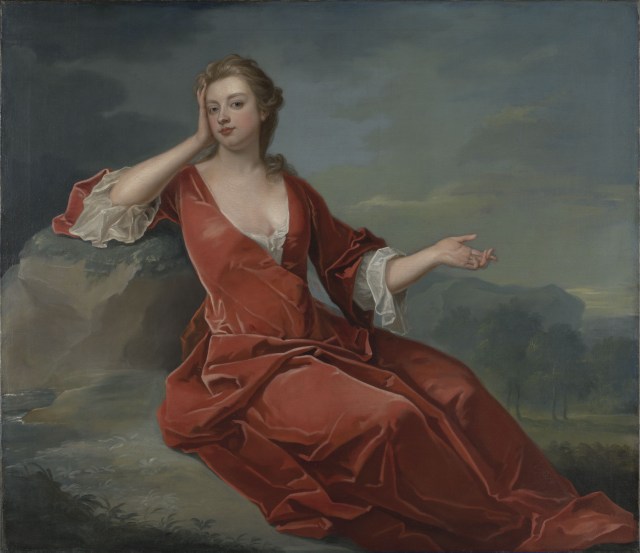
Sarah Churchill, Duchess of Marlborough. Oil on canvas by Charles Jervas.
The greatest sin a woman could commit was to participate in any sort of public life, be it theatre, politics, or social causes – this made her immediately ‘difficult’
*Brits-as-Nazis is not my origination, but the distillation of a comment made about the dedication of a monument at Guilford courthouse and subsequently reported to me. Despite a commenter’s attempt to attribute the equation to me, it is not mine, as should have been clear from “in certain circles.” Not my circles, not my monkeys.
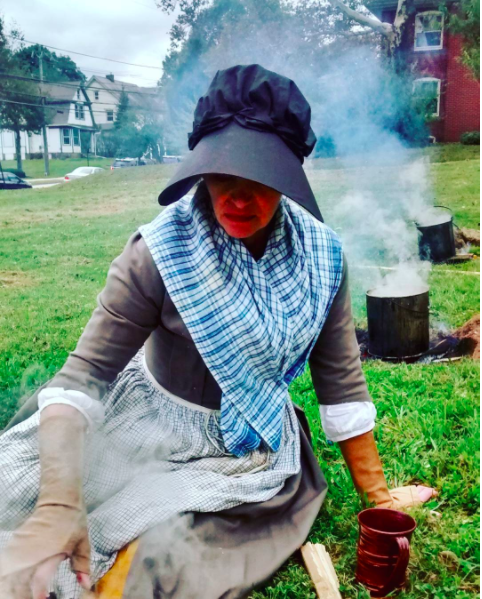
When I was in middle school, we were given an assignment that is now considered inappropriate: we were asked to trace our family history or genealogy as a way to help understand historical time, stories of immigration, and the ways in which we are all American (according to the then-prevalent “melting pot” model of being American). Exercises like that are now discouraged as educators recognize the myriad ways in which people form families, though in my middle school, what was revealed was not adoptions or absent parents but the yawning chasm of class and privilege. My people are more peasant than princess, so the women I portray in living history make sense to me. They don’t wear silk. They make things, and they sell things.
Walking back from Augustus Lutheran Church, Trappe, PA
Portraying a refugee was a little trickier to wrap my head around. Whiny I can do– if I wasn’t teaching workshops in New Jersey this November, I’d be in 1587 North Carolina pining for England and wondering why I didn’t listen to my mother instead of marrying that head-in-the-sky Virginia colonist. What made being a refugee tricky for me was finding something to do. Obviously I shared in the cooking chores and the walk to Augustus Lutheran Church, but projecting “refugee” was tricky for me.
Looking back, I can see that straggling after a militia company may well have been enough– not wanting to leave their “protection,” not having a place to be, illustrates displacement. Even dressed as a middle-class or lower-middle-class woman, I am out of place sitting on grass or following armed men.
Displacement: I had not previously considered this as a means of provoking informed interpretation. Interpreting lack or absence can be as effective as interpreting presence. “No shoes” or “no musket:” these are easier, more obvious, but as a refugee, I had no home, no place, and no belonging. That seems even more important to understand and interpret today, at least for those of us concerned with making the past present, and the ways we can study the past to understand the present.
Philadelphia Associators January 3, 2015. Beverly Schaefer, Times of Trenton
It’s upon us, this Princeton event, and Peale’s, too. And the overnight march I missed two years ago. I’m so glad to be part of this, and I’m interested in seeing where it goes from here– partly for me, and partly for the way we do living history. Now, I’ll miss some of what I’d like to see (like Mr. White’s tour of the second battle of Trenton, but when you’re plundering in Princeton, you’re committed.) A formal media release may be downloaded here.
A little more than two years ago I was asked if I wanted to join the Peale’s March to Princeton. I said no, because women couldn’t march and that was the experience I wanted. Someday, I will have the hallucination that allows me to square experiential learning with authenticity, and, at the same time, the world will care about having a women’s Tour de France.
Anyway: there’s a point. This event became a pivot point for me in thinking about accuracy and authenticity of all kinds.
Accurate impressions rendered in a place of shared value will transport you to the past, and give you insights you did not expect. That is the point of these exercises: insight and understanding. It’s how to get high on history.
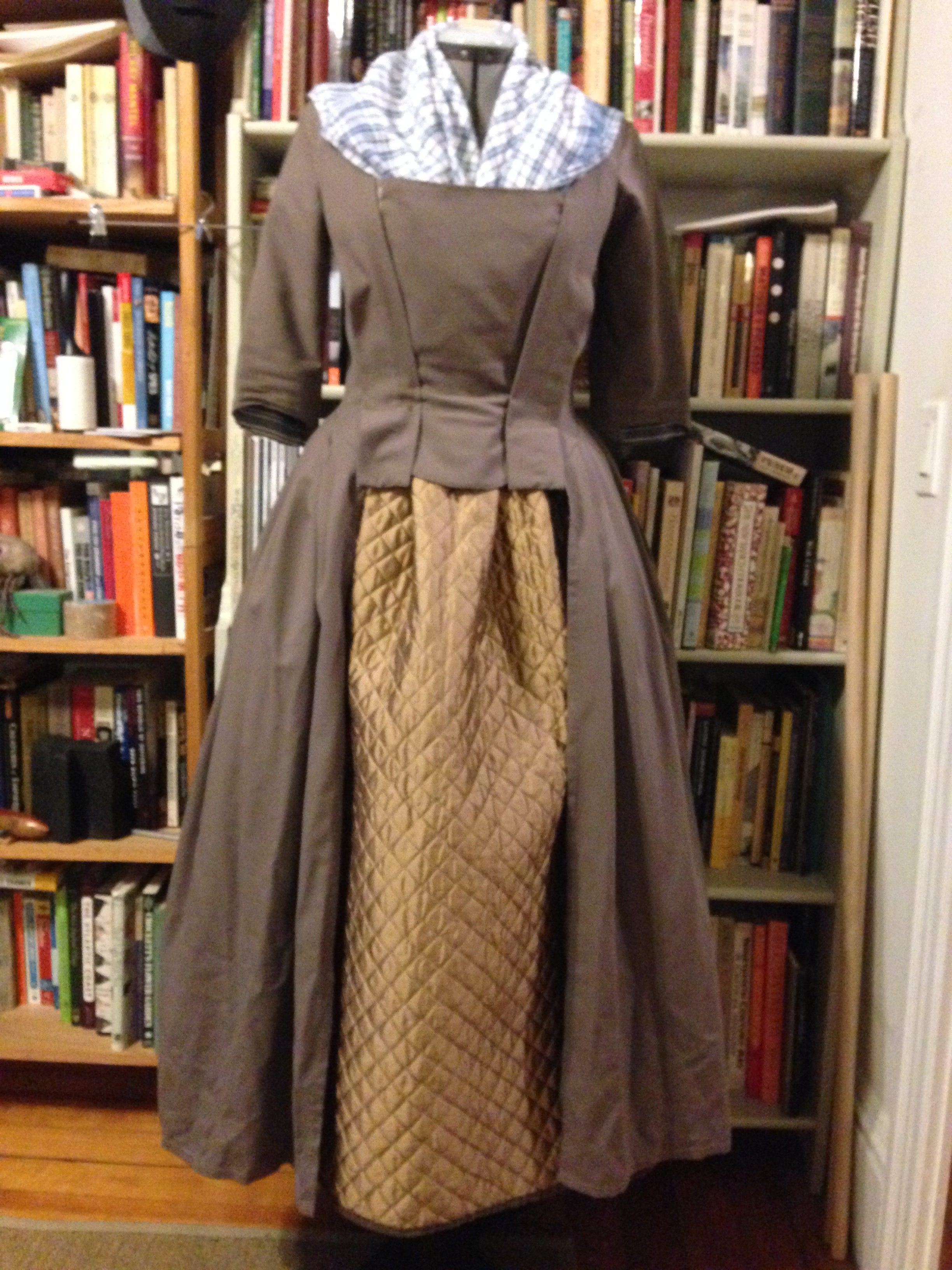
Test run: bedspread petticoat. Girl’s gotta keep warm.
In Palmer Square and at Morven, that means stealing (from each other), soldiers arresting Quakers, Loyalists and Whigs insulting each other, arguments about loyalty oaths, and women being attacked. (When you see the grey gown grabbed off the square by the red coat, please know that this is acting.) It means rough justice in a drum head court martial.
Will it work? I think so. Will it change my life, the way not attending two years ago did? That will depend on what I regret.




 Kirsten Hammerstrom
You must be logged in to post a comment.