
Once Upon A Time…

Betsy Ross and friends: A Child Guidance Educational Activity

This is the third set of these paper dolls (Educational Activity) I have owned. The very first set was given to me by my mother, Lo, at the Dawn of Time, in the Dark Ages known as the 1970s.

I wore them out.

A new set was purchased, probably once again at Marshall Field’s, possibly in the book department. They now reside in an attic outside Philadelphia (how appropriate).

From this Educational Activity flowed many more home-designed outfits and home-made paper dolls of historical and literary origins, which have led to this moment, when I make myself and my family into historical characters, make us outfits, and set us in motion with friends and colleagues in scenes of historical play-acting, by which I mean Educational Activity.
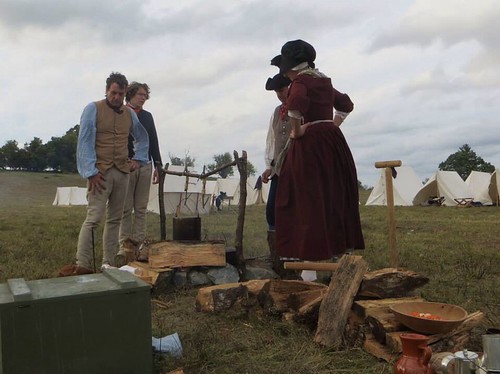
Cooking at Saratoga: very Educational. Photo courtesy D Molly Ross.

I like to think that the clothing we wear is more correct than the “Authentic Costumes” advertised on Betsy Ross’s box, but there is always more to learn. I am in no way denigrating Betsy Ross, or paper dolls, or suggesting that I see my family, friends and colleagues as paper dolls. But I do know that as long as I have been playing, I’ve been playing history and reading history, and drawing history, and using books and paintings and yes, even paper dolls, to figure out the world present and past.

If January Jones played Betsy Ross...
If January Jones played Betsy Ross…

Even though I always thought I wanted Betsy’s birthday cake gown, the one I really liked was the work gown. The “construction” of her garments confused me even as child: how the heck does that kerchief work? And the bodice front? Never mind, have a slice of dress, I mean cake. (Field’s had a cafeteria that served slices of pink-iced layer cake that I somehow conflated with the paper dolls, thanks to the shopping trips my mother and I made.)

Memory and fact, impression and citation: when we reenact the past as an Educational Activity, we should remember that some will walk away enlightened, and others will walk away thinking about birthday cake. Our job, beyond getting the facts right, is to engage our visitors, to interest them, and to excite their imaginations. What they do from there is up to them, but we will know that we have done our best to present them with a scene that can take them one step closer to being there.

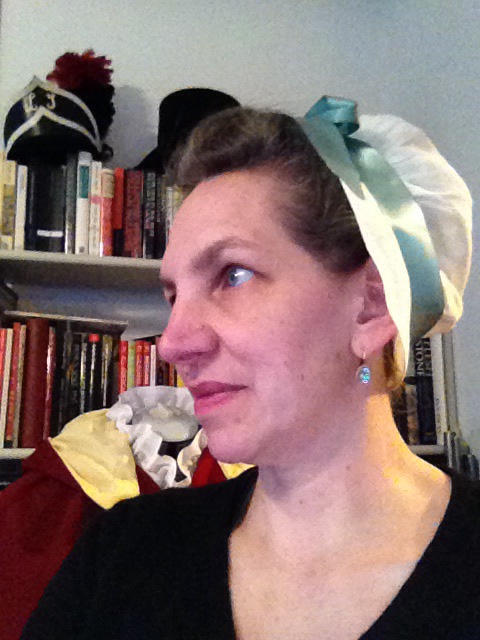
Hair-raising

An old gown, with new sleeve ruffles and petticoat.

We are going to a ball tonight, and while I am looking forward to seeing Sew 18th Century and the lovely Mr and Mrs B among other friends, this is a different kind of experience for Mr S and me. We are, after all, more accustomed to crashing parties than attending them. (There are photos of the Riot Act Night here.)

The biggest difference is in presentation. I ended up making a changeable blue silk petticoat to dress up a cotton print gown, to which I’ve added sleeve ruffles made by the incomparable Cassidy. While I once had plans–dreams–of finishing and wearing the silk sacque in time for this, I was overtaken by events  and have settled for an ensemble more suited to my persona, and Mr S’s planned outfit, the Saratoga coat and breeches. I feel just OK with center front closing cotton print for late 1777, and have seen enough cotton print gown and silk petticoats at Williamsburg to brazen it out.

This is a marked upgrade from linen petticoats that smell like woodsmoke (sigh!) and print neckerchiefs that you shouldn’t smell.

Perhaps the biggest change, though, is to my hair. (Yes, the pun is finally paying off, like a loaded gun in the first act.)

All cleaned up with someplace to go.

I started this day with wet hair, curlers, setting lotion and bobby pins, swearing like a sailor and convinced/hoping the world might end right in our bathroom. Last night I watched Jenny La Fleur‘s 18th century pouf tutorial, and thought I had the basics down.

Wrong. Or half-wrong. I should have gone looking for a don’t-lose-your-mind video, plus one on how to make pin curls in exacting detail. True to my ability to over-think anything, I began to wonder which way I should spin the pin curls– clock wise? Counter-clock wise? Is it opposite if you’re in Australia and New Zealand? My brain is a cluttered place.

In under an hour I had achieved a lop-sided mound of curlers and curls, which I thoughtfully covered with a kerchief to spare my family from death by Medusa. They refused to take me to Walmart, though I finally had the hair for it. Eventually, I pulled out half the bobby pins in the known universe, and had a head full of snakes. Silver snakes. Apparently there’s more grey in my hair than I realized.

Another half-hour of pins and hairspray later, I had a slightly more upscale version of my usual hair style, accented with a shiny green ribbon. Underneath that demure cap, my hair is doing terrible, feral things. Of all the things I learned today, I know with certainty that despite my small head, the next time I’m gonna need bigger rollers, and when I get home from the ball, I must wash my hair.

Sacque Rationalizations

Before I get any farther along in the process of making a sacque (and I have not made much progress) I thought I should start to really look at gowns, and try to understand them.

Not only do I need to understand how they’re made, I want to understand how they change over time, and what’s appropriate for different time periods and situations. This will, or could, have some bearing on what I make for the gentleman accompanying me to the celebrations for which this gown is being made. If I start from Mr S, whose best coat right now is the 1777 Saratoga private’s coat, then I ought to have nothing better than a second-hand sacque several years out of date, and that is reaching indeed.

SacqueBySacque_back
What good fortune it is that the LACMA dress seems to be a gown in flux! This is the brown silk cross-barred gown with an assigned date of ca. 1760, which seems to have been abandoned in mid-alterations. Trim down the rights and left fronts ends abruptly at the waist, and two halves of what might have been a compère front lack any trim but boast plenty of holes. The front skirts come close together, but it’s hard to tell if they are meant to nearly close, or if the gown is fitted to a mannequin that’s too small and not adequately padded out.

Replicating a gown in mid-alterations would be interesting, but not what you’d wear to a ball, so I kept looking. In Hamburg there is another cross-barred sacque-back gown from about this era. There are similarities and differences, and never as much information as you’d like to have. Who owned and wore these? Who made them? When and where were they worn? We’ll never know, but at least with two similar gowns one can fill in some details for another, or help us understand them both.

The serpentine trim on the pink gown in Hamburg makes clear how unfinished or mid-alteration the brown gown in LA really is despite the visual interest created by the fabric itself.

Sacque_by_SacqueFront

So, what to do for my gown? And when will it be from? LACMA is hedging their bets with ca. 1760. I think Hamburg is pushing it a bit late with ca. 1775, but a ca. 1770 date for a gown based on the two seems reasonable. That would mean that the coat Mr S wears should also be ca. 1770, or newer than his green linen coat and older than his Saratoga coat. And luckily, I already have a plan, some fabric, and a pattern as a place to start.

While the ball itself has no date per se, it is in celebration of Washington’s Birthday, which puts it after 1775 at the earliest (think transfer of command of the Continental Army in Cambridge). Does that make a ca. 1770 gown too early? It would depend, I think on how one imagined the ball and oneself. If you’re a frugal woman who has lost much in the war, you’ll remake your gown; should the flounces become the shirred cuffs of later gowns? Could the kind-of compère front of the LACMA gown be a stomacher cut in half and stitched to the sides, with the pin hole indicating where trim had been removed from a once-was stomacher? Is it reasonable to make a compère front for a ca. 1770 gown? I want one mostly to avoid the stomacher angst I always seem to have, and in a way it marks a place between stomacher-front and front-closing gowns.

These unprovenanced gowns stand without the particular context and personality of their owners; the fun and the challenge for us, as costumers and reenactors, is in trying to bring our personalities to the fact-based garments we create.

History Dress-Tease

What Cheer! Day is a week away, and exactly a week from now, at 6:30 AM, I will get into my B&G guy’s truck and head into the site. We’ll measure and tape out camp sites, fire pit sites, and safety lines, bring wood and gear out from the woodshed and basement. We’ll put out the handicapped parking only sign in the parking lot, drop the orange cones (I love the thick flexible plastic of a traffic cone), and drink some coffee. I haven’t decided at what point I’ll start to fret in earnest that day, but the trick to not fretting will probably be to get dressed in 18th century clothes as soon as we are done carrying items upstairs, because then I will have to take off my watch. Watches lead to fretting: there’s administrator time, and re-enactor time, which is more like artists’ time. Better to take off the watch and get closer to the past.

Half-pleated skirt, sleeves in progress

At the School of Instruction, I thought the “People of the Brigade” program worked well; at OSV, I really appreciated  the Military Fashion Show (I did not make it to Runaway Runway). Using these models, and knowing about the School of Instruction’s Women’s Dress program, I thought we’d combine these ideas. I don’t have a good name for the program yet, but the reason I’m going so nuts about the dress from 1774 is that I plan a “History Dress-Tease:” starting in shift, stays, stockings and shoes, I’ll demonstrate all the layers my runaway wore: 2 petticoats, pockets, dress, stomacher, apron, cap, bonnet.

Any soldiers I can convince to get down to small clothes and layer up with waistcoat, coat or frock, canteen, cartridge box, bayonet scabbard, haversack, knapsack, hat and musket, will demonstrate the gear they carried. I thought about a weigh-in, to record how much it all weighs, but my scale is a pathological liar, and varies by 4 pounds from one side of the room to another.

All this work has an educational, and not merely sartorial, purpose. Now, if only the public will come…