
Frivolous Friday: “Sport Your Little Spencers”

Spencers. hand-colored etching published by S W Fores, 1796. British Museum, 1851,0901.782

Spencers were clearly the rage for well over a decade, turning up in satirical prints from at least 1796 (We’ll get to that satire soon). I was wrong when I questioned the Maine catalog record that called a man’s short coat a Spencer: there were Spencers for men.

Here, everyone is wearing a Spencer down to the monkey and the dogs. What I find particularly interesting is that the short Spencer jacket is worn over the men’s coats– this is an entirely new concept to me. Yet, here it is again, in the “Pupils of Nature” print.

Pupils of Nature.hand-colored etching published by S W Fores after Maria Caroline Temple, 1798. British Museum, 1867,0713.409

Were Spencers were the 18th and early 19th century equivalent of Members Only or Barracuta jackets? (You will know a red Barracuta–even if you think you don’t.) Perhaps. They do seem to be a splashy unisex fad in the late 1790s that gives way to women’s wear, but that’s a thesis in need of more research than Frivolous Friday demands or permits.
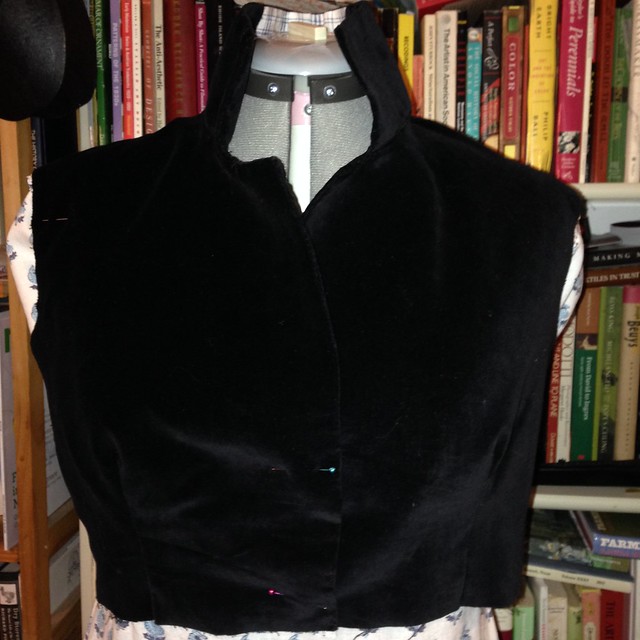
Some Velvet Morning

Sewing velvet is a strange experience. I’m working with a cotton velvet from a remnant table; it has a nice hand, but still crumbles and covers the table with fabric soot when I cut it. It’s not easy sewing black fabric with black thread, even in strong morning light, and “Some Velvet Morning” is an unhelpful thing to have stuck in your mind (especially the Lydia Lunch rendition).

With just one yard of 44″ wide stuff, cutting a Spencer took a little doing and some minor piecing. I borrowed techniques from some waistcoats I’ve seen recently, and pieced in linen at the back collar lining. That seems to be pretty common, and makes sense from a wear and hair perspective.

I patterned this on Monday morning before work, basing the pattern shapes on an 1810 fashion plate and an original at the MFA Boston. The MFA’s Spencer is particularly satisfying because of its connection to Lexington, Massachusetts. A New England-made Spencer is a happy find.

Frivolous Friday: A Feather Kerfluffle

Miss Caroline Vernon by François-Xavier Vispré (c.1730 – London 1790). pastel on paper. ©National Trust Images/John Hammond.

I troll the interwebs in the fishing and not the under-the-bridge sense: there’s a lot to read out there. Still, I’ve kept one eye on the feather-and-flower kerfluffle that erupted in certain circles this week, but have been much more interested in documentation of one kind and another.

Miss Vernon is really my favorite image of feathers on hats, and I wish I could say that a) I have replicated this fabulous creation or b) that I have seen such a thing, but alas! I have not.

Still, scouring sundry repositories for tayloring manuals (more on that another time), I found this delightful broadside. We can’t use 1782 to document 1780, and no means of using any of these items is mentioned or implied. Still, there they are, those inflammatory terms: Feathers, Flowers.

1782 Broadside. Early American Imprints, Series 1, no. 45771  (filmed)
1782 Broadside. Early American Imprints, Series 1, no. 45771 (filmed)

To paraphrase Max, Let the wild rumpus continue.

Frivolous Friday: A-Spalling Behaviour

Mr. Turner, out now on iTunes and elsewhere, won’t be for everyone: M’damsel isn’t treated very well– artists are, you know, often narcissistic, driven users– but the landscapes thrill.

We talk sometimes about going to the antique store in historical clothing and asking why our chattel is for sale. I toy with similar naughty thoughts about visiting historic house and other museums, but Mr Turner inspires a dream of a simpler pleasure: dressing in period clothes to visit a period gallery.

Classic Mr Turner in the salon

Possibly my companion would grunt as Turner does, but we might also unnerve guards by pointing walking sticks at salon-hung still lifes or reacting with disgust at the sight of an Impressionist work. (Might as well take it all the way.)

Everybody’s a critic

No takers yet for this diversion, which is just as well. I expect it would be a quick way to meet security and police staff if you didn’t coordinate with the museum/gallery in advance. Still: what a stunt. Someday I’ll pull it off.