Frivolous Friday: Festive but Frigid

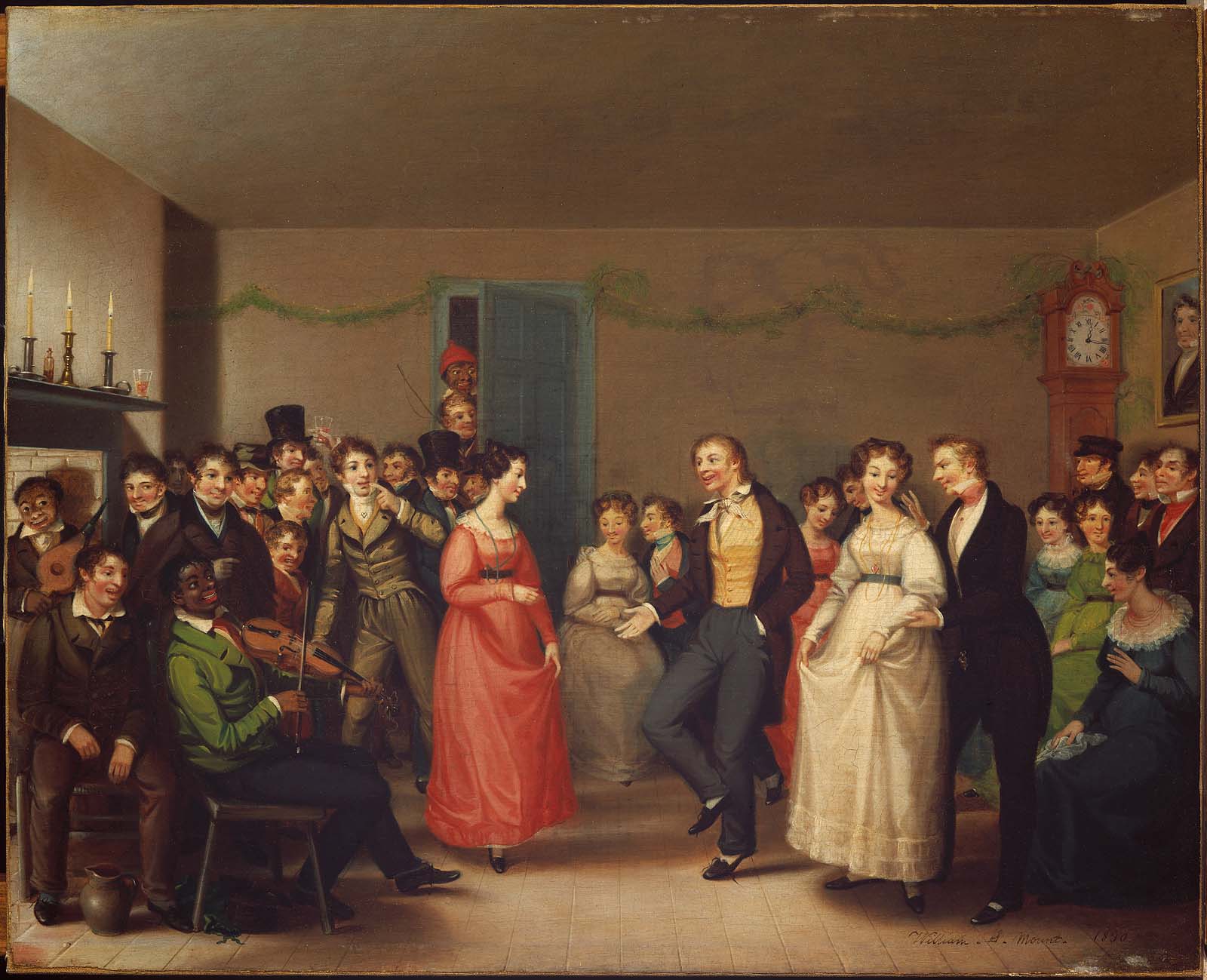
Rustic Dance After a Sleigh Ride, 1830. William Sidney Mount MFA Boston 48.458
Rustic Dance After a Sleigh Ride, 1830.
William Sidney Mount MFA Boston 48.458

I don’t know about your weather, but we’re in full summer in New England, sultry and humid, with the occasional thunderstorm and power outage to enliven the evening. A sleigh ride sounds like fun today– and I know we all just finished complaining about the snow of February– but a brisk ride followed by a dance would certainly round out this week.

1833 approaches faster than expected, so it’s time to pick that back up and get serious. Not just a gown but petticoats and, ideally, a new shift should be made. This may be the project that breaks my resolve and finds the Bernina back on my table for cording a petticoat.
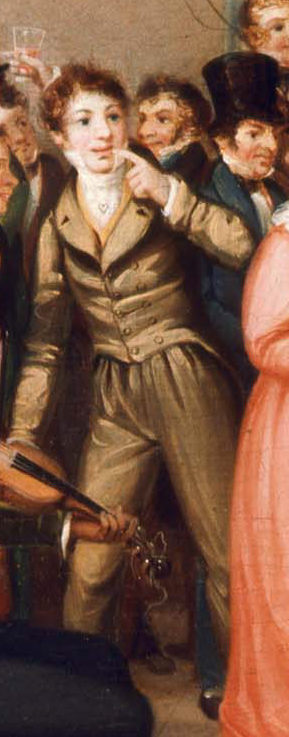
Detail, Rustic Dance After a Sleigh Ride, 1830. William Sidney Mount. MFA Boston 48.458

This image helps define the look of the early 1830s: not nearly as exaggerated as the fashion plates, these dresses and coats seem to fall into a progression from the 1820s– as you’d expect this early in the decade.

The gentleman at the back, in the drab colored suit, sports an interesting pair of trousers. I don’t think I know anyone ready to bust out the cossacks, but Mr Drab may be sporting a slightly modified pair. The collars and lapels show a shawl-shape that seems new, and modified from the more serpentine form seen in fashion plates– or else not yet as developed. There’s a range of headwear, too: tall hats on the left, a soft cap on the right. The Ladies’ Workbook has a pattern for one of those caps. Wonder how hard they are to make?
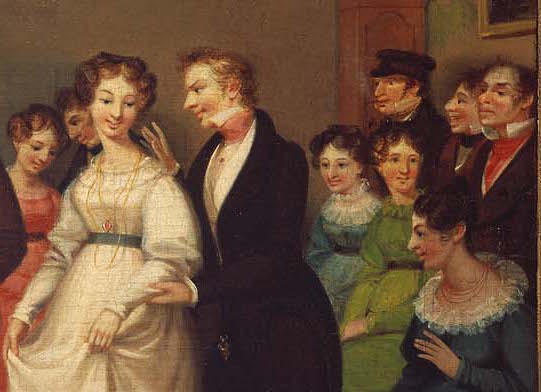
Detail, Rustic Dance After a Sleigh Ride, 1830. William Sidney Mount. MFA Boston, 48.458

In the detail, we can also see the women’s hairstyles, less exaggerated than the fashion plates with their high top knots, and within the realm of possibility for those of us not practiced in historical hairstyle recreation.

So much has carried into this decade: colored neck wear, ruffles or chemisettes under women’s gowns, men’s hair brushed forward. As always, it’s the details that count. Tall shirt collars, rounded lapels, ladies’ sashes, the shape of sleeves. This should be a fun decade to represent.
Itching for Style

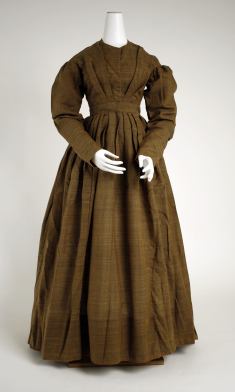
Dress Date: 1830s Culture: American Medium: wool Dimensions: Length at CB: 53 1/2 in. (135.9 cm) Credit Line: Gift of John Eastman and Gerard L. Eastman, 1976 Accession Number: 1976.209.2
Dress, 1830s. American, wool.
Gift of John Eastman and Gerard L. Eastman, 1976.209.2 Metropolitan Museum of Art

Wool. It’s a thing. This dress from the Met has many of the markers of everyday fashion– a vernacular form, if you will, of what Deliverance Mapes Waldo is wearing in this portrait

Deliverance Mapes Waldo and Her Son about 1830 Samuel Lovett Waldo (American, 1783–1861 American) DIMENSIONS 77.15 x 64.45 cm (30 3/8 x 25 3/8 in.) ACCESSION NUMBER 45.891 MFA Boston
Deliverance Mapes Waldo and Her Son, about 1830
Samuel Lovett Waldo. 45.891 MFA Boston

Of course, dating these things is never a science when they don’t come with a clearly labeled tag you can affirm with research. The extant garment first. The sleeves say 1820s, the waistline says 1830s. Could it be 1840s? Perhaps. Without provenance, it’s really hard to know.

Mrs Waldo’s sleeves are clearly 1830s sleeves: full on gigot, sloped shoulder. It’s the contrast between her sleeves and the Met’s dress that makes me question their date (along with the fashion plates we saw yesterday).

Here’s a wool gown from England, land of the fabulous wools.

Dress, England, Great Britain.  1836-1838. Printed wool, trimmed with printed wool, lined with cotton, hand-sewn Given by Mrs H. M. Shepherd, T.11-1935. Victoria & Albert Museum.
Dress, England, Great Britain. 1836-1838.
Printed wool, trimmed with printed wool, lined with cotton, hand-sewn
Given by Mrs H. M. Shepherd, T.11-1935. Victoria & Albert Museum.

Here the sleeves are starting to be narrowed at the shoulder, taming the gigot. That places this 1836 or later, which is helpful. The bodice style is still not the pleated or smocked front of the 1840s, so that’s another marker for mid-to-late 1830s.

What will I do? I don’t know. I’ve ordered two patterns (and one for a new chemise, sigh). The Past Patterns Lowell Mill Girl dress appears to make up quite nicely, but I also ordered the Wisconsin Historical Society pattern for comparison. (Hey, when you can’t examine originals, you have to use the patterns.) Fabric is always a question, but if I’m feeling plain wool, there’s always Burnley & Trowbridge’s “Virginia Cloth.” I’ve worked with it before, so I know how it handles, and while the color looks itchy, it’s actually pretty soft.

Sheer Madness

Mercury is retrograde and the schedule is tight, even for me, as I made the plans I’ll put into action at the end of this week: a special event Thursday night at work, followed by mad packing and a drive pretty far into New York.

I did say sheer.

Yes: I am going to Genesee. It’s a long drive from here, so I’m happy to be picking up some friends in Albany (neither of whom live there) for company and some relief behind the wheel. Of course we’re taking our car: it’s the Quartermaster cart.

Since this is one of two occasions when I can portray someone in trade rather than in service (and a better trade than selling fruit on the street), I made a new gown. And a new Spencer. And a new reticule. And cut out a new coat for Mr S, with a newly (fingers crossed!) patterned collar, based on plates in Lapsley and Queen and images texted from a friend.

Yes, I am a little crazy, but it does make life interesting.*

Finished –even hemmed– days before the event!

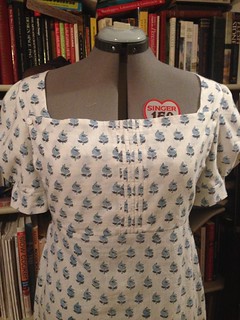
The gown is made from fairly sheer block-printed Indian cotton found on eBay. The pattern is based on one in Nancy Bradfield’s Costume in Detail with a bib front and tucks in the center back. To help with measurements, I also referred to the bib-front dress in the back of Bradfield’s book, as patterned on the fabulous 19th US site, as well as Janet Arnold.

The first bib-front gown I made ended up a little slanted: your mileage may vary, but I find patterning on opioids is not recommended (I sewed while recovering from hip replacement surgery). This one seems a little better, though the fabric came in for some commentary when I was working on this in a room full of light infantry “men.” We devolved from “chicken on flower” to “Seagull on a bush” in describing this buta-like shape. I only bled a small amount on the tucks, despite texting while sewing.

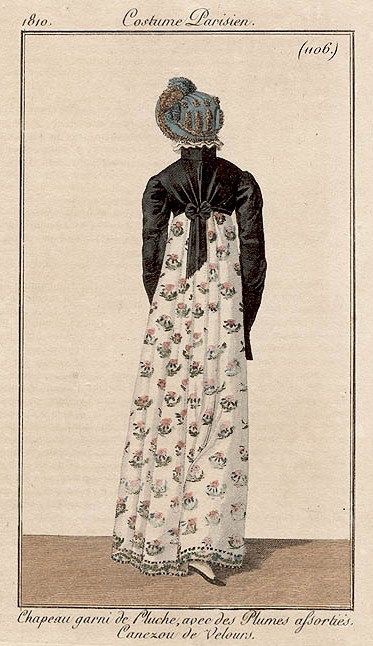
Canezou de Velours, 1810

Inspired by this 1810 fashion plate, I made a black velvet Spencer as well. That’s finished, save for the buttonholes, though there will be no texting while button holing.

Men’s waistcoats often have cotton or linen at the CB neck.

It got pretty matchy-matchy when I did the lining.

You will note that the plate describes a “Canezou de Velours.” Canezou was new to me, and while I don’t trustthe internet too much, here we are with Larousse: Vieux. Corsage de femme en lingerie.

Huh. It seems to be a lightweight-bust length garment for women.

Here’s the OED:

Oxford English Dictionary

canezou canezouHist.

(ˈkanzu)
[Fr., of unknown origin.]
A woman’s blouse-like garment of muslin or cambric. Also attrib.
1827 Lady’s Mag. Sept. 510/2 A canezou spencer of embroidered muslin. Ibid. 511/1 Muslin canezous over high dresses. 1893 G. Hill Hist. Engl. Dress II. 241 A cambric canezou..with sleeves full to the elbow. 1898 Daily News 26 Sept. 6/4 When the Restoration came in 1815,..Fleur-de-lys appeared on everything… The canezou replaced the hideous spencer.


Ah, the hideous Spencer. I rather like them, myself.


*A very long time ago, I had a drawing teacher who said there is never an excuse for being bored. There is always something to do, to see, to observe. That was my first lesson in being present. Perhaps I take this statement a bit too literally.

Under the Green Umbrella

May, 1802. Gift of Woodman Thompson, Costume Institute Fashion Plates, Metropolitan Museum of Art

How do you like this gentleman? He’s from the Met’s online collection of fashion plates, in Men’s Wear 1790-1829, Plate 032.

I know a gentleman with a similar waistcoat and a similar smirk who needs only the umbrella and spy glass to complete this picture.

In case you’re wondering, the Hull Museum (UK) has a page devoted to a brief history of the umbrella. While classically and stereotypically British, it certainly rains enough here to justify carrying one. The British Museum has 46 trade cards that include umbrellas, with a few pre-1800 examples.