Criss Cross, or, My Checker’d Past

Every now and then I look up from what I’m doing (tiny stitches, usually, though sometimes budget math) and realize that Objects in Mirror are Closer Than They Appear. Oops. It was just yesterday I was daydreaming about miniatures, and now I shall want a paintbox and brushes in a mere six weeks– and those six weeks are punctuated by a courier trip, a couple of exhibits, not to mention shepherding The Young Giant through prom and finals.
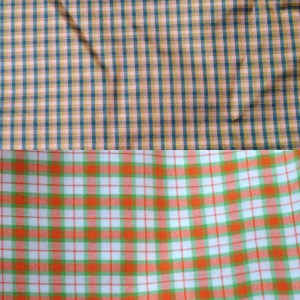
Top: check silk taffeta, Artee Fabrics Bottom: check cotton, Mood Fabrics
Top: check silk taffeta, Artee Fabrics
Bottom: check cotton, Mood Fabrics

This weekend, thanks to the SFR hunt for collar interfacing of an appropriate weight, I realized I’d better get a wiggle on my own sewing, and managed to hunt up the orange check from hell, pop it in the washer, and hunt up the pattern I intend to use.
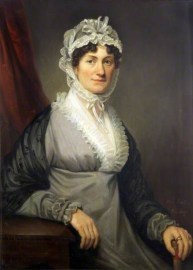
Mrs Catherine Morey oil on canvas by Michael Keeling, 1817. (c) Walker Art Gallery; Supplied by The Public Catalogue Foundation
Mrs Catherine Morey oil on canvas by Michael Keeling, 1817. (c) Walker Art Gallery

I’m stuck on that 1817-1819 range because of someone’s eventual and particular Mode of Transportation, so I was super pleased to find this portrait while trolling the BBC’s Your Paintings site. Actually, I’m pretty over the moon about this image, since it places that cross-over front firmly in 1817. I’ve made a version of this form already, so I can but hope the next iteration will be even closer to correct for the period, once I tweak the pattern a bit.

The pattern: therein lie so many rubs, often going the wrong way. Still, I remain enamored of the check and of the cross-front gown. Any checkered doubts were dispelled when Alison for reminded me of the sort-of-cross front check gown at the Met, whose catalogers are hiding behind circa 1820 which allows leeway back to 1815. Behold, of course, the ruffled neck of the bodice (I do expect mine will fit a bit better since I am squishier than a mannequin, and possess appropriate infrastructure).

Speaking of infrastructure, the appropriate stays are finished, entirely hand-sewn, and ready for deployment in pattern fittings before they debut at Genesee.

File_000 (1)

Six weeks to Genesee: at least one 1817 dress, another sheet, a portfolio and paint box, followed immediately by 18th century stays, a front-closing gown, and a bucket repair. Surely that’s all manageable, right?

Stay Thy Hand

IMG_6784

Stays. They’re infrastructure: absolutely necessary, a major time commitment, and decidedly unsexy. I am in dire need to two new pairs, one for late 18th century use and one for early 19th century, and each with deadlines looming.

I can manage 19th century attire and Genesee with the chopped-and-dropped corded stays I already have, but New Jersey will not happen at all unless new stays are made. It was like a weekend of penance chez Calash, two straight days of stay mocking up and making.

Of course I bled on them. That’s how I know they’re mine.

IMG_6786

And let’s get this out of the way: I thought backstitching the back seam was a little more difficult on this side, but ascribed it to sore fingers. Wrong! I failed to notice that I was stitching through all the layers, and not leaving one free to fold over and finish.

IMG_0806

A glass of cider and an hour later, I’d rectified the error. These are now fully bound along the bottom edge, and ready for the top edge binding. Somewhere there’s coutil for the straps, and then numerous hand-sewn eyelets later, I will have a finished pair of hand-sewn stays.

New stays deserve a new gown, and since I found this lovely image, I know what that new gown should look like (as well as a portfolio).  Happily, there’s a dress in Cassidy’s book that will serve as a reasonable basis for recreating this image. I’m still pondering the portfolio, and what it might be made of: paper or leather covered pasteboard? As the clock ticks down to June, I suspect I will be using a portfolio I already have on hand.

And then there are the the 18th century stays, with their history of woe.

File_000

I’ve gotten this far with the new 18th century pair, and an interesting business it is. I altered the front side pieces and the stomacher, but cannot see the back well enough (even with a camera and a mirror) to adjust it by myself, so further changes will have to wait until I have some assistance.

The tabs aren’t right in the back, and while the advice is to shorten the stays when the tabs flare this way, I found the fronts were still too low, once again riding at nipple-cutting height. Finally it occurred to me that the problem– slippage–might actually be one of waist. I lengthened the fronts half an inch and nipped the waist in, and found the fit more pleasing.  I suspect the back pieces need to be trimmed a bit before they’ll fit (they’re stitched closed in this version, so you know they’re too big).

Another weekend of work awaits– with focus, those early 19th century stays may be done by then, if there are no more finger injuries.

Frugal Friday: Make Do and Mend

In a world of fast fashion, mending is quite out of date (unless you’re a hipster, and I am one of the trilobites of hipsterism), so it is all the more appropriate that I have a gown in need of mending.

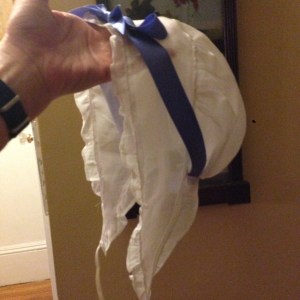
I am still making new things, like the “Bad Squishy” jellyfish cap. It didn’t look so tentacular until I held it up to show it off. As with any cap, the main goal is merely to keep it upon my head–always in doubt.

Tenactularly good. And now I can whip gather.

In just a week I’ll be headed up to Fort Ticonderoga to clean the officers’ quarters and generally represent the women who accompanied the 26th Regiment of Foot— and yes, I know I’m old enough to be the mother of any number of those folks, but there’s no need to point it out all the time. The main thing is the cleaning. And the weather, which looks like it could once again be unseasonably warm. That won’t stop me making another wool gown, which I am making up in a drab wool specifically for dirt and distracting my unsettled mind.

Washing, wearing, and airing

All the same, I pulled out the mother of all wrecked and wreckable gowns, the cotton gingham made for Bridget Connor. This has achieved a pretty nice patina, though I will confess to having washed it last fall after repeated wearings over the course of the summer. I know– not so necessary, but I did. Fear not: the stains remain.

But I wore it vigorously and made it up quickly– to the point of needing to take it off and mend it at Stony Point (was that really two years ago?). Mending is required once again, so that small seam ruptures do not become actual sleeve separations as I dust, sweep, and mop. Yes, of course I’ll be making experimental mops this weekend, why not? There just isn’t enough distraction in the world.

I worried about those eyelets I installed way back when, but was relieved to discover that I had seen a precedent, and that the date was within tolerances for someone of my age to retain in her clothes. The lacings also make dressing significantly easier for me; some days, putting on an open robe takes me back to the button-up and lace-up toys of pre-school, when tying shoelaces was a major accomplishment.

Illuminating Lampshades

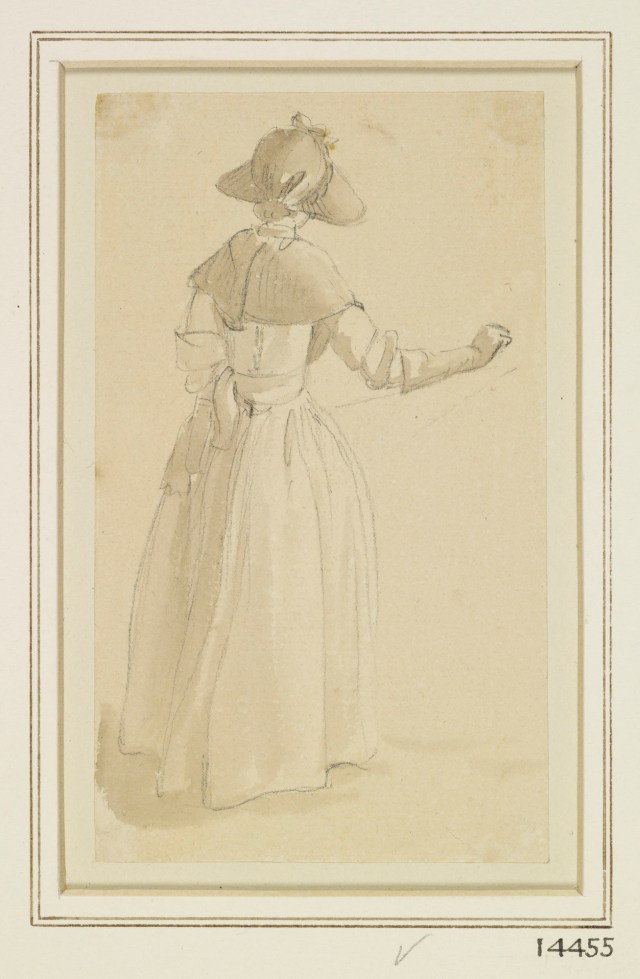
The more you look, the harder things get. That’s usually cause for celebration, but I’m starting to feel the pressure of more ideas and commitments than time. Here’s a question: in these undated Sandby watercolors, are the women wearing the bonnet colloquially called lampshade? What does lampshade look like from the side? My guess is that it looks a great deal like the headwear of the woman sitting on the wall. (Click the images to go to the Royal Collection site where you can enlarge them.)

Somerset House Gardens. Watercolor by Paul Sandby, 1750-1760. Royal Collection Trust/© Her Majesty Queen Elizabeth II 2014

So much good stuff in this image: the woman sitting on the wall, swinging her foot (take that, decorum); the black silk mantles; sleeve ruffles; gloves; pointy shoes; big skirts.

About those pointy shoes and big skirts….much as I would love for this image to be really relevant to my quest, we are looking at the 1750s. At least lampshade comes in to greater focus, both in date and in construction. Ooh, look! More lampshade.

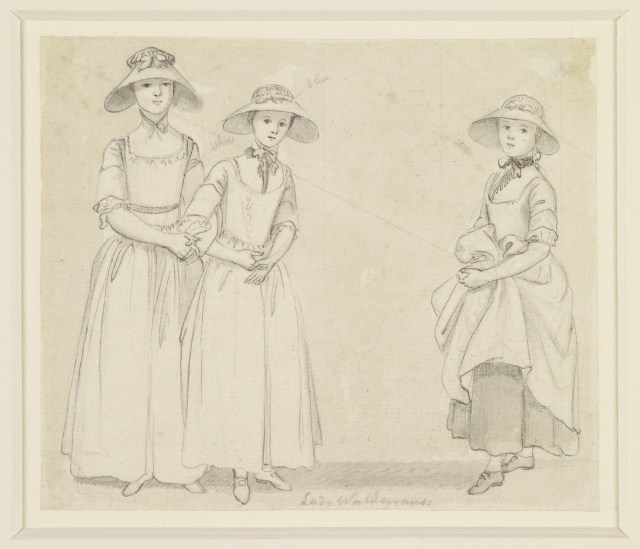
The Ladies Waldegrave, 1760-1770. Watercolor by Paul Sandby Royal Collection Trust/© Her Majesty Queen Elizabeth II 2014

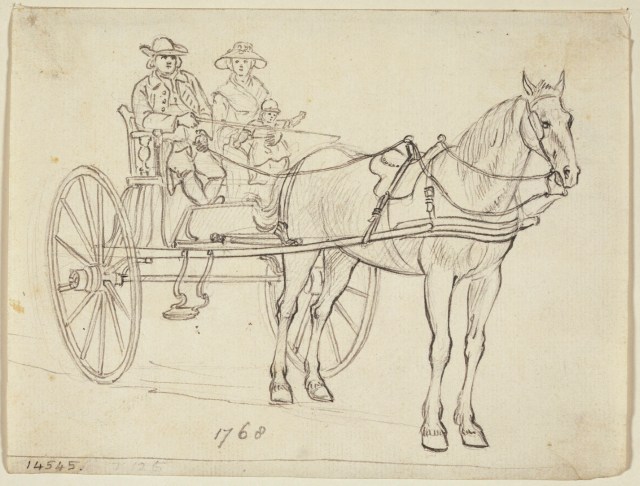
The eldest of these young ladies was born in 1760 and the youngest in 1762, so we’re really close to 1770 here. They’re not only incredibly adorable (I know a quite darling and very young lady for whom I want to make one of these pretty much immediately), but they’re in the right time period. Most of the bonnet images in the Royal Collection seemed to be of young women or girls, until I happened upon this image, from 1768.

A carriage, with man and lady 1768. Watercolor by Paul Sandby. Royal Collection Trust/© Her Majesty Queen Elizabeth II 2014

Well, “lady” might be pushing it where I’m concerned, but that image feels like the best solid evidence of bonnetness close to 1770.

Here’s another ca. 1770 image. Way in the back, there’s a bonnet.

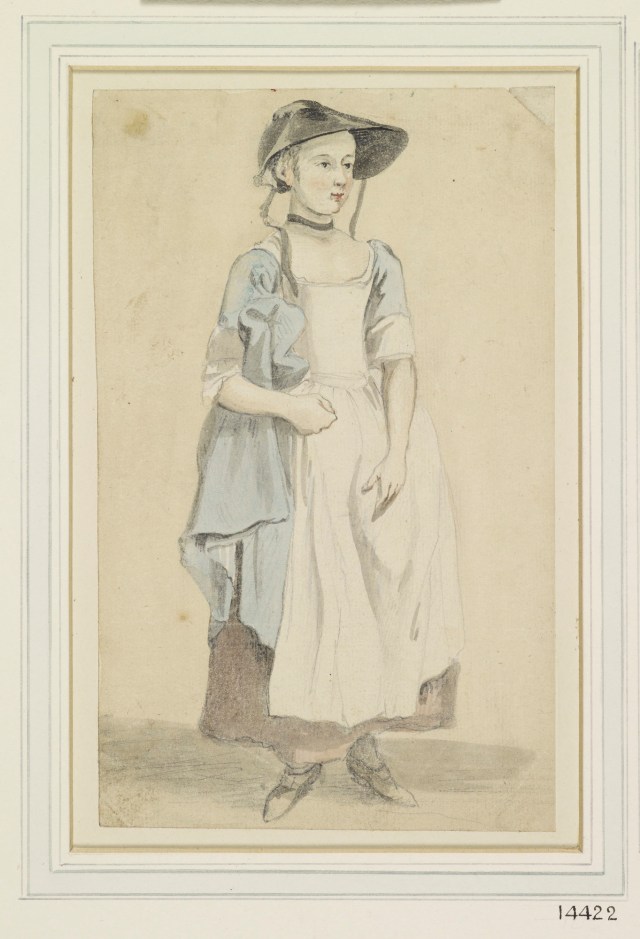
Can’t get enough of that black taffety? Have another.

A young girl, standing 1760-1780. Paul Sandby, Royal Collection Trust/© Her Majesty Queen Elizabeth II 2014

Wonder what that might look like from the back? Voila.

A girl in a sunhat, seen from behind, 1760-1770. Paul Sandby, Royal Collection Trust/© Her Majesty Queen Elizabeth II 2014

This is by no means an exhaustive search, but thanks to a Facebook commenter, I’ve rediscovered the Royal Collection, and found later images of the peculiarly lamp-shade like headwear, and one image with a firm date of 1768.

In Book of Ages, Jill Lepore quotes a February 27, 1766 letter from Jane Franklin Mecom in Boston to Deborah Read Franklin in Philadelphia, regarding the clothing her brother Benjamin had shipped to her. “For ‘Each of us a Printed coten Gownd a quilted coat a bonnet.’ She continues about her bonnet, “is very suteable for me to were now being black and a Purple coten.” (Lepore, Book of Ages, p. 144)

What do you suppose that 1766 bonnet looks like? Do you think it looks more like lampshade, or these transitional forms? Probably lampshade, but the materials are intriguing: Purple cotton. Is that the brim lining? Jane Mecom is in mourning, so I’d expect the main body (brim and caul) of the bonnet to be black, and most likely taffeta, which turns up as a descriptor in the runaway ads.

Wide-brimmed, black taffeta bonnet, possibly lined in cotton, 1766-1768. But how long did bonnets last?*  What went into them– Buckram? Pasteboard? Coated pasteboard? Baleen? A combination of pasteboard and baleen?

I’ve got some ideas, and if the next winter storm doesn’t delay the mail too long, I might have experiments to conduct this weekend.

*Or any clothing? But that’s a post for another day.