Feeling Shifty

It’s clean now, but in the photo you can see some of the abuse a shift takes in a day or two of real wearing. This shift was made from the Kannik’s Korner pattern. The first shift I made is now on a mannequin at work; I used Mara Riley’s Instructions, and they worked, mostly, with some operator error. I’m tall, and that means that proportions for my clothes sometimes have to be adjusted. The third shift I made was a late-18th century version, adjusted for the change in style and my height, and it is by far the best one yet.

So now I know I need to make another mid-18th century shift, what will I do? The first place I’ll start is with Sharon Burnston’s awesome article, The Cognitive Shift. This is one of the best pieces I’ve read on costume history and the logical, methodical approach is one that not only explains her process, clarifying objects and construction, but also sets a standard for how other garments could be considered.

Among the points Sharon has made over time is the lack of decent linen available for making shifts and shirts. What we can get today is too heavy, too coarse–it lacks the hand of the linen items made in the period we’re reenacting, and not just because the objects have been washed. The fabric is simply different, and unavailable. What  I think I’ll try (having exhausted whatever shift linen I bought from a sutler) is this light weight linen, not softened. I have some that was used for a cap, and so far seems to be working out. Once it is washed, it seems to have a decent drape and appearance.

My impression is not of a fine lady, and that is at least a saving grace. I don’t want to go all the way down the social ladder to wearing an oznabrig shift, but I do want to be as accurate as I can be–and as comfortable.

Sleeves of Wonder

They’ll be evil sleeves as soon as I try making them, but check this out: Mrs. Cephas Smith, Jr. (Mary Grove) and child, about 1803, seen at the MFA today. (Online catalog photo at left)

The dress reminds me a lot of the brown silk Quaker dress at the MFA (early 19th century).

What doesn’t fully register until you can get close to the painting is the sleeve detail.

Drawstring waist, check. Probably front-closing and not a wrap dress. Probably earlier than the Quaker dress, but of similar materials. I can feel the taughtness of that shoulder and think a similar detail of the front is shown in a drawing in Arnold or Bradford. The neck is a little higher than I’d expect, but this is not a high-style gown like the ones shown in Arnold. It’s a dress worn in Rutland, VT.

But those sleeves–I’d venture to guess at embroidery in silk thread and buttons, based on the repeated motif at the neck.

Buttons? They look like they sit above the fabric, float, in a way that embroidery would not. But I think of buttons (aside from some stomachers and buttons for polonaise loops) as decorative elements on women’s clothes coming at least a decade, maybe two, later than this painting. Time to sit down with 19th Century Costume in Detail again.

Runaway Styles

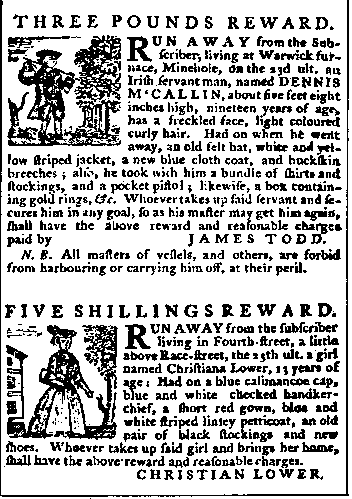
Many thanks to Becky Fifield (The Still Room Blog) for revisiting the article she published last year on her amazing Runaway Clothing Database (RCD). It is available now as a downloadable PDF from the publisher’s website. I devoured it for its systematic look at classifying–cataloguing, really–not just the runaways themselves, but their articles of clothing.

What Becky did with nearly 900 ads was to create catalog records for each woman who ran away, as well as her clothing. It’s a phenomenal project, and one that works well now, in an age of computer databases and improved cataloguing nomenclature. It is also a testament to dedication and love: the amount of time to construct the database and enter all the records is significant. That’s hours, tens of hours, of work before the fun part of analyzing the data can begin.

Kudos to Becky, for hard work and inspiration!

Roller Print Doll

20120717-180141.jpg

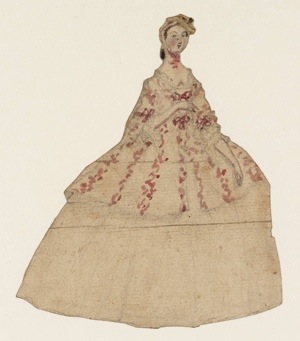
Cruising the Tate’s catalog, I found this, a cutout doll by Susanna Duncombe, no date, but clearly 18th century, since Susanna Dumcombe’s dates are 1725 -1812. I had to double check, but yes, she was 87 when she died.

There are fabulous bonnet drawings, and more of these wonderful cut outs. This one struck me, though, because the “jacket” and the petticoat do not match. Conventional wisdom is that patterned jackets and petticoats were always worn together. The title notes it is unfinished, so the petticoat might have matched if Susanna had finished the doll. There is clear line for a jacket hem, though, so it is at least a two-piece garment,

I think we might not know the “always” and “never” rules. And, too, I think that “always” and “never” are likely to be different depending on the status of the wearer. Plenty of runaways took off in calico jackets and short gowns worn with striped petticoats. (The 18th century was probably much more colorful than we credit.)

The fabric looks a lot like a roller print Burnley & Trowbridge had last spring. I wonder about its cut, too; it looks like a pet en l’air, as the loose-pleated kind of saque-back short garments are known. And that reminded me of the caracos fashion plates mimic-of-modes investigated.

Again, I draw no conclusions. But here is a fantastic serendipitous find, a period paper doll in what looks like a roller-printed garment. Too fancy for who I am in camp, but what a lovely garment to make, and then have to plan a picnic to wear to.