
Bonnets, buttonholes and boilers

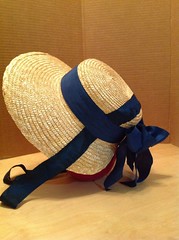
When all else fails, sew! The Harvest Fair at Coggeshall Farm Museum approaches and quite aside from the real work that’s gone into a quilting frame, and buttons on breeches, it’s been an excuse for a new bonnet.

A few weeks ago, I found the modern, not-as-fine bonnet based on the KCI bonnet, and similar to one sold by Meg Andrews.
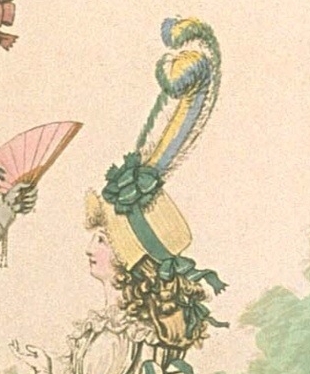
In a 1794 fashion plate, there is a similar bonnet with blue ribbons and an enormous feather. I don’t rate a feather as John Brown’s maid, or the Continental Army veteran’s wife, but blue ribbons seemed OK. Plus, I had them already.

The bows and the band and the strap don’t match, and my dress isn’t blue, but I think that’s all fine. The most I can say is that I’ve found two extant examples of this bonnet, and the fashion plate, which predates the farm’s interpretive year.

As a striving resident of Providence, Rhode Island’s busy port city, I’d have access to more goods than a Greenville woman. Bristol (where the farm is located) was also a thriving port, and again, boats from Rhode Island are sailing around the world bringing back china, silks, teas, spices, shawls and other goods, as early as 1787.

Now, pass me a boilermaker, please, because I’ll need a drink when the mechanical contractor tells me what the boilermaker will charge for a new Library boiler.
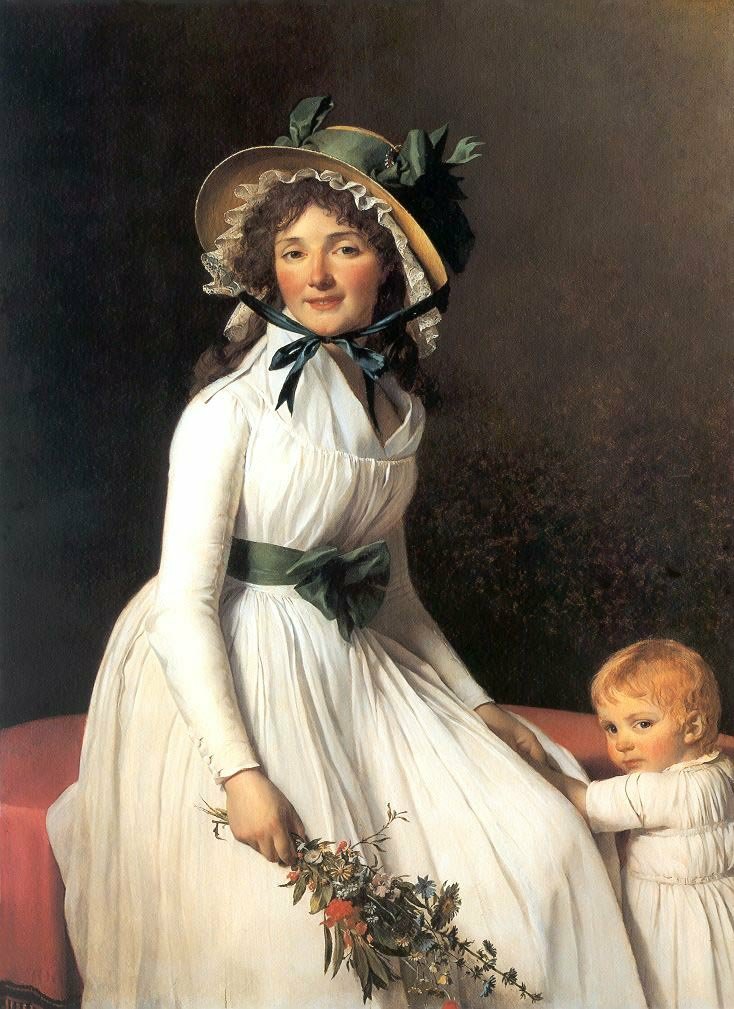
 

ETA: Aaand there’s this painting, Mme Seriziat, by David, 1795. Click for larger version, but she’s the reasoning behind the choice of blue ribbon.  The placement seemed to agree with the KCI and fashion plate ribbons, and joy! the color was in my ribbon box. I tried to get my ribbon to do what her ribbon is doing, but the bows and loops looked like sad blue silk dog ears– not so nice. So I switched them around to the back, based on the other images.
 

Bonnet, found

Readers may recall that I have a bonnet problem. It’s a problem I think can only be solved by more bonnets!

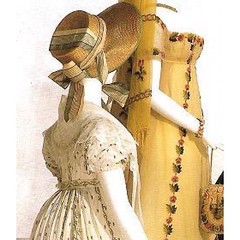
I’ve long admired and coveted the bonnet shown left in the Kyoto Costume Institute.

Well, see this bonnet? It’s called an 1812 Sun Bonnet over at HistoryHats.com. It is based on the KCI bonnet.

It is also similar to this ca. 1810 bonnet sold by Meg Andrews.

I’ll be spending time out in the sun in September, dressed for 1799. Black silk bonnet, yes, but, it could be hot and not so shady. Big plate of a straw hat? I guess so, but it’s a little too big for 1799. Straw bonnet? I wish….

But wait! Trapped on Amtrak, scrolling through Dames a la Mode,  what do I find? This! Check out that bonnet on the woman seated at right.

(Click through for larger version.) Similar cut out at the back of the neck to both the 1812 sunbonnet and the KCI bonnet. Interestingly, the woman in the straw ‘sun bonnet’ is wearing a dress with sleeves like those found on a chemise a la reine. She can’t be less fashionable than her companions, can she? How can that be in a fashion plate? I think this speaks to the persistence of fashion details longer than we might otherwise credit them. It only makes documentation trickier– or more fun, depending on who you are.

It’s 1794. By 1799, that bonnet might very well have made its way to Providence. We know girls and women were dismayed by the Jeffersonian embargoes, and driven to make their own straw hats in Providence. That means they had them, they’d seen them, and they’d seen fashion plates before the 1807 embargo.

Yes, I need a broadside or a newspaper ad to clinch the deal, but there’s an extant hat, a fashion plate in English, and I know by the early 1800s women are weaving straw for hats in Providence.

I think I might be able to have that hat after all…but I still have to finish that shirt I started for Mr. S. It simply will not sew itself!

Quilting Plots

I’ve been planning and plotting a quilted petticoat for some time (since standing outdoors all day at Fort Lee in November, actually) and while the debate continues on the listserve, I know what was worn—and survived—in Rhode Island. There are quilted calamancoes and I think a black satin quilt that are run off with, either on the body or in the arms of the fleeing servant. So there were clearly wool and silk petticoats in the colony, and that fits with what I know lives in textile boxes in museum storage, where there are glazed wool domestic petticoats, blue silk satins from France, and a black silk satin with a murkier origin.

My favorites are really the woolen ones, scratchy as they are, and for some, it is replacement waists, or the linings, that are scratchy, and with multiple layers between wearer and wool, what would it have mattered? I love them best because they are in the color family that includes the “Providence Green” color that lies somewhere between gold/khaki and sinus infection, and I love them for their imagery.

The one I think I like best is this calamanco petticoat: 

The catalog decription says cream, but I don’t know, it really looks gold. The lining is definitely lighter in color, and the thread much clearer to see. What’s interesting as well is that many of the linings are pieced (it didn’t matter!) and they’re striped. 

I bought some of the last of the cinnamon “camblet” from Burney and Trowbridge last year, and did a fast quilting test on a sample.  I chose a squirrel because they’re in the wallpaper and the woodwork at work, and because they are hilarious. I keep thinking I’ve seen one in a quilted petticoat, but I can’t find it again. They are not the easiest objects to handle, either, so finding the rodent again has proved challenging. When I do quilt up squirrels and birds, it will be with a diaper background, not the vertical lines shown here. Overall, the silk-wool blend with wool batting and linen backing quilted up nicely, and should work out fairly well….I think…though it will be lighter than the ones in the boxes.

Now that I’ve got two days to spend down in Bristol, making a quilting frame and quilting up a petticoat (which would look like a quilt, and not a petticoat, on a frame, os could pass for a 1799 activity) seems like a winning proposition. All I have to do is find an appropriate pattern for a portable frame for Mr S to make. If I finish that shirt for him, he might look more favorably on that activity.

A bit shirty about shirts

Fantastic seams around that gusset,seams I can really only dream of. (click for larger view)

I’m trying to be a finer seamstress, but I can tell when I’m tired and the seams wobble and the stitches get larger. Of course, I can’t always tell when I’m running on pure will power alone, so I don’t see the wobbles until the next morning.  That’s when I feel a bit shirty about how tired working can make me, since I would rather be sewing!

Mr S needs a new shirt; the one I made last year is holding up well for him but it is a small blue and white check. The check is the most common pattern in the Connecticut River valley so I’m confident in its authenticity for the period…despite murmurings about the size of the checks…but it is a “shirt from home,” compared to other shirts. Check shirts are documented to the Rhode Island Regiment in the inventory of clothes of a soldier killed at Fort Mercer in 1777. But by the later years, that shirt would have worn out, so another seems in order. I chose linen that is too heavy for a fine shirt, and probably too heavy for a not-fine shirt, but it was cut and assembly begun before the shift linen arrived on Saturday. So onward we go, and with pressing and washing, perhaps it will be OK. The placket and side slits are sewn, the neck gussets attached, and one shoulder strap. It is slow work, but a train trip next week might get it finished.

The Young Mr’s shirt, of the same check fabric and construction, has been mended twice in the  past year. He has not outgrown it, thanks to the volume of 18th century shirts, and while he has evidenced all the activity of a slug at events, he still managed to undo seams and essentially deconstruct a shirt in one day. It is a gift, I am sure.