The Colour of Things to Come

I have a thing for hats– well, for bonnets, really. I know I made stays and a shift before I made anything else for the 18th century, but I might have made a bonnet before I made a proper gown. It’s a condition I inherited from my grandmother, and a great aunt who was a milliner, so there’s little to be done about it– except to dive in deeper.

Miss Theophila Palmer (1757-1848), oil on canvas, attributed to Sir Joshua Reynolds ca 1770. Pretty sure that’s a white “whalebone” or “skeleton” bonnet.

As people do more research and generously share it with me, I’ve come to realize that I need to synthesize what we are seeing. It’s a tricky thing, what with that single (known) extant bonnet at Colonial Williamsburg and only prints and images to go on. What I’ve done to compile a stack of references from newspaper ads (primarily Mid-Atlantic and New England colonies at the moment) and interfiled them with images. This has given me a much better sense of  the change in shapes and construction over time, as well as the range of colours– yes, colours, available and popular.
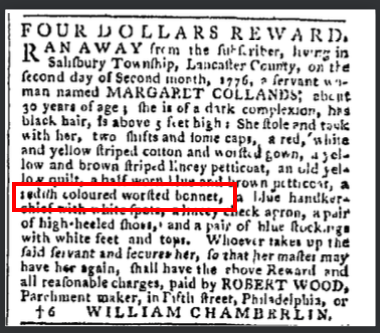
It’s not just that wool bonnets are a thing– there’s the ““a reddish coloured worsted bonnet” in the April 8, 1776 Pennsylvania Packet an ad for runaway Margaret Collands, and the “black durant” recommended in Instructions for Cutting Out Apparel for the Poor– but close reading shows that the colors are more varied than we’ve accept lately, but they vary by region and time period.
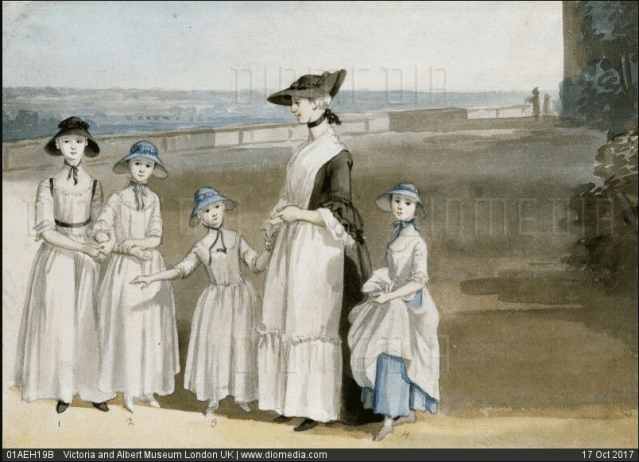
The Misses Waldegrave. Are blue bonnets *only* for children? Maybe.

There’s been a rule that “all bonnets are black silk,” which is too broad a statement. Most bonnets are black, that’s true. But in 1768, in Boston, a place where folks would have you think that black is the only colour bonnet you can ever have, you can have “Black, pink, blue and crimson sattin hatts and bonnets” (Joshua Gardner and Com. ad, Boston News-Letter, November 24, 1768).
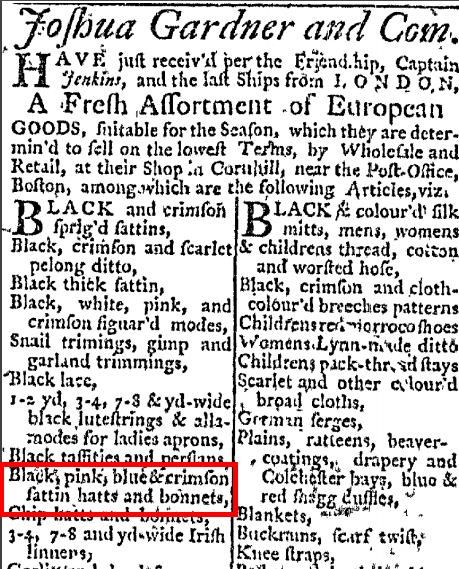
Heck, if you shopped at Caleb Blanchard, you could have a green bonnet, too! Blanchard advertised “black, blue, green, white and crimson Sattin bonnets” in the Boston Gazette on December 18, 1769.

What does this mean? My SWAG is that roughly 60-70% of bonnets should be black. After that, blue, white, red and green would make up the balance. In Philadelphia, green bonnets– and green flowered bonnets– last longer in the ads. Philadelphia is also where I see more white bonnets, a brown silk bonnet, a diaper bonnet, a “queen’s grey” bonnet, and, in Trenton, a “lye coloured” bonnet. In Rhode Island, there’s a blue stuff bonnet. So yes, bonnets should mostly be black. But they can also be other colours.

Tripping in Richmond

Visiting the Stately Home: an early touristic diversion

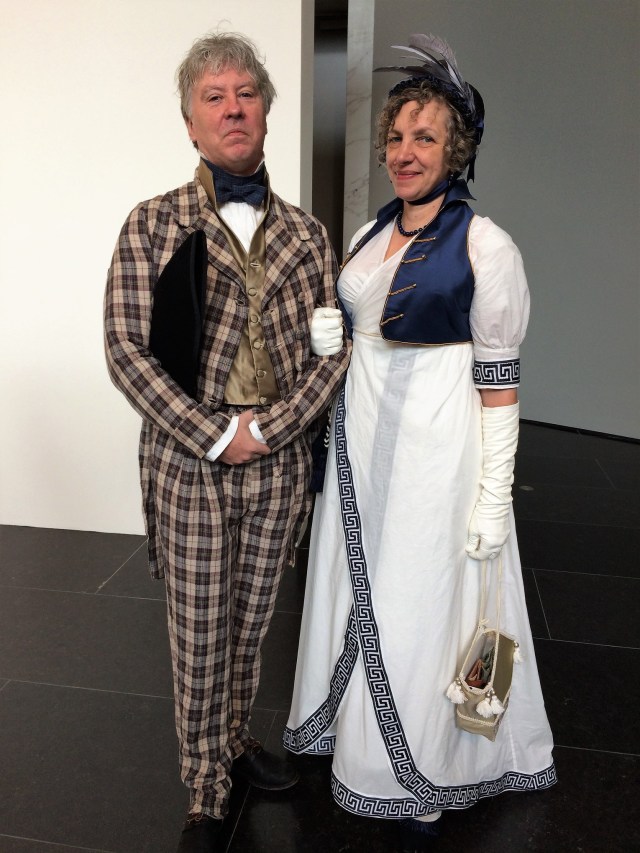
Friday night, Drunk Tailor and I waited until the worst of rush hour in NOVA was over and headed south to Richmond, surprised not to be engulfed in a terrific thunderstorm of the kind we are becoming accustomed to driving in. We had planned a weekend trip to see the Napoleon: Power and Splendor exhibition at the Virginia Museum of Fine Arts. It’s a traveling exhibit, but this is the first time I’ve been close enough to see it, and we had the added benefit of being able to attend in costume with the Regency Society of Virginia. (Reader: I required a new outfit.)

The idea of visiting a museum in costume is incredibly appealing, and all the more so when you can visit galleries of objects from the time period your costume replicates. Add to that the layer of traveling on the weekend in the clothes from the time when tourism first became a “thing” (at least among the monied classes), and you have a recipe for an excellent adventure.

(Somehow, while often at events together, Drunk Tailor and I are rarely seen “together,” so images like this are nice to have.)

If you are going to play the tourist, especially if you are visiting the “spoils” of the former emperor, you have to dress appropriately. American tourists today may travel in camo crocs and backwards baseball caps, but people in the past dressed for touring and it seemed appropriate to dress for this trip.

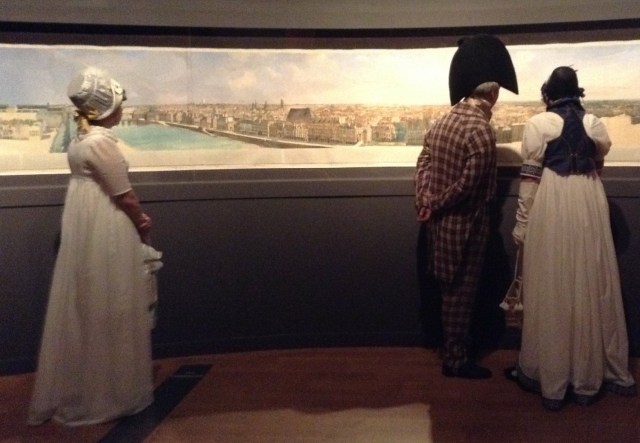
Admiring the panorama. (Cropped only to enhance periodicity)

This trip, with the fun of visiting in period clothes, reminds me of the books still in storage, and the books I have yet to read — one on early country house tourism— that document the changes in how people spent their time and consumed goods, and the reasonably concurrent rise of both the museum and the department store.

Raptures about the mounting, I think, but we might as well we shopping.

Peale and Zola have more in common than you might think, or at least Mr. Peale and Mr. Selfridge. These compendia of material goods are similarly structured — both organized around themes or types, whether ladies’ lingerie or Oceanic art– and have similar aims of edification and [cultural] consumption.

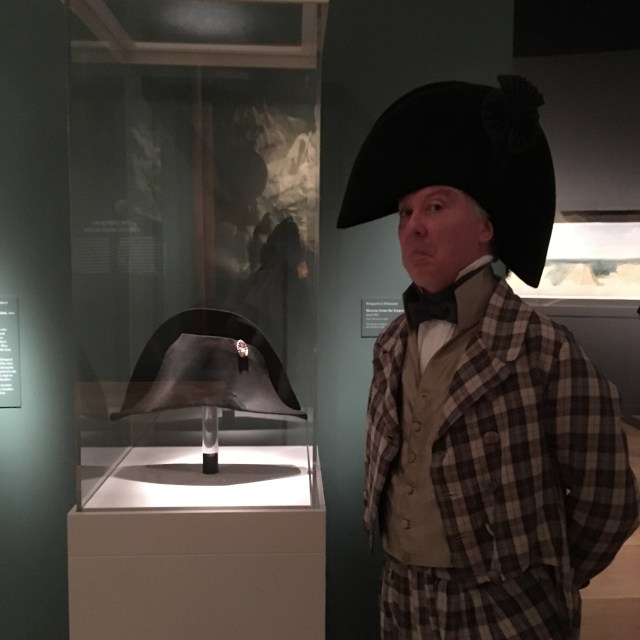
When your hat sees its cousin in a case….

All in all, an excellent trip, with much to see and talk about. After finishing our tour of the Napoleon exhibit, we lunched (another experience similar to the department store) and toured more of the museum, and had a day well spent.

The ‘Nancy Dawson’ Dress

Miss Nancy Dawson, aquatint print. Victoria and Albert Museum. E.4968-1968

Hat tip to Mr B for pointing out the resemblance; I know the print and never connected it to this fabric.

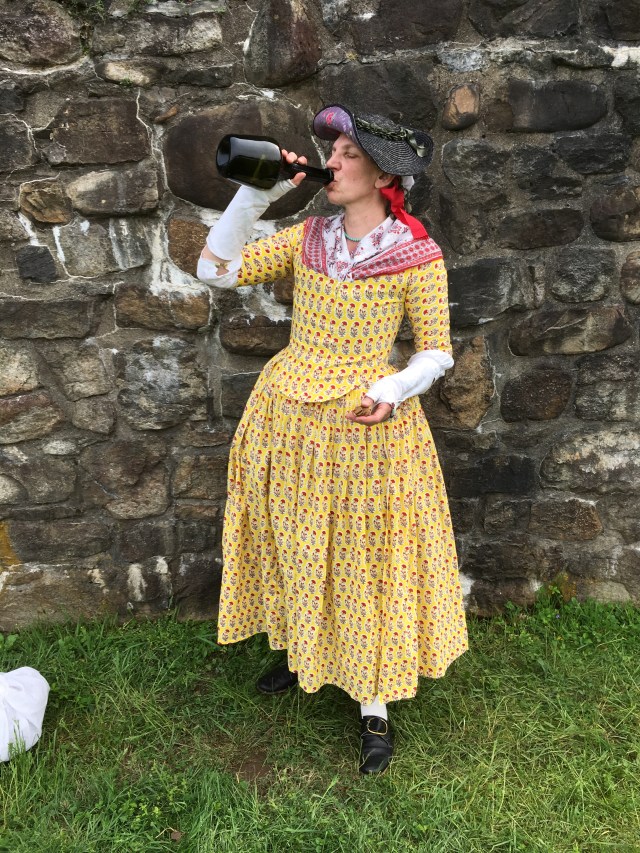
It’s been almost a year in the making, this bright yellow billboard of a gown. I’m not sure why I dawdled over the making; usually I’m pretty quick with a needle, but perhaps it was in part because the goal kept changing: first December, and then, it seemed, never, would I have an occasion to wear this. Federal exploits intervened, work intensified, things changed. But late April presented itself as an opportunity, so finally I had a goal, a deadline.

It was hot. And humid. That’s only water.

And I met it, with Drunk Tailor’s help (setting hems by yourself is a pain).

This is a fairly straightforward affair. I did use the Larkin and Smith “fashionable gown” pattern because I know how it fits me, but the front is modified to a simple closing and the skirts aren’t meant to be drawn up. This gown aspires to pretensions– though you can tell I’m fairly prosperous by the number of different prints I’m wearing.

The petticoat did require piecing– at my height, 44 inch wide fabric often needs to be pieced to achieve the lengths or width I need in historical skirts.

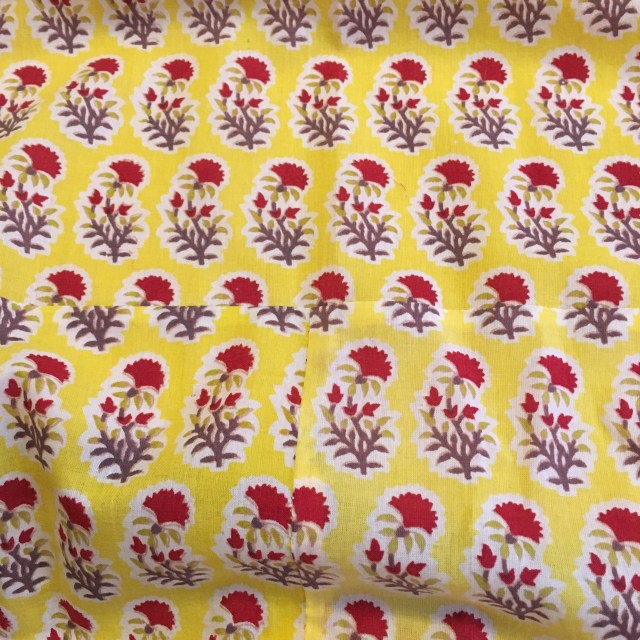
Happily, the piecing matches and doesn’t match, in a fairly satisfactory way. When this fabric arrived on my doorstep, I determined that it needed to be used in the most obnoxious manner possible– and since I’m not a small woman, a gown and matching petticoat seemed the best possible use. (I have other obnoxious fabrics for later time periods).

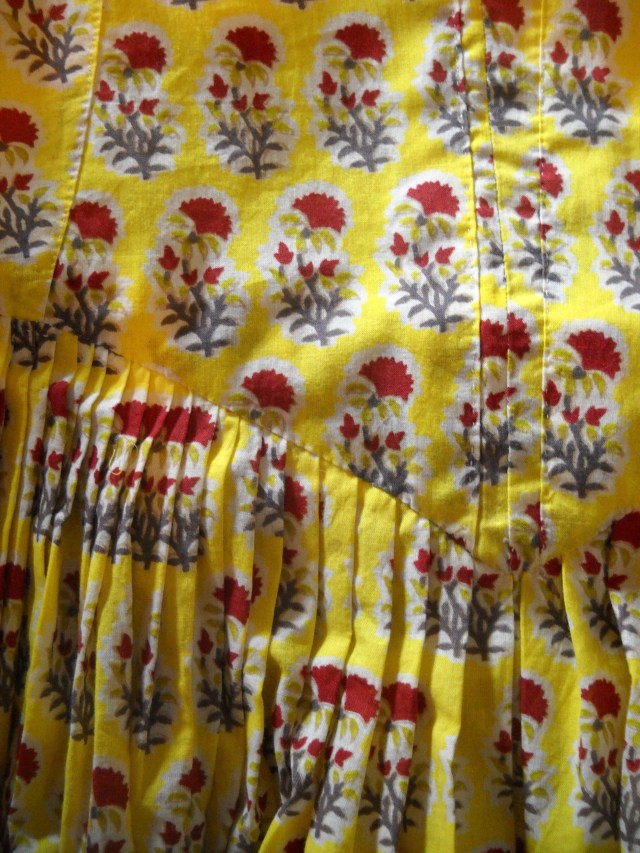
I did take care as I made it up, though, stitching with white thread and trying to make the pleats small and correct to the fashion and fabric. Any failures or flaws make it, to my eye, better as an article of aspiration to a rank and style I really can’t pull off.

One thing I forgot to pack was a bum roll– though wearing that on the drive to Fort Frederick would have been extra interesting– which was unfortunate, as it is truly required. These new (they’re a year old, and I expect to call them “new” for a long time to come) stays make a different shape in the back than the old stays, and now my own padding no longer negates the need for a bum roll. Still, I’m pleased with the result, even if it still wants cuffs. Not bad for eleven months of work.

Cross my Heart

The goal is on the left. How far have I made it? Well… I have been busy. We started on the right, remember?

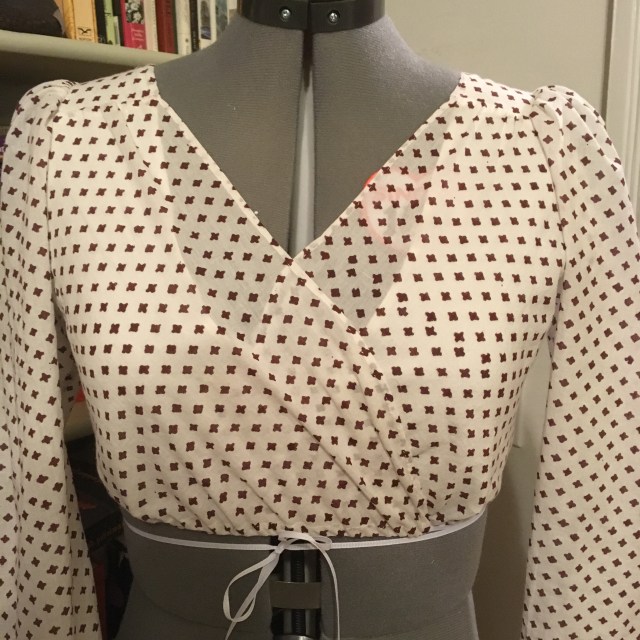
In executing the final plan, I did choose to cut a lining to support the lightweight fashion fabric; I didn’t think it would look, drape, or wear well without a lining.

The adaptation is truly that, and not a copy, in this instance. The lining means that the finished piece will have more of the appearance of a drawstring fitting than an actual drawstring across the back.

The sleeves, thankfully, were pretty straightforward, and I’m one of those odd people who really enjoys cutting and setting sleeves, so there you are. It took me about six days to get to this point, and then work came to a halt. I have other centuries I’m playing in, and am determined to finish that yellow dress to wear this weekend. When and where else can I look like a person of means than the Fort Frederick Market Fair?