
Night Lights and a Book

DSCN3605Last night, I went to a meeting downtown for my boss, and chose to walk instead of drive. I took some blurry photos along the way as evening became night and the city became more and more like Busy Town. The skill level of local drivers is not too different from Richard Scarry’s drivers…and the hills and the way the houses stack up, and the way we recognize or know each other here reminds me of Scarry’s books.

Walking back to the museum, I stopped at one of my favorite bookstores, where the selection runs from the perverse to the erudite.  I picked up many books and limited myself to three, including Very Vintage. (Did I mention Symposium’s remainder table pricing? Ah, yes: that’s why three books were possible.)
The text could have been edited a little more carefully and I am a fan of the endnote (not present here). But there are excellent photos I have not seen before and diagrams patterning garments. Now you see why I bought this: where else will I find diagrams of aTeddy Boy Jacket and a 1960s Bellville Sassoon-inspired evening dress?
dress2dress

Those English Gowns…

GMFS2At the V&A, a fun interactive exhibit on 18th century costume allows you to turn the costumes around and zoom in for a better view.

V&A Screenshot
V&A Screenshot

My favorite, because I need to start making something like this, is the Gown made from a Shawl, about 1797.
There’s a good description of the gown, and you can always search the collections for the catalogue record and more non-turnable images. This is a good thing because the 3-D image player requires Flash, so it doesn’t work on an iPad.

I found the viewer helpful in understanding the sleeve-collar relationship, which was confusing to me with the contrasting colors. The description in the catalog record helps, too:

“An open robe with a medium high waist, the material stitch is pleated down the back, and then flowing into the skirt. The sleeves are of white satin, trumpet shaped, with a short green silk oversleeve. The oversleeve is bound with cream ribbon, and the undersleeve at the wrist where it fastens with three pearl buttons, with metal shanks, has a narrow green ribbon turn back cuff. There is a shaped falling collar of green silk bound with white, and a green ribbon binds the front of the gown. The bodice is lined with linen, and extends in front to cover the bust. The sleeves are lined with white linen.”

Fairfax House
Fairfax House

The oversleeve makes me think of this Fairfax House dress. I’ve not been able to find a larger image so I can’t get “close enough” to determine how it all goes together. Time to collect images of extant examples and fashion plates in a Pinterest board, and start comparing them. And time to think about whether or not this is a style seen in New England…and time to get ready for work.

Fashion Plates & Subject Headings

Women_17901799_Plate_009Ah, the Met. You have to love them, so much wonderful material available online, and free. Collections of immeasurable depth and wealth, an incredible professional staff–this is the pinnacle, right? And yet…

They have a weakness. It’s a weakness shared by many places, but it is a major one, for the online user. It’s the lack of subject headings or dates assigned to their Library’s Digital Collections. They use OCLC’s ContentDM which has a pleasant enough interface, and fields that, in the Met’s Costume Institute Fashion Plate Collection, include Thumbnail, Title, Subject, Description, and Date.

They’re only putting data in Thumbnail (see image; I love that dress), Title, and Description. Description is what I would call Credit Line, and contains the donor name.

Title is a trifle vague. The image above is “Women 1790-1799, Plate 009.” No date, no subjects. The date is October, 1791, right there in the image, but not searchable, not sortable.

Women_17901799_Plate_049 Catalogers, I implore you: subject headings. If not subject headings, the date, please, when it is on the item. That makes the collections not only sortable, but searchable.
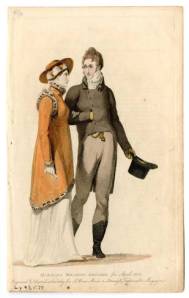
Enough with my lunch-too-late commentary! I’ve been immensely grateful to have a new digital plaything while waiting for the lunch room to clear, and this plate is delightful: April 1797, which was certainly blustery, if not cruel.

Mens_Wear_17901829_Plate_002And, since we’ve been on the topic of men’s wear, here’s a well-dressed gentleman and his lady in Morning Walking Dress for April 1807.

This weekend, I am off to the Farm for the Christmas Sale. Not such a pretty dress as these, but one I am pleased with nonetheless, and which (with wool petticoat, stockings, and cloak) should keep me warm–I do expect to be quite busy.

The Line of Beauty

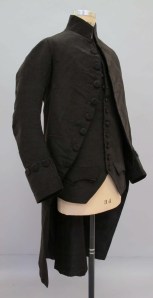
In considering menswear, I found this suit at the Met. Incredibly plain, it reminds me of classic Balenciaga: all about fabric and drape. It also reminded me of Hogarth’s Analysis of Beauty, and the serpentine line.

You could also call it the Ogee curve, and it’s found in the serpentine legs of 18th century tables, and does not come from, “Oh gee, that soldier’s got nice legs.”

In this variation on the theme, the contrasting lining emphasizes the lapel line, but the overall effect is less elegant. It’s about materials, too, not just cut. There’s so much to learn just by looking, really looking, at clothes and paintings from the past. There are subtleties we miss as we rush past, and miss because we haven’t read enough to understand what we’re being told.

So much hides in plain sight, because we don’t see the world the way the tailors and painters and engravers saw it. I don’t pretend to have the key to that world, but it’s worth looking for, mostly just by looking.