…For the Approaching Summer

Summer is, of course, fully upon us and those of us on the eastern seaboard feel its oppressive and sticky heat. Ordinarily, my town isn’t terribly hot and cools off at night, but like everywhere else, this is not the case. Last weekend, I wore wool; technically a wool and cotton blend, but more problematically, burgundy in color. This is the price of gowns inspired by London watercolors.
Summer

This leads to constant questions: Aren’t you hot in those clothes? Aren’t you dying of the heat?

There is an underlying tone that suggests that perhaps the people of the 18th century didn’t know enough not to wear wool, or perhaps they only had winter clothes. I’ve heard “well, they didn’t know any better,” as if they never took their clothes off, and if only they had, 18th century men and women would have promptly abandoned their stays, gowns, waistcoats and breeches for tank tops, shorts, and wife beaters. Of course, history is not a Fiat commercial.

Well, what did “they” do?

Barbara Johnson's book, 1764.
Barbara Johnson’s book, 1764.

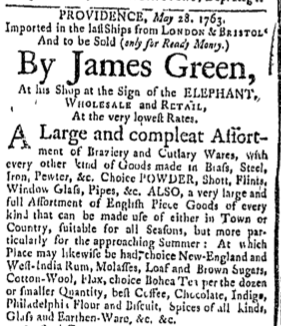
They took their trade to James Green and merchants like him who offered “Piece Goods of every kind … suitable for all Seasons, but more particularly for the approaching Summer.” (Boston Post Boy, August 8, 1763.)

And what would be suitable? Cottons, fine linens, light silks, in light colors.

Barbara Johnson chose floral prints on white backgrounds in July and August of 1764, both could be “suitable for summer.”

And as you probably know, the answer to “Aren’t you hot?” depends on who you are, but is often, “Not really. Once my shift/shirt is soaked with sweat, I’m pretty comfortable.” This is true as long as your shift/shirt is made of linen; cotton and cotton/linen blends don’t wick as well as linen.

Alterations in Force

Horrid Green Frock Coat at Birth

Remember this coat? I’ve been attempting to solve this coat for a while. While the Zombie Coat had to be put aside after the tail pleat debacle (what was I thinking? Sewing while tired means hems only, or simple straight seams), I finished up the Horrid Green Frock Coat. It is somewhat less horrid now. Mr S wore it yesterday to be a member of the Jackson’s militia impression of the 10th MA at Longfellow House in Cambridge.

The sleeves were removed and the seam taken in to remove excess material. Perhaps I could have slimmed it a bit more, but it needed to sit the armscye.

The shoulder seam (where back and front join) was also taken in and snugged up twice. The side seams were taken in a great deal from the armscye down, but not enough. To fix the remaining bagginess at the small of the back above Mr S’s hips, I will have to take more out of the front panel, “and work it into the side pleats.” (Easy enough for the Master to say, harder for my brain to figure out.)

Somewhat better, but two more seams to snug.

This is the closest photo to the one above. You can see that the line of the front has been changed and slimmed, and a collar added for stability and style in addition to those cuffs. I also changed the shape of the pocket flaps, and moved them to change the look of the front panels. They don’t have to match the pocket slits, as long as they don’t reveal the slits (one bag is madder linen, I ran out of large pieces of green), so I moved them to change the look of the front.

The mariner’s cuffs were fun. If the Zombie behaves decently this week, I’ll give him mariner’s cuffs on his too-short-blue-wool-sleeves. Well, I’ll probably give him mariner’s cuffs anyway, just so he can get the coat on and off.

On Brattle Street, Cambridge, while it was still “cool.”

And, finally, a full-length view of the coat. It takes more than webbing and belts to reshape a silhouette. It’s taken 13 months from first making that coat to get it to this point. Thanks to an expert’s chalk marks in February, transforming it into something at least wearable was possible, though at first sight, those chalk marks were devastating and overwhelming. It took overalls to get me to face this coat, so thank goodness for the horribleness of overalls.

In the Pink

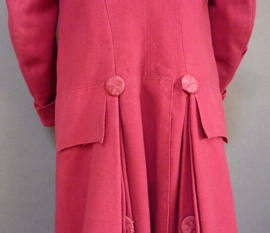
Detail, back pleats
Detail, back pleats

I swear I try to be positive about the mistakes I make. But not only did I discover this morning that I had lost my struggle with spacial processing, now I have found clear imagery to show how I should have handled the pleats on the Zombie Coat. Live, learn, unstitch and restitch: that’s all I can do. Now I have only to decide whether to do the unstitching this weekend, or next week. It will have to be done: now I know the way I’ve done it is wrong, and the master’s eye will be on that mistake and then he will know, and I will know that he knows, and it will just go on from there to tired shame.

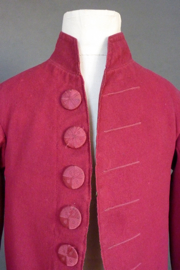
Man's wool  coat, 1770s. Meg Andrews.
Man’s wool coat, 1770s. Meg Andrews.

My favorite part of the description is this:

Either the coat was altered for another man or the wearer got fatter! … There is a half moon insertion under the arms… There’s no detail photo of that half-moon insertion, but I do so wish there was. The description notes additional changes: “If you look at one cuff you can see a lighter part of a button shape next to the seam. The cuffs have been removed and then added to the edge of the cuff to lengthen the sleeve.” At least we know garments in the past, even ones as lovely as this, were altered and changed.

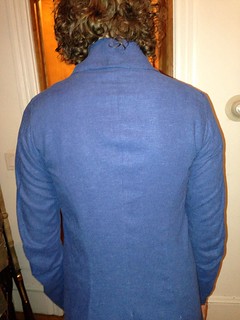
Puckering on the Zombie Coat. It’s still a nice blue, and you know what? It fits me, so maybe he’ll lose it to his refugee mother.

I will probably be inserting shapes of various kinds into the Zombie Coat, since I do now have a diagnosis for this puckering at the shoulder blades. “Viewed from the back and sides, it appears that the sleeve is binding on the front of his shoulder, causing pulling across the back shoulders – the puckers are caused by the stretching of the fabric across the rounding of the back and shoulders. If you make the top of the upper sleeve wider, or raise the shoulder cap it will create more fullness over the top of the sleeve and reduce the binding that is translating down the sleeve and across the back.”

By the time I make the changes I need to, the Zombie Coat will have acquired its own pre-history.

One Hot Banyan

Prince of Wales' banyan, ca. 1780. Royal Pavilion & Museums, Brighton. ID CT002728
Prince of Wales’ banyan, ca. 1780. Royal Pavilion & Museums, Brighton. ID CT002728

Alert! This item is currently on display at the RISD Museum of Art in Providence, through August 18, 2013. I have been to see it twice now.

As much as I am itching to get this on a table and investigate it, I am limited to craning my neck and squatting in front of the case. Awesomeness in cotton, this banyan has a five-button mariner’s cuff with a double arc like a broken pediment on a chest-on-chest. It would be a crazy thing for a Continental private to come strolling out of a tent in, not to mention impossible to make before the next camping excursion, but holy cats! that’s one fine banyan.

The RISD Museum is free on Sundays. You, too, can entertain the guards by craning your neck–photography is not allowed. Next visit: sketchbook.

There are a lot of other wonderful things to see, too–silk jersey breeches I expect to see on a colleague at some point, an indigo silk frock coat, the greatest great coat ever, and Fred Astaire’s tails, as well as a small section that I think does everything PUNK wanted but failed to do.