Pinner Aprons

Mr & Mrs Thomas Sandby. Watercolor by Paul Sandby. RCIN 917875, Royal Collection Trust.

On Saturday, Sew 18th Century and I went out for lunch and fabric shopping. Along the way, I brought up pinner aprons, and that I’d seen them in British prints. She said, “You should blog about that!” and I went back to check my sources. Fail! There was an English print after a French original, and that doesn’t count!

So I shelved that idea, and went about looking for more Paul Sandby images of soldiers and maids and tents, and found instead Mr and Mrs Thomas Sandby. Ahem. Pinner apron alert.

Fluke, right? Well, no, not exactly.

Lady Chambers and child. Watercolor by Paul Sandby, RCIN 914409. Royal Collection Trust.

Because here is Lady Chambers and child, with Lady Chambers in a pinner apron.

The thing to note, though, is that “apron” here is a decorative, almost ceremonial garment made of black silk, while the maid engaged in Domestick Employment is wearing a working garment of [probably white] linen.

Domestick employment, washing. Mezzotint by Richard Houston after Phillipe Mercier, 1736-1775. British Museum 1876,0708.23

Well, can I wear a pinner apron as a Continental army laundress or not? Probably not, though I will be going back through all the images of laundering I can find. It would be so useful and protective a garment!

No, instead, it looks as if the black silk pinner apron was a fashion adopted by the British upper class probably in imitation of the aprons worn by young girls. These fleeting, black silk accessories were probably adapted to some other use when the fashion had fallen from favor. (You could make a lot of mitts out of one of those.) Sadly, I don’t care enough about the elite to go chasing inventories and more images, but someone else can. I think I have seen a few other examples of this style, but cannot immediately place them. My sense is that these are not common.

I’m much more interested in laundresses and maids. Doesn’t she look sassy? We could call her Bridget. 

A country girl, full-length, facing front, leaning against a fence & a tree. Watercolor by Paul Sandby. RCIN 914438. Royal Collection Trust

So Hip

I don’t always feel the need to enhance my anatomy; in fact, I rarely do, but then I started on the sacque. Ah, the sacque. I nearly abandoned the whole business but then I thought I’d look pretty silly dressed as the maid, or for George Washington’s funeral instead of his birthday party.[1]

I also don’t want to have a house littered with UFOs, because that is what my knitting stash is for. In order for the sacque to look right, I need hips. HIPS.

And while I planned to make panniers AKA pocket hoops, a simpler and easier solution occurred to me. Hip pads: I’d seen them on Sharon’s site and thought I could at least try a pair. They’d help my poor fake quilted petticoat (FQP, long story[2]), which will come in handy for a party in February. So I spent my New Year’s Day making hips and playing a bit with the sacque silk.

To make the hips, I started out by laying a piece of muslin against Cassandra, and tracing a waist arc. I worked between the muslin and paper to create a paper pattern, and then made up a muslin, which I filled with polyester stuffing and then tested under the FQP. Better, no?

Then I added the seam allowance to the paper pattern (which you can download here and print at 100% if you have a waist in the 30 inch range and want enormous hips yourself) and cut four more of linen.

After three episodes of Death Comes to Pemberly[3], I had hips. They weren’t quite the same size, but my right hip is larger or higher or something, so I put the smaller one on the right and the larger on the left to balance my own deficiencies.

The alteration to the silhouette is pretty amazing, though Mr S did laugh. Perhaps this figure is an acquired taste.


[1] All I have right now to wear with the Celebration Spencer is a black petticoat, so I’d be rocking the 1799 George-is-Dead look.

[2] The story is that I have a real one basted onto a frame but I cannot fit both the frame and a sofa in the apartment. We chose sofa. I am sad but comfy.

[3] I’m ambivalent. Though I do love Trevor Eve, I wondered why there was not more changing of dress for various times of day

Les Oublies

Les Oublies. Le Bon Genre Plate 79: three ladies and a child look at a sundial in a garden, watched by a man. August 1815 Hand-coloured etching. British Museum 2003,U.14

I was first attracted to this image by the gentleman and his shapely legs, as you might expect, since tight buttoned gaiters or overalls do turn my head. This plate doesn’t make much sense to me: I can’t really grasp the satire, I can only guess. The explanation given for the series doesn’t help immensely. “The series is devoted to costume, mostly set in fashionable interiors, but the plates are treated in a semi-caricatural, humorous way that links them with French social satire.”

My best guess is that this plate from 1815 is showing off the latest filmy white fashions and tiny pink Spencers in contrast to the forgotten origins of the classical influence, personified by the gentleman in common dress at left. His hat and the gaiters suggest the French revolution, now forgotten (see “oublier” though the reference is also to the small cakes being eaten by the woman under the tree). The clock provides a reference to the passing of time, and forgetting, but I don’t think it is actually a sundial. The strap makes it look as if the man can carry it, and that’s a needle, not the fixed vane of a sundial.

Whatever it all means, I do find this more interesting for the man’s clothing than the women’s; after a while, the subtle differences between white columns is lost on me, but that’s a pretty interesting buff-colored waistcoat.

The Historical Sew Fortnightly: 2013 review, 2014 plans

The Andes Candies coat at Saratoga

I didn’t get nearly as many things made for the 2013 Historical Sew Fortnightly as I wanted to. Some of the challenges didn’t appeal to me,  but mostly I just couldn’t keep up! Reenacting ate a lot of my life, especially in the late summer and fall. The Andes Candies coat and the What Cheer Day sewing, while totally gratifying, happened when I was thinking about the “Green” color challenge. But, on the positive side, because I’ve waited and played with Spencers, I have a much better pattern plus what I hope will be an entry for HSF #25, the One-Metre Challenge.

Looking ahead to 2014, I can see that July and August are going to be tough. We expect to have a lot going on at work, and the reenacting season will be in full, heavy swing. (Starting July 19th, there are five weeks in a row of events and work. We won’t be able to do everything, so there will be some figuring out to do. Also, our house will be a mess.)

The 2014 Challenges Announced Thus Far:

Last year’s mending. This year: more lost buttons.

Challenge #1, Make Do and Mend, will be a chance to fix things I know are awry. There’s a petticoat hem come undone, some binding that needs reattaching, buttons popped off waistcoats, and haversack straps to be shortened. That’s all without even looking: Imagine what I’ll find if I look (or maybe not, it could get ugly). I think this challenge will help me tidy up after last season, and prepare for the next. There was mending last year, too.

Challenge #2, Innovation, is a little more worrying. I’ve got a major dress project underway, and will have to adapt that to this challenge. Fortunately, I think compere fronts on sacques might count as an innovation, so that will help keep me on track.

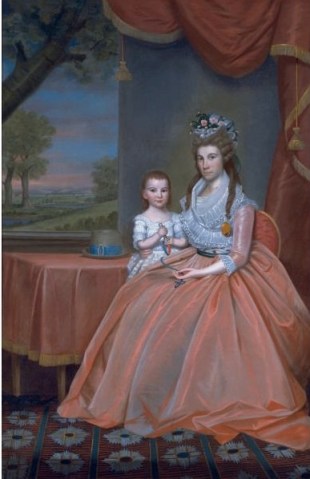
Mrs. Elijah Boardman and her Son, William Whiting Boardman. The Huntington Library, 83.8.15

Challenge #3, Pink! Will probably not be mine. None of the things I plan to make are even remotely pink. I thought I had some pink silk and was about to ditch the sacque for a pink Ralph Earl, but it turns out that silk is more lavender than pink. I looked at some pink silk, but then Sew 18th Century helped convince me to buy the cross-barred silk instead. And, like yellow, pink can be unfortunate on me, unless it is coral. Of course, pink can mean red if you’re making traditional hunting clothes…so this could still get interesting. And I know of a receipt for 5/8 of a yard of pink satin…which sounds to me like a waistcoat.

Challenge #4, Under it All, will probably have to be pocket hoops or other skirt supports for the sacque. I have been working on a faux quilted petticoat, with limited success (it may qualify for make do and mend…), but would need hip pads to round out the silhouette properly. Have you noticed this is a bit out of order? Yes, I need the skirt supports first, but six weeks in advance is plenty of time! Well, from this vantage point, anyway. It’ll look like madness on the other side of New Year’s.

I know I’ll miss deadlines and fall behind, I know I’ll get distracted in the summer and stop reading about all the great things people have made, but thanks to the HSF, I’ve kept more on track and become a better seamstress, than I was a year ago. Many thanks and kudos to the Dreamstress and everyone else around the world who joined in, and will join in, on this international sew-along.