Le retour au Baltimore, 1824-2024

The Marquis came back (or his analog did, at least) last October 7, and we were there.

two men in 1820s clothing stand in front of Baltimore harbor. They are wearing tall hats and long coats. The man on the left stands astride a red velocipede.
Hell’s Dandies at Fort McHenry

Way back in January 2024, Mr. K and I were asked by the Museum of the American Revolution if we would be interested in joining them (and their tents) at Fort McHenry to celebrate the Lafayette Centennial in Baltimore at Fort McHenry. Of course, I said yes, figuring that 10 months or so was ample time to prepare. 
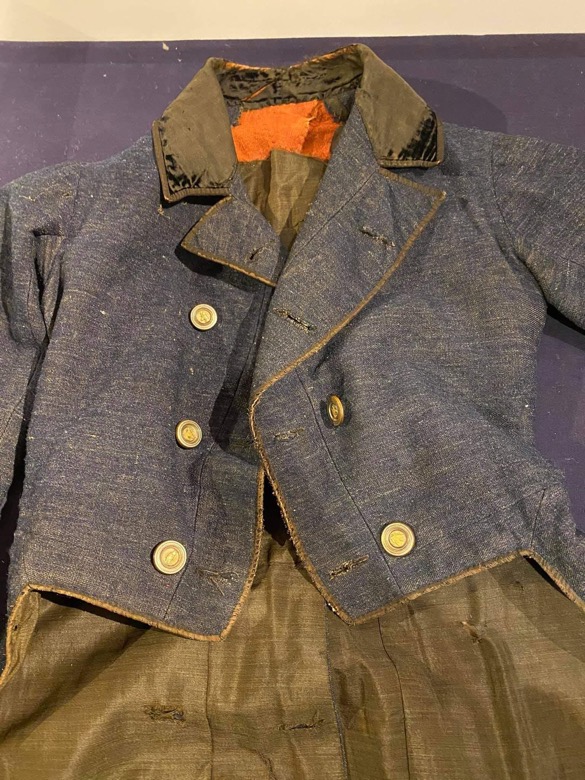
a blue denim coat with a very worn black velvet collar
The coat, posted on social media in February 2021

Reader, I began a dress in a workshop in May. I made another dress to wear and finished it the evening before the event. Why am I like this? (ADHD, I think.) Mr. K needed a new coat, so I patterned one for him to stitch from an older Burley & Trowbridge homespun. In 2021, someone (Genesee Country Village & Museum, maybe?) posted a fabulous image of a coat and waistcoat, which was the primary inspiration, along with coats including a blue broadcloth number at the DAR seen in the An Agreeable Tyrant exhibit. (Sadly, not in the online gallery.)
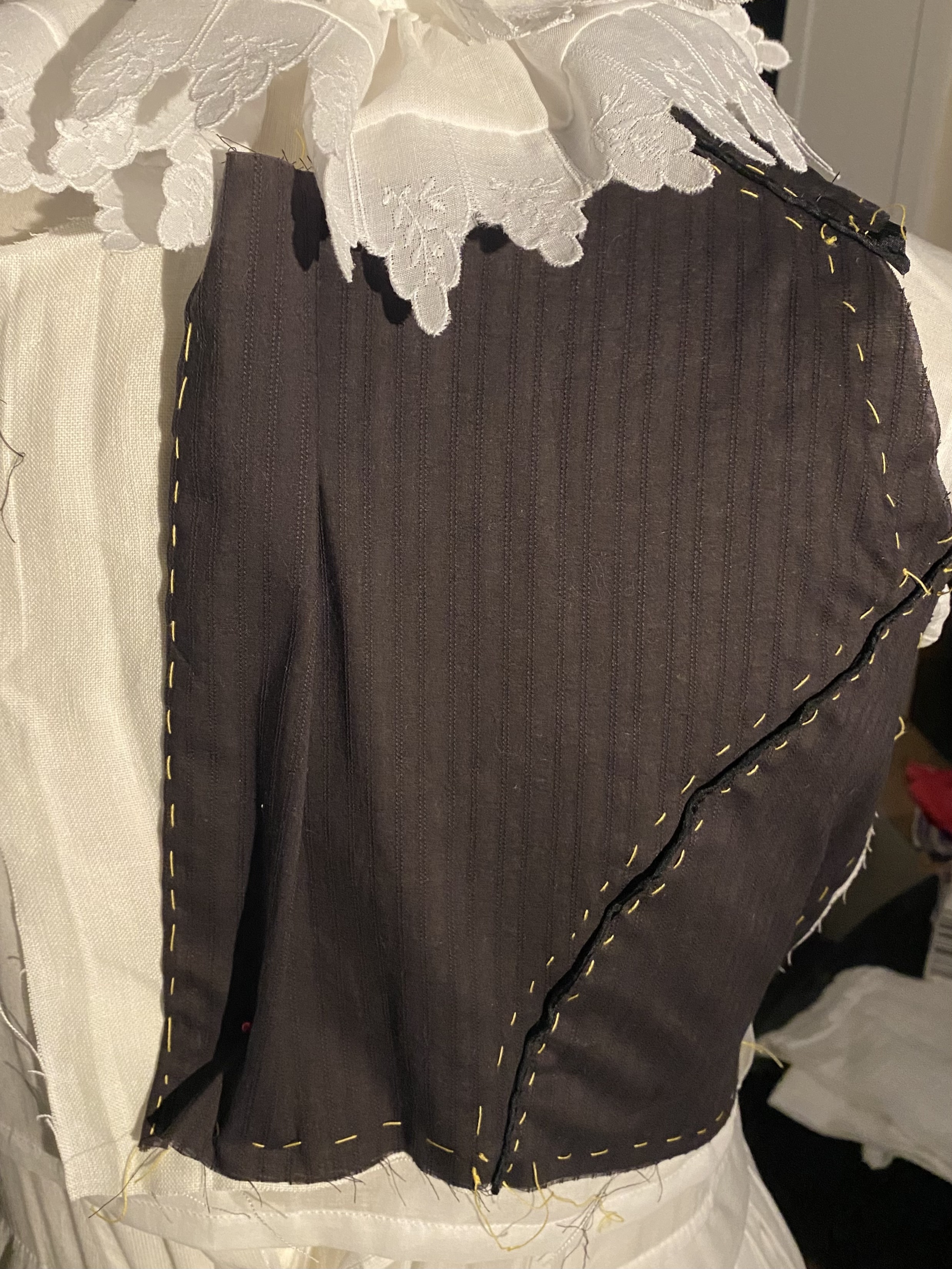
a purple cotton bodice back on a female mannequin, with a frothy chemisette with a pointy collar underneath
In progress: bodice back with piping in place

An Agreeable Tyrant also provided the inspiration for the dress I wore. I had almost too little sheer purple cotton fabric with a woven stripe, purchased at Lorraine Mill in Pawtucket a very long time ago. I meant to make an early 1800s gown, and had even started on the bodice around 2018 when life began to go very sideways and I stopped. I loved the fabric, though, and the deep color. 

I started on Sunday, September 22, and finished on Sunday, October 6. I have a full-time job and am in graduate school, so I’m not entirely sure how I managed to do schoolwork, work-work, and gown-work but I’m pretty certain the One Weird Trick was to do no housework. It’s embarrassing when the cat’s fluffy tail picks up thread and lint, but it is a reliable measure of how much vacuuming is needed. 

The bodice closes in back with a drawstring, which is much the easiest method for me– I did not have time to fuss with the fittings buttons require. The front panel is a gathered rectangle with a band at the top, piped on both the top and bottom edges. A waistband joins the bodice and skirt. The sleeves and skirt were based on shapes I drafted in the Burnley & Trowbridge workshop (I swear I’ll finish that dress). The sleeve has a piped petal cap, which was a pain to make but very gothic, to go with the points that decorate the bodice neck edge, and of which I have no images. Since I had the space at B&T to draft the skirts full-size, they actually work now– astonishing– and make a satisfying conical shape. I’ve struggled with skirts since 2014, and it’s nice to have that solved after a decade! 

gold colored geometric shapes on a white background show the layout of skirt pieces for a historical garment
1820s gown skirt layout

I’ve started using Illustrator to figure out layouts when I am short on fabric. In this case, I only had a little more than 3 yards of fabric, but managed to get what I needed out of what I had. Sure, bigger sleeves would’ve been nice, but I managed long sleeves and that seems like an accomplishment.
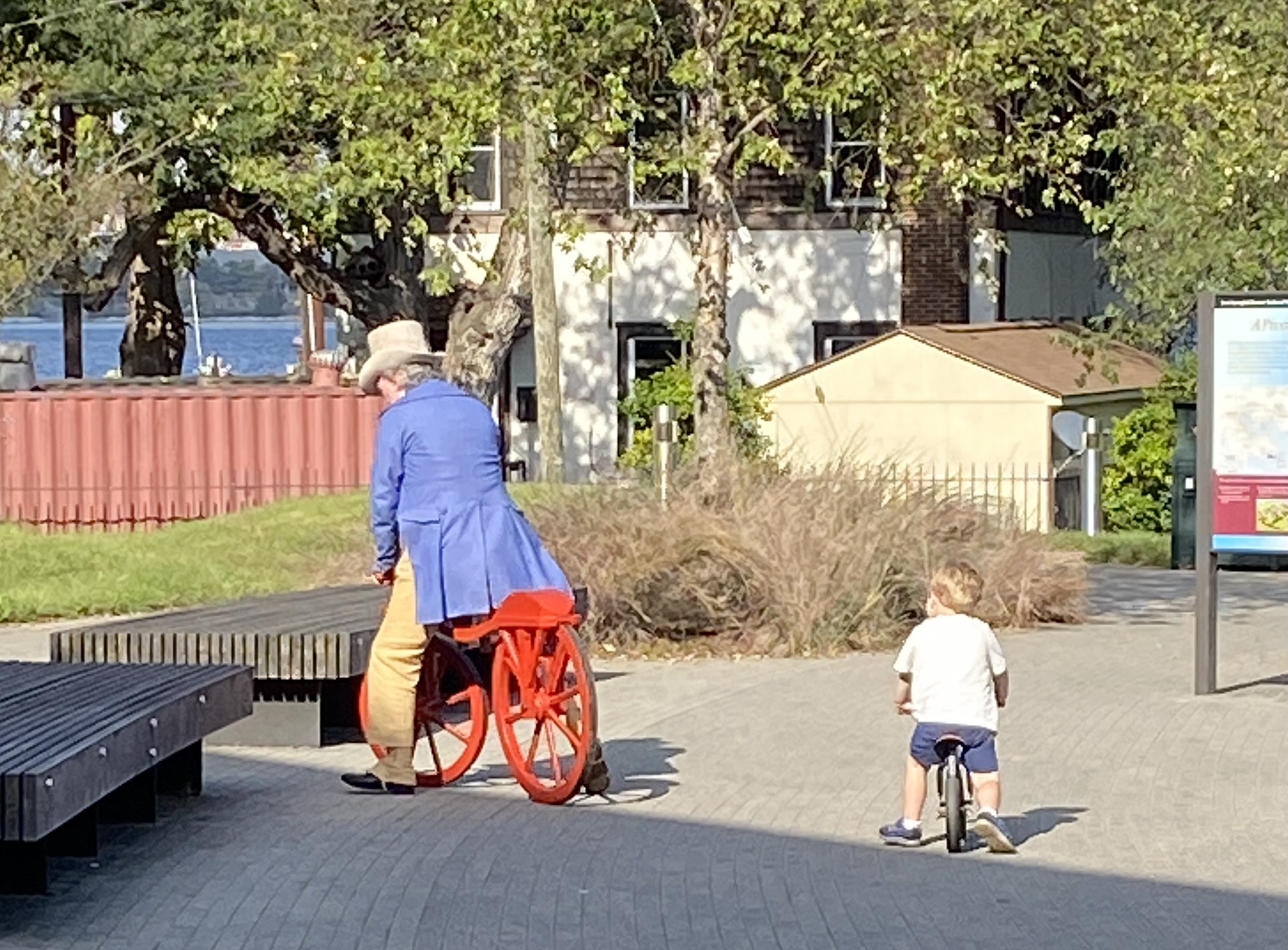
a man on a red velocipede followed by a boy on a foot bike
Riding School at Fort McHenry

Mr K. was able to debut his very apt and very dangerous velocipede, another project a decade in the making. We picked it up in February in Williamsburg. It is a handsome and impractical beast, tough to ride, but fun all the same. Charles Willson Peale and his sons had the first velocipede in the States, in Baltimore, so the Fort McHenry “1824” was truly appropriate. We entertained spectators, saw Mr. McC (who also took a turn about the site), and spent the day as very decorative appendages to the Museum’s tents. All in all, a day well spent. 
What’s In a Wardrobe?

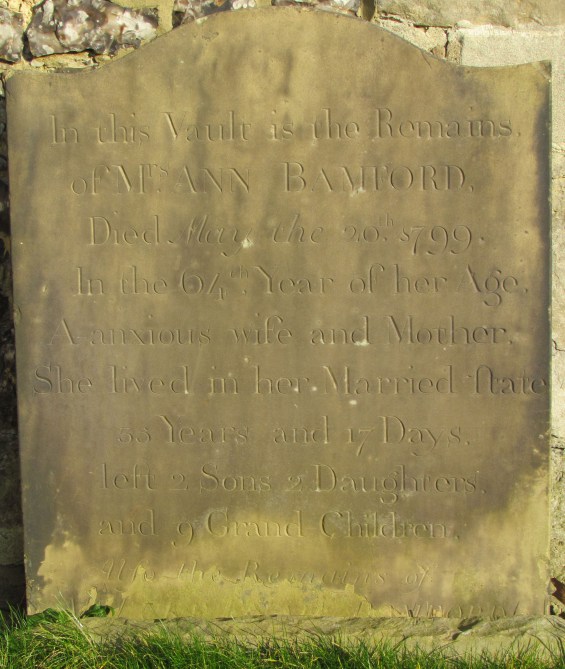
Ann Bamford & unreadable (below ground) Luke Exall Bamford?

Like Mary Cooley, Mrs. Ann Bamford provides a look into what a woman wore in the 18th century. Born in 1735, Mrs. Bamford’s estate inventory was created after her death at the age of 64 in May, 1799. (She is buried in the St. John the Baptist Churchyard, Borough of Harrow, Greater London. Her gravestone notes she was “An anxious wife and mother,” and records that she was married state to Luke Exall Bamford for 35 years and 17 days. That tells us that the Bamfords married in 1764, when she was 29. I love this detail of the late-20s marriage, actually reasonably typical for women of the period. When Anne Pearson and James Sparks married in 1772, they were roughly 43 and 50, respectively. Older, certainly than Mrs. Bamford when she married (James Sparks’ first marriage was in 1751, when he was 25; and early marriage, but he was by then already a Captain and ship’s master). 

Six years, at most, separate the Ann(e)s, Bamford and Sparks. In 1799, Anne Pearson Sparks is 70 or nearly so, married to a former Captain now gentleman and living in England, so the Bamford probate inventory provides a window into what the fashionable and well-to-lady of a certain age might have owned.

lwlacq000090The inventory, taken by a man,  and now in the collection of the Lewis Walpole Library, may suffer from a lack of feminine insight when it comes to descriptions, but it is comprehensive, listing at least 399 items. It begins: 

  • A Brocaded Sik Nightgown
  • A Gold Laced Jacket and Pettycoat silk grosgrain
  • A pair of pocket hoops
  • Two white petticoats worked at the bottom
  • A Black velvet bonnet
  • A Black Bombazine Negligee and Pettycoat
  • A piece of Printed Muslin for a Gown
  • One sprigged muslin nightgown
  • One Brocaded silk gown unmadeup

In the entire list, there are (among other things):

  • 3 jackets and petticoats, probably riding habits
  • 15 gowns and nightgowns
  • 5 negligees or sacque-back gowns
  • 20 petticoats
  • 14 shifts
  • 28 pairs of sleeve ruffles (various sizes, some worked, some laced)
  • 8 pairs of shoes
  • 3 waistcoats; 2 white, 1 fustian
  • 45 aprons, cloth, muslin, net, worked and embroidered
  • 33 caps, including wired caps and caps “with ribands”
  • 4 bonnets, including one in black velvet and one white
  • 11 hats
  • 26 pairs of stockings, including a pair in green silk
  • 3 stomachers
  • 12 cloaks
  • 58 handkerchiefs of various kinds, some “for wearing,” some worked (embroidered) in gold and silver
  • 5 entries described as“gown unmade up”

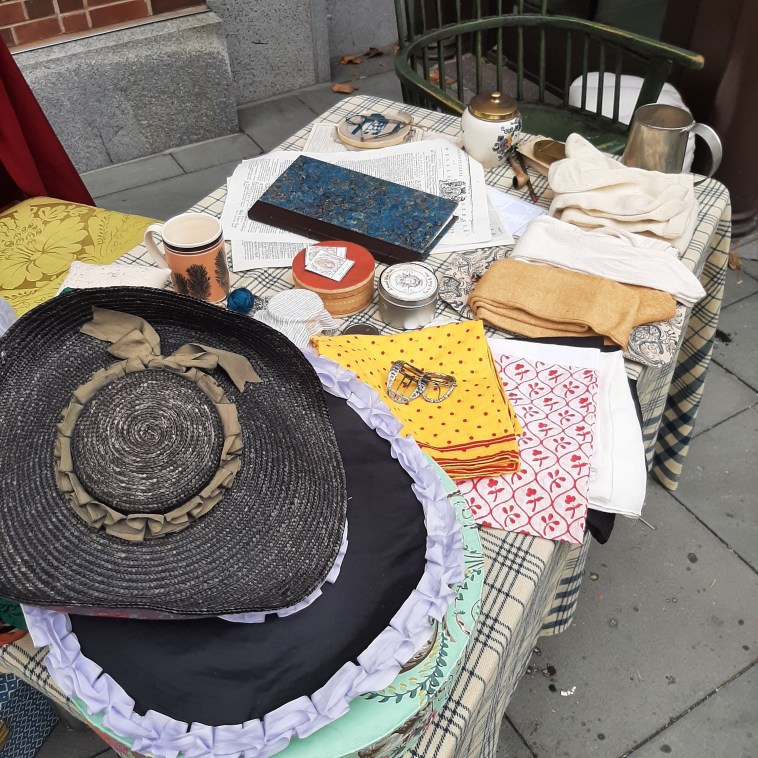
    a stack of 18th century hats and patterned handkerchiefs sit on a check blanket
    I love a stack of hats and handkerchiefs, too! Hats & hankies from Burnley & Trowbridge

There’s no reliable way to know when the gowns were made, or what exact style they are. We cannot know the state of all 45 aprons, the styles of all 33 caps, or 4 bonnets. There’s hope in the five gowns “unmade up.” There’s frivolity and impulse purchasing in 58 handkerchiefs. Fifty-eight! 26 pairs of stockings, one pair of green silk, and one pair of thread with clocks, but the majority seem to be worsted. 

What does Ann Bamford not have? There are no quilted or matelasse petticoats; this may be a function of the list being made in 1799 when the fashionable shape shifted away from the round bell provided by quilted petticoats, but Ann retains a pair of pocket hoops and has no rumps or pads. The infrastructure of a fashionable shape for the 1780s and 1790s seems missing. 

Screen Shot 2024-01-23 at 6.11.36 PM
Cabinet des Modes, August 1, 1786.

It’s likely that the inventory contains clothing from a range of years, possibly dating back to Ann’s marriage. The brocade gowns may well have been reworked from earlier styles, and the jacket-and-petticoat combination in silk grosgrain with lace sounds like the laced and decorated riding habits of the 1760s when Ann was married. As styles changed in the 1770s and 1780s, she might have had additional riding habits made, since they were worn as traveling and visiting costumes and even at home. There are other clues: the black bombazine nightgown and petticoat and the black silk negligee and petticoat suggest mourning, as do the silver silk negligee and petticoat (there is a second silver silk petticoat as well). These would provide stages of mourning, deepest in black and half in silver. English, Ann’s mourning garb might have been worn for deaths in the royal family (like Barbara Johnson) as well as for her own family. (In this context, negligee describes an informal gown, that is, one worn at home, during the day. Nightgowns, or English gowns, were slightly more formal, for day or evening wear. There are subtle distinctions lost to us, but not entirely dissimilar from our “work to evening” outfits where accessories can change an outfit’s meaning.

A Milliner’s Wardrobe

Among the things I ponder about Anne Pearson Sparks is what she wore, and how much clothing she had. She would have seen the latest fashions and fabrics when she traveled to England to buy millinery goods. How did she translate those styles for her Philadelphia customers, like Mrs. Cadwalader, and how did she interpret them for herself? It’s largely unknowable since there are no known images of Anne. Probate inventories provide insights into the quantity and type of clothing women had in the 1770s. They skew higher income since people without wealth had so much less to leave, but given that Anne Pearson owned her own house, and had a £2700 marriage settlement, she certainly had means.

(Above right, Portrait of a woman by Charles Willson Peale, ca 1775. Metropolitan Museum of Art Accession Number: 26.129.2)

The February 1778 inventory of Mary Cooley’s estate, digitized by Colonial Williamsburg, provides an extensive list of clothing and other items owned by a York County (VA) midwife, including 10 gowns, 6 petticoats, 9 shifts, 5 pairs of shoes (4 leather and one black satin), 15 caps, 9 “chex” (checked) aprons, and 4 other aprons, presumably white. The type of gown is not specified, that is, they are not itemized as “nightgowns,” “sacks,” or “negligees,” though there is an additional wrapper. No bedgowns appear on the list, and there is only one pair of stays. Since only items with value (i.e. sale value) were listed, Mary Cooley’s total inventory probably included bedgowns. The clothing worn by the enslaved woman Bett and her child Peter was also probably not on the list. Bett and Peter appear at the end of the list after items typically found in a kitchen, where they probably worked, lived, and slept; it is likely their clothes were few and had no value.

What does Mary Cooley’s list suggest for Anne Pearson?

The gowns include:

  • 1 Brown damask Gown 60
  • 1 black Callimanco Gown 60
  • 1 Striped Holland Gown 70
  • 1 dark ground Callico Do. 70
  • 1 Callico Do. £5 
  • 1 flower’d Do. £7 
  • 1 India brown Persian Do. £3..10/
  • 1 Purple Do. £5 
  • 1 flower’d Crimson Sattin Do. £12
  • 1 Striped Holland Gown 70/

That gives us:

  • 2 Holland (fine linen) gowns suited to the hot, humid Tidewater.
  • 1 Calamanco (glazed woolen) gown, best for winter 
  • 1 Damask (probably silk, could be silk and wool) gown, worth 60 shillings ( £3), so less than the silks
  • 3 Calico (cotton, probably all printed, one with a dark ground), also suited to Tidewater 
  • 3 Silk gowns, in “India brown,” flowered crimson satin, and purple Persian. 
Woman’s Round Gown (Robe à l’anglaise) c. 1775-1780s. Striped cotton plain weave. Accession Number:
1959-113-1 Philadelphia Museum of Art

Linen, wool, silk. Living in Philadelphia, Anne Pearson probably had more wool than Mary Cooley; how many more? Would we swap one linen and cotton for two woolen (stuff or worsted or calamanco) gowns? Would we swap a cotton gown for a riding habit? Anne traveled back and forth between Philadelphia and London for years, and a riding habit or (and?) a Brunswick would make sense for travel. With appearance a key part of advertising her trade and reputation, Anne probably had more than 10 gowns, but call it 10 and add at least a riding habit.

Then we add petticoats. Petticoats expand a wardrobe by matching or contrasting with open robe gowns. Six petticoats! That’s a good number of options, but remember, they need to balance the seasons.

Mary Cooley has:

  • 1 Pink Persian Quilt
  • 1 Black Shalloon Petticoat
  • 1 Blue Callimanco Petticoat
  • 1 India Cotton Petticoat
  • 1 old striped Stuff Quilt
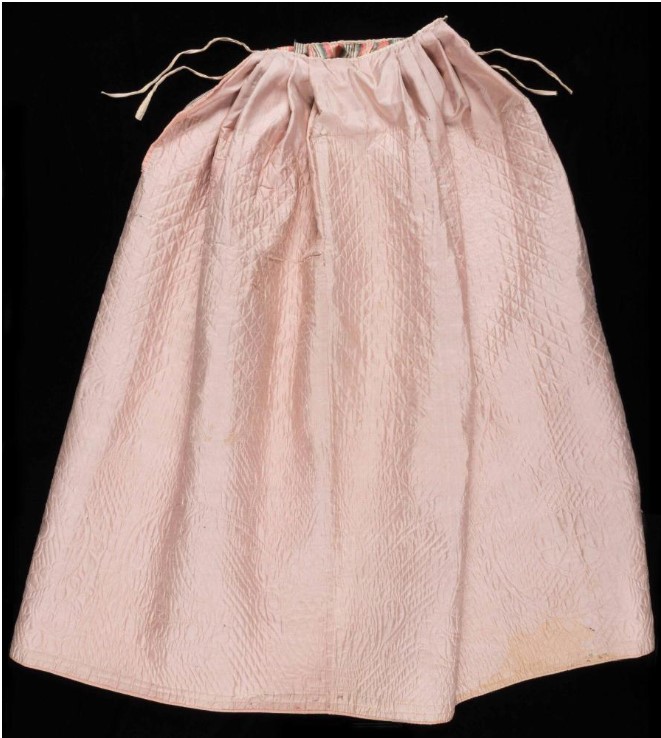
  • 1 blue Quilted Petticoat
Quilted Petticoat, 1770-1775. Colonial Williamsburg OBJECT NUMBER 1995-191

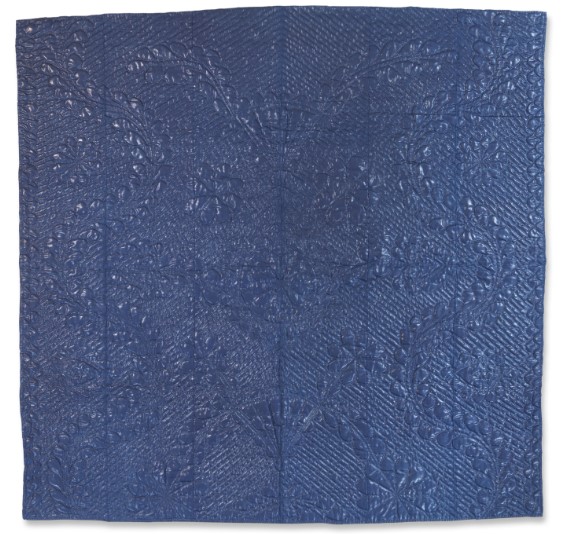
The pink Persian (silk) quilted petticoat certainly came from a milliner’s shop, and was likely made in England; it could easily be worn with those silk gowns. Having the color here helps us begin to imagine the combinations. Pink Persian and brown damask? Black shalloon and black calamanco? Black calamanco and blue calamanco? The India cotton petticoat was probably worn with one of the calico gowns, and we can contemplate striped stuff with a striped Holland gown. In any case, Mary Cooley’s two, possibly three, quilted petticoats helped her keep warm in silk, calico, or linen. The blue calamanco petticoat might also have been quilted; there are many calamanco whole-cloth quilts, and I like to imagine one as vibrant and shining as this quilt or perhaps this one. Quilted or not, under candlelight both gown and petticoat would glisten. 

Deep Indigo Glazed Calamanco Quilt, Probably New England, Late 18th Century

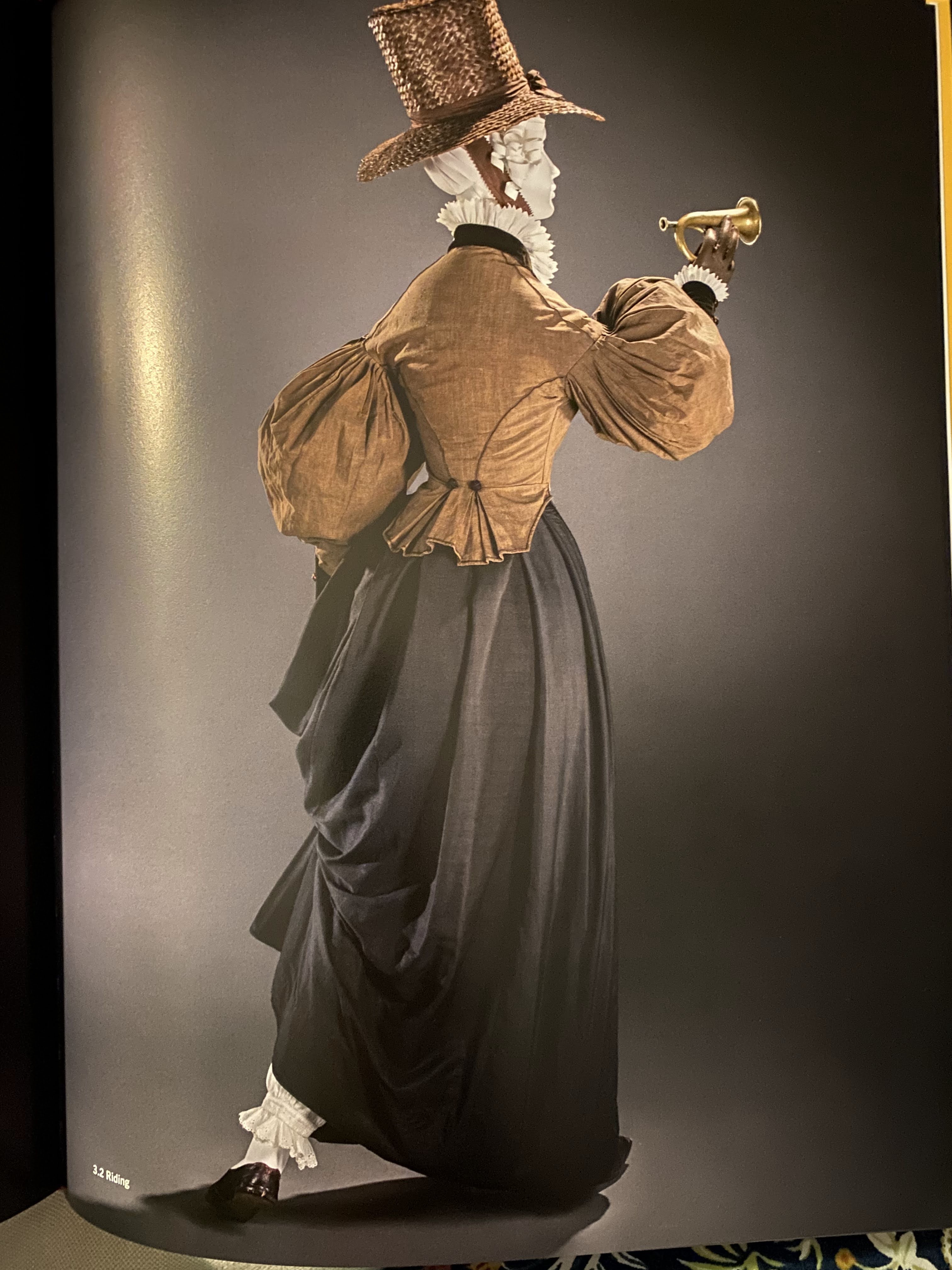
1830s Riding Jacket

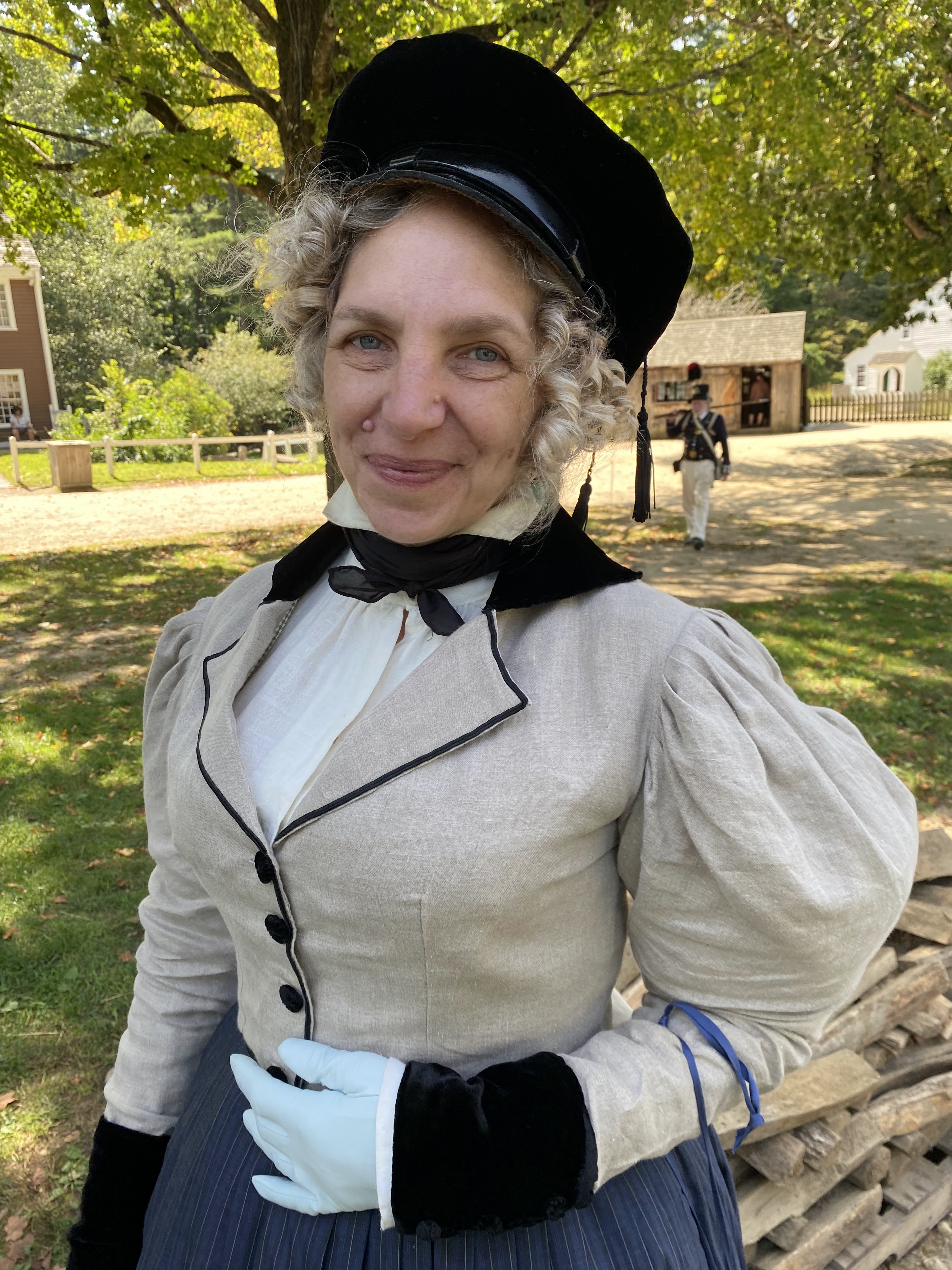
There’s a wonderful exhibit winding up a tour, and although I have not been able (yet?) to see it, the catalog was a Christmas present in 2022. One ensemble in particular captivated me: an 1830s unbleached linen riding jacket worn in Boston, MA. The enormous sleeves and oversized hat probably contributed to my fascination, and with a place to actually wear such a thing, making seemed like a good idea. Or at least an achievable idea. 

This journey started in July, 2022, and was finished in August, 2023. Things happened.

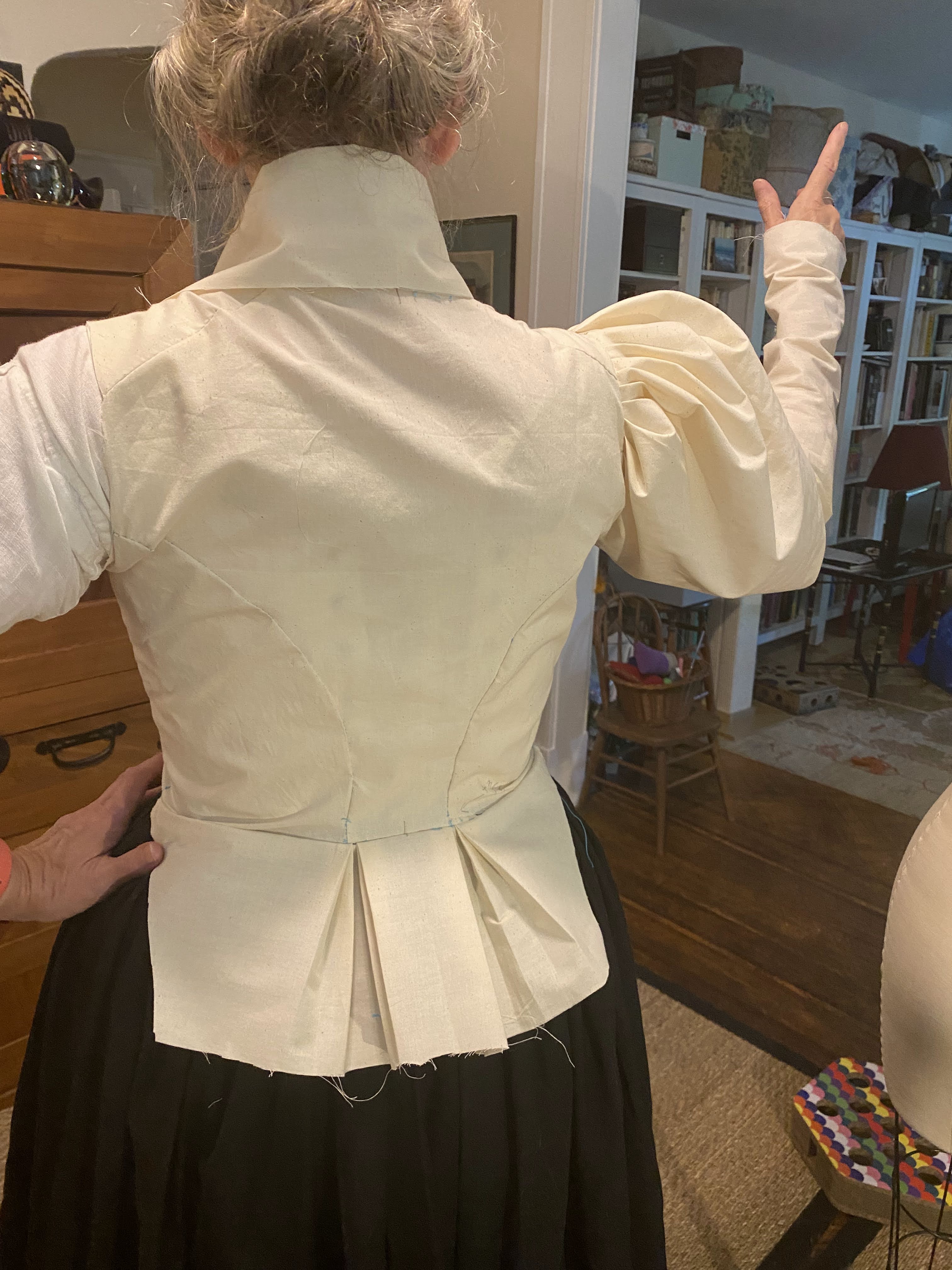
I started with a muslin mock-up, of course, using a previous year’s Spencer a l’Hussard as a starting point. (There is a point when you’ve made enough different things that you can kit-bash your way to many new garments.) The biggest change to the Spencer pattern was in the front closing and collar. The a l’Hussard has a standing collar and fastens with hooks, while this has a fall collar, lapels, and closes with buttons.

There are no published images of the front of the extant jacket, so I looked at both fashion plates and other extant riding habits, ultimately deciding to make a single-breasted jacket.

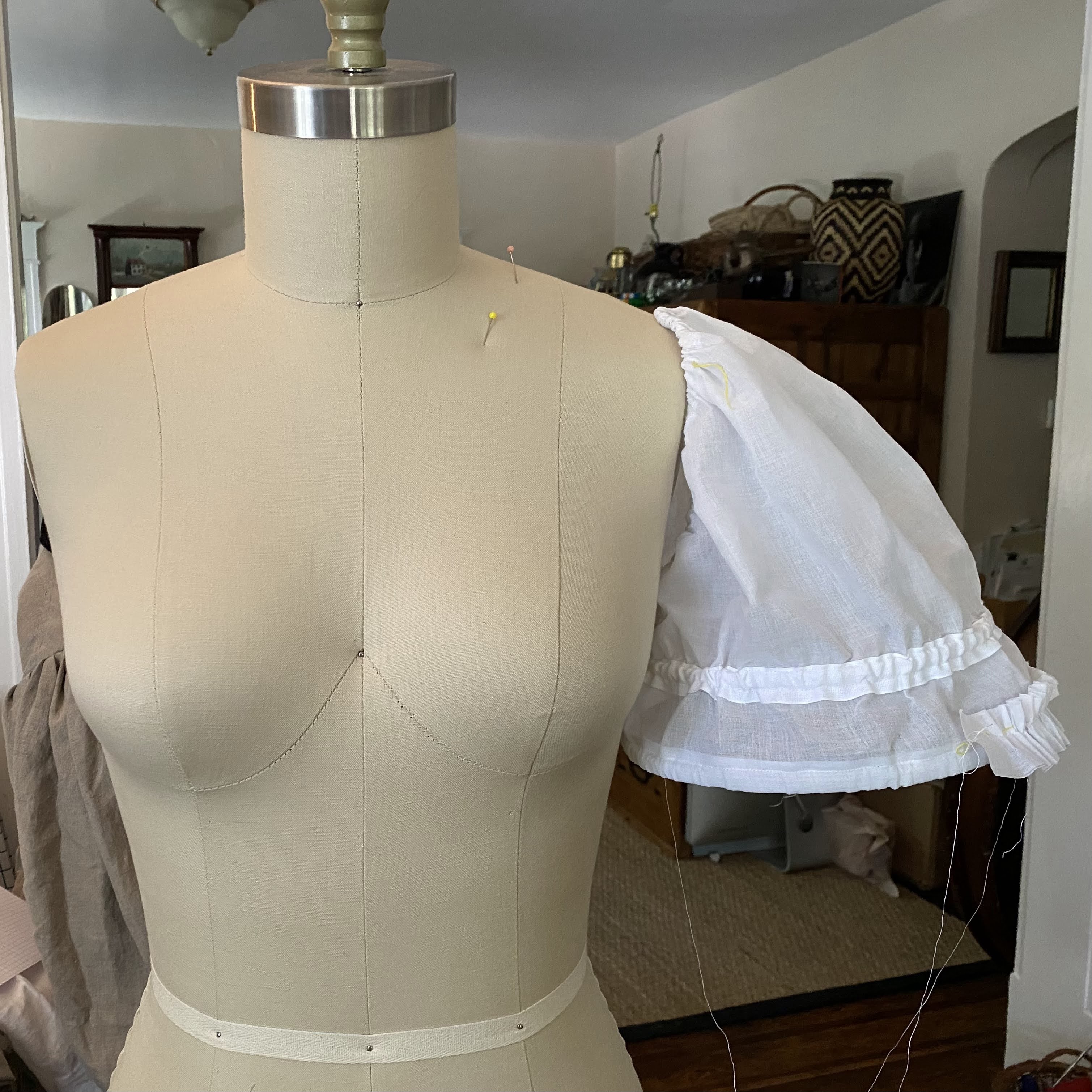
The construction is straightforward, and much like a gown from the period. The bodice is lined, while the sleeves are not. I took advantage of the smaller piece sizes to use up some linen cabbage, and got myself a flashy mis-matched lining as a bonus. One of the trickiest parts was figuring out sleeve supports. I had a melt down over the cage supports, which showed through the lightweight linen and looked awful. I tried them first because I was concerned about the heat down- or wool-filled sleeve puffs would generate for an Labor Day weekend event. In the end, I remembered that I had cotton organdy, and that crumpled up to a nice volume inside some polished cotton covers. These are made with twill tape to attach them to stay straps, if you’re wearing them under a gown; the straps slip over your arms and the puffs rest more or less on your biceps.

Unfortunately, I became anemic while I was making this, and attending a workshop not long before we were supposed to travel to New England wore me out to the extent that we could not travel. Truly annoying, both in thwarted plans and how lousy I felt. Many iron supplements and one appendectomy later, we decided we would make it to the Militia Muster event at Old Sturbridge Village. (It was quite a year.)

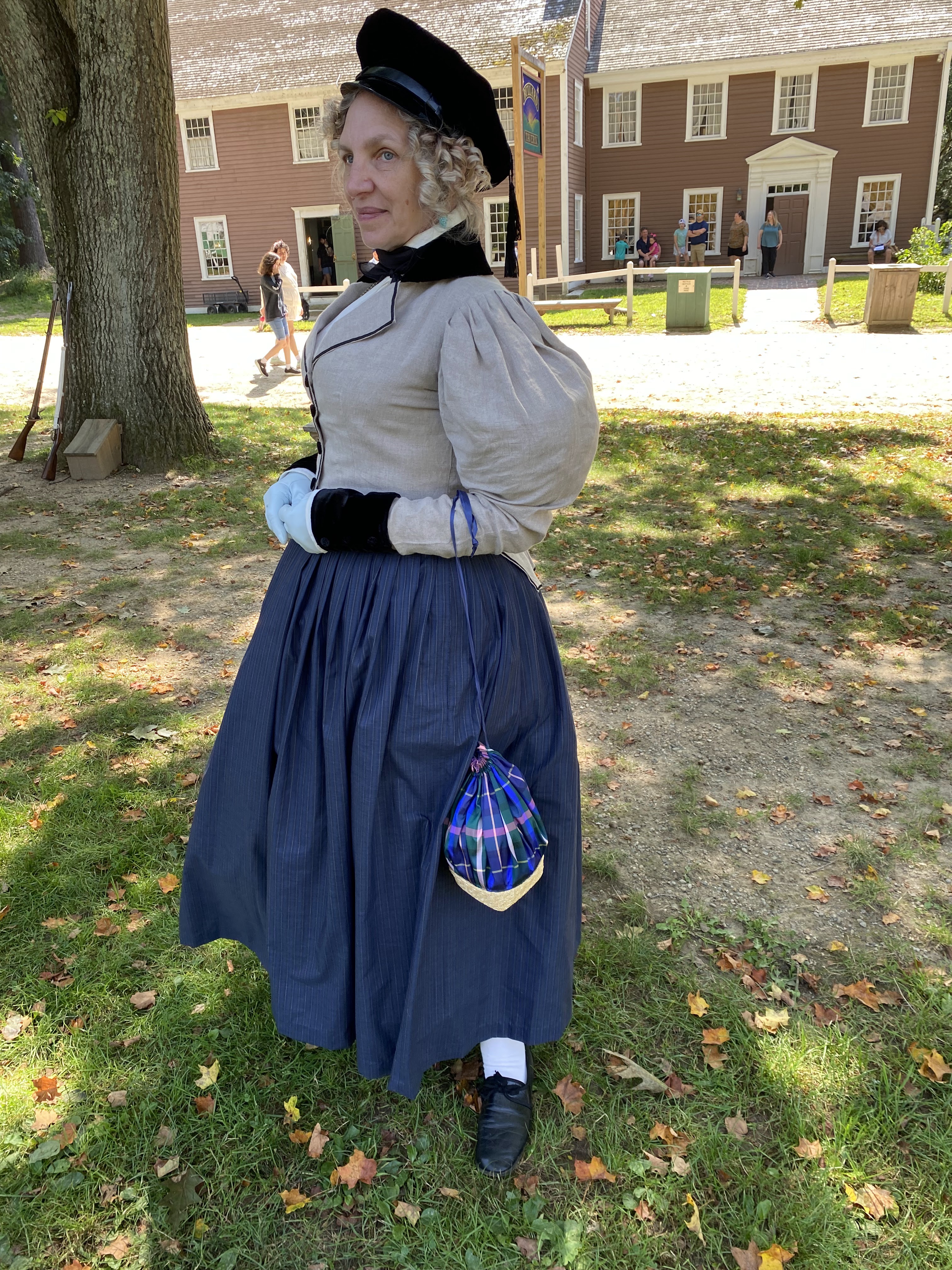
To finish this, I stitched on the black wool tape, outlinng back seams, the hem of the peplim, and the front edges. I couldn’t tell from the images whether or not the original had tape, but decided to err on the side of embellished, especially since the cuffs and collar were black velvet. I added custom black velvet buttons embellished with silk thread, made by Blue Cat Buttonworks. Truly lovely, and not within my skill level.

I had planned to wear this with the blue cotton skirt and a riding shirt or habit shirt, but I miscalculated the neck opening and ended up without enough time to restart, so I borrowed a shirt from Mr. K. Luckily the sleeve plumper fit over the shirt, and the jacket fit over all of it! The weather was lovely for early September in New England, and I spent a pleasant day talking about women’s sportswear and the rising interest in physical culture as part of a well-rounded and healthy education in the early 19th century.

The ensemble is accessorized with a black velvet wheel cap, for which Mr. K made the shiny leather brim. The reticule/workbag was made by Anna Worden, and the shoes are black leather Robert Land Regency slippers. The unbleached linen and checked linen lining came from Burnley and Trowbridge, while the skirt fabric came from a Rhode Island mill store remnant table.