Cooking and eating will be different at Monmouth, because there will be camp kitchens.
This means two things that give me stomachaches: trying something new in public and sharing with strangers. How to alleviate this discomfort? Research, of course, because we don’t think our landlord wants to have an 18th century camp kitchen in our yard, even as an attraction or energy saving option. (Nor have we figured out how to ask him about the hanging-chicken-cooking experiment we want to try using the metal fire pit he lights for snuggling with his many girlfriends.) For more on camp kitchens, you can read John U. Rees’s article here, or check out the work done on the common British soldier in America by the 18th century Material Culture Center.
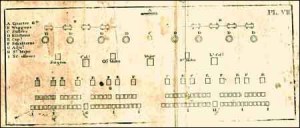
The circles are the kitchens.
With a camp kitchen, we can leave our three sticks at home. Kitchens are also far more authentic for a large camp (see the plan from von Steuben at right). I’ve also read that it’s quicker than cooking over an open fire, which is a plus.
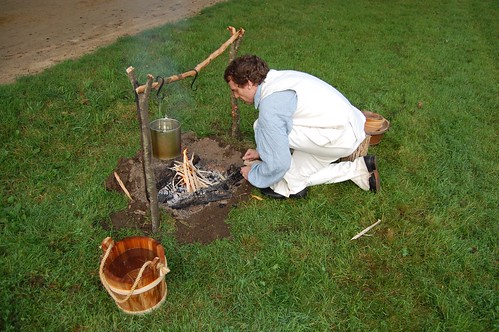
A large heap of earth cannot be good in a downpour.
The main downside that I can see to a camp kitchen is rain: from the photo and this drawing, you can imagine for yourself the results of a downpour. At least it’s going to be drier there by the end of the week…
As someone who just finished mending a petticoat, you’d think I’d leap at the chance to drench my hem in water to prevent future mending episodes, but not so. For one thing, in the house or in the camp, that’s water I had to haul or cause to have hauled, and I’m not wasting it. Wet the hems and what’s next? Caked lumps of ash, mud, and.or other filth. No thanks.
High-tech historical cooking
The burns I got in my dress were acquired at the end of the day when we were hearth cooking and were practically in the fireplace ourselves. That is where you must be if you wish to stir the sauce until it thickens, and there was the hoisting of roast in its pan a couple of times, and general playing with fire in pursuit of food. My ca. 1799 dress is longer than my 1770s petticoats and gowns, and the extra inch or two probably contributed to the burns. But I wasn’t engulfed by flames, because the damn thing is wool. Self-extinguishing wool, worn with linen and wool petticoats and a linen apron. not going to go up in flames. Also not going to get dipped in water–and wouldn’t that result in steam and hence scalded shins?
I don’t know where these rumours start, but they could have started with a cynical curator joking with house tour guides who failed to get the joke. Not that I know anything about a story of about Providence kitten named Georgie in honor of George Washington’s visit to a large brick house on a hill .
The majority of us do not consider the chicken. We may consider whether the package of chicken we purchase is free range, organic, cage-free, grain fed, cruelty free. But we are unlikely to think about the implications for the physical being, the essence of chicken-ness, that the chicken’s conditions create for it.
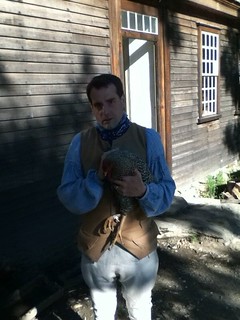
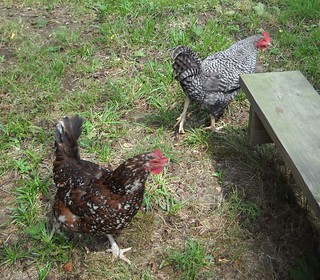
And I am here to tell you that the cage-free, organic, free-range chickens and chicken parts that you purchase at Whole Foods or your other large vendors bear little to no relationship to the actual free-range, catch-as-catch can, ne’er-do-well chicken of the historic barn yard. For one thing, living history chicken is ripped.
It’s well-developed physically, with strong, sturdy bones and robust ligaments. Its musculature is tight: this is not a bird in need of a personal trainer. Its meat, when cooked, is not white. It is dark meat, not so dark meat, and sort-of white meat. Its taste was described to me as gamey, but I disagree. It was chicken, but earthy, sweet and fresh and rich.
But all that came after the meeting of human, knife, and chicken.
Disassembling the chicken fell to me; I declined rubbing butter into flour having prevented a fall down cellar stairs by putting my hand in fresh goose guano, so I after I washed my hands, I addressed the chicken in its bowl, and took up a knife.
By this time, post-carrots, -parsnips, -squash, -string, -tallow and -suet, the knife lacked the purest essence of knife, that is, sharpness. But it functioned well enough for the task, with some persuasion. The skin was much thicker and more resilient than a store-bought chicken, and greasier, though not in an unpleasant way at first. The muscles were well-developed, and pink. Rosy pink, deep pink, dark like wine. There were no large slabs of the shiny, flaccid, pale meat you find on the chickens in the store. Those aren’t chickens any more: those are products.
The process of quartering the chicken took strength and pressure on the knife, and the strength of my hands. I did have to rip joints apart, and break the carcass’s back. All of this had a sound, and a mild smell of chicken, mixed with the melting tallow. But it was the sound that, with the greasy, slick knife, and the grease that soon covered my hands and wrists, that kept bringing me back to what I was doing, and that, when the bird was broken apart and in the pot and my hands washed, again (they itched), send me outside and up the hill for air and sky.
We boiled the chicken in a kettle we’d already boiled crook neck squash in; later, we added sage, thyme, parsnips and carrots. It was delicious. The broth was incredible, and the whole meal very simple. That’s the whole of the recipe: boil a chicken, add herbs and root or fall vegetables, boil until done, serve. Use any uneaten broth and bones/meat for stew, pie or other dishes. That’s it.
The product chickens from the market are bred to fall apart. They haven’t got what a running, pecking, eating everything chicken’s got in muscle, ligament, and tendon.
On Sunday, after we came home, I looked at the food in our cupboards. There were boxes, cardboard, plastic, layers of packaging. The cheese was square. These things came from the good market, but were they food, or were they products? I felt like a passenger on the ship in Wall*E, and I was appalled.
Our first overnight, camping-in reenactment went fairly well. Why the artillerists had to bring a concertina to a gunfight, I’ll never know, but a 2:36 AM rendition of “Good Night Ladies” was truly unnecessary.
The most important thing I can emphasize about reenacting in high summer is to stay hydrated. We brought the big white water pitcher we used at the House Cleaning in April, sliced a lime into it, and filled it repeatedly at the town pump. The Young Mr doesn’t like lime in his water, so he filled the coffee pot for himself, but the rest of our Regiment and members of the 10th Mass helped themselves liberally. It was well worth bringing.
The meals we ate were simple: apples, bread, ham and cheese for breakfast and lunch (I forgot to bring the eggs…) and beef stew for dinner. The stew is the most interesting part of the business. Mr S bought the meat, and without even realizing it, he picked up the appropriate amount of rations. Men were supposed to be issued a pound of beef and a pound of flour or bread a day; women, half that, and children a quarter. The amount we packed was a pound and three quarters. Seemed like too much when I packed it into the cooler, but as it turned out, we ate it all.
Enhanced Ration Stew (feeds 3 to 4)
1.75 pounds beef stew meat
3 carrots, sliced
1 very large onion, roughly chopped
4-5 small, firm, potatoes, cubed
Half a small kettle of water
2 packets or cubes of portable soup (beef boullion)
Note: start the fire and get it hot before you bring the meat out…
Cut the meat into smaller chunks, add to the kettle, and place over the fire. Brown the meat on all sides; note that this will take as long as it takes.
When the meat is browned, add the onions and cook until they start to get soft. Add the rest of the ingredients, stir, and cover.
Bring to a rolling boil for at least twenty minutes; stir occasionally. Be sure to add wood to the fire to keep it hot. I think we cooked our stew for about 2.5 hours, but it’s hard to say exactly, as we were not wearing timepieces. We started the fire after the battle, which would have been at about 3:30 or 4:00, and ate around 6:30.
I used my pocketknife to slice the vegetables first, and arranged them in our wooden bowls. Then I sliced the beef into smaller chunks, using a piece of firewood as a cutting surface—since it gets burned, you don’t have to wash anything but the knife in hot water. Thanks to the 40th Foot at the SOI for demonstrating that technique.





 Kirsten Hammerstrom
You must be logged in to post a comment.