Coats and Cooking

And happy not to be walking to Walloomsac, since we can’t leave till Friday.

Before we leave, there’s plenty to done, of course, and most of it in men’s wear.*
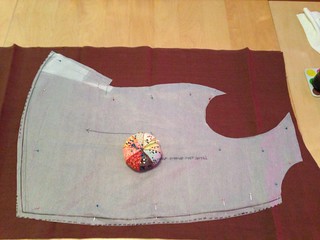
The first piece on brown linen

The Young Mr needed a new jacket, a proper one, with pockets and everything, correct for a scalawag. So that meant patterns and muslins and fittings and questions, until neither of us could really stand the other and his father called me an ambush predator of fittings. The only way to fit these wily creatures is, as they amble through the room, to leap out and toile someone.

With the pattern more-or-less fitted to the wiggly Young Mr, I cast about for fabric: there was not enough of a striped piece for both waistcoat and jacket; waistcoat won, because matching stripes on a jacket seemed too risky in this great a hurry. Instead, I sacrificed the last yardage once meant for a gown.
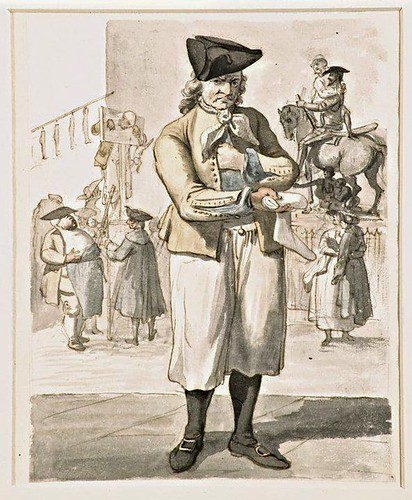
The Stocking Seller, by Paul Sandby, 1759

This is the inspiration for the kid’s new garment, along with Sandby’s fish monger. It seems a plausible garment to work from, and the brown linen is in keeping with the brown linen jacket at Connecticut Historical Society and the unlined linen frock coat recently sold at auction. It will also match his trousers, but this is what happens when you sew from the stash.

One pair of breeches altered, one waistcoat wanting the last seven newly-made buttons, one waistcoat in production, one jacket in production: you’d think that would be enough to get done. But I’m also working to expand my cooking repertoire, as bread and cheese gets tiresome and scrounging broken ginger cakes from the Sugar Loafe Baking Co.— while potentially good theatre–is not a solid plan for sustenance.
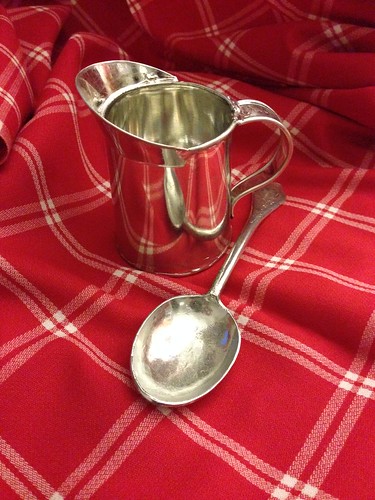
half pint and spoon measures
Half-pint and spoon

Boiling food in summer- sounds awful, right? But it’s an easy and correct way to cook,once you translate recipe measures and control the amount you’re making. I like to use Amelia Simmons’ cookbook, because it is specifically American, and my more skillful friends cooked from it at the farm.

From Enos Hitchcock’s diary, I know that he ate a boiled flour pudding with some venison stew (near the Saratoga campaign, I think) so I consider this a plausible recipe for the field, pending eggs, of course.

A boiled Flour Pudding.

One quart milk, 9 eggs, 7 spoons flour, a little salt, put into a strong cloth and boiled three quarters of an hour.

Simple enough, though Simmons later corrected the receipt to 9 spoons of flour, and boil for an hour and a half. I got out the spoon, and looked online at modern boiled pudding recipes, and will give a modified version a whirl sometime this week (always better to fail at home than in the field). Boiling the pudding in a linen cloth in a stew would make a savory bread substitute…and I really liked the one we had at the farm. Will the gentlemen at Bennington like it? Perhaps we’ll find out. If we’re not cooking with hosewater, almost anything should be edible.

*Yes, it’s a terrible and terribly dated show, but I always hear  this in Mr Humphries‘ voice from Are You Being Served?

Ceci n’est pas une cruche

This is not a pitcher

Sometimes a pitcher is not a pitcher. In the same way that Matthiessen‘s Snow Leopard is not about a snow leopard, this was not about me: this was about the woman who approached me as I walked with Cat to the water bubbler with this white ceramic pitcher from Home Goods.

She stopped me to say, “You shouldn’t have a pitcher in camp. You should have a bucket.”

This is true, as far as it goes: but really, I should have a tin kettle (and I do). But the reasoning I was given had to do not so much with the fragility of the pitcher (which I pack in a basket or wrap in our towels and stuff into something in the supply wagon) as it did with the myth of Molly Pitcher. For an explication of the Molly Pitcher myth, I refer you to the Journal of the American Revolution, because, as I said to the woman who approached me, “It’s not my fight.”

So what’s the point? Maybe there are several:

One might be, Everyone has a hobby horse. Some of us are made mad by The Bodice. Some of us cannot abide makeup on “camp followers” who look like stragglers from a high school production of Sweeny Todd. Some of us are material culture and camp equipment fanatics– begone, ironware! Still others twitch at the baggy, off-the-rack cut and fit of some uniforms.

For another, This wasn’t about me– or my pitcher. The woman who approached me had a thing about Molly Pitcher and the myth of the woman on the battlefield with a pitcher, bringing water to the men. My pitcher and I were merely a trigger.

colonial woman with pitcher and kettle
Everybody’s got something to hide ‘cept for me and my…pitcher? or kettle?

And for a third, We all make choices and compromises. I chose not to bring the antique family copper coffee pot into the field, and also chose not to let the coffee and water sit overnight in the tin kettle. I chose, too, to use the white pitcher and a redware one for water that we drank all day long. When it’s hot, I slice lemons or limes into the water to make it easier to drink as much water as we need to in a day spent sweating outdoors, and it prevents scurvy to boot.

Fourth? We can all, always, make better choices. Few among us achieves true 18th century purity– I can assure you that even had I dashed my pitcher to the ground Saturday and dropped to my knees in repentance, I was not 18th century to the skin. There are monthly occurrences that I won’t go old school on, and on this point I shall not be moved.

But back at my ‘rock maple’ table, I could do better. We could/should have but one wooden bowl (mine), and the boys could/should have tin bowls, and we could/should swap out the redware canns with the handles broken off, but they make a nice refugee statement and until they break completely…

And there is a fabulous copper cistern by Goose Bay Workshops that I covet for its copper glory, but since it is not tinned inside, no lemons or limes would be allowed, and it would be hard to argue it for a Light Company. That puts me at another tin kettle, designated for water, and dipping our cups in. I can probably live with that choice.

But then, if I encounter someone who wants to talk about Molly Kettle, I’ll know I’m in real trouble.

“All sorts and conditions of women”

img094

Ever on the track of laundresses and working women, I came upon The Project Gutenberg EBook of The History of Modern Painting, Volume 1 (of 4), by Richard Muther. I was rewarded with  a laundress and a cook holding a spider. Daniel Chodowiecki, a German artist, seems to have been as drawn to the common people as Paul Sandby. The caveat of course is that is he German, so details may not always be correct for American interpretations (pinner aprons, for example).

Still, we have the classic washtub-on-a-table set up, and the laundress is barefoot, which makes very good sense, though my feet hurt just from thinking about standing barefoot on the stubble of the field at Saratoga.

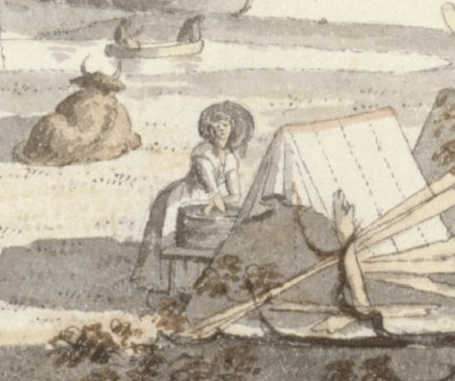
Encampment of the Loyalists at Johnstown, a New Settlement, on the Banks of the River St. Lawrence in Canada, taken June 6th 1784, James Peachey.

Laundresses come with style, too, though I am asking myself, “Is that a fabulous hat, or is your head just in front of some balled-up, sleeping livestock?” Was is discernible is that her hair is down, and she is leaning on the washtub. The tent seams are also clearly visible, and she does have the iconic washtub on a table set up.

Encampment of the Loyalists at Johnstown, a New Settlement, on the Banks of the River St. Lawrence in Canada, taken June 6th 1784. James Peachey

In another detail of the same image, we have a woman who is clearly wearing a black bonnet, tending a kettle on a fire. Here’s yet another piece of evidence for the three sticks-two kettles-no matches set up, and for the tinned kettles being left to get black on the outside.

What is she wearing on her body? There’s a white (or a least white-grounded) kerchief, and what looks like a grey or drab petticoat. But is that a short gown, jacket or bed gown? I’d say jacket, mostly because of the fit, but it’s hard to say at this distance. Whatever word you care to use, she’s wearing a reddish-brown garment fitted to her torso that appears to have a side-back seam.

Once again, tent seams are visible. This tent, just like the one in the other detail, also has some large off-white item thrown over the end. Could it be a blanket, out to air in the sun?

I do also appreciate the short blue jacket/white trousers of the man or boy to the left of the woman, since I know a guy who possesses those clothes and prefers trousers to breeches. He appears to be drinking from a cup as he carries a kettle, presumably of fresh water.

Encampment of the Loyalists at Johnstown, a New Settlement, on the Banks of the River St. Lawrence in Canada, taken June 6th 1784, James Peachey.

The entire view of the Loyalists’ camp is here, with a zoomable image. The drawing is full of details applicable to camp life interpretations, from women’s bonnets to fishing rods.

As I contemplate the troublesome Bridget Mahoney, I find the detail below of a solder and a woman rather pleasing.

Does she solemnly swear she is up to no good?

In a Pickle

Yes, for breakfast.

I like pickles. I don’t like being in a pickle, and I have to say that work this week has been as bitter-tasting as any week since February, so it’s a fine thing that the pickles I made last weekend are ready for eating.

The recipe is based on the Hannah Glasse recipe my co-commissariat made for Cambridge, and which I sampled in the NPS staff kitchen. I thought they were delicious, and so proceeded to make my own version, with some variations.

Here’s my version:

  • 3 large cucumbers
  • 1 medium onion
  • white vinegar
  • salt
  • whole peppercorns
  • fresh ginger
  • ground mace

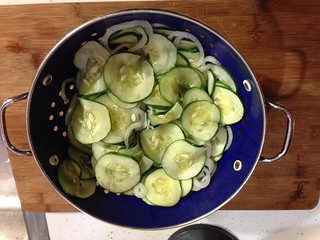
Slice the cucumbers and onion thinly and evenly (I used my old Martha Stewart Everyday mandolin from K-Mart). Layer alternately, sprinkling with salt, in a shallow dish or bowl, and cover, for 24 hours, in the fridge. Drain in a colander, pressing with paper towel to remove excess water.

Place the drained cucumber and onion slices in a bowl and cover with white vinegar for at least four hours, or while you go to work and are unable to leave early as you had planned. Pour the vinegar into a saucepan and boil with a little salt.

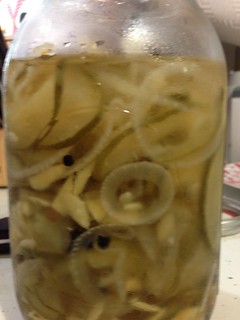
Peel and slice the ginger into sticks, and add to the cucumbers and onion. Sprinkle all with mace to taste, and add whole peppercorns as desired. Pour the boiled vinegar over all, decant into clean, boiled jars and seal.

I tasted these first over the weekend, and they were strong and spicy! The ginger made them a little hotter and sweeter than the ones I had in Cambridge. They seem a little mellower now (I had some with breakfast this morning) and I think they will be OK at OSV this weekend…if I take them. Glass jars seem crazy to pack for camping.