Down and Out in Upstate New York

Other folks have covered aspects of this past weekend at Fort Ticonderoga, leaving me with little that needs adding but much to look into. Portraying a British servant is more intuitive for me than portraying an American: the hierarchy of the British is more explicit than the American, especially in a military context. We mimic the British structure, and while I considered that running a fort’s servant set might/should/would mimic that of a Big House, I wonder if that’s true.
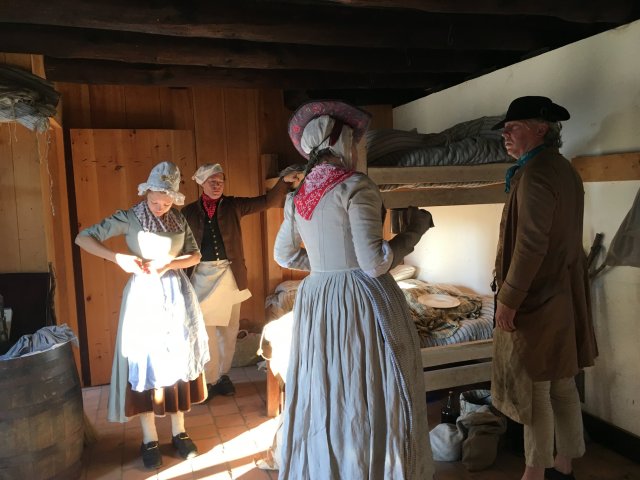
 

Miss S, Mr. B., Your Author, and Drunk Tailor

How did a set of servants from different places, answering to different masters, interact? What  kind of rivalries developed? And who had ultimate below-stairs authority? It’s been a long time since I experienced workplace politics, so the past weekend gave me much to ponder about how the lower sorts managed– and managed up.

For me, the name of the serving game is managing the people you serve to make your own life easier. Servants had so much to do– as many of us do in real life– that the only way to manage the workload was to– well, manage the workload, or at least the person who set it.

As John Brown’s housekeeper, I ran a household of several (three+) servants and six residents. Even a household that small required extensive stair climbing and coordination, even without a working kitchen! The Browns never had more than three or four household servants we could document, which again makes me wonder about the actual number of servants a complement of New England officers would have.
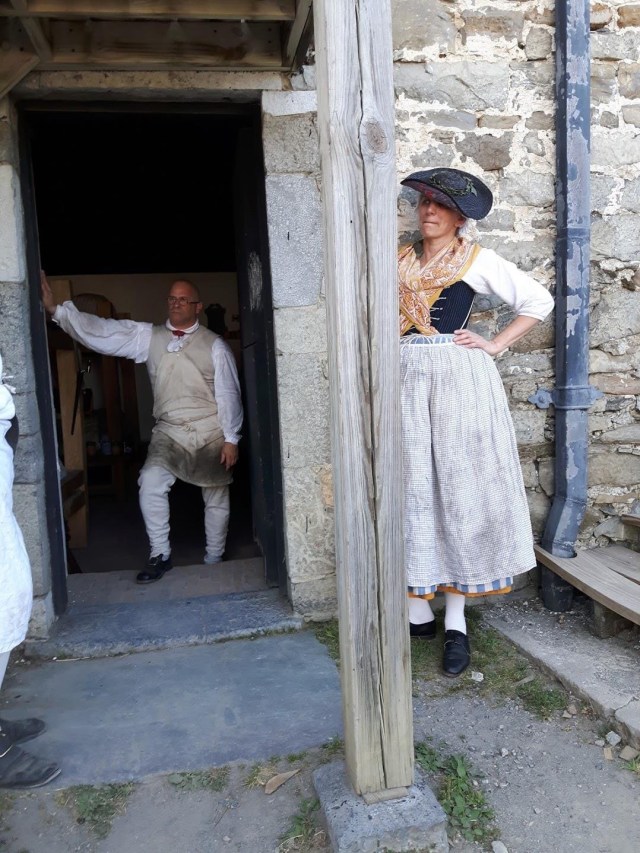
Ow. That’s what my face means. Pierre was a trooper.

Thus far, I’ve found good quantification of servants in Philadelphia households in 1775, but have yet to crack the code on New England or Continental Army servants, so more hours on JSTOR await.

Paul Sandby. At Sandpit Gate circa 1752
Pencil, pen and ink and watercolor. RCIN 914329

No matter what one ultimately decides the research shows about the number of servants and their roles in an American occupied fort, I know I spent the day more immersed than I have been in a long time. Fort Ticonderoga provided a picturesque backdrop, and my body provided a four-dimensional pain experience reminding me of the tribulations of women in the <cough> period </cough>. I spent the majority the day (the part I was awake, anyway) experiencing the full joys of being  female and still fertile. The more I read about archaeology of the 18th century, particularly in the privies and trash pits, the more I think nearly everyone in the past felt pretty awful most of the time. If that hunch is correct, I nailed Saturday despite appearing in undress (which I can at least document to Sandby at Sandpit Gate).
Serving Delaplace

dscn4628

With 400 miles between us, Drunk Tailor and I have few chances to explore the past together, so I was both delighted and nervous when he agreed to join the British Garrison 1775 event at Fort Ticonderoga as one of Captain Delaplace’s servants.  Even better, we were also joined by the itinerant Deep North Yankee who wandered around the Fort (possibly seeking roofing shingles, of which he is much in need).

dscn4631

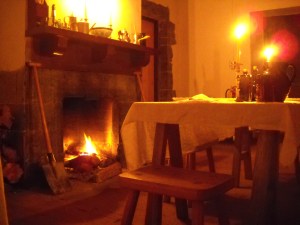
Friday nights are always magical, candle and firelight (and only the warmth of the fire) as we drink cider and talk about history. But morning always comes: Saturday, cold and clear, Mr S and I woke and blinked across the room at each other, and I wondered to what degree I really wanted to ever crawl out of bed…only hunger and an eventual need to pee (and fear of a Sergeant) propelled me.

Yup, you cook 'em on a board.
Yup, you cook ’em on a board.

First order of business: breakfast. Mr S, supplied with his corn meal of choice, made us johnnycakes, which provided perhaps more interpretive than nutritive value. Still, they were warm and tasty and he is the only person I know who can make them; my efforts end up as FEMA disaster sites.

Captain Delaplace’s servants were tasked with cooking for his mess, so Mr S and I got a start. We had a chicken, an onion (I traded onion # 2 for some bacon), butter, carrots, potatoes, a butternut squash, salt, and some port. I don’t know where this English serving woman of 1775 encountered mis en place, but she accidentally introduced coq au vin to the Captain’s table with the dinner meal.

Captain and Mrs Delaplace dining, manservant in attendance

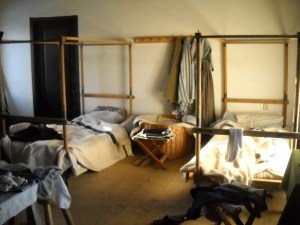
The Captain and his Lady dined on chicken braised in butter and bacon with root vegetables in a port sauce; we servants waited until they were done before we could eat. (Confession: I need to eat a lot, and have a sensory overload problem, so when visitors fully crowded the room, I had to dash across the parade ground for a Clif Bar and an Ativan before I could continue to wait for my dinner.) In the afternoon, dishes were washed at the table, as was common (at least in early New England), dried, and set away, while the Captain’s lady and child played in the cabbage patch between the beds.

dscn4657

When the room was empty, servants were able to eat (huzzay!) and found the meal very tasty indeed. I would certainly make this again, and learned more about cooking– a typically female task I generally try to avoid– than I had expected to. Then we had yet another round of dishes before it was time to tidy the room and make ready for tea or supper.

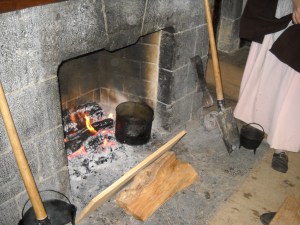
To that end, we cleared the table and broke it apart to reveal the floor and hearth, which needed to be swept of bread crumbs, squash peels, dead leaves, and other detritus. The best way to sweep an unfinished floor in the 18th century (per Hannah Glasse et al) is to strew the floor with wet sand and then sweep. I mixed sand with lavender-infused vinegar and threw it on the floor; this keeps the dust down as you sweep months of dust and dirt out of the corners and from behind tables and chests.

The trick is to sweep in one direction (more or less) from the back of the room to the front, and then to gather up the sand (here in a shovel) and pitch it off the landing. Much was thrown out the door and over the stair rail, just as servants would have done in 1775. (And I am told it is soothing to nearly hit the sergeant, but perhaps that’s merely hearsay, if not heresy.)

img_9478

When we were done, we restored the table (Drunk Tailor noticed the height of the ceiling, and wondered about hanging birds in cages whist awaiting the return of the tabletop), fully reset with cloth, candlesticks, plates, and knives, ready for the supper we didn’t cook, as we skipped away at the close of the day to find our own meal in Glens Falls, where live music is inescapable on a Saturday night.

Can it!

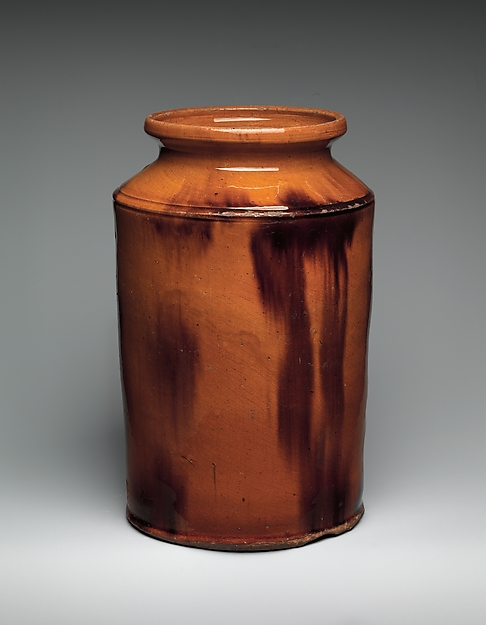
Jar. Paul Cushman, 1805-1833. Stoneware. 20032.475

Or, how do you keep your pickles?

At work, we have found that the road to history is paved with unexpected documents. As often happens, while looking for something completely different, m’colleague and I found two documents that might help illuminate the question of food preservation and storage in the 18th century.

Probate inventories: I read all the way through and had one of those d’oh! moments. Why? Because at the end, there’s all the kitchen stuff. Andirons, warming pans, roasting pans, kettles, firkins, kneading trays, piggins, barrels, casks, bottles. This is the stuff of cooking and keeping food.

There are clues in the receipts (recipes): Amelia Simmons gives a hint in the final instructions “To pickle or make Mangoes of Melons.”

“put all these proportionably into the melons, filling them up with mustard-seeds; then lay them in an earthen pot with the slit upwards, and take one part of mustard and two parts or vinegar, enough to cover them, pouring it upon them scalding hot and keep them close stopped.”

To pickle Barberries ends thusly:

“let it stand to cool and settle, then pour it clear into the glasses; in a little of the pickle, boil a little fennel; when cold, put a little bit at the top of the pot or glass, and cover it close with a bladder or leather.”

Jar, Thomas Commeraw.1797-1819. Stoneware. 18.95.13

To pickle cucumbers:

“put them into jars, stive them down close, and when cold, tie on a bladder and leather.”

To keep Green Peas till Christmas:

“have your bottles ready, fill them, cover the them with mutton suet fat when it is a little soft; fill the necks almost to the top, cork them, tie a bladder and a leather over them and set them in a dry cool place.”

If we tease these apart, we come up with some basics: preservation is done with pickling and “putting up” foodstuffs in pots, jars, bottles, and glasses. These are sealed with bladders, which are tied on; there is a sense in the first receipt that “close stopped” might imply corkage, but the repetition of bladders in the following receipts suggests otherwise for most of these; the entry for Emptins does state “will keep well cork’d in a bottle five or six weeks.”

Covered jar, Connecticut. Earthenware, 1800-1830. 18.27.1a, b

The other key? You’ve probably come across food packages that require storage in a “cool dry place,” and as we have cupboards in our kitchens, or perhaps in our pantries, early cooks also had pantries or butteries (say it but-trees). How’d they do it?

Jar,. Earthenware, 1800-1900. 18.95.11

The 18th century house was not centrally heated. 18th century Providence residents recorded temperatures of 48 and 58 degrees indoors in the winter, in rooms with fireplaces. An unheated room or cellar would be cool, too; here in the Ocean State, maintaining dry conditions could be the bigger challenge.

What did those jars and pots look like? As you can see in this post, the Met has a few– fortunately, these appealed to collectors and wound up in museums. Closer to home for the original question, the Missouri History Museum has a collection with a number of jars. A cursory look showed dates in the 1830-1860 range, but the shares are consistent with those seen at the Met.

I’m not a food historian, and I don’t pretend to be, but as I think about answering a question, these are the steps I take. Recipes, collections, and then more looking. I just hadn’t remembered that probate inventories would list everything, so one might get a sense of a household’s contents and thus its eating and storage habits.

Gingerbread (in the) House

Illustration by Tasha Tudor

Here we are again, at the time of year known as Impending Parental Visit, which causes a variety of reactions ranging from full-on repaint the kitchen and both baths freak out (whilst nursing an 8-week-old Young Mr) to Eh, she’s got a dog acceptance.

This year, Mr S had the freak out, and has undertaken a living room painting project which he has carried out on weekends since Thanksgiving. It does look good, and I am grateful for his persistence, because this year’s late fall and early winter brought me a serious case of the blues.

That's a happy cat!
happy cat!

I’m in the midst of trying to finish a dress before my mother arrives (my sewing area is really our dining table, with the Strategic Fabric Reserve stowed in sideboards and cupboards). Yesterday, I tried it on: it fits, and looks rather nice (grey wool, and when it’s done, you’ll see it). But it fails in intention: clearly, it is no maid’s dress.

But I felt so much happier in my stays and petticoat that I dug up the wool dress made for farm adventures, put on my apron, and made ginger bread.

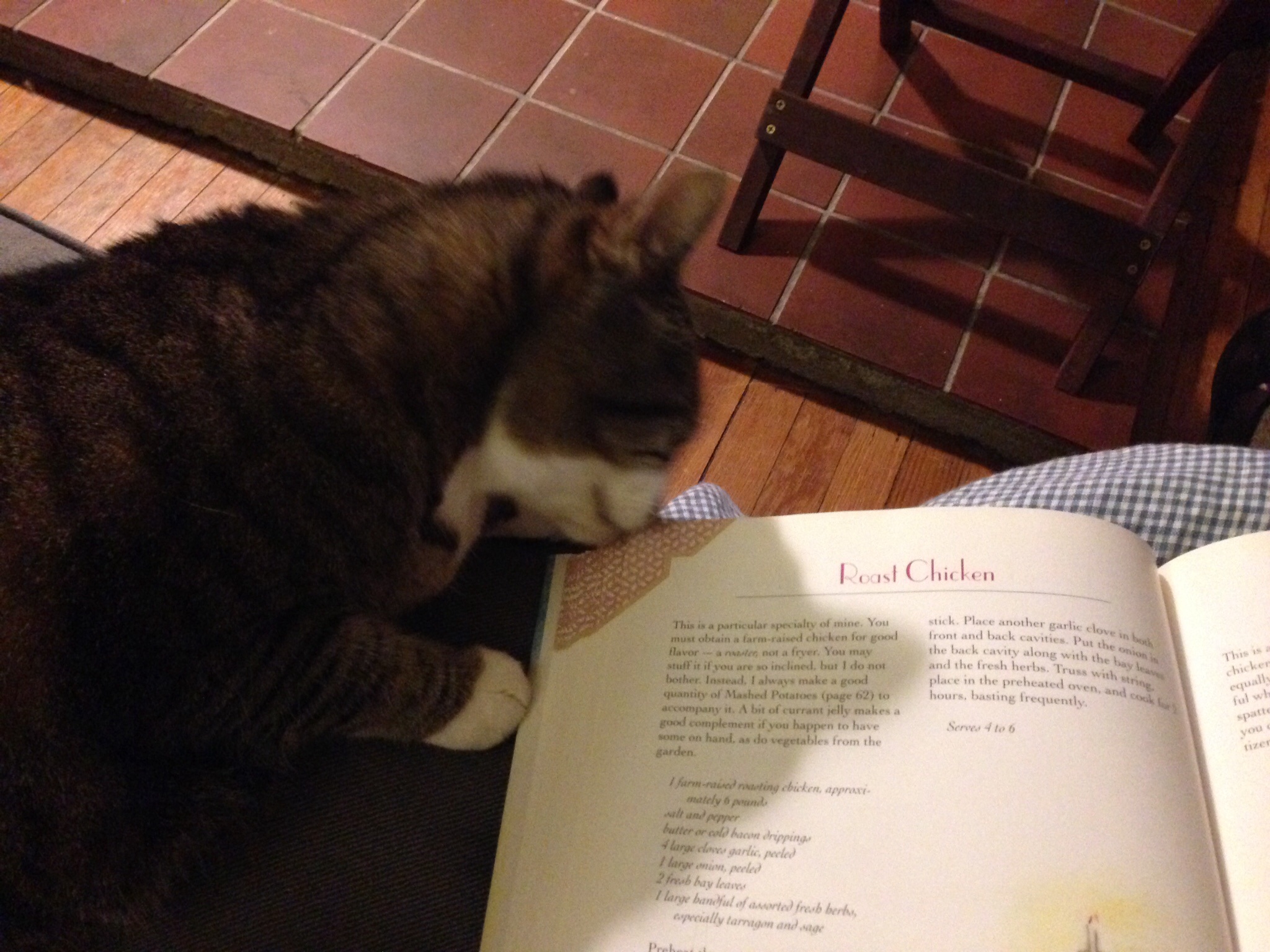
The cat approves of my reading material.

The recipe, which I shared recently with a friend, is an old Rhode Island family receipt, and very similar to the Tasha Tudor cookbook receipt. (The Howling Assistant approved of Tasha’s Roast Chicken receipt. She is a poultry fan.)

When copying over the receipt for my friend, I forgot the hot water, and failed to warn him that this gingerbread cake is best eaten with a fork. Delicious, but sticky, here it is:

1/4 cup butter, room temperature or a little softer
1 cup sugar
1 teaspoon baking soda
1 cup boiling water
Combine the last two ingredients and pour over the butter & sugar.
Add 3/4 cup molasses
Combine well.

Sift into the liquid mixture:
1.5 cups flour
1/2 teaspoon ginger (I use a heaping 1/2 tsp)
1 teaspoon cinnamon
pinch salt

Combine gently. Into the mixture drop one unbeaten egg.
Beat the whole with a hand-cranked eggbeater or whisk.

Pour into greased 9×13 pan, and bake at 350F for 35 to 40 minutes, or until a toothpick comes out clean.

Gingerbread cake
Gingerbread cake

Good with tea, coffee and clementines. I’ve made this perhaps a dozen times, once without the egg, and it’s always edible. (The egg provides some leavening, so made without it, the cake is dense and extra sticky.) Baking it makes the whole house smell good and it’s a simple, one-bowl receipt. For an easy holiday treat to share, I recommend this Rhode Island Gingerbread Cake.