Order!

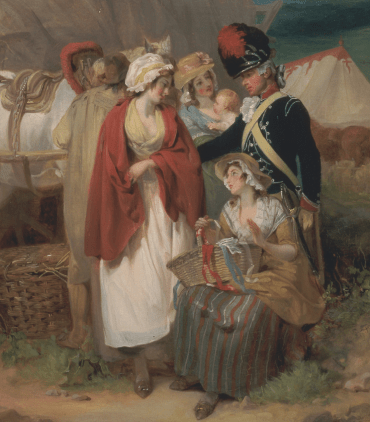
Francis Wheatley, 1747-1801, British, Soldier with Country Women Selling Ribbons, near a Military Camp, 1788, Oil on canvas, Yale Center for British Art, Paul Mellon Collection

You know you’re taking something seriously when you’re willing to pay for the privilege of reading a primary source. The microfilm I ordered from the Phillips Library arrived a week or so ago and I managed to snatch an hour or so between meetings to read and print some of the most interesting pages. I get a week or so more before the reader at work goes to storage, and then I’ll have to go haunt another library.

This is the kind of stuff I will happily read at bedtime, though it should also be noted that I will read regimental record books at bedtime, or runaway ads, so we may not share tastes in literature.

I was willing to pay for the film because I wanted to read the books in full to get a better sense of the context in which Bridget Connor was operating. (Delightedly, I realized last night as I fell asleep, of course there’s no death record for her in Massachusetts. She was expelled from camp at Newburgh, so why would she walk all the way back to Massachusetts? Why not set up a new life in New York? A whole new place to look for her!)

Beyond Bridget, there’s a wealth of detail in the Stephen Abbott Orderly Books.

Thomas Sandby, 1721-1798, British, Encampment at Maestricht, 1747, Pen in black ink, over graphite with gray wash on medium, moderately textured, beige, laid paper, Yale Center for British Art, Paul Mellon Collection

“Regl Orders 5th June 1782
the Regiment will make Every preparation
to March on Fryday the Soldiers are to
Clean there arms to Morrow and pack up
there Clothing.. The Commedants of Com
apanies are Directed to Send the tent poles
which are Finished to Morrow by 12 oClock
to the Landing where the tent Lay the Guard
with the tents will pitch a No of tents Suff
iciant to Cover the Straw and what ever Bag
gae is Brought previous to the march”

This helps us get a picture of the camp, and from the order about the tent poles, I think we may gather that there were plenty of tent poles NOT expected to be finished. (My colleagues enjoyed that part when I read it aloud at work.)

Regimnl Orders June 6th 1782
the Regiment will turn out to Morrow Morning
at the Beating of the Revelee and to March
By Six oClock they are to pack there cloth
ing and kook there provisions this Evening
when they have arivd on the Ground for Encam
ping the officer commanding on the Spot
will order a partry if Forty men from the Reg
iment a Capt and two Sub’s to Command them
to Return to the Encampment in order to asist
in Bringin on the Baggage the Soldiers
are to Carry there kittles in there hands and
are to Leave there arms and pakes &c at the
New Encampment any Soldier who is found
Plundering another pack is to be tyd up and
punished with out Trial..

Carry their kettles in their hands, their provisions cooked the night before. Now, wouldn’t that change an encampment’s appearance? Let alone tied up plunderers…

Who was Bridget Connor?

Detail, James Malton, 1761-1803, A Military Encampment in Hyde Park, 1785, Watercolor with pen in black ink, with traces of graphite on moderately thick, moderately textured, beige, laid paper, Yale Center for British Art, Paul Mellon Collection. B2001.2.999
Detail, James Malton, A Military Encampment in Hyde Park, 1785. YCBA Paul Mellon Collection. B2001.2.999

Who knows? She’s hard to find, though I am told and have real hope that the microfilm of the Abbott orderly books that chronicle her misdeeds in wending its way to me down the dirty, salt-and-sand covered highways of southeastern New England.

Where have I looked for her and Francis Connor, whom I presume is her husband?

Francis appears in Soldiers and Sailors of Massachusetts, for seven months’ service. That’s all I can find.

Well, crap, right? This genealogy stuff in Massachusetts is hard work—there are so many more people and towns than we have here in Li’l Rhody—but diligence and method pay off, and when you figure you’ve about exhausted the primary sources you can access for now,[1] you turn to secondary sources.

Lest you think I dislike Deborah Samson, note that I found her life a useful source in thinking about Bridget, as well as Book of Ages and Jane Franklin Mecom’s life. I’ve also been re-reading Holly Mayer’s Belonging to the Army.

Crippled soldier with family. Etching, London (?) ca. 1760. Lewis Walpole Library, 760.00.00.16

The common denominator: poverty, and the resulting lack of choices. This is useful for Bridget, because her story is probably one of necessity. Most women who followed the Continental Army, and worked for it, were from the lowest ranks. [2] These are women who would do what was necessary to survive, and as Mayer notes, “would rather steal than starve.” [3]

I’m not suggesting that Bridget, who would likely have received rations, needed to steal shirts to survive: I rather think she was attempting to leverage her position and profit by ill-gotten gains. But how did she end up in the Army to begin with? Massachusetts in 1782 is not New York in 1780, or Rhode Island in 1778.  What drove her to (presumably) follow Francis Connor?

Late in the war, maintaining troop strength is more difficult. The fervor of patriotism has cooled, and recruiting sergeants find it harder to fill the ranks.[4] There are bounties to be had, and the economy has suffered. Could Francis have been a property-less laborer who enlisted for the bounty? Nothing talks like cash. And, if the couple were tenants somewhere, without Francis’ income, Bridget might not have been able to maintain a home. Laundry doesn’t pay that much.

Why didn’t she stay with family? Could they have been indentured servants? Could they have been immigrants? My guess is that Bridget had no family, and if Francis had family, Bridget got on with them as well as she did with the officers of the 10th. I think she had nowhere to go, no way to survive without Francis.

Did they love each other? Did they like each other? Were they grifting together? I don’t know—but Francis Connor deserts the same day Bridget Connor is expelled from camp, so they’re bound together in some way. No matter what, Bridget was assuredly dependent on Francis.

Knowing so little about them opens up a world of possibilities, and the “opportunity” to do a great deal more research on the context of 18th century Massachusetts populations and enlistments. My best guess is that they’re an unpropertied laboring class couple from Boston, source of many of the relatively unstable and non-homogenous companies that made up the 10th Massachusetts. I also think they don’t have family, and might be former indentured servants. I have guesses about their religion and country of origin, which could be why the records are so hard to find. [5]

Looking for Bridget, and not finding her, leaves me with more and more questions, and I’m happy about that.


[1] She’s in the Abbott Orderly books, at least. Other Orderly Books to follow, as time and funds permit.

[2] Mayer, Belonging to the Army, page 122.

[3] Mayer, page 127

[4] How do you think Deborah Samson got in, passing as a boy? That’s 1782 for you.

[5] The Catholic Diocese of Rhode Island maintains separate historical vital records, and when we cannot find someone in the usual town records, we ask the genealogist if their family is perhaps Catholic or Quaker. Lack of evidence can be a suggestion of faith in my home state. But could these two be Irish Catholic in Massachusetts in 1782? I have no idea, but it seems a great stretch and a great question all at once.

Anachronisms, ahoy!

Deborah Sam[p]son (Gannett), oil on paper by Joseph Stone, 1797. RIHS Museum Collection, Gift of Jesse Metcalf, 1900.6.1

There’s a petition circulating in certain government circles in support of a campaign to give Deborah Sam[p]son her very own stamp. This is, in part, fueled by the upcoming 250th anniversary of the founding of Sharon, MA.

I’ve got no problem with that—commemoration is something we humans do and need. And Deborah Samson’s is an interesting story, but possibly not for the reasons cited in the letters from officials who shall remain nameless. They describe her as “a pioneer of promoting women’s rights and eliminating gender barriers” and “a trailblazer for gender equality,” phrases that would have been just about nonsense in the Revolutionary war period.

And that’s my problem with it: the anachronistic representation of a woman’s story, bent to the purposes of the present. Don’t get me wrong—I’m a feminist, I’ve enjoyed Deborah Samson’s story since I read about her as a kid in one book or another, so I sympathize with the Stamp Movement.

What makes me crazy is bad history.

Hannah Snell, as depicted in an excerpt from "The Life and Adventures of a Female Soldier," the narrative of the most famous cross-dressing British soldier of the century. It appeared in Isaiah Thomas's New England Almanack (Boston, 1774). Printers recycled the image on other imprints. American Antiquarian Society.
Hannah Snell, as depicted in an excerpt from “The Life and Adventures of a Female Soldier,” the narrative of the most famous cross-dressing British soldier of the century. It appeared in Isaiah Thomas’s New England Almanack (Boston, 1774). Printers recycled the image on other imprints. American Antiquarian Society.

In Masquerade, Alfred Young tells Sampson’s story well, busting myths that both we—and she—created. (This short bio is a good overall sketch of Deborah’s life. ) What struck me the most about Deborah Samson’s life was the lack of certainty, stability, and material comfort. We’ll never know the specific circumstances that led her to enlist, though Young does yeoman’s work to unearth everything he can about her life and circumstances, and the context in which she lived.

I’m not an unbiased reader—I did get a little shouty on the third floor when I read “trailblazer for gender equality,” and that phrase has lingered and grown tattered as my colleagues and I have chewed it over—but Young’s point about women of the lower sorts is well taken.

Here’s an excerpt from an interview with Young about the book:
“In cross-dressing, Deborah was like a good many other plebeian women we are discovering who were in flight: to escape indentured servitude, to avoid the shame of a pregnancy, to get out of the reaches of the law, and so on. But to explain why she carried it off so long, you have to fall back on her skills and resourcefulness.”

So much for that pioneer of promoting women’s rights—Samson was a pioneer in skillful deceit (no mean feat) and in using that deceit to further the main chance, that is, Deborah Samson’s chance. What’s wrong with that? I like that better, and that’s my bias and my interests.

Reading about Deborah Samson helped me think about Bridget Connor and the women like her, probably less skilled and less educated than Samson, probably even more impoverished. It’s a mysterious mix of personality and circumstances that drives us all, but considering what we can know about Deborah Samson helps us understand her not so much as a pioneer for gender equality but as a self-interested human being acting for herself despite the barriers of class, education, and gender. And that can help us understand the people we can know even less about, like Bridget Connor.

For a taste of historical prose, you can find an annotated version of Samson’s story written by Herman Mann here, at Harvard University Library’s digital page delivery system.

Camp Followers or Women of the Army?

Soldiers and Camp Followers Resting from a March. Jean-Baptiste Pater, 1730. private collection. used from Wikimedia Commons.

I prefer woman belonging to the army, or “regimental woman,” which sounds like Mick Jagger or Roy Orbison could sing it, but one could have a pretty lively discussion of which term to use. Camp followers has a connotation–prostitute–that doesn’t reflect the full reality of army life for women in either the British or the Continental armies.

Were there prostitutes who took advantage of the proximity of a large customer base? Yes, undoubtedly. In the John Robinson Waterman Papers there is an unusual letter from Col. William Battey dated October 28, 1812 with a sketch of the army camp near Albany and a description of camp life. This description includes the treatment of a woman accused of prostitution and summarily banished from camp. I think she was beaten and half-drowned, so the army took the no-prostitutes-whatsoever dictum very seriously.

As far as cooking goes, a commenter elsewhere explained that women would have been cooking, at least for themselves. Typically, they did not cook for the soldiers’ mess, unless they were being paid to. This must have been a difficult situation for the Continental Army: when women were present, it made excellent sense to assign them all possible non-combatant tasks to ensure the maximum fighting force. But could discipline be maintained? Not always, given Bridget’s temper.

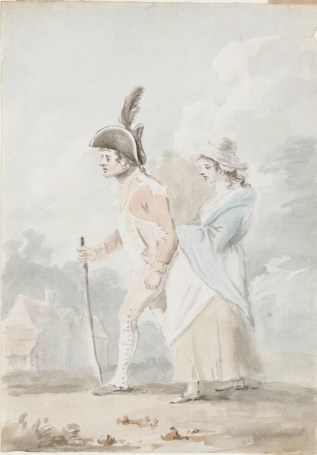
A soldier and his girl. Henry Bunbury, ca. 1794. Lewis Walpole Library, Drawings B87 no. 8

Rolling back a bit and trying to consider the army’s structure and camp layout, what are the mechanics of handling rations for women with the army? How are they fed? And did it vary, unit by unit? There is probably far more variation than we credit, that will only be illuminated by careful attention to the documentary record. That means finding as many victualing rolls and returns as possible, looking for women. It means reading all the orderly books that can be found, looking for women.

The best secondary source I know for the Continental Army’s women is with Holly Mayer’s book, Belonging to the Army. (And I’ll admit I haven’t read it in two years, so it’s time to re-read it.) If you’re British, I’m not in a position to help you as much, but there is Don Hagist’s work on Women of the British Army. For a more granular understanding of women in all armies, you have to turn to primary sources, and what’s available varies from unit to unit, state to state. There is a handy index of orderly books,  and while these vary in their utility, they are a good place to start. In fact, the whole RevWar 75 site is useful (though it is not loading at the time of this writing).

Soldiers’ diaries and accounts are also useful. Jeremiah Greenman of the 2nd Rhode Island Regiment recorded his experiences throughout the entire war, starting in 1775, when he joined Arnold’s expedition to Quebec. There were two women on that expedition, attached to two different companies. While there is not a plethora of detail about the women, it is clear that they were strong and able, and in one case, more able than her husband.