Interpreting Bridget

Shirts? What shirts?

This weekend, we’ll be at the Brigade of the American Revolution’s School of Instruction, taking anxiety to the Hudson Highlands as I give a presentation on interpretation. Sure, it’s part of my day job to interpret objects and documents and even, sometimes, to do costumed interpretation, but experience has never prevented me from worrying. It has allowed me to focus my worries more productively and specifically. One of the things we’ll be trying, or attempting to try, are vignettes based on the shirt-stealing and selling ring of 1782.

Events from Captain Abbot’s Orderly Book for interpretive vignettes

Soldiers Steal a Shirt and dispose of same (~July 13-14, 1782)*
Cast: Two soldiers, officer who catches them
Props: shirts

Court-Martial July 15, 1782: Paul Poindexter and Titus Tuttle, for theft of a shirt
Cast: Two soldiers, accusing officer, three officers of the court
Props: Shirt; table and seats, orderly book (optional)

Discovered buying a shirt (~July 21-22, 1782)*
Cast: Bridget, soldier selling shirt, officer who catches them
Props: Shirt(s), money

Court-Martial July 23, 1782: Bridget tried for buying a ‘publick shirt’
Cast: Bridget, accusing officer, three officers of the court
Props: Shirt & money; table and seats, orderly book (optional)

Insolence to Officers of the 10th Mass (~July 23-24, 1782)*
Cast: Bridget, officers (two preferable, one adequate)
Props: None required, large stick probably handy

Court-Martial July 25, 1782: Bridget tried for insolence
Cast: Bridget, accusing officer, three officers of the court
Props: Table and seats, orderly book (optional)

Expelled from camp, July 25, 1782*
Cast: Bridget, drummer, officer(s), jeering onlookers; Francis skulking at the edge
Props: Drum, Bridget’s chattel

* Events are extrapolated from the Orderly Book as things that must have happened to cause the events that followed.

We’ll see…in the meantime, I’m finishing up a shirt for the Young Mr, so that his small clothes will no longer be too-small clothes, and so we have extra shirts for this black market ring.

Order in the Court

Female court martial : held upon the conduct of an admirable lady. [London? : s.n., 1757] Lewis Walpole Digital Library 757.03.00.04+
Female court martial : held upon the conduct of an admirable lady.
[London? : s.n., 1757] Lewis Walpole Digital Library 757.03.00.04+

Everything I think I know about courts-martial I learned from the movies (The Caine Mutiny and Breaker Morant, or Paths of Glory) but thankfully I can realize that knowledge is probably not so applicable to Bridget and her context.

Thanks to Yale, it’s easy enough to find the  Rules and Orders for the Continental Army, as set down by the Continental Congress in 1775. I don’t have to know this, the guys know it, but it’s helpful for me to understand what’s happening. I also figure Bridget would have known how the system worked (or should have) since she was part of it, and would have observed life around her. In the same way that I understand the  organizational politics and policies of my workplace, she and the soldiers would have understood the rules and regulations under which they lived and worked.

In the first case, remember the shirt-selling soldiers? Here’s the regulation they were breaking:

“Art. XV. Whatsoever non-commissioned officer or soldier, shall be convicted, at a regimental court-martial, of having sold, or designedly, or through neglect, wasted the ammunition, arms, or provisions, or other military stores, delivered out to him, to be employed in the service of this Continent, shall, if an officer, be reduced to a private centinel; and if a private soldier, shall suffer such punishment as shall be ordered by a regimental court-martial.”

There you have it: they sold provisions or “other military stores” delivered to them to be employed in the service of the Continent, and suffered such punishments as were ordered.

And Bridget? Well, for one thing, she should have known she was subject to the articles, rules, and regulations. She was one of those “all persons whatsoever.”

“Art. XXXII. All suttlers and retailers to a camp, and all persons whatsoever, serving with the continental army in the field, though not inlisted soldiers, are to be subject to the articles, rules, and regulations of the continental army.”

Technically, I cannot find anything stating outright that one could not buy issued goods from the soldiers to whom it had been issued, but since selling it was wrong, receiving was wrong, too.

We know from the final punishment that Bridget probably breaks yet another article:

“Art. XL. No person whatsoever shall use menacing words, signs, or gestures in the presence of a court-martial then sitting, or shall cause any disorder or riot, so as to disturb their proceeding, on the penalty of being punished at the discretion of the said court-martial.”

I think the “the Insolence to the officers of [the 10th Massachusetts] Regiment” may have taken place at the court-martial, given the swiftness of her punishment.

The Shurts off there Backs

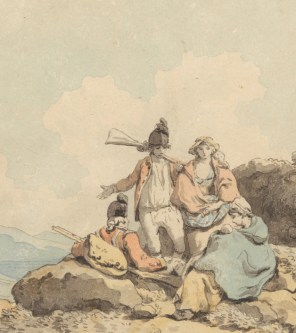
Francis Wheatley, 1747-1801, British, Soldiers and Country Women, undated, Pen and black ink with watercolor on medium, smooth, cream wove paper, Yale Center for British Art, Paul Mellon Collection

Among the things I wondered about Bridget Connor and her court martial was from whom she’d bought that “publick shurt.” Why would a soldier have an extra shirt, or be willing to sell an extra shirt?

There are some circumstances in which it is plausible.

ClothingRegs1776_77

While shirts could have been sent from home,  regulations established in 1777 called for soldiers be issued two shirts, or an equivalent bounty. A soldier who wanted cash for alcohol or other non-regulation and non-issued goods or services might sell his second shirt, or steal a shirt to sell.

With the context of what soldiers should have been issued, we can  begin to tease the story out of the orderly books.

Regimental Orders July 15th 1782

At a Court Martial whereof Capt Dean was pre
sident, was tried Paul Pendexter & Titus Tuttel
soldiers in the 6th Company 10th Massachusetts Regt
For Stealing a Shurt and Disposing of the Same
ware Both found Guilty and Sentancd to Sixty Lashes
on there Naked Backs—the Colo approves
the opinion of the Court and orders it to
take this Evening and the prisoners to Return
to Duty——-The Court Martial of
which Capt Dean is president is Desolvd

The quote above is a full seven days before Bridget appears at her own Regimental Court Martial “for purchasing a publick Shurt from a Soldier.”

Paul Pendexter and Titus Tuttel were just the guys to get caught, until Bridget was discovered. It does make me wonder if there was an extensive ring for black market shirts (and where did they go once Bridget had them? Did she try to sell them back into the public stores, i.e. the quartermaster)?

Criminal masterminds these people weren’t, but it does seem possible that the Shirt Ring was fairly busy before it was collared.

tite Dressed

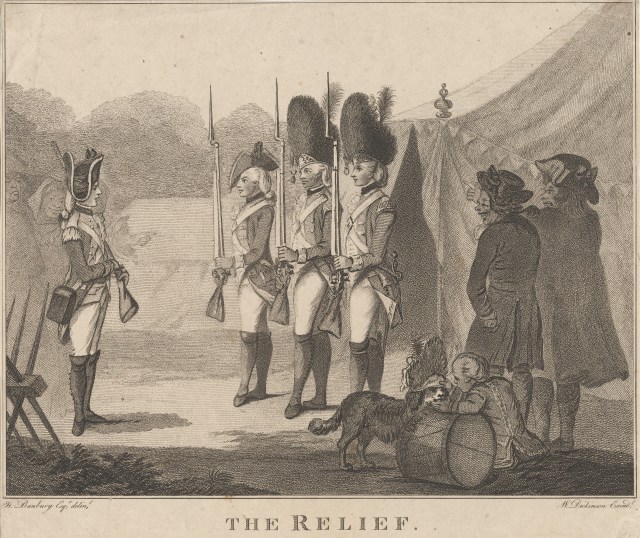
William Dickinson, 1746-1823, The Relief, 1781, Stipple engraving and etching on moderately thick, slightly textured, beige laid paper, Yale Center for British Art, Paul Mellon Collection

Reading the Abbott orderly books takes some patience, even though they have been transcribed. As with so many 18th century texts, punctuation is unreliable and open to interpretation. Here’s an entry from July, 1782, on the subject of uniforms, guard duty and fatigue duty.

July 22 1782
The Greatest Care and aten
tion is to Be pade to the preservation of the Mens
Clothing and to keep the Cloth Clean.. As
the Guards are always to Be fill Dressed in
uniform they are not while on that Duty to be
put on Ferteeg or any kind of Meaniel service
but to appear Clean, tite Dressed and In a
Soldierly manner when any parties for
Ferteeg are Necesery they are not to be applied for
and Sent in there undress or Ferteeg Clothes
this order to be Strictly observed

Which seems in more sentence-like form to be:

The greatest care and attention is to be paid to the preservation of the men’s clothing and to keep the clothes clean. As the guards are always to be full dressed in uniform, they are not, while on this duty, to be put on fatigue or an kind of menial service, but to appear clean, tight dressed, and in a soldierly manner. When any parties for fatigue are necessary, they are not to be applied for, and sent in their undress or fatigue clothes. This order to be strictly observed.

Here’s what I think it means:

Pay attention to the men’s clothing and keep it clean.
Men assigned to guard duty are always to appear in full uniform. When on guard duty, these men are not to be assigned to fatigues or menial duties. They should instead always appear clean, neatly dressed, and solider-like. When fatigue parties are called, the guards are not to be assigned to that duty, so that they do not appear on guard in their fatigue or undress uniforms. This order is to be strictly obeyed.