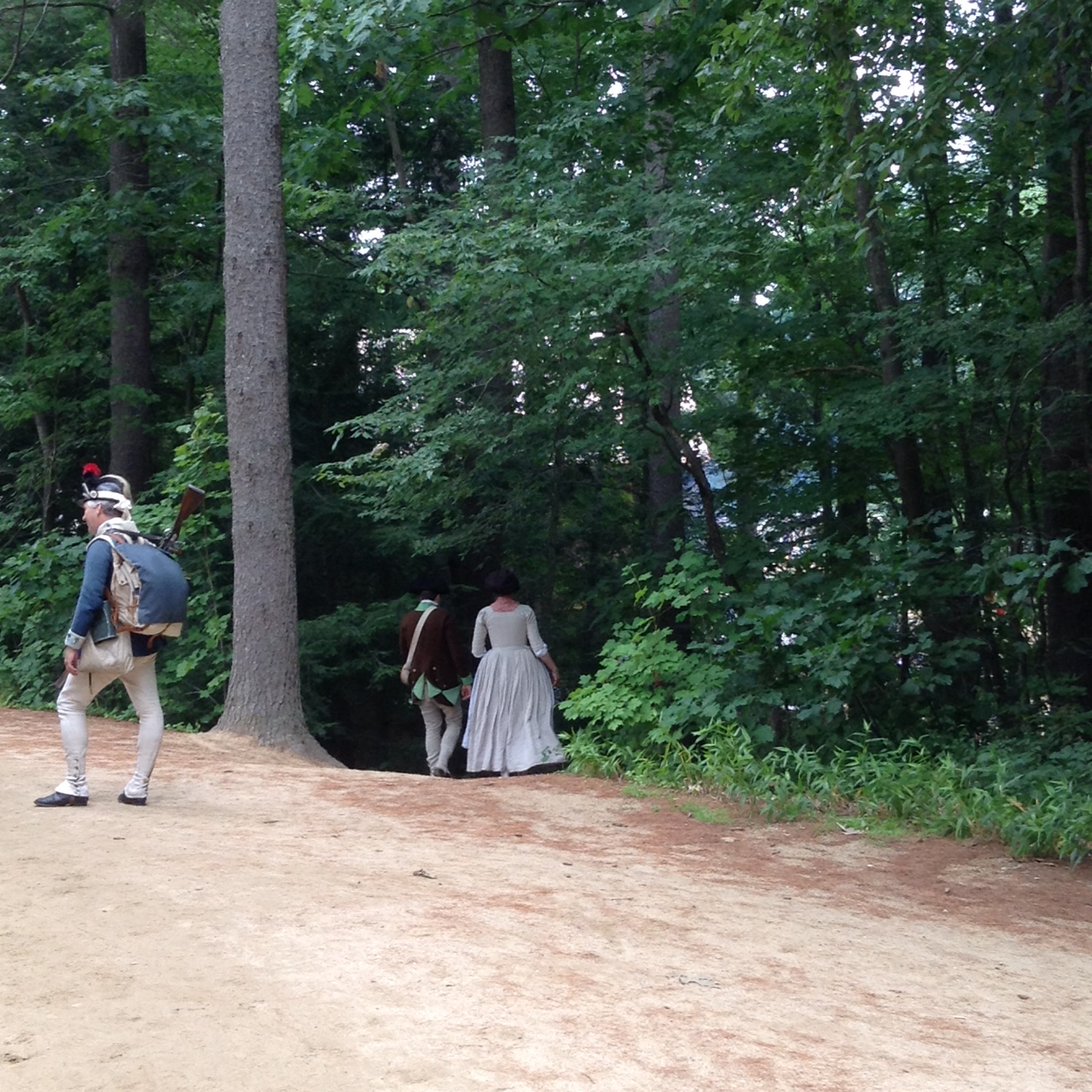
Coats and Cooking

And happy not to be walking to Walloomsac, since we can’t leave till Friday.

Before we leave, there’s plenty to done, of course, and most of it in men’s wear.*
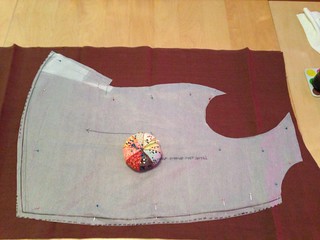
The first piece on brown linen

The Young Mr needed a new jacket, a proper one, with pockets and everything, correct for a scalawag. So that meant patterns and muslins and fittings and questions, until neither of us could really stand the other and his father called me an ambush predator of fittings. The only way to fit these wily creatures is, as they amble through the room, to leap out and toile someone.

With the pattern more-or-less fitted to the wiggly Young Mr, I cast about for fabric: there was not enough of a striped piece for both waistcoat and jacket; waistcoat won, because matching stripes on a jacket seemed too risky in this great a hurry. Instead, I sacrificed the last yardage once meant for a gown.
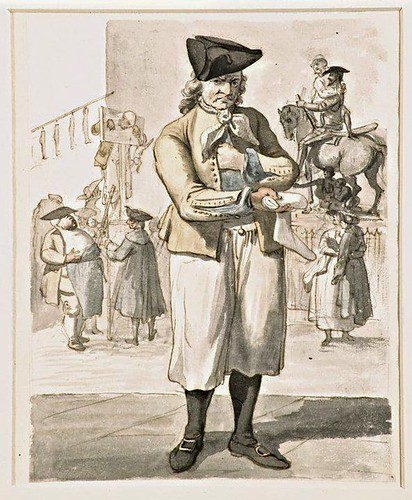
The Stocking Seller, by Paul Sandby, 1759

This is the inspiration for the kid’s new garment, along with Sandby’s fish monger. It seems a plausible garment to work from, and the brown linen is in keeping with the brown linen jacket at Connecticut Historical Society and the unlined linen frock coat recently sold at auction. It will also match his trousers, but this is what happens when you sew from the stash.

One pair of breeches altered, one waistcoat wanting the last seven newly-made buttons, one waistcoat in production, one jacket in production: you’d think that would be enough to get done. But I’m also working to expand my cooking repertoire, as bread and cheese gets tiresome and scrounging broken ginger cakes from the Sugar Loafe Baking Co.— while potentially good theatre–is not a solid plan for sustenance.
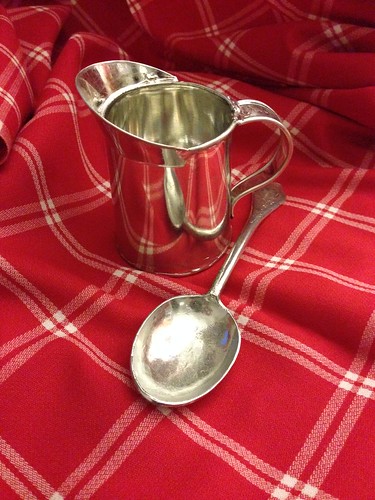
half pint and spoon measures
Half-pint and spoon

Boiling food in summer- sounds awful, right? But it’s an easy and correct way to cook,once you translate recipe measures and control the amount you’re making. I like to use Amelia Simmons’ cookbook, because it is specifically American, and my more skillful friends cooked from it at the farm.

From Enos Hitchcock’s diary, I know that he ate a boiled flour pudding with some venison stew (near the Saratoga campaign, I think) so I consider this a plausible recipe for the field, pending eggs, of course.

A boiled Flour Pudding.

One quart milk, 9 eggs, 7 spoons flour, a little salt, put into a strong cloth and boiled three quarters of an hour.

Simple enough, though Simmons later corrected the receipt to 9 spoons of flour, and boil for an hour and a half. I got out the spoon, and looked online at modern boiled pudding recipes, and will give a modified version a whirl sometime this week (always better to fail at home than in the field). Boiling the pudding in a linen cloth in a stew would make a savory bread substitute…and I really liked the one we had at the farm. Will the gentlemen at Bennington like it? Perhaps we’ll find out. If we’re not cooking with hosewater, almost anything should be edible.

*Yes, it’s a terrible and terribly dated show, but I always hear  this in Mr Humphries‘ voice from Are You Being Served?

The Coats of August

Coat, Nantucket Historical Association, 1985.0068.001

I could have a coat problem so very easily. Look at that coat!

I was looking for something else when I came across this coat. Pity my friend who got the excited, “Who do you know on Nantucket?” text message, because after I saw this coat and couple others, I was checking out the high speed ferry schedules. (They’re not too great; I’d need to stay overnight at least one night– poor me, right?–which means this must be a winter visit.)

Once you’re hooked on 1812, it’s hard to travel back in time, but travel back I must, for Bennington is just a little over a week away.

What am I thinking? Well, in my madness and in the face of the enormous growth of the Young Mr, here I am thinking Coats in August.

Paul Sandby, 1731–1809, British, London Cries: A Fishmonger, ca. 1759, Watercolor and graphite on medium, cream, slightly textured laid paper, Yale Center for British Art, Paul Mellon Collection
Paul Sandby, 1731-1809, British, London Cries: A Fishmonger, ca. 1759, Watercolor and graphite on medium, cream, slightly textured laid paper, Yale Center for British Art, Paul Mellon Collection, B1975.3.210

I know, Bennington/Walloomsac is 1777, so why am I looking at 1759 coats? Because I’m thinking a short-skirted workman’s jacket for the kid, of striped linen, rather than another frock coat. My plan–such as it is– is to alter the  pattern I know fits him to make these shorter skirts…we’ll see how this experiment goes, and hope for fewer than six toiles!

By next Friday night, I need to complete:

  • One new coat, from a newly drafted pattern
  • One new waistcoat
  • New buttons for a waistcoat
  • Alterations to breeches including new buttons and new knee bands

That doesn’t seem so bad, does it?

Disappearing Act

Being_A_Sandby

As you can see in this Sandby-like image, we went, briefly, to Sturbridge for Redcoats & Rebels, so that Mr S could wear the Andes Candies Coat and the Ugly Dog Coat in the Military Fashion Show and so that I could see Sew 18th Century again. (Thanks to her for the photo!). We didn’t realize how tired we were until we sat down.

It was then that I began to process the exclamation about Fort Plain and “We’ll make a bunch of the Ugly Dog coats,” which spun quickly to the research that needed to be done on the shape and type of lace and the regiment the coats were initially meant for.

Mr S says Mr HC rolled this out in the safest place possible: The Great Meeting House, in front of the public, where no harm could come to the one who suggested all that detailed sewing for Mr S and the Young Mr.

Afterwards, as we walked through the camps, I was glad we had not camped or spent more time: tired, I have even less patience for candelabra and spinning wheels in camp.

Instead, we enjoyed walking in the village. Just before the photo above was taken, Mr FC (at left) had been stopped by a family, who had many questions for him. My favorite moment was the little girl, perhaps 4 or 5, who held out her hand to him and said, “We found a cricket skin!” There are few men better suited to rolling with that that Mr FC, who took it all in stride.

After our stroll, yes, we exited through the gift shop. But I had a goal, a half-pint tin measure. Half of that is a gill, and multiplying up takes me to pints and even quarts, which means I get a little more sophisticated in camp cooking. Porridge, boiled flour puddings, dried pea soup will all be easier to get less wrong in a kettle with a basic measuring device. Yes, gills are the measure for rum, but I don’t recommend mixing it with hose water.

Ceci n’est pas une cruche

This is not a pitcher

Sometimes a pitcher is not a pitcher. In the same way that Matthiessen‘s Snow Leopard is not about a snow leopard, this was not about me: this was about the woman who approached me as I walked with Cat to the water bubbler with this white ceramic pitcher from Home Goods.

She stopped me to say, “You shouldn’t have a pitcher in camp. You should have a bucket.”

This is true, as far as it goes: but really, I should have a tin kettle (and I do). But the reasoning I was given had to do not so much with the fragility of the pitcher (which I pack in a basket or wrap in our towels and stuff into something in the supply wagon) as it did with the myth of Molly Pitcher. For an explication of the Molly Pitcher myth, I refer you to the Journal of the American Revolution, because, as I said to the woman who approached me, “It’s not my fight.”

So what’s the point? Maybe there are several:

One might be, Everyone has a hobby horse. Some of us are made mad by The Bodice. Some of us cannot abide makeup on “camp followers” who look like stragglers from a high school production of Sweeny Todd. Some of us are material culture and camp equipment fanatics– begone, ironware! Still others twitch at the baggy, off-the-rack cut and fit of some uniforms.

For another, This wasn’t about me– or my pitcher. The woman who approached me had a thing about Molly Pitcher and the myth of the woman on the battlefield with a pitcher, bringing water to the men. My pitcher and I were merely a trigger.

colonial woman with pitcher and kettle
Everybody’s got something to hide ‘cept for me and my…pitcher? or kettle?

And for a third, We all make choices and compromises. I chose not to bring the antique family copper coffee pot into the field, and also chose not to let the coffee and water sit overnight in the tin kettle. I chose, too, to use the white pitcher and a redware one for water that we drank all day long. When it’s hot, I slice lemons or limes into the water to make it easier to drink as much water as we need to in a day spent sweating outdoors, and it prevents scurvy to boot.

Fourth? We can all, always, make better choices. Few among us achieves true 18th century purity– I can assure you that even had I dashed my pitcher to the ground Saturday and dropped to my knees in repentance, I was not 18th century to the skin. There are monthly occurrences that I won’t go old school on, and on this point I shall not be moved.

But back at my ‘rock maple’ table, I could do better. We could/should have but one wooden bowl (mine), and the boys could/should have tin bowls, and we could/should swap out the redware canns with the handles broken off, but they make a nice refugee statement and until they break completely…

And there is a fabulous copper cistern by Goose Bay Workshops that I covet for its copper glory, but since it is not tinned inside, no lemons or limes would be allowed, and it would be hard to argue it for a Light Company. That puts me at another tin kettle, designated for water, and dipping our cups in. I can probably live with that choice.

But then, if I encounter someone who wants to talk about Molly Kettle, I’ll know I’m in real trouble.