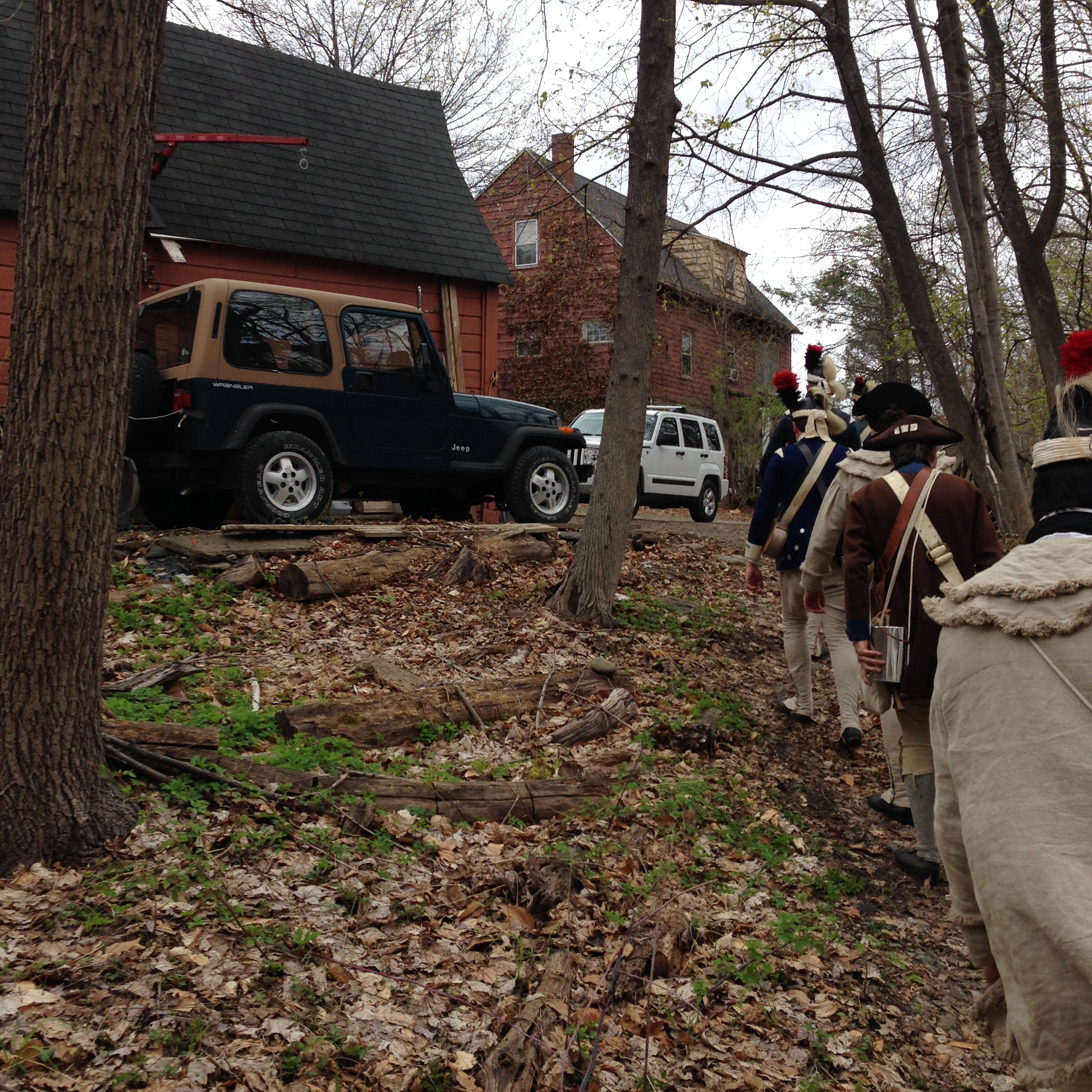
The School of Instruction is always interesting, and this year was no exception. One of my favorite activities is walking with the troops (well, behind). The experience is usually surreal, and the walk we took behind Knox’s Headquarters met expectations.
Clash of the Time Periods
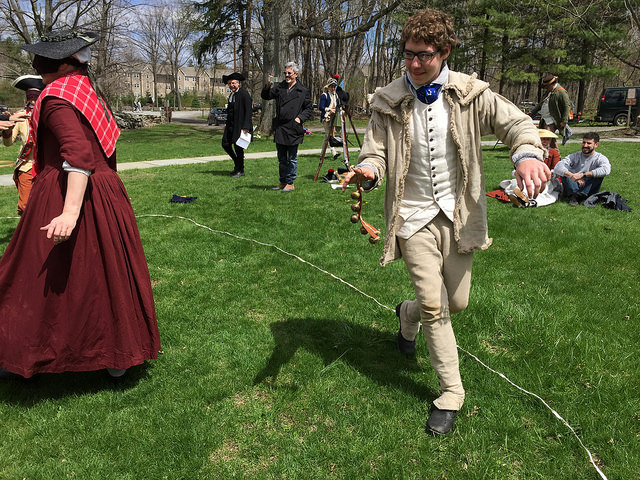
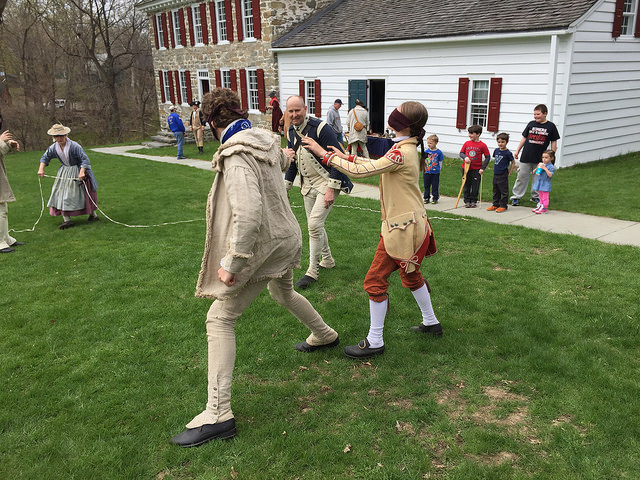
Knox’s Headquarters was a new location for us, with new activities: we played a Jingling Match, which resulted in as much giggling as jingling, and felt like the Walking Dead met the 18th Century.
Jingling without Giggling is the hard part
The game is pretty simple: mark out an area, blindfold as many as are willing to play, and set one without blindfold loose. The object is to touch the person ringing the bell, and it is a hilarious and merry game indeed, though I do agree with Mr McC that playing with a number of men full in their cups, or at certain sites (Stony Point comes to mind) would be too dangerous.
Still, it’s simple and fun, if a little Kubrickian when you first tie on the blindfold. The person who catches the jingler is the next one to taunt the blindfolded.
Next stop? Bell research, of course. I definitely want to play this in Newport later this summer.
No, we didn’t go, and I have regrets. Six weeks before the event, I thought I was working on January 3rd, and by the time the schedule changed, it was too late. Instead, you can read about Drunktailor’s experience.
Reenactors portraying Philadelphia Associators. Beverly Schaefer, Times of Trenton
The background is interesting, similar to the kind of events and projects we’ve been talking about here in RI: site- and time-specific events that combine commemoration, history, and experimental archaeology, or an emotional and social archaeology, if you will.
From event co-organizer Dave Niescior, quoted in the Rutgers-Camden News Now: “The goal is to gain a better understanding of the hardships endured by individuals who lived and made a critical moment in history.It is one thing to write ‘the troops marched overnight to Princeton,’ it is yet another to understand what that physically and mentally meant to the men who had to put one foot in front of the other all night long.” Co-organizer Matt White told NJ.com, “We’re trying to stage a number of vignettes to give people a sense of what was going on in the Continental Army in this period between late December and early January of 1776 and 1777.”
that’s cold. From Daily Reenactor
These and other collected images help convey a sense of the event, which–as far as I can tell– did provide participants with the kind of transcendent experience I know I enjoy and hope to find at events.
This is the kind of event that I think proves a belabored (and elsewhere belittled) point: accuracy matters. It is just about ALL that matters.
On a now-defunct phone, I had an old video of the Young Mr with a now-deceased reenactor of whom I was quite fond, despite our wildly divergent politics. In it, Mr D shows his Charleville to the Young Mr on the front porch of an 18th century home and asks, “Do you know what this is?” The Young Mr shakes his head, and Mr D answers, “It’s a time machine.”
Although I remain committed to reducing the degree to which living history is musket-centric, there’s truth in that statement: Mr D had an original, period Charleville and a fairly well-cut uniform, considering his generous figure. Using, showing, and interpreting actual period pieces and well-made, correct replicas is the single best way to connect the present, and the public, to the past. Accuracy matters because it’s the literal key to the past: you have to cut the pattern right.
Accurate impressions rendered in a place of shared value will transport you to the past, and give you insights you did not expect. That is the point of these exercises: insight and understanding. It’s how to get high on history.
You know The Tent Article, don’t know? You do, if you’re camping 18th century private soldier style in your hand-sewn coat.
Scene of the Camp on Hampton Green, 1781
The Tent Article (hereafter The Document) pulls together documentation and research assembled by a team of living history enthusiasts dedicated to replicating the 18th century enlisted army experience in an accurate manner. Though the PowerPoint format affects the overall length, be warned: we are talking 300+ pages here.
No strangers to the pursuit of the accurate and never ones to shy away from an arduous task involving pointy objects and string, the 10th Mass assembled on Saturday afternoon for a round of tent sewing.
I first read The Tent Article in 2012, and was promptly ashamed of our hand-me-down tent which had everything to recommend it in terms of price, but wanted in terms of accuracy. In response, I began making 1/8″ scale models of tents to figure out how much linen I would need to buy in order to make a truly correct tent. Finally, all that edumacation in art and architecture had utility! Alas: distractions arose, cost overwhelmed, our then-primary regiment scoffed, and I abandoned hand-sewn tent plans.
Fast forward to Tyler Putnam’s blogging on The First Oval Office project, and I was once again intrigued. I began calculating how much vacation time I might need to complete a tent by hand in our living room. Well, thank goodness for finding fellow travelers, because lo and behold! The 10th Mass had tents in want of sewing, so I could learn a great deal without filling our home with excessive yardage.
“Sails.”
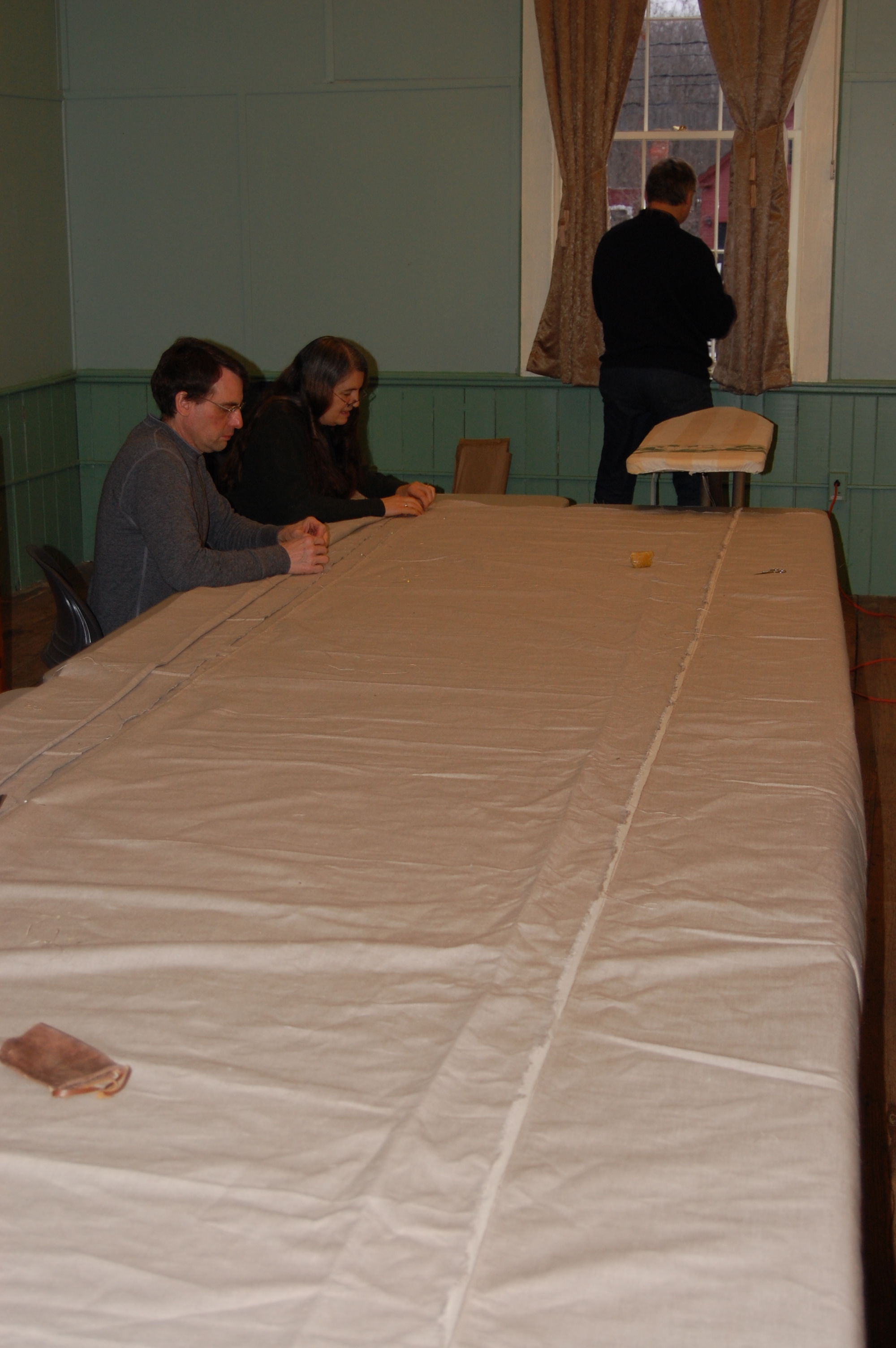
Progress was made last August in Newport, where the tents masqueraded as sails, but the canvas languished unsewn until last Saturday, when we duly assembled in Hopkinton and unfurled the vast expanse of linen. It was suggested that I might know some people with access to sail lofts (!), but in about 4 hours, a number of us managed to finish the final foot of backstitching and to flat-fell a little more than 60 feet of tent seams.
It’s a vast expanse of linen.
The Document was consulted to make sure we were proceeding correctly, though the iPad misbehaved and forwarded us many pages to grommets. (I’m looking forward to those, as I enjoy sewing eyelets– and have just earned myself the dubious honor of sewing at least half of them, I’m sure.) We checked the images, threaded our needles, and off we went.
A few inches (feet) of felling had to be unstitched and resewn, but heavy linen is wily and some stitchers were newer to the process than others. But by the close of day, all seams were felled, needles packed, and tentage folded.
Next up, per The Document, are mud flaps. This should get interesting, as math in front of an audience usually is.
I promised a pun, so here’s the worst. Somehow we got on to unfortunate reenactorisms, which collided with Star Wars, and brought us to the realization that what we needed were light sabres… ’cause it’s the 10th Massachusetts Regiment Light Infantry Company. We were punished for this hilarity by having to drive home on untreated roads into snow that looked like we were trying to take the Millenium Falcon to hyperspeed.
In the past decade, museums, particularly historic house museums, have been challenged to refresh and reinvent their interpretations and presentations. The most notable challenge has come from the Anarchist Guide to Historic House Museums (AGHHM), and the Historic House Trust of New York’s executive director, Franklin Vagnone.
I re-read a number of Vagnone and Deborah Ryan’s papers recently (including this one), thinking not just about What Cheer Day in a historic house, but about reenacting, living history, and costumed interpretation.
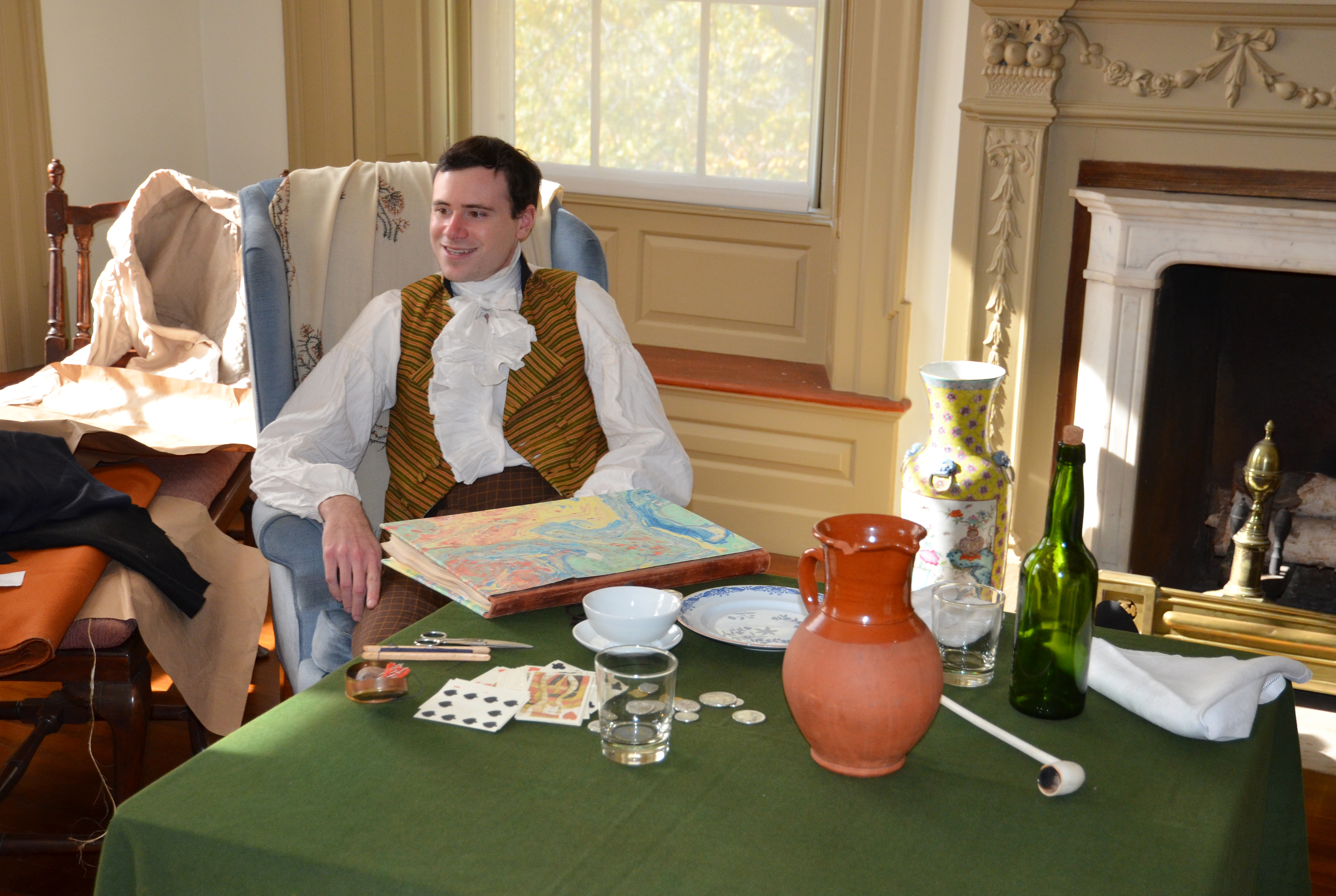
To make a historic house museum (HHM) seem more inhabited and real takes a lot of stuff: clothes, dishes, shoes, stockings, toys— all the stuff that surrounds us now, but correct for the time of the HHM, and arranged in a plausible manner, not like a sitcom set, where chairs before a fireplace face the visitor and not the hearth.
Stuff makes a house
To a degree, this is set-dressing, but set-dressing for a still-life, or real life, if the habitation will be by costumed interpreters. It has to be accurate to be authentic, whether it’s a HHM or a living history event that is striving to create a moment, or series of moments, in time– immersive moments.
We cannot step into the past unless we believe the representation we’re seeing, and that’s true no matter where we are: that’s why fabric matters, sewing techniques matter, tent pins and kettles and canteens matter. The world is made up of tiny details that we do actually notice without even knowing it: we see more than we realize, faster than we think. We’ll trip on the different, and stop.
A variety of coats can tell a variety of stories
But what we want to do, as interpreters, is to have the visitor catch the right difference: not the one about which canteen and why, but the larger interpretive point. In one hypothetical example, wooden canteens are a way to talk about defense contracting and supplying the American army, just as over-dyed captured coats are a way to talk about the American Revolution as an international, and not just a civil, war.
An encampment is, in a way, a neighborhood of HHMs turned inside out, with each regiment a separate family within the larger neighborhood. Each regiment tells a story about itself and its history, and is a lens through which visitors see the larger story.
That’s why accuracy matters: you don’t want to debunk Ye Olde Colonial craft in camp, or cotton-poly polonaises (poly-naises?) worn by purported women on the ration: you want to focus on the larger interpretive point. When not everyone plays by the same rules, it is better to focus on your own accuracy and authenticity and to ignore Ye Olde Annoyances.
Tell the larger story, the story of your own regiment’s people: that’s your interpretive goal.









 Kirsten Hammerstrom
You must be logged in to post a comment.