Two Words: Bed Sack

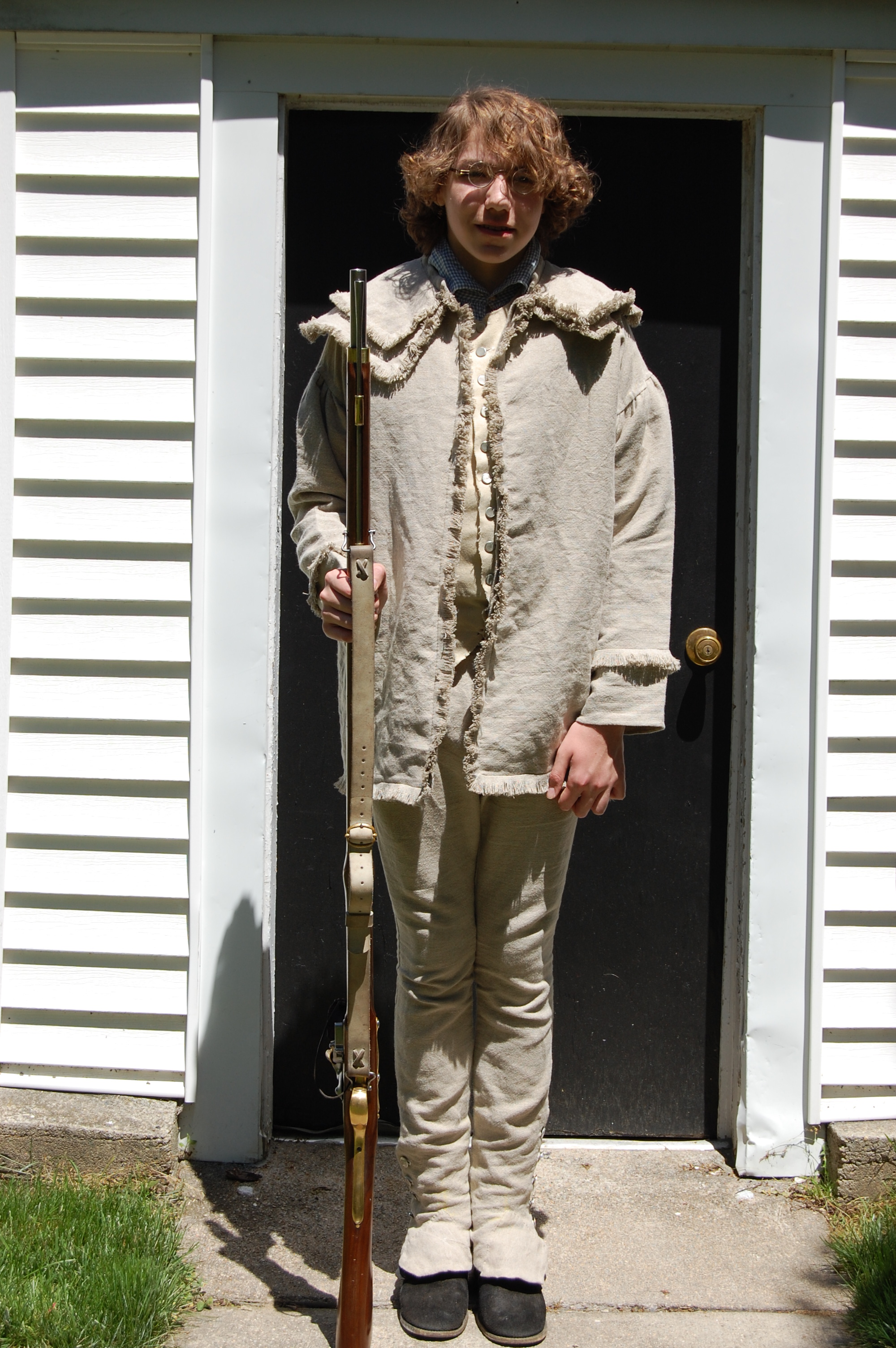
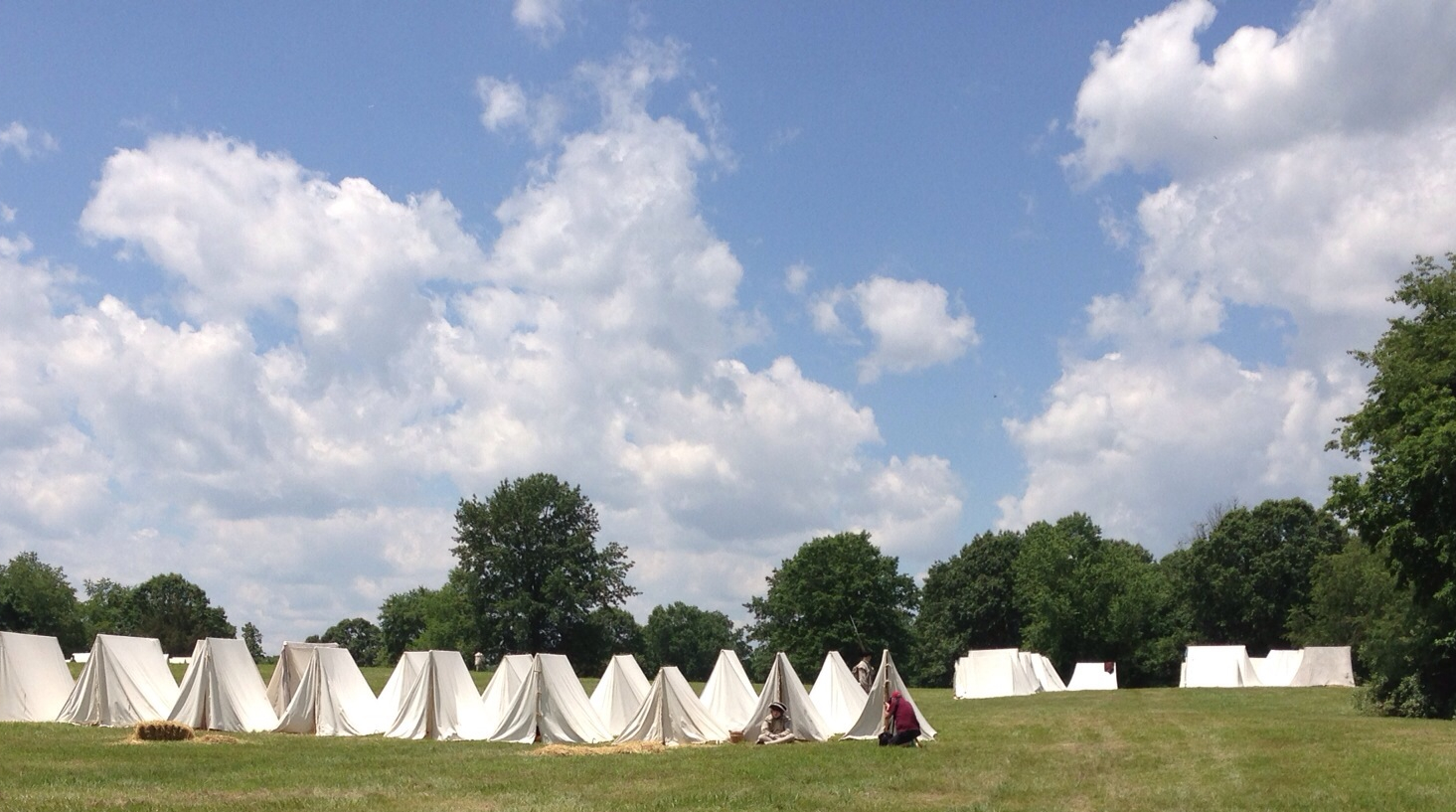
The Young Mr outside our tents

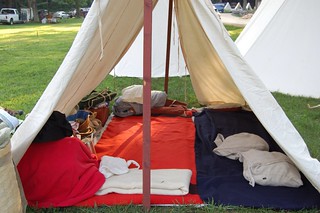
I’m making one. Or two. Whatever: I’m making them for famille Calash. Sleeping on straw and a sleeping pad is better than either alone, but I find with the arthritis that I need more warmth and more cushion than I used to require. True, I am self-padded, but the steel prosthesis does feel—it is only an illusion, but I feel this—closer to the surface, and thus colder, than bone. This makes for a Cranky Kitty, and it is far better for all concerned that Madam Commissariat be a Happy Kitty. I will forgo chairs and tables and other clutter—it is both authentic and pleasant to be unburdened—but I like to sleep well.

There’s a simple enough pattern in one of the Packet books, but the gist of the thing is this: Enormous Market Wallet. Interior common tent dimensions are about 6×6 or 6×7 feet, so you need to end up with something along the lines of 3×6 or 4×6 or 6×6 feet. The Packet suggests four pieces of ticken, each 30 x 80 inches, aiming for a finished size of 42×72 inches, with an center slit four inches wide and a couple feet or so long. (I used the 18th Century New England Life market wallet instructions for a guide in making ours, and will use the same idea for bed sacks.)

I’m not yet aware of extensive documentation of these for Continental troops, but there is one reference in a West Point waste book (see here, footnote three). Since we don’t allow fire in the tents, I am willing to compromise on cotton ticking for these, and (ssshh!!) machine sewing the seams, with a hand-finished slit edge. I might even borrow the serger from work to make really quick work of this business. They will truly hardly be seen, so although I know I am cutting corners, I don’t feel too wretched about it.

Monmouth Menus

Food: It is always on my mind, even cataloging. When the tan and brown and black colors of a sampler make me think of Tiramisu,  I know it’s time to wrap up work for the day. But food is particularly on my mind this week, as I plan and calculate for Monmouth, hoping to use the lessons I’ve learned in the past instead of just being anxious. I know it’s not a test, but it feels like one, somehow.

The Young Mr has aged suddenly, in Don Draper’s kitchen.

Continental rations were supposed to be a pound of beef and a pound of flour a day for man, half that for a woman employed by the army and a quarter of that for a child. The Young Mr (who isn’t really a child and is sort of a soldier) would get more if he was really a drummer… but in any case, we’re looking at 2 + ½ + ¼ or 2 ¾ pounds of beef and the equivalent of flour at a minimum to feed two soldiers, a woman, and a child per day (at a minimum, I expect to feed the adjutant as well as ourselves).

I float out ideas like fire cake or pudding to take account of the flour, but Mr S reels me in and suggests that we should stick to what we know until we can test other ideas on the landlord’s fire pit. We shall substitute bread, therefore, and I probably will not make a nuisance of myself at the bakery or the grocery and ask them to weigh the loaves, as I have my own kitchen scale and can obsess about this in the comfort of our home.

Too fancy! From the Complete Housewife.

My plan is about the same as every camp dining plan: that’s suitable, given the repetitive nature of Army rations (and the repetitive complaints of the soldiers, echoed in every war).

Friday
Pasties. They keep and travel well.

Saturday Morning
Bread, cheese, strawberries, eggs
Ideally, I’ll find a farm stand where I can buy local strawberries, but we will only get into a discussion of what exactly would have been in season on New Jersey in June 1778, which leads to a discussion of global heating.

Saturday Lunch
Bread, cheese, ham, cookies from home

Saturday Dinner
Beef stew and bread, strawberries, cookies from home

Sunday Morning
Bread, cheese, fruit, eggs

Sunday Lunch
Bread cheese, ham, and anything that’s left

This is essentially the same plan that I had for OSV last year, with the biggest sticking points being: will I remember the eggs? Will I manage coffee? I’m not very good at anything until I have coffee, or some kind of caffeine, which could be a challenge this time around. There’s an ice truck scheduled to go through the camps, but what I want to know is, when’s the coffee truck coming?

Lunatic Fringe

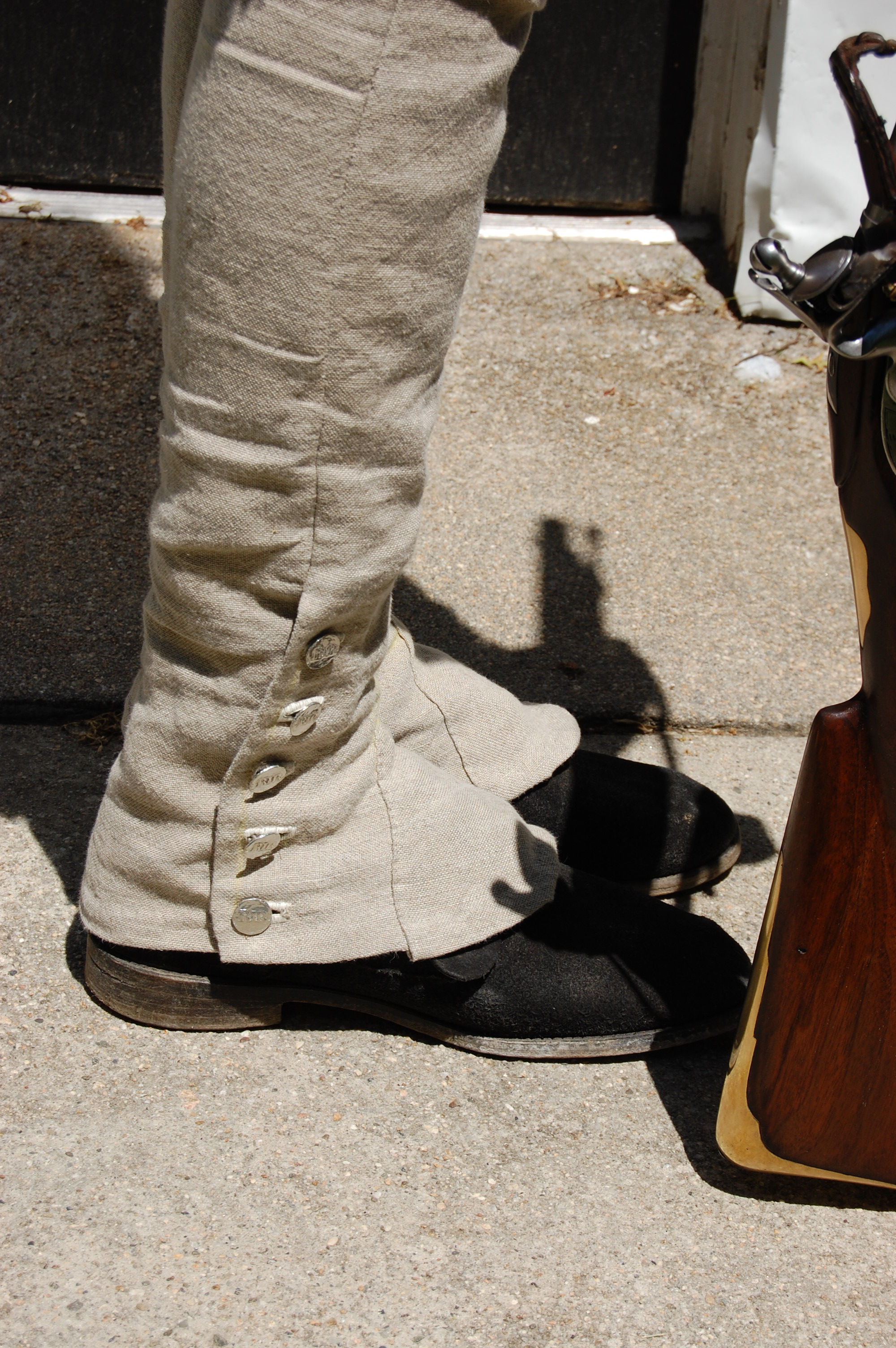
Hunting frock and overalls complete!

Oh, my goodness, it’s done! It’s done, and the photos have passed the master. Phew! Just one more to go, oh, my goodness, no.

The Young Mr was allowed to carry a musket in the Warren Memorial Day Parade. I do not love a parade, so I didn’t go. But he had no overalls of suitable fit and they were so nearly done, that I resolved to finish them, and finish them I did, in time for bed on Saturday, no less. It’s all thanks to BBC’s brutal but entrancing programming. My sewing better to blood curdling screams (also courtesy ITV), which seems awful but there it is…though the darkness of Mad Men has proven good for back stitching, decent button holes require murder.

Buttonholes. I hate those guys less now.

Fifteen button holes, multiple fittings, and some curse words have resulted in a pair of decent-fitting overalls that did not split at the knee or stretch too extremely when worn. And atop it all, in the yard if not in the parade, the new model hunting front adopted by the 10th Massachusetts. The Young Mr is uniform-forward as Neal Hurst’s research has led the adjutant to conclude that the men were wearing frocks, and not shirts. (In the Rhode Island records, I found that rifle frocks were listed until 1780/1781, when the Records of the State of Rhode Island began to indicate rifle or hunting “frocks or shirts.” That’s a wrinkle for Mr Hurst, but I saw only frock in 1777-1780.)

Lunatic fringe. Cut, fold, clip, strip, stitch.

The fringing is a task completed by Mr S, who has fringed the strips for his own Rhode Island hunting frock, and now knows what fun awaits him as another frock will made for him. My goal? Another complete 10th Massachusetts kit by June 15. I’ve sewn buttonholes in a moving car before, and I expect to be felling seams or sewing buttonholes as we travel down to New Jersey. They’ll be fine; after all, the traffic is murder.

Eating in the Field: Playing with Fire

Multi-Day, or Events with Fires

(e.g. Redcoats & Rebels at OSV, “encampments”)

Less will be more next time, I swear.

We use as small a cooler as we can, and save it for things that get dangerous, like meat. We skip dairy. If your impression is that of soldiers in the field, forget cream in your coffee or milk in your tea, unless you can point to the farm you stole it from! (See John Smith’s diary.) We hide the cooler under a blanket in our tent. Yes, the blanket is a red bed cover from Ikea and needs to be replaced.

Carrots, onions, potatoes, parsnips, beets, apples, can all travel in bags, baskets or bowls. Think basics if your impression is common soldier or common person.

Rations were generally a pound of beef for a soldier, half a pound for women on the ration, and a quarter pound for children. You can use these proportions to figure out what to make, and John Buss had a lot to say about the quality and frequency of the beef and other rations. Jeremiah Greenman of the 2nd Rhode Island ate dog on the way to Quebec, and that was one time they weren’t the 2nd Helping Regiment. We draw the line well on this side of that kind of authenticity.

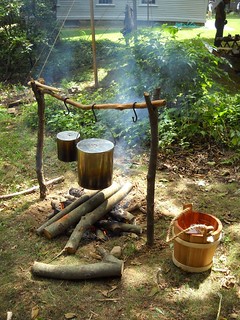
Three sticks, two kettles, one bucket. I love that bucket.

Men carried their rations in haversacks, so yes, a little eeww if you’re thinking a pound of salted beef in a linen sack along with a pound of bread or flour.  That’s where the cooler comes in, and a metal bowl or plate. We use split firewood to cut the meat on, and then burn the wood instead of washing a wooden cutting board in the field.

I have brought home-baked tea bread to events, and taken cookies (little cakes) to the farm. But you have to think about the context of the event, and your specific impression. I’d like to strip everything down to the “three sticks, two kettles, no matches” principle, but we’re stuck with cooler because we cook.

What we did at OSV, which was two dinners (Friday and Saturday) and two breakfasts  and lunches (Saturday and Sunday) was this:

Friday Dinner: pasties

Saturday Breakfast: apples, bread and ham and cheese. Guess who forgot the eggs and oatmeal? Yes, me! The one in charge of stores. Thankyouverymuch.

Saturday Lunch: Apples, bread and ham and cheese.

Saturday Supper: Beef stew with carrots, onions and potatoes. Authenticity would have made this plain boiled beef but fortunately for us, OSV is a farm, and we could pretend John Smith had helped us enhance our rations. We scraped the kettle clean.

Sunday Breakfast: Apples, bread and cheese. The soldier in the tent next to us appeared with a cup of coffee. We eyed him with real envy; sensing peril, he quickly told us we could get our mugs filled at the OSV store, at a discount. Off we quick-marched, and Bob finished his coffee in safety. It wasn’t very good coffee, but it was the best coffee I had that week.

Sunday Lunch: By this point, the child had eaten anything that remained, and we had to buy lunch.

What did I learn from that experience?

  • Bring more fruit
  • Bring more bread
  • Bring the coffee & the coffee pot

When we consider packing for Monmouth this summer, these are the factors we’ll take into account, and one of the largest factors will be the amount the kid is accustomed to eating.