Longbourn: Book Review

The Chocolate Girl is adapted for the cover of Jo Baker’s new book

 On Sunday, I read the NYT review of Jo Baker’s new book, Longbourn. As soon as I finished the review, I ordered the book, which arrived Wednesday evening. By 2:00 AM Thursday, I had finished it.

I like Austen, but my favorite Austen novel is Mansfield Park, not Pride & Prejudice. The BBC and other adaptations sometimes make the world of her novels seem too cloistered, too precious, and too refined to me. (Mrs Hurst Dancing can be a helpful corrective.) So of course I was captivated by the premise of Longbourn: “The world of the people who laid the fires, cooked the meals and fetched the horses for Jane Austen’s Bennet family.”

The story was engaging–heck, I stayed up until 2:00AM  to find out how it ended–and while I found it slightly romantic for my taste, on the whole, the world was believable.

For one thing, there is plenty of mud. And Sarah the housemaid must clean the mud off the Bennett girls’ petticoats. The hauling of water, laying of fires, and the chill and exhaustion the maids feel is pretty well rendered. Baker addresses the question I’ve always had, How did servants tolerate servitude? by portraying Sarah’s struggle with resentment and resignation to her lot.

I thought, too, that the way Baker described women as “breeding” was also good; she referred as well to Elizabeth Bennett’s “dark, musky” armpits, and that seemed a nice way to slip in historical hygiene information. But women in English gentry were valued for their breeding capabilities: the need for a male heir didn’t die with Henry VIII, and it is much of what drives, or drove, the plot of Downton Abbey. For women, the past was a smaller world, and Sarah’s life is particularly small. Her carriage rides help define the very real confinement of her world.

There are a few slips: backpack instead of knapsack once or twice, but not many. It feels well-researched, well imagined, and believable. I don’t want to wreck it for you, so I won’t go into too much…there are some classic plot twists and devices that I put up with because they’re so typical of the literature of the period. I particularly enjoyed that Sarah reads from Mr Bennett’s library, including Pamela. It was a nice way to reinforce Wickham’s creepiness, and the echoes between the novel derived from a novel, in which  fictional characters read real novels, delighted me. (Being a fictional character myself.)

Jo Baker’s not Hilary Mantel-– this isn’t the kind of writing where the language stops you cold and sentences leave you breathless with awe, but for historical fiction derived from Jane Austen, Baker’s book is excellent and well-written.
Lovers & Fighters

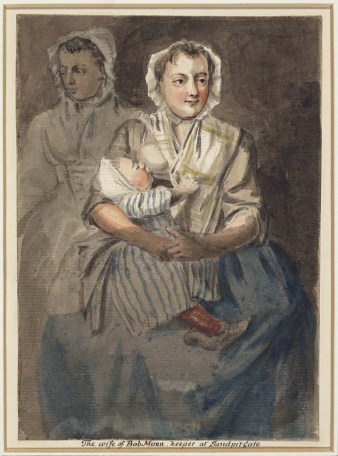
The wife of Bob Munn, Keeper at Sandpit Gate. Paul Sandby, Royal Collection Trust  RCN 914337
The wife of Bob Munn, Keeper at Sandpit Gate. Paul Sandby, Royal Collection Trust RCN 914337

On Sunday,  Mr FC mentioned that they knew the names of at least two of the women of the 10th Massachusetts, including one notorious woman, Bridget Mahoney. I mentioned this in an email to Mr HC, and got back four solid paragraphs of information. I sincerely and earnestly wish I had those retention skills, but embedded in one paragraph was that they knew of a woman in Wallcott’s company, because the brigade chaplain, Enos Hitchcock, had baptized the child of a soldier in Wallcott’s company.

Enos Hitchcock was the pastor of the First Congregational Church in Providence, and I happen to be fairly familiar with his pastel portrait and his diaries. The Rhode Island Historical Society published his diaries in 1899, and they can be read online thanks to the Open Library.

Here’s what I found, reading and searching:

April 25, 1779
Baptized child of Richard Northover, Soldier of the Train, by the name of Mary.

May 5, 1779
Married Sgt Bates and Mrs Lucy Gun

May 9, 1779
Baptized Lydda, daughter of George Wilson and Letty, his wife, of Capt. Buckland’s Train—Baptiized Adaulph, son of John Degrove of the above company

May 31, 1779
Sent for to go aboard the Lady Washington galley to marry John Thompson and Abia Chase

June 21, 1779
Married Henry Smith and Phebe Cockswain, late Brewer’s Regt.

Three baptisms and three marriages in just over 8 weeks: that’s a busy regiment.

Of course, they did their share of fighting, and not just on the field. I did not witness the fight instigated on Sunday morning by Mr FC, against the New York troops in which there was shoving, the beating of Mr S with a hat, and the deflection of Mr McC, who upon arriving with a shovel, was put to work digging.

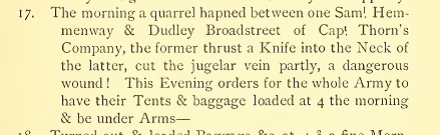
September 17, 1777. Enos Hitchcock diary.

September 17, 1777. Enos Hitchcock diary.

In Hitchcock’s diary, I found an account of a quarrel near Stillwater, NY on September 17, 1777. This was intramural knife-thrusting, but clearly, the 10th Massachusetts were very busy men.

‘Countryside at War’ Saturday

The Countryside at War, Hartwell Tavern, MMNHP, August 24, 2013

We came, we saw, we sewed, we ate cake. No, it was more than that, though there was any quantity of excellent cake on a lovely Saturday.

I had a chance to spend the whole day with people I really enjoy talking to, like Sharon Burnston and Sew18thCentury. (I love that silk gown. I really do.) We are all preparing for an event we will be part of in Providence in October, and I think and hope it will be great fun! But I’m getting several weeks and 25 years ahead of myself.

On Saturday, Sharon was a widow who had traveled from New Hampshire to visit her daughter, who was but one month from her confinement. She had a portmanteau of clothes for the soon to be born child, and food, as the blockade and closing of the city had made obtaining anything very difficult.

Before the jacket was applied

Visitors came and asked interesting questions, but there wasn’t much I could answer. Reader, I had not studied. I had sewn instead, vain woman that I am, laboring to produce new trousers and a new waistcoat for the Young Mr. He spent the day reading his school book, recovered in craft paper and blue check linen. Saving grace, that cover, and I plan to make many more. The Young Mr (after hauling carts and goods for people) found  some handy stones and settled in to get his work done.

His father plans to make him a full-size wooden musket from some mahogany that was left over from construction at work: there are no rules to prevent him learning to drill will a dummy musket. At events when he’s not trying to do his school work, he does enjoy being put to work. He likes to feel useful, and I am grateful to people who recognize that, and help me keep him in the hobby. This was all his idea in the first place…

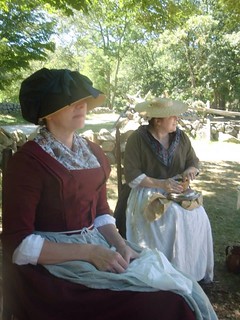
Sew18thCentury and I had a long walk on the bike path, which was mildly dangerous. Bonnets block a great deal of your vision, and change your hearing, so bicycles are particularly troubling. And when wearing a bonnet, one has to peer out from under it to see anything above you, or your lap, as you can see here.

Our clothing was documented, as you know from posts on this blog. I assembled sheets for each of us, and they can be found here: The Young Mr, Mr S and Kitty. I finished it all late on Friday night, so by the time I reached my own, well…there’s always next year to tidy that up. I still like the gown, and I really like the lightweight wool olive/brownish petticoat with the gown. Hooray! Clothing I like, in wool, that can be worn in summer. What’s not to like? (Well, pins, for one thing. They bend and pop out.)

Drilling in the shade, Shirley-style

The men were drilled for the September 28 event, which rolls forward, sort of. I expect or hope for a schedule this week, which will be helpful. Fingers crossed…though no matter what, I will have to hope a train back to Providence by 3 to make rehearsal for the event at work. That should be interesting…

Now it’s down to finishing and fixing projects in process, and deciding on fabric for a housekeeper’s gown from 1800. I think I’ve settled on a year and style, but the fabric eludes me still. I have to find it pretty soon, because on Saturday, I’ll start making coats for Saratoga. I’m a sucker for beauty, and the Adjutant got me with sea foam green and dark brown wool. The facings are false, so really, a button-hole-free, single-year, described in a letter, regimental coat? The artist in me won, and I am so making that.

Many, many thanks to Sharon Burnston and Friends of Minute Man National Park for the photos! I took none, except of the Young Mr in our yard.

Documenting Mr S

The guys are usually easy: they wear what the sergeant tells ’em to wear, and they like it, because that’s what soldiers do.

Mr S in Cambridge

Sergeant’s not a sergeant in quite the same way in 1774-1775: he’s a militia sergeant, and while we can still get up to tricks that get us yelled at, the clothing we wear is more personal. Mr S’s clothes seemed, at first, to be completely undocumentable.

Really? Yes, I have been known to have some anxiety issues over small matters. So I calmed down, re-read the standards, and looked again.

The shirt is checked linen, see here for details. The stockings, which will be replaced by hand-knit blue stockings, are also documented to Rhode Island.  But wait! That’s 1777, can it count for 1775? How long do stockings last, anyway?

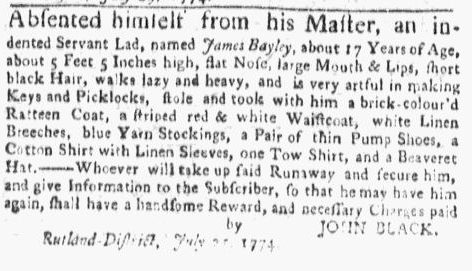
I’ll own up to having been described as “literal and precise,” and I’m taking that comment to heart. Reader: literal is where one gets into trouble when one is precise. Literal interpretations can lead you, almost hubristically, into creating replicas of runaway ads  or extant garments that don’t reflect who you are, or what time you are portraying, not really.

bluestockings_whitebreeches
Boston Post Boy, 7/25/1774

But not to worry, I dug up the blue stockings. This is from the Boston Post Boy, July 25, 1774. “White Linen Breeches, blue yarn stockings.” This is not too bad: Mr S has got his basic extremities covered now. It’s hard not to be distracted by the Cotton Shirt with Linen Sleeves, which reminds me of women’s shifts with finer sleeves, or sleeves to pin on.

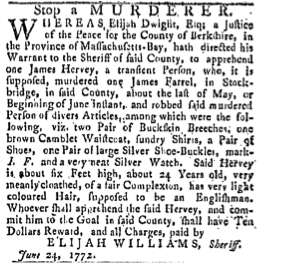
browncamblet Waistcoat 7-4-1772 providence
Providence Gazette, 7/4/1772.

Keeping focused, let’s get Mr S more fully dressed, more proper, and warmer, since this is late August. You can’t see his waistcoat under the green jacket, but here you can. I know this broadcloth fabric, and its color, are from the acceptable palette for the last quarter of the 18th century, but can I find one in Providence or Massachusetts? Just about. The waistcoat described in this ad is camblet. There’s no goat or camel in Mr S’s camel-colored waistcoat, but I think we’ll call it found and be grateful that Mr S has not taken any action despite the numerous photos I have posted of him in various “poofy shirts” and “funny outfits,” as some of my friends describe them.

What’s left? There’s John Appleton’s ad in the Essex Gazette of May 17, 1774 for “blue, green and cloth colored bandannoes,” which pretty much takes care of the neck cloth; we’ve a brownish one, and a blue one; the Young Mr likes the orangey one, but I think we have those documented.

1774_greenJacket
Essex Gazette, 12/6/1774
1774_Prov_greenJacket
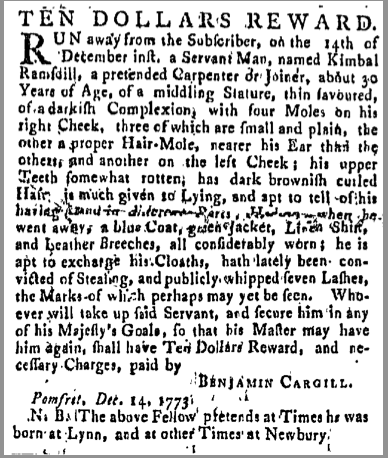
Providence Gazette, 1/29/1774

The green jacket, that’s what’s left. In the Essex Gazette of December 6, 1774, we find a “green jacket, light breeches, and yard Stockings,” much like what Mr S is wearing.  Nice! Multiple sources of documentation for items are always welcome chez Calash.

And, knowing that, you will not be surprised that I have found another jacket, closer to home. In the Providence Gazette of January 29, 1774, the man with the “proper hair mole” runs away in a green jacket. He’s also got leather breeches, and they’re on my wish list, though other things must come first, given their expense–things like tires, and allergy drops for the Young Mr.