Mummers Crash

Visards. chipboard, paint and ribbon

On Thursday, Mr S and I got an intriguing invitation from Mr Cooke: would we like to be part of a secret plan to create a disturbance? We are the sort of people who got thrown out of a mattress store just for asking questions, so we said yes. You’re invited to the best riot you know about, you say yes.

This plan involved crashing the Colonial Twelfth Night Party at the Major John Buttrick House in Concord. As mummers. In masks.

‘Mascara’, Givannbi Grevembroch. Venetian, 18th century

This morning, after some very cursory research and reading of the documents we were sent, I made our ‘visards.’ The form is based on the Elizabethan ‘visard’ shown here, and while that object is too early, it seems to be typical of the masks that persist, even into the 18th century.

In the Venetian carnival traditions, this round, black form is known as a moretta, held in place by a button the woman held in her teeth.

We were having none of that– I was supposed to make a ruckus, after all–so I opted for ties, which I sewed on despite the presence of a stapler. The basic form is an oval, 7 inches by 7 inches, but I would recommend cutting the forehead down if you will be wearing this with a hat or bonnet. (I had to trim Mr S’s, and should trim my own.)

Mr S borrowed my blue cloak, we both borrowed sticks for Mr Cooke, who had a very fine, knobby and thorny-looking shillelagh. In the kitchen of the Butterick House, we joined Mr C, Mr JH, and Mr GH to go over the plan one more time, and to try out our lines. Once we were gathered, we put on our masks, hoods, and visards/visages, and felt pretty creepy. Wearing a mask is very disorienting– you don’t look like yourself, but more importantly your vision is altered (especially those who couldn’t wear their glasses under their guides) and significantly limited. I wish I’d practiced a bit more, especially with the mask and bonnet combo’s bucket-on-my head sensation.

Mummer in the house.

We managed not to terrify ourselves but rather to compliment one another on our very fearsome and convincing appearances as rabble-rousing mummers. Mr JH gathered us up, and off  we went slinking out the door and to the street, where Mr Cooke and Mr FC began to sing. The two of them together made a fine and convincing racket, which I was only sorry that Mr S and I could not join (much to learn). We barged into the house and into the room where the very proper guests were gathered, and launched in.

Did I mention this was a secret? There were some confederates in the room, but the sedate civilians were caught unawares and were, according to reports, frightened. (Also very entertained, but also shocked.) A scene played out with the mummers begging for money, teasing guests, and generally causing commotion until the constable arrived and  read us the act prohibiting such behaviour. We protested each clause, but it was clear we had broken the law. Fortunately, the spirit of Christmas prevailed, and on this night before Twelfth Night, we were allowed food and drink if we would let the company alone. It was a happy conclusion for everyone.

Les Oublies

Les Oublies. Le Bon Genre Plate 79: three ladies and a child look at a sundial in a garden, watched by a man. August 1815 Hand-coloured etching. British Museum 2003,U.14

I was first attracted to this image by the gentleman and his shapely legs, as you might expect, since tight buttoned gaiters or overalls do turn my head. This plate doesn’t make much sense to me: I can’t really grasp the satire, I can only guess. The explanation given for the series doesn’t help immensely. “The series is devoted to costume, mostly set in fashionable interiors, but the plates are treated in a semi-caricatural, humorous way that links them with French social satire.”

My best guess is that this plate from 1815 is showing off the latest filmy white fashions and tiny pink Spencers in contrast to the forgotten origins of the classical influence, personified by the gentleman in common dress at left. His hat and the gaiters suggest the French revolution, now forgotten (see “oublier” though the reference is also to the small cakes being eaten by the woman under the tree). The clock provides a reference to the passing of time, and forgetting, but I don’t think it is actually a sundial. The strap makes it look as if the man can carry it, and that’s a needle, not the fixed vane of a sundial.

Whatever it all means, I do find this more interesting for the man’s clothing than the women’s; after a while, the subtle differences between white columns is lost on me, but that’s a pretty interesting buff-colored waistcoat.

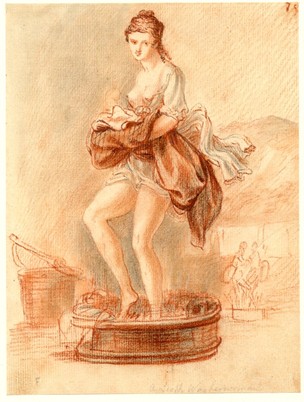
Ironing on Grass

Paul Sandy, The Laundress, 1780. British Museum, 1904,0819.624

This print makes me think of Gertrude Stein, “Irons on the grass alas” because I think I would be pretty alas if I were ironing on grass. Still, I’m glad to know that ironing in camp is plausible, because it’s one more thing I can do, though also one more heavy item to pack.

I continue to chase laundry in my spare time, with a Pinterest board of collected images, which will give you a sense of the timeless drudgery of washing clothes. There will be stooping.

A Washerwoman, by John Varley (1778-1842). Tate Britain, T08695

In this sketch by John Varley, he has helpfully given notes to supplement the lines.

“neckhandkf
spots Drab stays
blue check apron”

The symbol in front of ‘spots’ suggests the neckhandkerchief’s pattern, a dot in a square, much like the ones you can today from Burnley & Trowbridge.  “Drab stays” suggests a very utilitarian pair of wool stays, and that the washerwoman has stripped off her gown or bodice, and is working in shift, stays, and petticoat(s). This seems to be the same woman is in the “Woman with Wash-Tubs” drawing, and I’d guess her hat is straw.

A Scotch Washerwoman. Crayon drawing by Pauil Sandby after 1745. British Museum, Nn,6.61

There’s a remarkable consistency in the English drawings, though Varney and Sandby are about two decades apart. The tubs, the tools, the stooping: laundry is hard and unglamorous work, Sandby’s Scottish laundress aside. I can guarantee you that the 10th Massachusetts would have to outsource laundry in that style. (In any case, Scotland typified poverty and backwardness for late-eighteenth century Englishmen, so Sandby’s drawing, in addition to being titillating, is perpetuating English stereotypes of Scottish dress and practices and is, thankfully, not a reliable source.)

The Checkered Past

Some gentlemen I know should consider what they might want to do to avoid (or alternately, encourage) having this coat made for them. It’s really a lovely thing, found as the best things are, while looking for something else.

It reminded me, too, of the textile sample book at the Met, currently on display in the Interwoven Globe exhibition. (No, I haven’t seen it; I’m going to try, but…).

Wm Booth has a new linen coming in the winter, and as the men in my house have outgrown or outworn their shirts, I am thinking of making new check shirts. I did finish a white shirt at Fort Lee, which will go to the Young Mr (his small clothes being now his too-small clothes). I will have to make Mr S a white shirt for best wear, but they could each use a second working shirt. At least with checks you get “cut here” and “sew here” lines.

Last week, I found a weavers’ book in the Arkwright Company Records (Box 1, Folder 1, 1815). It’s a slim, blue paper-covered volume with small samplers glued in to the pages, and full of checks and stripes. Blue and white, red and blue, checks and stripes were prevalent in the late 18th and early 19th centuries. The more I look at extant garments, sample books, and ads, the more I think the streets must have been a vibrant, if grimy, visual riot.