Sandby in Salem (New Jersey)

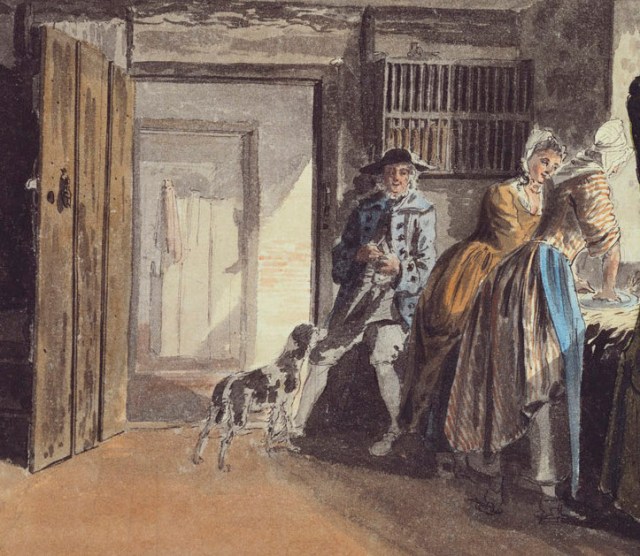
The Kitchen at Sandpit Gate (detail). Watercolor on paper by Paul Sandby 1754. Royal Collection Trust, RCIN 914331

The best times are always those when we are the least self-conscious– not that we can necessarily choose those times. Often they simply happen to us, but if we are lucky enough, we will notice, or someone else will record those moments for us. Last weekend, without even meaning to, we came as close as I may ever hope to get to recreating Sandby images of the Sandpit Gate kitchen.

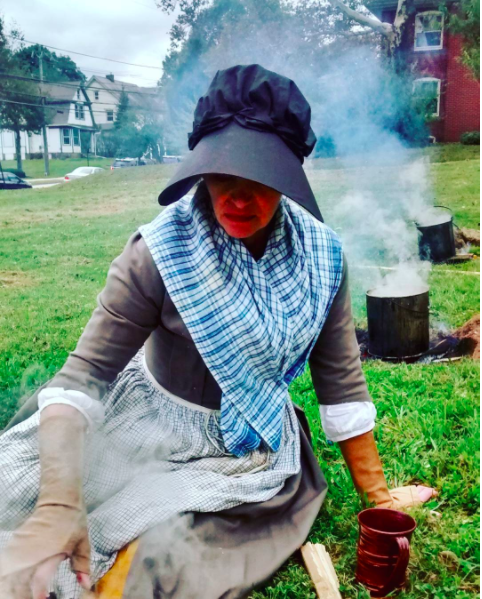
Mistress F commanded the kitchen: I served as her reasonably able scullion, and, with assistance from Drunk Tailor and the company of the B’s, we managed to produce enough food for several dozen people.


(I baked the pound cake at home, but the egg and onion pies were made on site. I lack historically correct baking apparatus aside from one pie plate.) Cooking in the cabin at Hancock House reminded me of good times long ago— and not so long ago–and how much I enjoyed throwing refuse out a window, and using a soapstone sink. The weekend also brought to mind “show, don’t tell” as it applies to interpretation, and made me think again about how to create more immersive educational experiences for visitors, without becoming ritualistic.

There’s not much time to think those esoteric, grad-school-seminar thoughts when you’re in the midst of cooking, and that can actually be a relief. Instead, better to think of the light, and the landscape, and the time remaining until a pie is cooked through.


The landscape and the light: redemptive, all that space, the blue sky and the grasses. I thought of The Witch of Blackbird Pond, which I haven’t read in decades, for in some ways, the coast of New Jersey resembles the coast of Connecticut. It’s one of the first historical novels I remember reading– it is probably one reason I have ended up doing the work I do, and spending as much time as I did in New England. (You can read it here.) It’s not brilliant literature, and it was nearly two decades old when I read it, but it was certainly memorable.
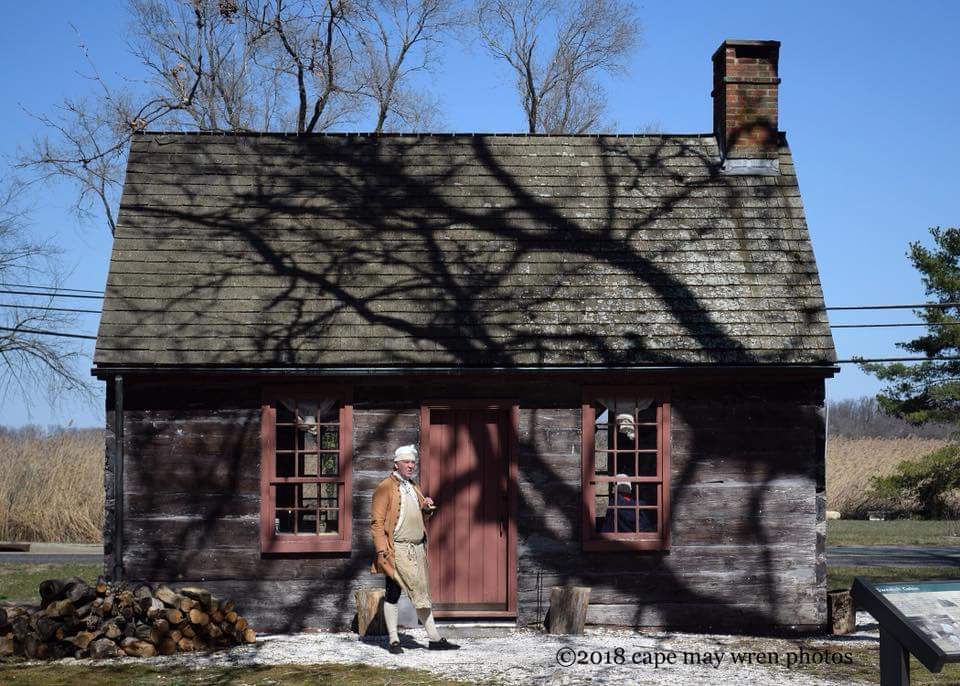
Photos courtesy of HM 17th Regiment, Al Pochek, and Cape May Wren Photography.
Occupation as Liberation

Philadelphia Ledger, October 10 1777

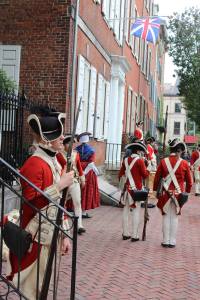
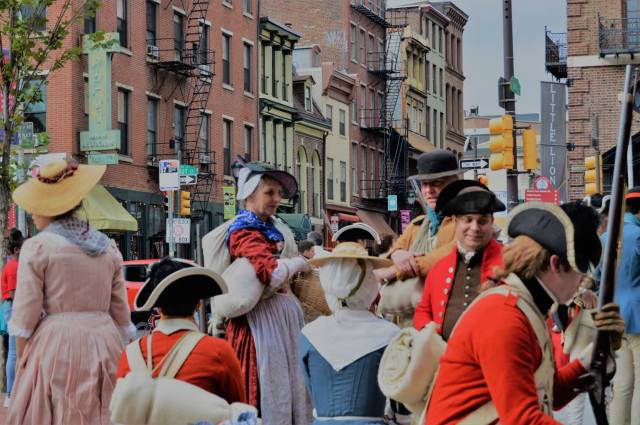
240 years ago, Philadelphia was occupied by British forces under the command of General Howe; the city was taken after a brutal campaign through the outskirts of the city, as you may recall from a few weeks ago— and this is after the Battle of Princeton, with the accompanying ravages upon the populace. This past weekend, interpreters at the Museum of the American Revolution brought the issues of occupation to life for visitors. But what struck me the most when we got home, was my cousin’s comment on this photo:

Hanging with the British and Citizens of Philadelphia

“I suppose you hang out with Confederates, too.”

Ouch, dude. That’s my partner you’re impugning.

Occupation of town/homes.

I understand that, in certain circles, British troops in North America during the American Revolution are equated with Nazis, and I understand that it’s easy to see the world in Manichaen terms (though my cousin usually does not), with good guys and bad guys. But after watching Ken Burns’ and Lynn Novick’s Vietnam War series, I am reminded how (grossly speaking) “one man’s terrorist is another man’s freedom fighter,” and while, as an America citizen, the “good” or “righteous” side should default to the Patriot/Whig cause, interpreting the other side offers room for people to question how they would have behaved in the past, and more importantly, to understand the actions of their country in the present.

There is no right answer.

Studying the past allows us to see the present through new eyes: Philadelphia in 1777 is occupied by a colonial power attempting (in part) to retain control of natural resources. Which side will you be on when the moment comes? Will you side with law and order, or will you side with natural freedoms and the rights of man (some exclusion apply; not all rights are right for you, and do not apply to African Americans, women, or American Indians, or non-property owning white men, etc. etc).

240 years later, what is the point of this hobby, these funny clothes, wandering around outside, talking to strangers? The point is that the past is always present. If we can understand the choices people faced in the past, we can understand our own predicaments better, and one hopes, analyze our options to choose better this time. We operate from a place of self-interest, even when we wish we could be idealistic, honorable. From the outside, actions aren’t always what they seem.

On Sunday (though I have found no photos thus far), I was arrested by the 17th for peddling a calico gown stolen from a room on Hamilton’s wharf, and alleged to be part of the Captain’s baggage. I tried to run, but was caught by two soldiers, and dragged away. From the outside, this looked like something bad: soldiers roughing up a woman. But I wasn’t innocent, and that’s the point: what looks like a bad thing may be a good thing. Costumed interpretation liberates us from the exhibit label, and allows us demonstrate a complicated past more quickly than a text panel can be read, and more engagingly.

When we assume that all Americans are “good,” we gloss over realities of people trying to get by when work, food, and money were scarce, and how “good” people do bad things. To play that well, you need both sides of the story. And that, dear cousin, is why I hang out with the Brits.

Living Like a Refugee

At the Speaker’s House. Photo by Drunk Tailor.

When I was in middle school, we were given an assignment that is now considered inappropriate: we were asked to trace our family history or genealogy as a way to help understand historical time, stories of immigration, and the ways in which we are all American (according to the then-prevalent “melting pot” model of being American). Exercises like that are now discouraged as educators recognize the myriad ways in which people form families, though in my middle school, what was revealed was not adoptions or absent parents but the yawning chasm of class and privilege. My people are more peasant than princess, so the women I portray in living history make sense to me. They don’t wear silk. They make things, and they sell things.

Walking back from Augustus Lutheran Church, Trappe, PA

Portraying a refugee was a little trickier to wrap my head around. Whiny I can do– if I wasn’t teaching workshops in New Jersey this November, I’d be in 1587 North Carolina pining for England and wondering why I didn’t listen to my mother instead of marrying that head-in-the-sky Virginia colonist. What made being a refugee tricky for me was finding something to do. Obviously I shared in the cooking chores and the walk to Augustus Lutheran Church, but projecting “refugee” was tricky for me.

Looking back, I can see that straggling after a militia company may well have been enough– not wanting to leave their “protection,” not having a place to be, illustrates displacement. Even dressed as a middle-class or lower-middle-class woman, I am out of place sitting on grass or following armed men.

Displacement: I had not previously considered this as a means of provoking informed interpretation. Interpreting lack or absence can be as effective as interpreting presence. “No shoes” or “no musket:” these are easier, more obvious, but as a refugee, I had no home, no place, and no belonging. That seems even more important to understand and interpret today, at least for those of us concerned with making the past present, and the ways we can study the past to understand the present.

Reading Double

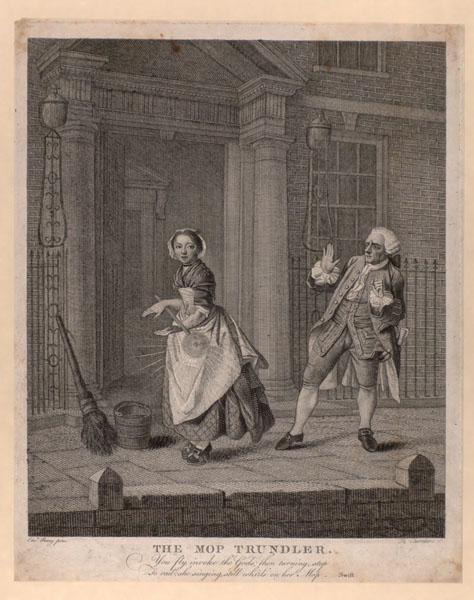
The mop trundler. Chambars after Penny. Bodleian Library, University of Oxford: John Johnson Collection
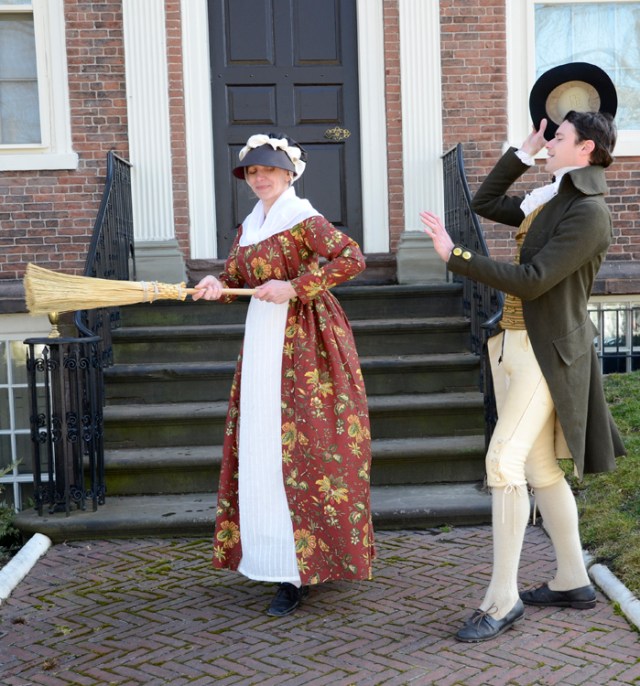
Photo by J. D. Kay, 2013

I love this image, and the original on which it is based. I love it so much that we’ve recreated it (in a later time period) whilst fooling about during a photoshoot.

But what does it really show? The image in the print depicts a passage in Jonathan Swift’s poem, A Description of a City Shower,

Such is that sprinkling which some careless quean
Flirts on you from her mop, but not so clean:
You fly, invoke the gods; then turning, stop
To rail; she singing, still whirls on her mop.

Straightforward, right?

Well, not so fast. Thanks to the wonders of ILL, I’ve been reading The Satirical Gaze: Prints of Women in Late Eighteenth-Century England, by Cindy McCreery, and looking at prints anew. Her chapters on prostitutes and old maids are particularly interesting, and confirm some of what I had been thinking about when we use prints as documentation.

Here, in the Macaroni Provider, we have what is “Probably a portrait of some (alleged) notorious procurer; perhaps Thomas Bradshaw whose portrait he somewhat resembles.” We have a pimp, folks.

The Macaroni Provider / Macaronies, Characters, Caricatures & designed by the greatest personages, artists &c graved & published by MDarly, 39 Strand. 1772 (Vol.3). British Museum

So, with this information in hand, let’s look again at The City Shower. We have a maid– one of the few classes of women found in city streets unaccompanied, and a class of women often associated with prostitution (along with street vendors and market sellers). The fashionably dressed man recoils from the spray from her mop– is he rejected the literal filth, or the implied filth of a “maid of all work,” who may have a venereal disease? Is it reasonable to wonder if Swift is using double entendres in the lines Such is that sprinkling which some careless quean
Flirts on you from her mop, but not so clean, 
so that the mop is the woman’s pubic hair, and not so clean suggests she is diseased?

I don’t know, and absent intensive research or a time machine, I may never know. But once again I wonder how we use and understand these images, and think that they pose more questions than answers. McCreery’s book (based on her dissertation) helps get at some of these issues, and is well worth a read. (I found the Amazon review hilarious, myself, once I had the book in hand. No, it’s not a compendium of prints; it’s an analysis.)