Pushing Interpretation Forward

Dare I say progressing?

servant mannequin in 18th century room
That’s no ghost, that’s my kid

In the past decade, museums, particularly historic house museums, have been challenged to refresh and reinvent their interpretations and presentations. The most notable challenge has come from the Anarchist Guide to Historic House Museums (AGHHM), and the Historic House Trust of New York’s executive director, Franklin Vagnone.

I re-read a number of Vagnone and Deborah Ryan’s papers recently (including this one), thinking not just about What Cheer Day in a historic house, but about reenacting, living history, and costumed interpretation.

To make a historic house museum (HHM) seem more inhabited and real takes a lot of stuff: clothes, dishes, shoes, stockings, toys— all the stuff that surrounds us now, but correct for the time of the HHM, and arranged in a plausible manner, not like a sitcom set, where chairs before a fireplace face the visitor and not the hearth.
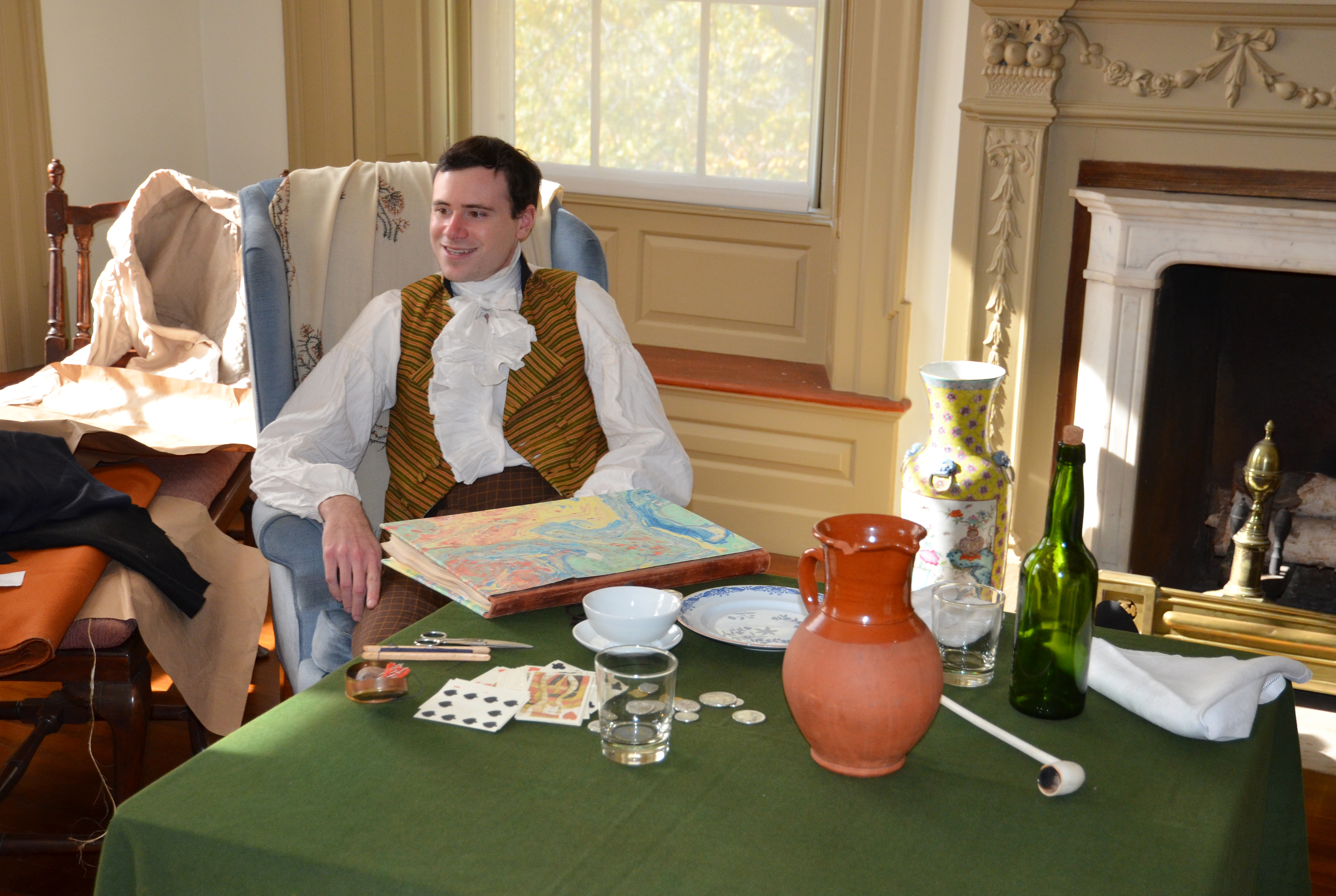
Man with cards, glasses and pipe in 18th century room
Stuff makes a house

To a degree, this is set-dressing, but set-dressing for a still-life, or real life, if the habitation will be by costumed interpreters. It has to be accurate to be authentic, whether it’s a HHM or a living history event that is striving to create a moment, or series of moments, in time– immersive moments.

We cannot step into the past unless we believe the representation we’re seeing, and that’s true no matter where we are: that’s why fabric matters, sewing techniques matter, tent pins and kettles and canteens matter. The world is made up of tiny details that we do actually notice without even knowing it: we see more than we realize, faster than we think. We’ll trip on the different, and stop.

A variety of coats can tell a variety of stories

But what we want to do, as interpreters, is to have the visitor catch the right difference: not the one about which canteen and why, but the larger interpretive point. In one hypothetical example, wooden canteens are a way to talk about defense contracting and supplying the American army, just as over-dyed captured coats are a way to talk about the American Revolution as an international, and not just a civil, war.

An encampment is, in a way, a neighborhood of HHMs turned inside out, with each regiment a separate family within the larger neighborhood. Each regiment tells a story about itself and its history, and is a lens through which visitors see the larger story.

14999323655_5d9dcf2259_o

That’s why accuracy matters: you don’t want to debunk Ye Olde Colonial craft in camp, or cotton-poly polonaises (poly-naises?) worn by purported women on the ration: you want to focus on the larger interpretive point. When not everyone plays by the same rules, it is better to focus on your own accuracy and authenticity and to ignore Ye Olde Annoyances.

Tell the larger story, the story of your own regiment’s people: that’s your interpretive goal.
Cold Scoops

What Cheer Day preparations must begin in earnest now, no matter how distracting I might find orderly books or silk shoes (not in my size, alas: no last can be found). I already have clothes enough for a housekeeper, though I still crave a broadcloth Spencer and am working on a petticoat. I’ll hardly go outside that day, so why am I thinking bonnets– especially when I have a known bonnet problem?

One of my favorite resources for Federal era Providence is Julia Bowen’s diary. Born December 1, 1779, Julia’s diary records her life in Providence in 1799, when she was 19. She records the daily activities of the second set of Providence women– daughters not of the most elite merchants, like John Brown and John Innes Clark, but the Bowens, Powers, Howells, and Whipples. Distinguished, but not super-elite. Many of the entries are as prosaic and superficial as you’d expect from a young woman in late adolescence, and thank goodness they are, or we’d never be able to imagine life in such fine detail.

Julia got me thinking about bonnets with her entry of April 12:

found the Major & Citizen Sarah & C. Angell altering their cold scoops into Rosina hats, so busily were they employed that the Major could not go a visiting, which deprived me at once of the greatest pleasure I anticipated in my visit.

(She used code names for her friends; some we can decode, and some we cannot.)

I haven’t been able to decipher what “Rosina hats” were, but cold scoops I could handle: coal scoops.
That colloquialism fits not just fashion plates but extant coal scoops and buckets.

You just have to imagine them turned over.

The Gallery of Fashion, 1797, Bathing Place, Morning Dresses.

I went for cold scoop, with a pasteboard brim and olive green taffeta brim and caul. The mannequin is a 3-D sketch, if you will, of what the housekeeper plans to wear this autumn. At least until she can figure out what a Rosina hat is.

Not by Half (robes)

two ladies looking out a window in 1790s garments
The Frail Sisters, 12 May 1794. British Museum, 2010,7081.1077

Here’s the British Museum’s description of this print: “Two young women dressed in fine clothes in a room with decorated wallpaper, one sitting in front of the window looking onto the street, with a pet squirrel on her lap, turning to smile towards the viewer and pointing at herself, while the other stands behind her chair on the right. 12 May 1794.” It’s good to get the pet squirrel question out of the way.

This is another print that’s hard for us to read completely: you might wonder why they’re called the Frail sisters. Is Frail a proper noun, an adjective, or something else? It’s probably code: frail here may well refer to the strength of their morals rather than their biceps.

he frail sisters John Raphael Smith (1752-1812) Chalk (black and coloured) on paper (given a light grey ground) Height: 19.4 cm (circular); Acquisition Witt, Robert Clermont (Sir); bequest; 1952 D.1952.RW.4037, Copyright: © The Samuel Courtauld Trust, The Courtauld Gallery, London
The frail sisters
John Raphael Smith (1752-1812)
Chalk (black and coloured) on paper (given a light grey ground) Height: 19.4 cm (circular);
Witt, Robert Clermont (Sir); bequest; 1952
D.1952.RW.4037, Copyright: © The Samuel Courtauld Trust, The Courtauld Gallery, London

There’s another Frail Sisters drawing, also 18th century, probably late 1780s-early 1790s. This is appears to be a ‘straight’ drawing, but I don’t know: it could be an artist’s portrait of three prostitutes at play. Or it could be actresses (they weren’t so very far from prostitutes and courtesans).

Mrs Frail appears in William Congreve’s Love for Love; do these images also reference characters first seen in Restoration comedies? This is stuff I haven’t thought about in a long time, so I can’t yet unpack how the title and meaning of the print relate to what the women are wearing. And I might be over-thinking things a bit, so let’s step back and just look.

What is the standing sister wearing?

A half-robe, indoors. Time of day, indeterminate, but perhaps morning.

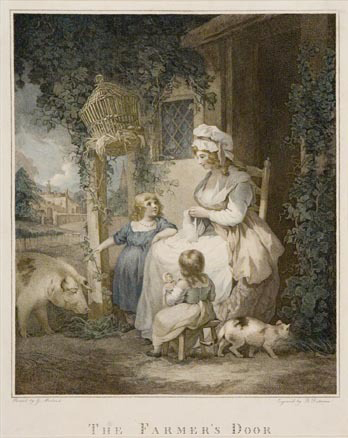
The Farmer's Door. George Morland, London: Published by J. R. Smith, King Street, Covent Garden, Aug. 4, 1790
The Farmer’s Door. George Morland, London: Published by J. R. Smith, King Street, Covent Garden, Aug. 4, 1790

A somewhat easier image to read is the print after George Morland’s The Farmer’s Door, from 1790. This genre painting presents the romanticized vision of humble life, with the farmer’s wife and her children (note the blue stays on the seated child).

Is the farmer’s wife wearing a half-robe over a quilted petticoat and apron? The quality of the images I can find is poor, and the coloring questionable.

In another version here, the kerchief is clearer and seems to go over a long-sleeved garment with a short skirt.

Selling Carrots by George Morland Date painted: 1795 Oil on canvas, 76 x 63.5 cm Collection: Brighton and Hove Museums and Art Galleries
Selling Carrots
by George Morland
Date painted: 1795
Oil on canvas, 76 x 63.5 cm
Collection: Brighton and Hove Museums and Art Galleries

In Selling Carrots, there is another short-skirted garment with long sleeves worn over a petticoat and with a kerchief.

Without getting overly distracted by titles and meaning, I think there are clues to how these half-robes or jackets are worn by women of different classes, aspirations, and locations. For rural women who are not gentry, these appear to be comfortable working clothes worn all day. For urban women, they seem to be worn early in the day, and sometimes out of doors, perhaps even to the lending library.

The Stamp Act Protest of 2014

Last Saturday, we stepped back in time to 1765 in Newport. I know: Newport always seems to be in a different time than gritty Providence, but this trip was truly different.

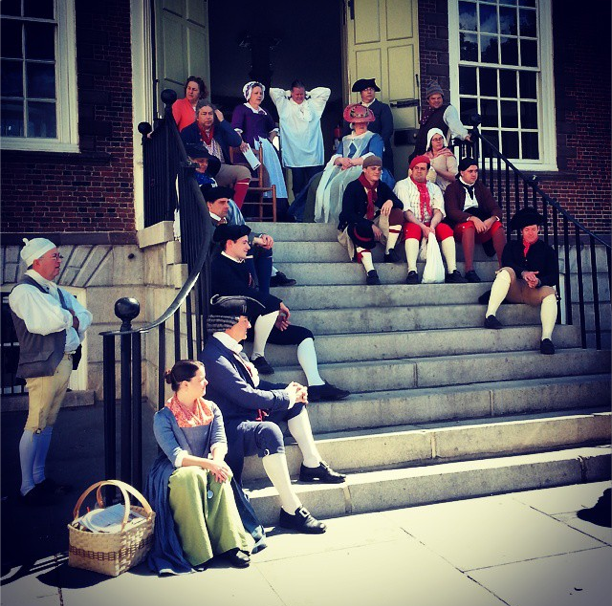
On the Colony House steps

We were headed across the Bay for a Stamp Act Protest (no rioting, per police request). In this effort, we joined a large group of recruits from New England and even beyond, to fill Washington Square and other sites in the city.

18th century sailors prepare to sew a sail
Preparing the ‘sails’ for stitching. I never really noticed the cars till I saw the photos!

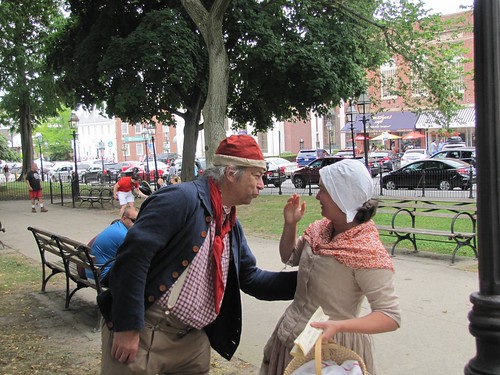
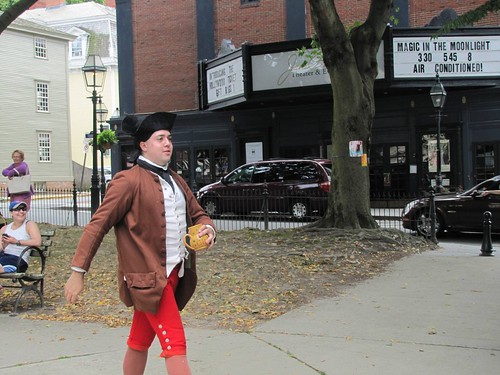
Stationed around the square were sailors mending or making a sail*, an apprentice-less printer, a sleepy apprentice boy, a tailor and his journeyman, a milliner, and leading citizens, one of whom was kind enough to read the newspaper to the apple seller, who wonders what has become of her son.

You must be very careful indeed around the sailors!

Up the street, some very fine ladies were having tea. Their refinement was evident in their appearance and dress, as well as in the elegant setting of their tables. They wanted none of my apples, as they had imported citrus fruits, far better than the apples the island’s trees produce. (Wasted on tea, truly: what one wants to do with a lemon is to find some rum and make a punch.)

18th century tea party in Newport
The Ladies’ Tea
Ladies at a tea table
Seated for tea
Mr Robinson marches forth

The news was very bad, and tempers flared in the square. Mistress Ellery told me that dinner parties had become impossible to hold: parties nearly come to blows over discussions of taxes, customs, stamps, and the oppressive policies of Mr Robinson, who insists on enforcing the very letter and penny of the law. (He was quite insulting on the quality of my apples, indeed, spitting one upon me even as he continued to eat it!)

The apprentice boy had charge of the effigy; the tailor sewed on.

As the afternoon wore on, the debate grew more intense and the crowd more heated. And effigy of Mr Howard was made, paraded, and hung, and then the crowd of protesters dispersed to the White Horse Tavern.

18th century men at the White Horse Tavern in Newport
Fortified!

Tensions seemed to dissipate, though when the runner came, the protesters– now fortified with ale, porter and cider–ran down the street to “plunder” Mr Howard’s house, played here by the Wanton-Lyman-Hazard House.

18th century people at Want-Lyman-Hazard House
Ignoring the mistress of the house, protesters dashed to the back.

Although the mistress of the house tried to reason with them, the crowd would not be dissuaded, convinced of their mission (and perhaps more fortified than you would expect after just one glass). They carried their loot to the front of the Colony House, and heaped it up, glorying in their success.

The goods!
More goods!

In the end, the house was not looted, tensions were dissipated, and the protesters dispersed into the afternoon. We were well-rewarded with cheese and ale at the Colony House, and enjoyed discussing the events of 1765 and 2014 with the public and Newport Historical Society staff members.

*Yes, Virginia, they do look like tents. That’s because they are tents. Someday, Light Infantry soldiers will sleep beneath that canvas. But for now, keep stitching!