
New England Spencers

You may recall how tortured I was (sort of) about making a Spencer for What Cheer Day, concerned that Spencers could not be documented to Rhode Island, let alone New England. I had the same worry about the Not-Quite-Good-Enough Coat.

JDK_8210_1

Things will come to those who wait, and what came this week was the long-awaited Proceedings of the Dublin Seminar for 2010, Dressing New England. In it I found an article by Alden O’Brien, Federal New England Fashion in the Diary of Sylvia Lewis.

Sylvia Lewis [Tyler], Diary (1801-1831), MSS 2899 in the Americana Collection of the NSDAR provides the basis for O’Brien’s article and my joy. It begins routinely enough with my favorite stuff– spinning!– and carries on to knitting: stockings, mittens, gloves, a hat or two, and even “comforters,” or scarves. Shag, or thrummed, knitting is mentioned, so at least those of us interpreting the world of 1801 and later can be war.

The real excitement comes on the third page: in the winter of 1803-1804, Sylvia Lewis cuts and sews a greatcoat. Then, in 1806, she makes a green Spencer, and in 1808, a black one.
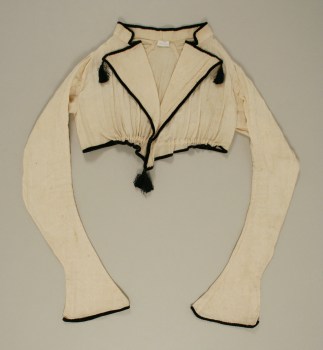
Spencer ca. 1800 French. silk. Purchase, Irene Lewisohn Trust Gift, 1991 1991.239.2
Spencer ca. 1800
French. silk. Purchase, Irene Lewisohn Trust Gift, 1991
1991.239.2

1806 is still later than I wore my Spencer. They’re shown in fashion plates of the 1790s, and here’s a pattern, too: so they’re clearly worn in Europe earlier than 1806. The similarity between the French silk spencer at the Met and fashion plates gives me confidence that they are being made and worn in the 1790s and early years of the 19th century; Spencers are also mentioned in tailoring manuals of this period.
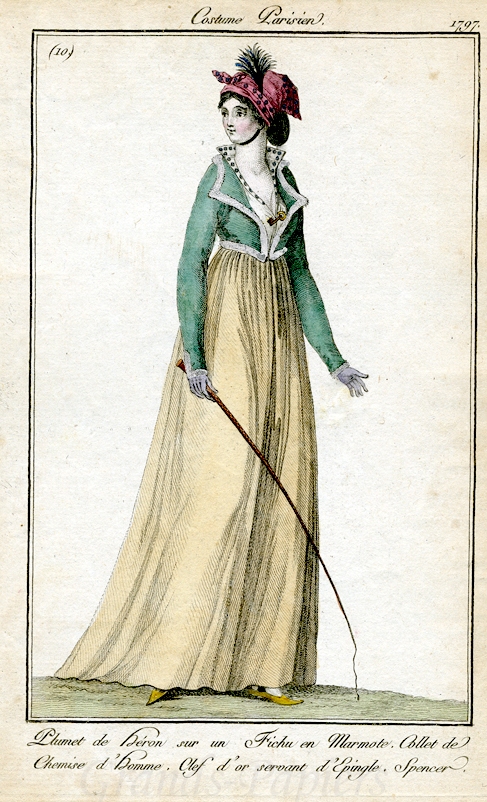
1797, with a similar shape to the Met's French silk spencer.
1797, with a similar shape to the Met’s French silk spencer.

They’re placed in New England with written documentation, but how early are they here? And what did they look like? I know of one in a private collection which I am slavering to see, based on the description of the wool. The MFA has a few that seem to be local to Lexington, and there is one in Maine with a catalog record that shines with passive aggressive crankiness, and delights when compared to another in the same catalog. And no, I’m pretty confident that gentlemen did not wear spencers, or tailed spencers, at any time.

But there’s really good stuff in Sylvia Lewis’s diary for anyone who wants to know more about clothing production, use, and costs in early Federal New England. Even if your Library doesn’t have it, your Librarian can get a copy of the article for you through ILL or you can buy the entire proceedings here.
Frocks Coats in Providence

Saturday last saw the launch of History Space, the collaborative project of the Rhode Island Historical Society and the Newport Historical Society designed to help living history practitioners and reenactors acquire the clothing and skills needed to bring the past to life.

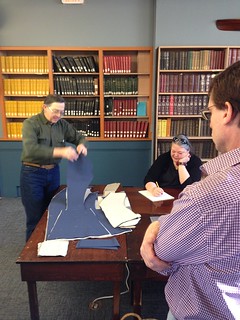
Many parts to a frock coat.

Scheduling being what it is, we plunged right in to hands-on work with Easy Grace and Comfort, a two-day man’s frock coat workshop with Henry Cooke. We saved enormous amounts of time in the workshop by having Mr Cooke cut coat kits for participants, and I know it was well worth every penny.

There is much less on-body fitting when Mr Cooke cuts a coat for the kid than when I do. (I think the Young Mr grows while I am trying to figure it out, but Henry cuts fast enough to head him off.)

Buckram and button stands

The most painful part of the whole thing (if fitting is largely done) is stitching on the buckram interfacing and the button stand. The zig-zag stitch as demonstrated by Henry was fairly easy to get the hang of when you caught the rhythm, but the tightness of the Red Edge stand tested my needle and even my fingertips.

There were some complaints at one table, largely voiced by the Fifer Formerly Known as Lambchop, who awaits his 10th Mass name.

Sleevils!

We made it all the way to sleeves, which is impressive, considering that some of the gentleman had not made more than a haversack or knapsack before. But if you can backstitch, and have some help with your fitting, you can make a coat.

I happen to like sleeves, myself, stitching them up and setting them in the garment. I think it’s the three-dimensionality of them that appeals to me– and I like a good challenge.

And here we are: sleevil one.

It’s critical to pay attention, though, so you make one left and one right sleeve, and to keep track of them as you set them to the garment body. I sometimes mark mine with chalk, and have even pinned notes to the pieces when feeling especially daft.

I’ve made it to an assembled coat body and sleeves, with one sleeve basted on. Before Saturday, I plan to baste on the second sleeve and test fit sleeve set on the boy. I’ll also try to get pocket flaps made. Since I have a talk to write and a bedgown to finish as well, I’m probably dreamin’ big.

When this suit is done, the Young Mr will have a very nice blue ensemble that includes breeches (join in the fun here) and a waistcoat. I think he’ll look rather nice, and better than he has previously. I still want to make lower-class* clothes for him, but first he does need a nice suit.

*I said urchin, but Mr Cooke said urchins can’t be over 6 feet tall. Basking sharks are big, but in this blue-grey suit, perhaps the Young Mr will finally be a grey reef shark.

Maid to Order

DSC_0572 I play the maid a lot, or one the lower sort, both at home and abroad.

I’ll be a maid in Newport again this February, and for that event, I’ve made the skritchy rust brown gown.

Not quite finished, it still requires hemming and something to finish the sleeves, but in three days, I got pretty far, considering.

This back-closing bodice with bust darts was pretty awful to fit– strange relationships developed between the bodice neckline and a waistband now discarded and on its way to Johnston.

DSC_0573

The back closes with a drawstring at neck and waist, as simple as possible. Mr S and I discovered that fitting a bodice back was deleterious to our relationship, so drawstrings won over buttons. I can tie the lower string, but not the upper– annoying, as I was trying to make a gown that was easy enough to put on solo at 4:30 AM. Vanity won over a pinned apron front gown, though I know they exist in Rhode Island collections. The skritchy rust-brown cotton pays homage to that extant garment, which is a rough homespun brown wool. I may not be stylin’ extant, but I’ll be itching correctly.

The Unbearable Sameness of Dressing

One of the arguments I hear against changing the way people dress as civilians at reenactments, particularly the women but sometimes the men, is that “if we all use the same pattern, we’ll all look alike, and that’s not how people dress now or then.”

I have news for you: that is how we dress[ed].

I know, we can’t apply modern thinking to the past– that’s crap historiography. But why do we resist using the same correct patterns for historic garments when we are clearly dressing alike today?

I’ve not yet read a paper on the similarity of women’s dress in Robert Feke or John Copley’s portraits that really convinced me, but if you look at enough of them, you might think there’s only one woman and one dress in all of British North America, because Badger and Greenwood are painting her, too.

Even if those clothes are studio props, what does it say that the sitters wanted to be portrayed in the same clothes? Look, if that’s the only means of getting myself into a Charles James, you bet I’d take it. Or, for a more contemporary analogue, Alexander McQueen.

Luxe et Indigence. Le Bon Genre, 1817

Dressing is about status as much as it is about self-expression, and in the 18th century, dressing signaled refinement, sensibility, and status through the quality of fabric as much as through the cut of clothes. Air Jordans do the same thing today, or North Face jackets, or Kate Spade purses. They show what you can afford, even if you’re eating oatmeal for dinner behind closed doors.

We dress the same now, and we dressed the same then, with variations according to pocketbook. We can’t all afford K&P superfine wool today any more than we could have bought the best wools or prints in the 18th century. But using accurate patterns and fabrics appropriate to our station will create the best impressions possible– even if my gown is cut to the same pattern as my wealthier acquaintance’s.