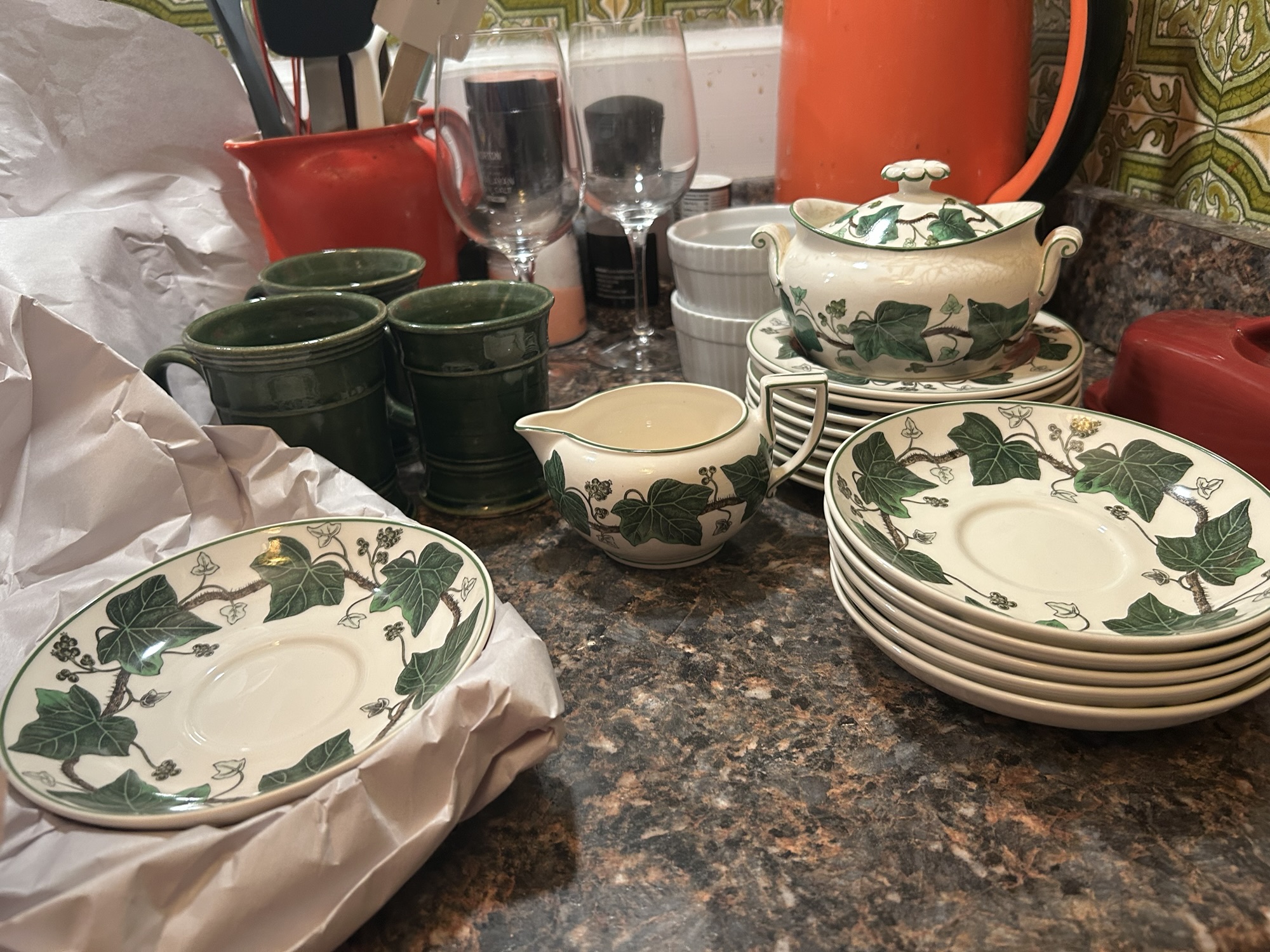
I’m standing at the sink in the kitchen in my Baltimore apartment. It’s the smallest kitchen I’ve ever had, but I’m unpacking Wedgewood plates, cups, and saucers. There’s a creamer and a sugar bowl. What on earth am I going to do with these? We will eat from them, but how ridiculous is it to stand at the sink, some 30 years after receiving the wedding present, washing a service for eight? There are no longer 8 of everything– some have chipped badly, some broke in use– and I wonder how hard it is to get replacements. They’re available, if I want to spend $70 to $90.
This is crazy! No one will care if the plates are chipped. We’re in the collapse right now, and things are not going to improve unless there is drastic (unlikely) change. We will be lucky to have food to eat, who cares about plates?! But still I ordered three replacement plates, because I hate chipped plates, and well, why not? Why not have nice dishes as the world we know changes forever, irrevocably?
A nice table won’t stop the fascism (that takes other work). Does a nice table affirm our humanity and our dignity? Am I mimicking the disaffected and the royalists who clung to sensibility as the American Revolution swirled around them? Maybe. For now, our dishes will be pretty and clean, and the cat will get her special meals, and we will be as normal as we can be, knowing all the while that nothing is normal and nothing ever will be.
In August, the Museum of the American Revolution contacted me about making a snuff-colored cloak. Although many 18th-century women’s cloaks were red, some were not. Newspapers carry ads for stolen goods and runaways in brown camblet cloaks lined with baize; white silk cloaks; black silk cloaks; and cloth cloaks, which are probably “cloth colored” wool– what we would think of as drab or beige. The Museum referenced an ad from the Pennsylvania Gazette of April 30, 1777, May 7, 1777, and May 21, 1777.
Pennsylvania Gazette, May 7, 1777. page 3
“Run away from the subscriber, living in Evesham township, in the State of New Jersey, Burlington county, on the 20th of April. 1777, a certain Sarah McGee, Irish descent, born in Philadelphia; she is about 23 years of age, about 5 feet 7 inches high, very lusty made in proportion; she had on when she went away, a snuff coloured worsted long gown, a spotted calico petticoat, stays and a good white apron, a snuff colored cloak, faced with snuff coloured shalloon, a black silk bonnet, with a ribbon around the crown: She was seen with her mother, in Philadelphia, who lives in Shippen street, where it is supposed she is concealed. Whoever takes up said servant and brings her to her master, or puts her in confinement, so that her master gets her again, shall have the above reward, and reasonable charges, paid by Barzillai Coat”
I was not clever enough to latch onto the snuff-coloured shalloon facings, but I made up a hooded cloak with a snuff-coloured silk lining and dispatched it just before school started. (I doubt I could have achieved a happy color match in any modern “shalloon.”) I’d picked up the wool and silk in Natick, Massachusetts on a summer trip in 2018, and had planned — and put off– a snuff-coloured cloak of my own. Oh well.
Highly Scientific
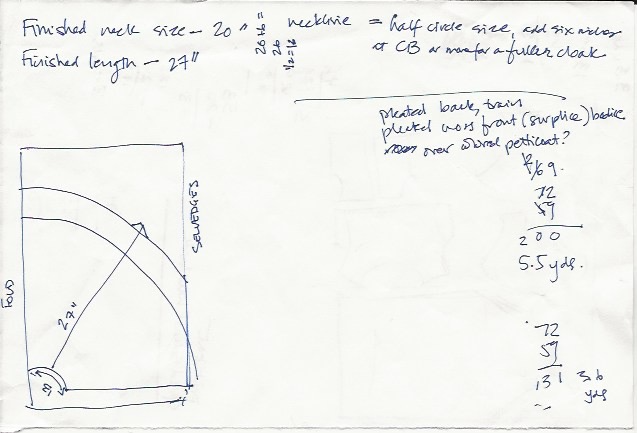
As the semester drew to a close, the cloak started gnawing at me. That was really nice wool! And such a nice color! I really had wanted my own cloak. I succumbed to ordering some substitute wool, and over the winter break, made myself a cloak. They only a day or so, once you’ve done the math to chalk and cut the pieces. I have a handy diagram to help me figure it out, adapted from Sue Felshin’s classic post on cloaks. You don’t need much else.
This wool is heavier than what I’ve used before, and I’m not fully enamored with the drape. Still, this will go a long way towards completing the Cinnamon Toast Crunch Quaker look when I wear it with the brown gown I made this past summer. I love my red cloak, but for a Philadelphia Quaker’s brown gown, a snuff-coloured cloak is a better match.
The making is really simple. You do want to start with a well-made wool broadcloth or coating that will hold a cut edge– that eliminates a lot of hemming, and takes advantage of the natural characteristics of the wool just as 18th-century makers did. You don’t need a lot; I used 1.75 yards of 52-60” wool, which makes an acceptable length cloak even for me (I am 5’-10”).
The finished cloak (and a fancy petticoat)
The cloak neck edge is pleated to a neck size that suits you (annoying, I know, but that’s how this works). The hood is stitched up the center back (I used a butt stitch), with the last 6” or so pleated. This is the trickiest bit. Even strokes make a nice array, but the real trick is stitching the pleats flat so that they hold the shape. Sometimes it turns out better than others; heavier weight wool will be harder to wrangle, as this was.
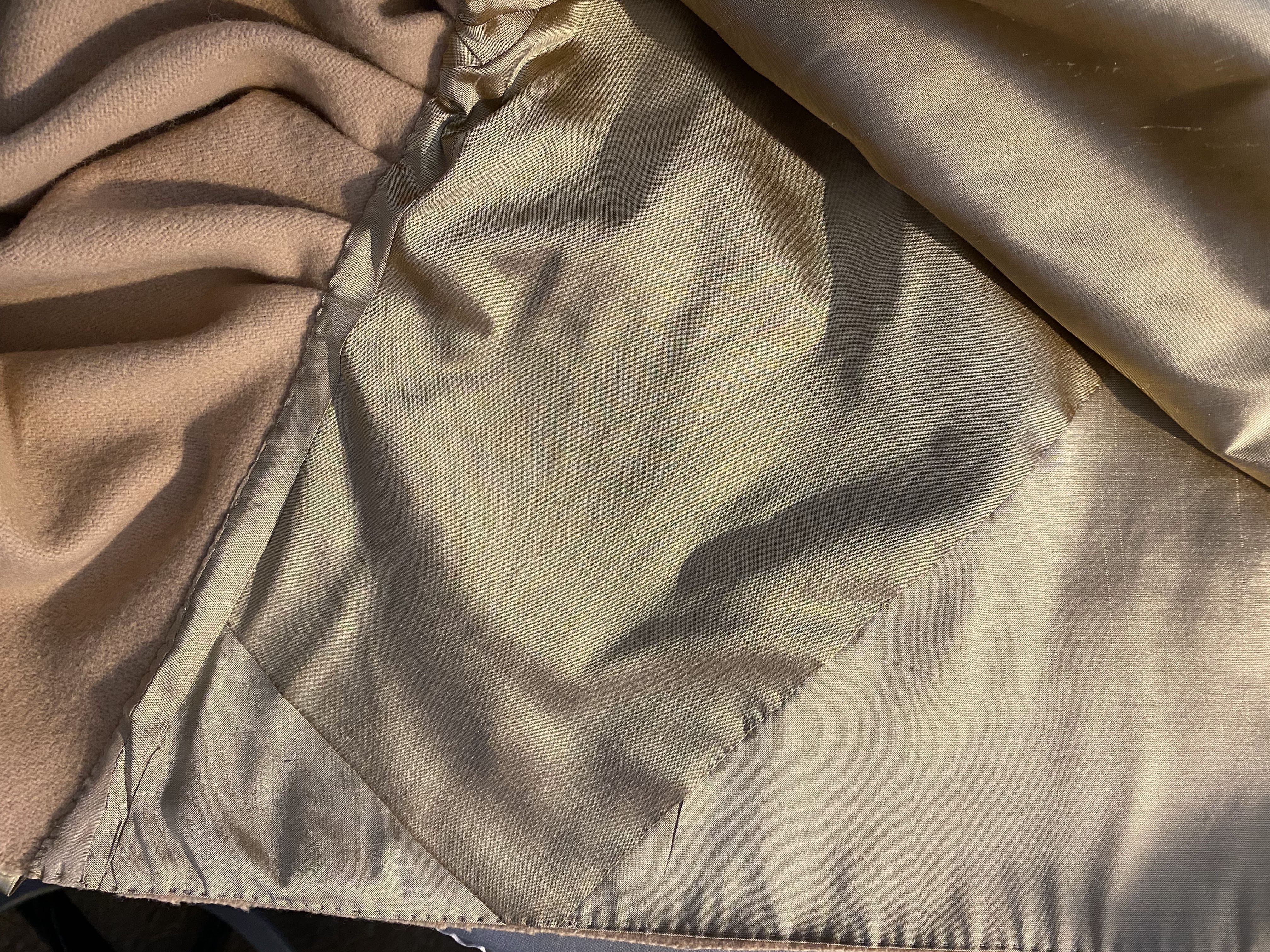
Piecing is period, and appropriate for the inside of hood.
I ended up piecing the silk for the hood lining (piecing is period) and I’m pleased with how that turned out. I barely had the patience to do it, but the result was pleasing and I saved silk, so there’s that. For ties, I used some silk satin ribbon purchased for some other, now-forgotten project. I tend to save materials, thinking I’m not “good enough” to use them– that is, not skilled enough. Well, if not now, when? The cloak and its ribbon ties mean much more worn than that they will stashed in storage. Eat the cake. Buy the shoes. Make the dress, the cloak, the apron, the ruffles. Make whatever brings you joy.
Shopping with a basket at Fort Fred. (photo by Denise Wolff)
The subject of carrying things at living history events never seems fully resolved. There were the fireworks I like to call Basketgate, and in the four years since, more women have been carrying frails than firm-sided baskets. But here’s the thing: baskets were not used as purses. They were used for shopping, and for babies (thanks, Ruth!), not for toting about one’s personal effects. That’s what pockets were, and remain, for.
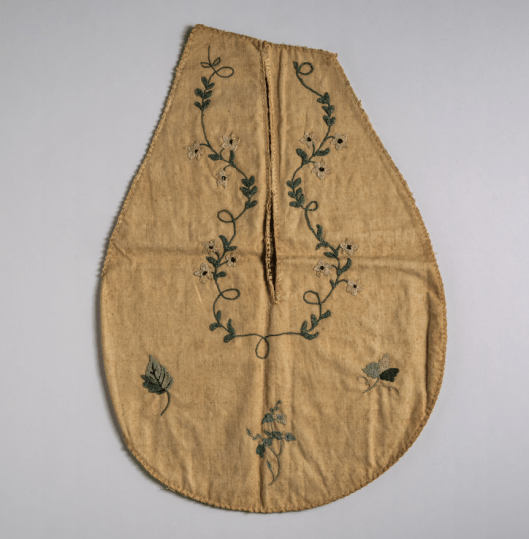
Pocket, silk on linen, ca. 1780. Martha Elizabeth Spach (probably). MESDA 2400.
18th century women were not cursed with the tiny pockets of today’s fashionable jeans. No, they had voluminous pockets capable of holding a vast array of items: pocket journals, purses (like our wallets), game tokens, an orange, keys, and almost anything else you can think of. The pocket shown in the image is 15″ long by 11″ wide, which is a fairly typical size, though some were even larger. When I made these, I described them as “large enough for a puppy,” and Facebook wouldn’t let me post them. There is now a full-length book on The Pocket and I look forward to reading it next year, when my ILL will finally request it ($50 being too dear for my budget). In the meantime, the Victoria and Albert Museum will get you started if pockets are new to you.
So, baskets for shopping and pockets for personal things. What else might you use to convey something from one place to another?
Paul Sandby RA, 1731–1809, British, London Cries: A Man with a Bundle, Old Clothes, undated, Watercolor on medium, cream, slightly textured laid paper, Yale Center for British Art, Paul Mellon Collection
A wallet, of the kind reenactors call a “market wallet,” though that was not the period term. You can read about these in an article by Charles LeCount. The man in the watercolor has a very full wallet over his shoulder, demonstrating the larger end of the wallet spectrum.
Which one you choose depends on who you portray, and where. Silk wallets or pocketbooks belong to a particular class and the ones in museum collections are often from France. Flamestitch wallets are reasonably common in North America among people with the time to make them. The really neat thing about these is that the patterns show regional differences, so you can tailor your choice to your place. (I lack the patience, skill, or time to really make headway on mine, but in addition to a wonderful custom pattern, I found kits here.) I have a leather one I love, made by this fellow craftsperson and friend.
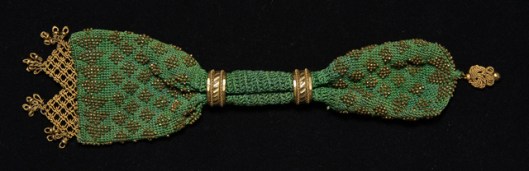
Miser’s purse, early 1800s, maker unknown. Purchased 2002. CC BY-NC-ND 4.0. Te Papa (GH009865)
Your coins? A purse. (we call these miser’s purses, though long purse or ring purse might also be used. The forms originates in the 17th century, and although it is most popular in the 19th century, it does appear in the 18th century. It’s just not common, so no, not everyone should have one. A simple bag will do for those with coins they wish to keep wrangled.
Servant Returning from the Market, 1739, Jean-Baptiste-Simeon Chardin. Louvre Museum, MI 720
A bag, a pillow case, or even a tied cloth, as seen in the painting by Chardin.
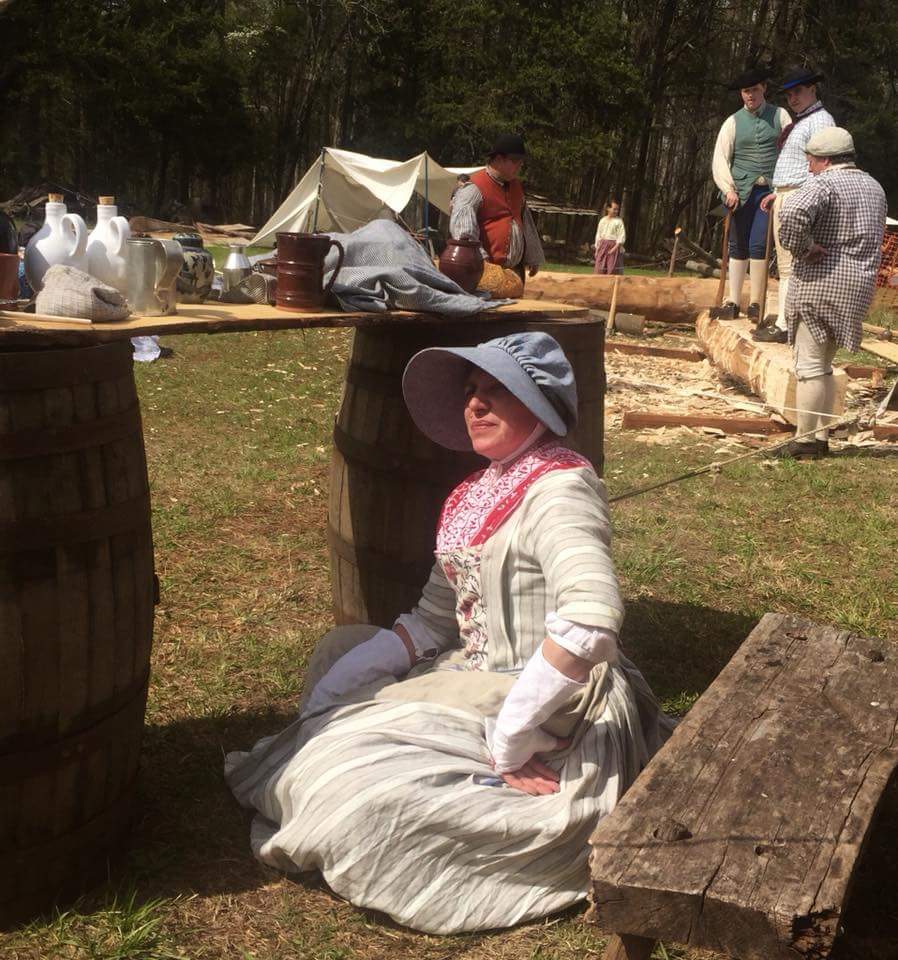
It was a simple set up: two barrels, a board, my frail, and me. (I could really use a wheelbarrow, and a rain deck. At least the rain deck is something I can make myself.) But this was more than adequate to sell luxury goods (rum, whiskey, radishes, and ginger candy) to the soldiers at Fort Dobbs.
I didn’t think it was hot– which may be thanks to that nifty new checked linen shade bonnet– but it was. Have I forgotten how to take care of myself outdoors in warm weather? Perhaps because I’ve spent so much more time lately on winter events, I’ve let the “drink all the water” mantra slide. It’s clearly time to revive the summer skills, with Monmouth not all that far away.








_-_WGA04758.jpg)


 Kirsten Hammerstrom
You must be logged in to post a comment.