As you would expect from recent reports, the Young Mr has outgrown almost everything he owns, with the exception of his shirt. I put a lot of time into that blue wool jacket, so I’m not ready to sell it on Etsy yet, but I do have to replace it. Sewing new things means I get a chance to look again at sources for inspiration, and to do better this time around.
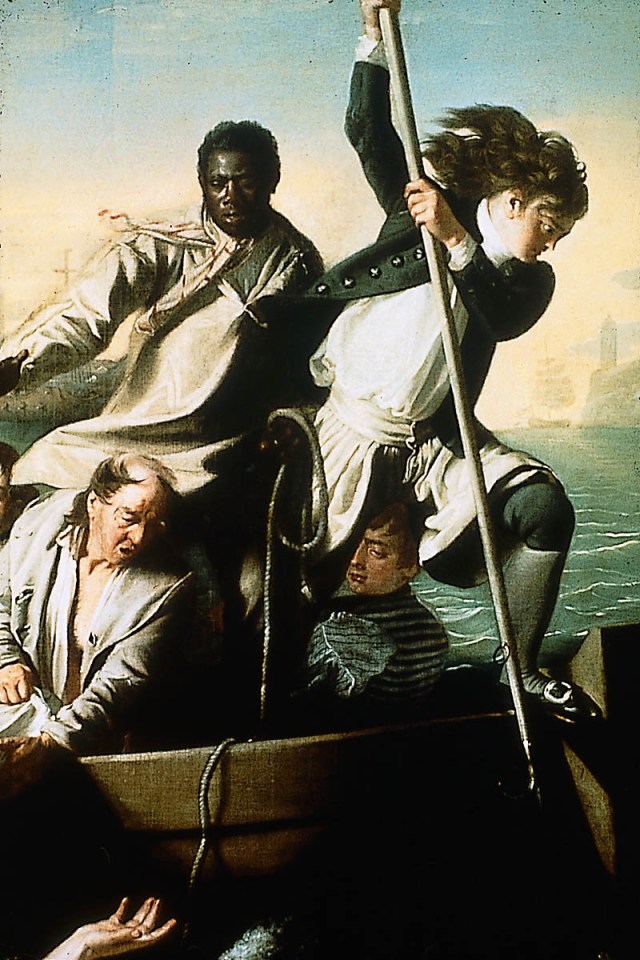
Since we’re in summer, I’m thinking blue linen, since I have access to very local inspiration in the form of Oliver Hazard Perry’s short jacket. But for earlier ideas, there’s Copley. I particularly like the horizontal stripe on the waistcoat, and what seems to be a striped shirt. Striped shirt! How exciting is that?
I’m thinking striped trousers, based on a Massachusetts letter, but we’ll see how far I get with that. The final deciding factor in wearing, of course, could be striped trousers are better than no trousers.
Mr. Turner, out now on iTunes and elsewhere, won’t be for everyone: M’damsel isn’t treated very well– artists are, you know, often narcissistic, driven users– but the landscapes thrill.
We talk sometimes about going to the antique store in historical clothing and asking why our chattel is for sale. I toy with similar naughty thoughts about visiting historic house and other museums, but Mr Turner inspires a dream of a simpler pleasure: dressing in period clothes to visit a period gallery.
Classic Mr Turner in the salon
Possibly my companion would grunt as Turner does, but we might also unnerve guards by pointing walking sticks at salon-hung still lifes or reacting with disgust at the sight of an Impressionist work. (Might as well take it all the way.)
Everybody’s a critic
No takers yet for this diversion, which is just as well. I expect it would be a quick way to meet security and police staff if you didn’t coordinate with the museum/gallery in advance. Still: what a stunt. Someday I’ll pull it off.
I wrestle a lot with myself, which sounds much sexier and more athletic than it is, when it’s your patience and conscience. It’s a constant fight with my own brain and animal nature, like Snowy pondering a bone.
It’s hard to keep sewing for an ever-taller young man who refuses almost all attempts at fitting. (Especially when your calloused fingertips and split thumb keep catching on the silk buttonhole twist.)
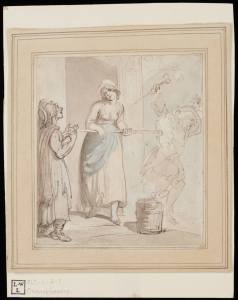
It’s hard to have program ideas and then realize you will end up as the maid, serving a meal to a group including some people you might not like. (Don’t you think that must be a fairly authentic emotion, historically?)
It’s hard to put aside plans for your first pretty silk dress because someone doesn’t want to go where you want to go.
It’s hard to embrace the importance and meaning of interpreting the ordinary in a culture that celebrates the unique.
I come to that and stop: mission.
Watercolor by Thomas Rowlandson, 1785? Lewis Walpole LibraryDrawings R79 no. 7
You can take anything too far, of course, and an occasional silk gown and turn around a dance floor might make being the maid a little easier, but in the end I know that what’s important to me is representing the people who have been forgotten.
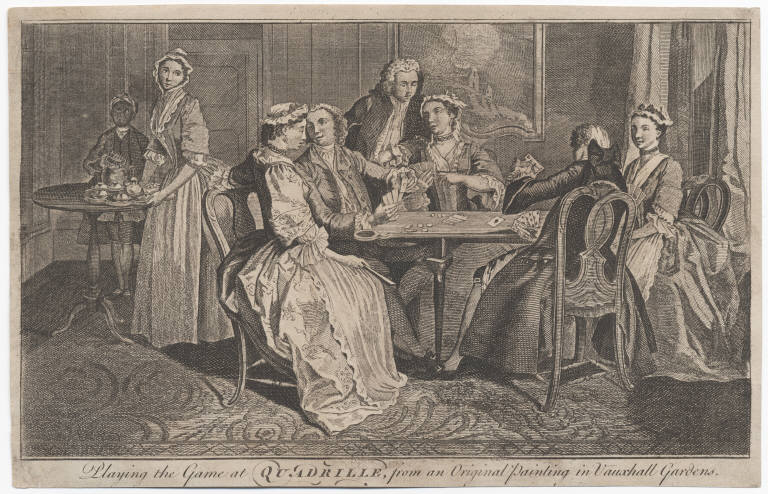
That same impulse may be part of what drives the splintering into ever-smaller groups with every-different coats, but walking the cat back also leads me to think that lace, tape, and shiny buttons may be part of the equation, too. Are those uniforms the gents’ equivalent to cross-barr’d silk sacques? As in any culture, it is easier to have your cake and eat it, too if you’re a guy.
For most of us women inhabiting the past, if we’re not baking cake, we’re serving it.
Playing the game at quadrille : from an original painting in Vauxhall Gardens. London : Robert Sayer, ca. 1750. Lewis Walpole Library, 750.00.00.14
It’s a funny thing to want a break from work you find important, but as with anything, variety and perspective are important.
She looks wistful, doesn’t she? The others are whist-full.
In a world of individualists, each trying to stand out, quotidian celebrities– cast a skeptical glance at your social media feed and tell me I’m wrong–our impulse may not be to inhabit the background. But most of us are the background. We’re large only in our own minds, stars of the movies of our lives that flicker past our eyelids. And that’s ok: that’s noble, even, to live a small, thoughtful life.
Silver Pocket Watch of Meriwether Lewis, 1936.30.5
Once upon a time, when I worked in Missouri, I was fortunate enough to spend a lot of quality time with some amazing artifacts.
Meriwether Lewis’s refracting telescope.
William Clark’s compass.
Meriwether Lewis’s pocket watch.
William Clark’s Account with John Griffin for thread, cloth and other articles including a hat for George and shoes for Mary. (July 1820, William Clark Papers, B13/F5, MHS)
Account of expenses in “horse keeping,” 1829- 1831. Request to Clark to pay to Mrs. Ingram, with request to serve as receipt. On same document: ADS Dashney to Major Graham, 26 June 1826. Order to pay William C. Wiggins. (1831 Dec 13, William Clark Papers, B14/F2, MHS).
There are letters to one of Clark’s sons, trying to get him to stay at West Point. There are bills for bolts and iron work for Clark’s house. Yes: there are amazing things in the collection as well, and historians of all kinds can do amazing work in the papers.
But they are ordinary. They are daily life played out in the first third of the nineteenth century in St. Louis, bills and accounts punctuated by letters from famous people and news of wars and explorers. But after processing the family’s collection, what struck me more than anything was how ordinary they were, how quotidian.
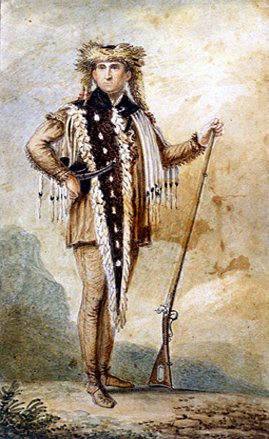
Meriwether Lewis in Indian dress. engraving after St. Memin, 1807.
Lewis was fabulous, interesting and mysterious. I don’t know what really happened on the Natchez Trace, but I know what happened in St. Louis. William Clark kept living, paying his bills and stumbling sometimes, refusing a role as territorial governor before accepting it. He got boring. And for that, I love him more than Lewis.
There’s real value in interpreting the everyday, ordinary people, in bringing work and working people to life in the past. I don’t always love repressing my ego, but I know that a nostalgic view of the past can be dangerous. I meant backwardly aspirational when I first wrote it, and I mean it now: most of us would not have been merchants wearing silks and velvets and superfine wools.
After wrestling with my ego and silk dress disappointment most of this afternoon*, I’ve found satisfaction in the thought of expanding my understanding of working class women. If really digging into interpreting the world of the marginal makes me uncomfortable, it must be worth doing, and doing well.
*Thankfully whilst performing useful tasks like running errands and thus wasting little real time on this nonsense.
Madora [sic] water color by Maria Caroline Temple ca 1800. Inscribed Maria C. Temple. delt.’ and ‘Vide “Young Philosopher.” British Museum 1869,0612.599
I was looking for images of maids in 1800, and came across this in the British Museum. Having no idea what Maria Temple meant by Vide Young Philosopher, I went searching. Turns out the answer is surprisingly easy: It’s a novel published in 1798 by Charlotte Smith. So it seems that what Maria Caroline Temple did was to draw a scene from a novel she’d read. I was delighted by this, as something I used to do a long time ago was to draw scenes from books I had read and loved.
With a publication date of 1798, I think we can feel pretty confident in the British Museum’s ca. 1800 date; what I was looking for was a non-satirical illustration of a maid in 1800: what did she wear, how did she comport herself? not because I haven’t been a maid in 1800 before, but because I need to be a better maid in 1800.
The things to love in this image, aside from the clothes, are the checked slipcover and window drape, the brass lock on the heavy wooden door, and the view through those wavy panes of glass. I don’t love the wallpaper, but I appreciate the evidence of it– but not as much as I appreciate the hint of drape matching that raucous slipcover.
Now I just need to hunt down an affordable copy of this clearly dramatic and romantic work of early fiction, and to find out exactly what books were being read in 1800 Rhode Island.





![Madora [sic] water color by Maria Caroline Temple ca 1800. Inscribed Maria C. Temple. delt.' and 'Vide "Young Philosopher." British Museum 1869,0612.599](https://kirstenhammerstrom.com/wp-content/uploads/2023/03/89c0c-an00291773_001_l.jpg?w=640&h=610)
 Kirsten Hammerstrom
You must be logged in to post a comment.