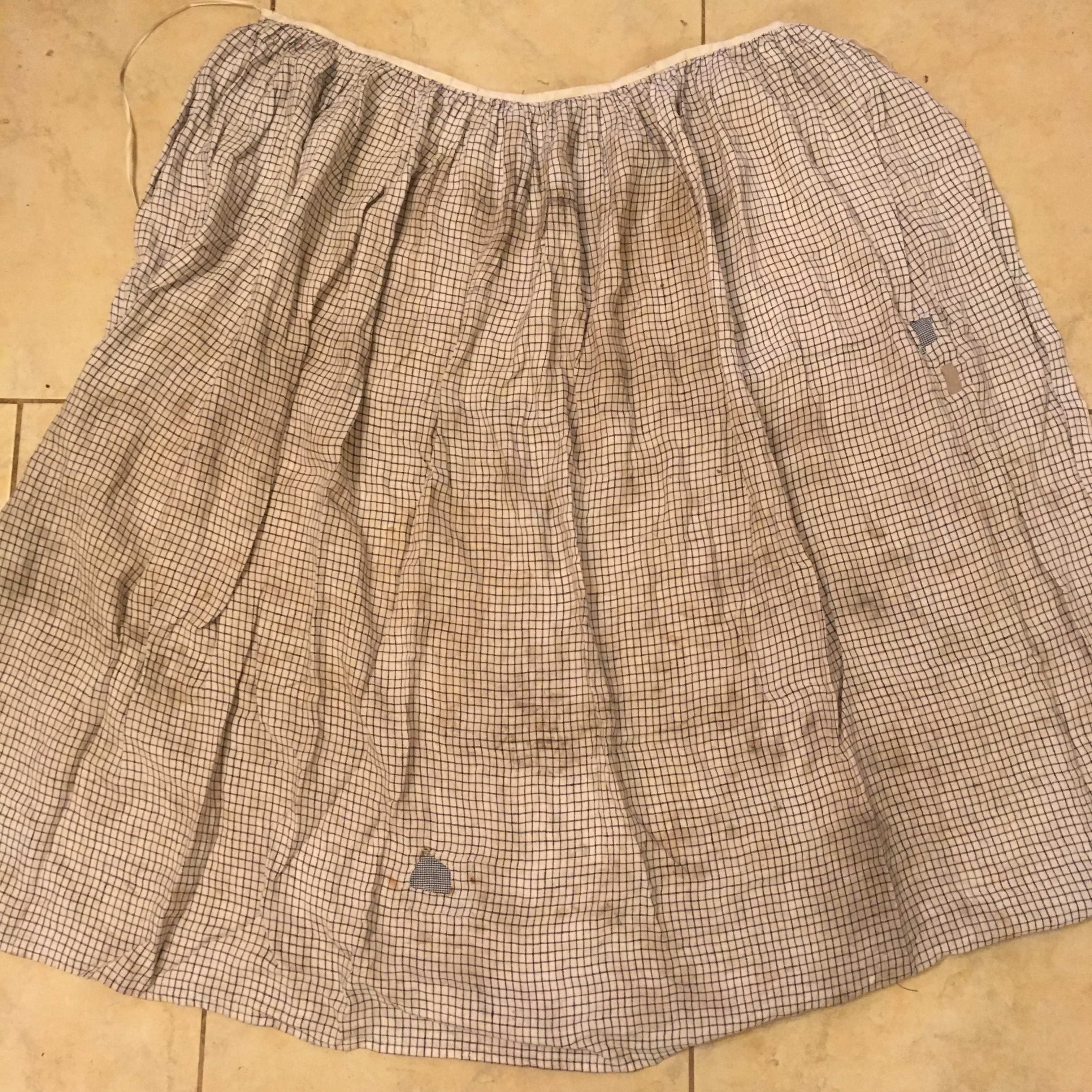
My poor old apron. It’s almost– but not quite– the firstarticle of historical clothing I made. (The first was a shift. Infrastructure and fundamentals, people.) It acquired some new wear (actual holes!) in New Jersey, and required mending.
First, it needed to be washed. I hadn’t taken a objective look at my apron in a while, but after we got home from Salem, I knew I had to mend it, which meant washing.
Reader, it smelled.
You get used to smells, and even enjoy them: wet wool, gunpowder, wood smoke. And then there’s tallow. I’ve never gotten used to the smell of tallow, and I don’t remember when this apron encountered hard fat, but the odor is unmistakable.
So is the water.
This past weekend, I had a chance to mend this favorite apron while I peddled luxury goods at Fort Dobbs’ War for Empire event.
Although I have a sturdy plain linen apron, I’m fond of checks, and of the hand this apron has achieved after much wearing and some washing.
It will never be really clean again, but for now, the apron is mended and back in rotation.
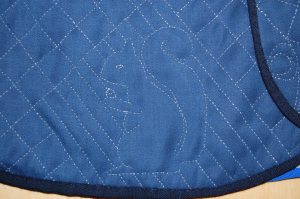
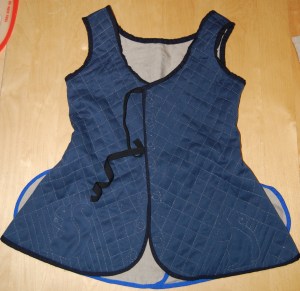
I updated that garment and wore a nearly-completed version at Ti last February but never wrote about the new version: the Squirrel Waistcoat.
Wool hand-quilted to a wool backing and lined with wool, I wore this almost finished at Fort Ti last February, and found it comfortable and cozy. I had imagined its state to be far worse than it was: with a lining in need of piecing, mangled seams, your worst nightmare come true. But no: all it really needed was some binding adjustment, not surprising considering that I stitched the binding by candlelight while chattering away with friends over cider.
The back pieces weren’t bound at all, but because I’d imagined this needed so much more work than it did, I put it aside until now, when I know I will want it for a weekend in Trenton, and another at Ti in December. All it took was a little time, and accepting that the bindings will not match.
This wasn’t a long, involved project, really, though I spent lunch hours and evenings working on it last January and February. It is, as so many things are, about patience. Patience and good needles.
The construction was based on the quilted waistcoat I made two years ago, with a pattern derived from Sharon Burnston’s research, using fitting adjustments I’d made to an earlier jacket pattern (long since abandoned due to living in New England).
I don’t fully remember how it fits best, over or under my stays, but I’ll get a couple of opportunities to test drive the layers in the next two weeks. And in the meantime? Squirrel!
Miss Nancy Dawson, aquatint print. Victoria and Albert Museum. E.4968-1968
Hat tip to Mr B for pointing out the resemblance; I know the print and never connected it to this fabric.
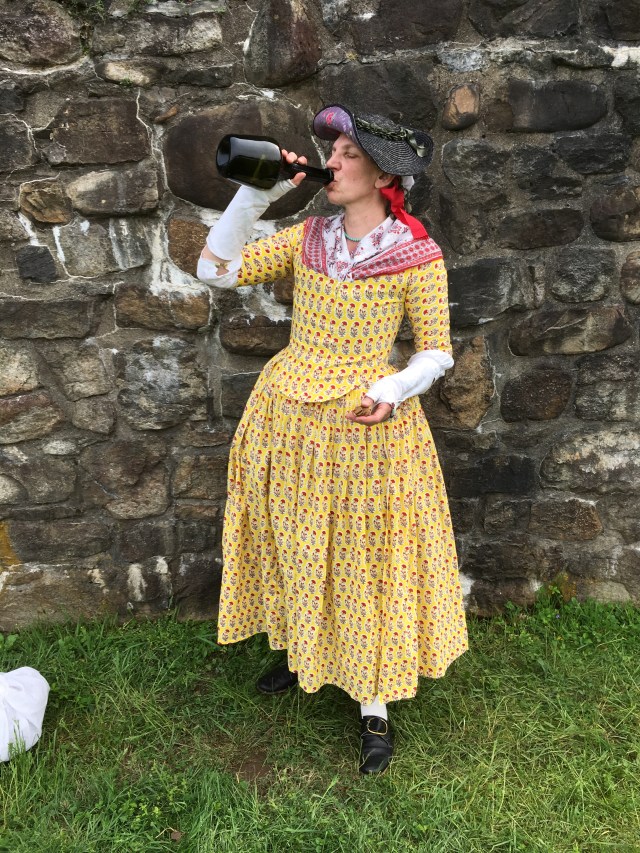
It’s been almost a year in the making, this bright yellow billboard of a gown. I’m not sure why I dawdled over the making; usually I’m pretty quick with a needle, but perhaps it was in part because the goal kept changing: first December, and then, it seemed, never, would I have an occasion to wear this. Federal exploits intervened, work intensified, things changed. But late April presented itself as an opportunity, so finally I had a goal, a deadline.
It was hot. And humid. That’s only water.
And I met it, with Drunk Tailor’s help (setting hems by yourself is a pain).
This is a fairly straightforward affair. I did use the Larkin and Smith “fashionable gown” pattern because I know how it fits me, but the front is modified to a simple closing and the skirts aren’t meant to be drawn up. This gown aspires to pretensions– though you can tell I’m fairly prosperous by the number of different prints I’m wearing.
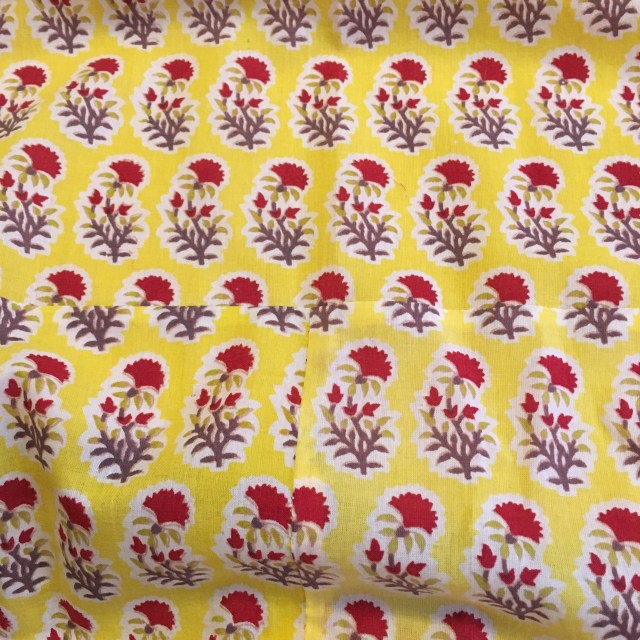
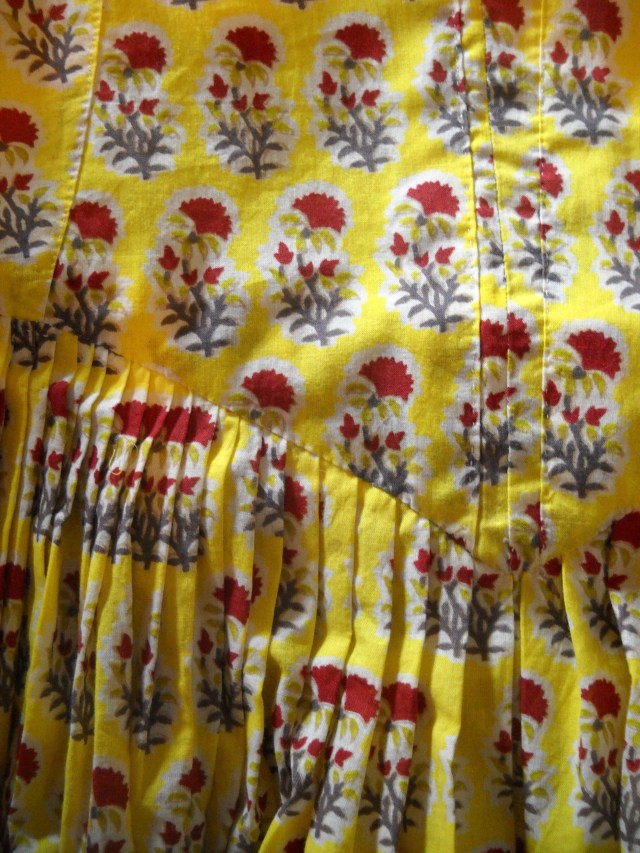
The petticoat did require piecing– at my height, 44 inch wide fabric often needs to be pieced to achieve the lengths or width I need in historical skirts.
Happily, the piecing matches and doesn’t match, in a fairly satisfactory way. When this fabric arrived on my doorstep, I determined that it needed to be used in the most obnoxious manner possible– and since I’m not a small woman, a gown and matching petticoat seemed the best possible use. (I have other obnoxious fabrics for later time periods).
I did take care as I made it up, though, stitching with white thread and trying to make the pleats small and correct to the fashion and fabric. Any failures or flaws make it, to my eye, better as an article of aspiration to a rank and style I really can’t pull off.
One thing I forgot to pack was a bum roll– though wearing that on the drive to Fort Frederick would have been extra interesting– which was unfortunate, as it is truly required. These new (they’re a year old, and I expect to call them “new” for a long time to come) stays make a different shape in the back than the old stays, and now my own padding no longer negates the need for a bum roll. Still, I’m pleased with the result, even if it still wants cuffs. Not bad for eleven months of work.
These new stays are, so far, the best I’ve ever had and well worth the blood, sweat and swears it took to make them. Gowns do seem to fit better over these stays; they held up well at muggy Monmouth and in polar Princeton, but the last two rounds at Ti left me feeling like I’d taken a hoof to the ribs.
What gives, kidneys? At least this time I made it past Fort Ann and all the way into a private room in Glens Falls before I had to free the sisters and release the lower back.
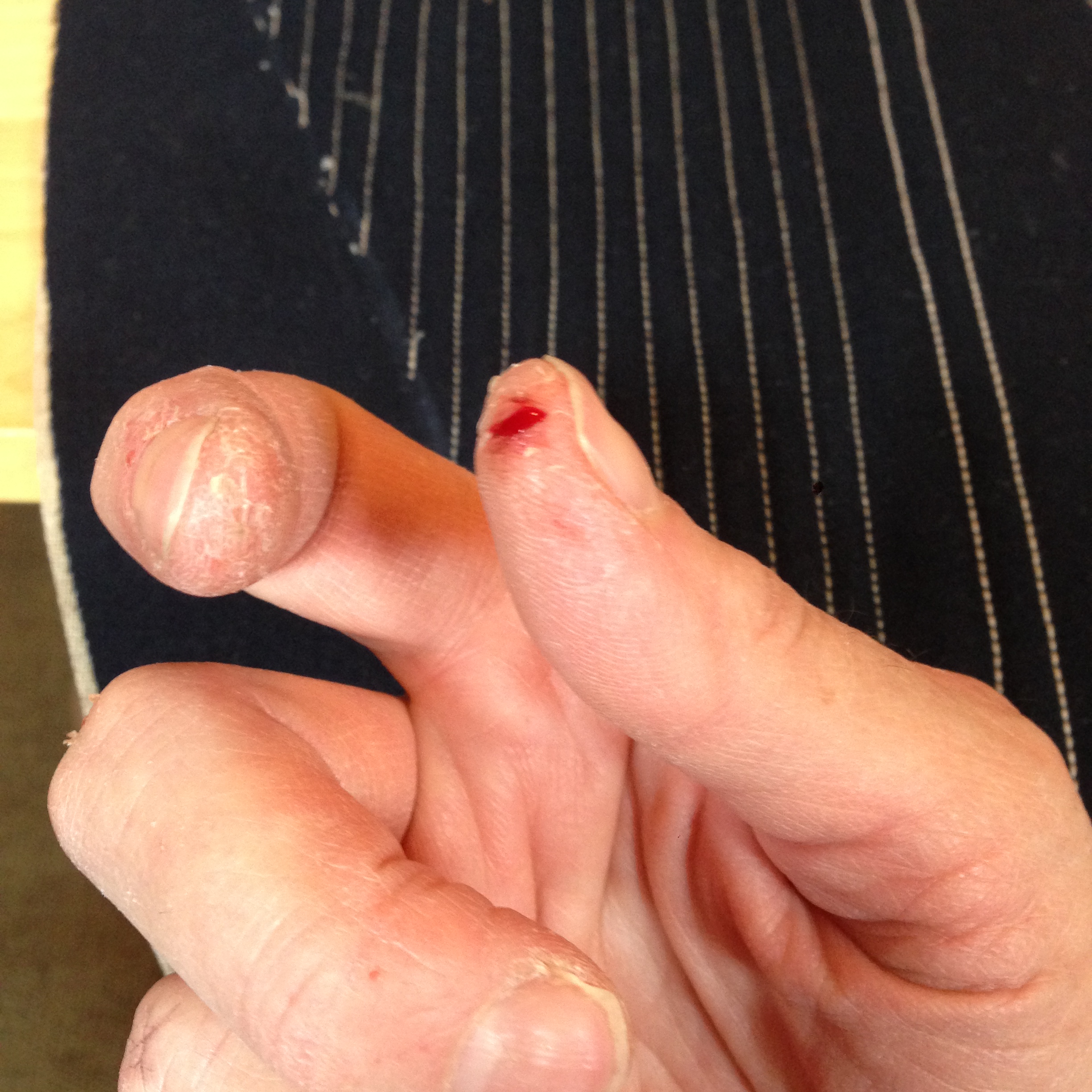
But this time, there was a bonus: the previously indicated Bust Blister. On the left side (I’m right handed), I developed a fairly robust .25” x .125” blister that crowned the top of a nearly 2” red mark, mirrored on the right by a less red and slightly less long mark. The culprit?
The Busk of Doom, of course.
Strictly speaking, I should not sport a busk when I desport as Captain Delaplace’s serving woman, or as a refugee cooking up the last of the bread, eggs, and milk. I’ve earned these marks and (potential) future scars by dressing above my station, and need to adjust accordingly.
Step one: Rounding down the busk edges (now in the capable hands of Drunk Tailor).
Step two: Foregoing the busk when working.
Step three: Wearing partially-boned stays when working.
Two is the easiest; three is the hardest. Which do you think I am, therefore, actually contemplating as a necessary next step?
But of Course: Step Three, Pathway to Finger Cracks and Stained Stays.
d’oh! surgical tape made this *much* better later.
Fortunately I have people close to me who will ensure that I work through steps One and Two before embarking upon step Three, but I certainly want to know more about (and will look much more closely at images of) working women in the third quarter of the 18th century. My suspicion is that women who are performing labor that requires movement– up and down before a fire, back and forth across a floor, bending over a tub– may not be wearing stays made in exactly the way high style stays are made for ladies who bend over an embroidery hoop, glide back and forth across a ballroom floor, or move up and down the stairs of a well-built home they supervise.
Or my busk pocket is too big, my busk edges too square, and my actions too fast and continuous.
Paul Sandby. At Sandpit Gate circa 1752 Pencil, pen and ink and watercolor. RCIN 914329
What are these women wearing? They certainly look fully boned. What can I change to make my stays work better for working? No matter what, where there are variables, there are experiments to run, and that’s what really makes history fun (even when it hurts).









 Kirsten Hammerstrom
You must be logged in to post a comment.