but that’s fine, actually. I like to get dirty. The red Virginia cloth dress is now clay-splashed, and while it was made especially for the “People of 1763” event, it may no longer work. Fine for cherry-sellers, fine for hand-bill hawkers, it will not do for a lady’s maid, and I don’t especially want to clean it. Hope I can get my stays wrangled back into shape and that my cross-barred gown fits…but if not, I’ll be a recently promoted lady’s maid.
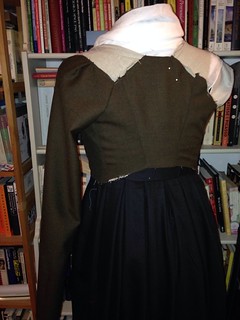
From the back.
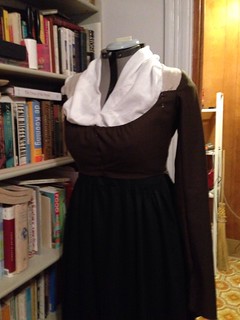
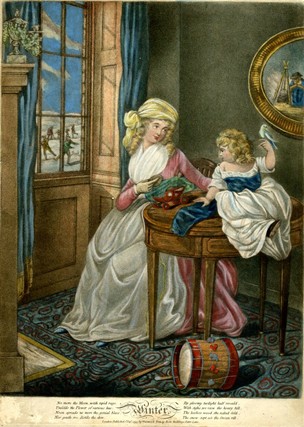
My other upcoming role as a maid will be at the John Brown House Museum, on October 5. This has required quite a bit of thinking and stewing about appropriate clothing and realistic background. I finally settled on a black-and-brown combination of petticoat and open robe, with the style of the open robe based on Paul Sandby drawings and extant garments, but determined by the scant three and a quarter yards of brown worsted that I was able to find.
Winter, 1795. The British Museum, 2010,7081.509
The bodice back is based on the 1795-97 cross-front gown from Museum of Costume in Bath shown in The Cut of Women’s Clothes. The front is meant to be transitional: a little bit of gathering at the neck, but not a great deal, with the edges still pinning closed. The sleeves are long and slim, and will button at the wrist once I’ve gotten the length worked out.
The skirt will pleat, with fullness centered on the back triangle and decreasing to the front. For the black petticoat, I used the double inverted box pleat of the 1790s open robe in Costume in Detail. As you might imagine or just plain hope, they work! I’ve also made a small pad to help lift the skirt in the back and create the right profile; I’m thinking of adding buttons and loops so that it can migrate from gown to gown.
Kyoto Costume Institute. Right: Robe a l’anglaise, 1790-95, England. AC5065 85-3-1
(Part one of a series)
Or do you wear what you are?
Both statements seem true, but what I know is this: dressing for the October 5 event has me stymied.
I am stuck on fabric. Sharon Burnston’s advice last Saturday was very helpful: Think Ralph Earl. She’s right: Earl’s iconic images give you the shape and accessories of southeastern New England dress in the last decades of the 18th century.
The tricky part for me is that Earl’s portraits don’t show you the maid or the housekeeper.
The character I’m playing is interesting to me: she’s invisible but powerful, respectable but not refined, loyal but detached. We don’t need to get into my familiarity with any of these paradoxes, but this might be a comfortable discomfort. What could this have to do with fabric? A great deal, as it happens.
The first thing I thought I should do was to figure out the “when and why” of my character’s style choices. After talking with Sharon, I thought I understood our characters’ relationship better, and at the very least, what her character would expect of mine. And let me tell you, it is much harder to imagine being a naughty maid when you like and respect your mistress!
But I like my work to be playful: authenticity does not preclude wit, and in the late 18th century, I would argue that authenticity, at some levels, requires wit. So, how does one visually signal respect for one’s employer and playfulness?
Good lord, when is she going to talk about fabric? Right now, that’s when!
With fabric, and with style and fit, that’s how you can signal the respectful/playful combination.
And fabric is where I’ve been stuck. The gown in the photo (aside from some interesting odors and a few unidentifiable splotches) is made of a sober and suitable wool fabric. The sleeves are partially lined with an Indian block print fabric to provide a non-itchy surface and a little contrast. But I think the gown’s style is a little forward for my character as I understand her in relationship to Sharon’s character. It was also made short for working at the farm, and needs a pressing.
Still, an earlier style in a solid light-weight wool feels a little too sober to me. It feels more like the Fortnightly Dances, and less like me or my character. A possible compromise? Style like Ralph Earl, fabric like the KCI gown.
Thanks to the Strategic Fabric Reserve, I have some black cotton block print yardage and in looking for that, I rediscovered the yellow linen.
BLOCK-PRINTED COTTON British, ca. 1780–90. Cora Ginsburg.
Why this particular fabric? Aside from my whimsy and the KCI inspiration, dark grounds come into fashion in the late 1780s, and as a servant, I will lag a bit, style-wise. Could I have a cheaper version of the fabric at left (a child’s dress, 1780-1790, at Cora Ginsburg)? Barbara Johnson’s book at the V&A contains samples of dark ground prints from 1787 on; they’re different the vine-like print at left, but floral prints on black or dark brown are popular in these last decades.
I’m not committed to the black ground gown for this event. I’ve ordered swatches of Burnley & Trowbridge’s new light-weight wools, and we’ll see. Color and hand could convince me, and I can always line the lower part of the sleeves with a cotton print.
Mabel Ruggles Canfield. Oil on canvas by Ralph Earl, 1796. Litchfield Historical Society, 1917.4.4
In three weeks, I start a three week cycle of events in different decades: Saratoga in 1777 will be followed by Boston in 1763, followed by Providence in 1800. This causes a kind of temporal whiplash, though I know well enough what I should wear for 1777 and 1763, and Mr S’s brown coat will cut out this week so I can begin to sew on Saturday.
Providence in 1800 worries me more, but last Saturday’s conversation with Sharon helped immensely, especially when she said, Think Ralph Earl. So simple, I was embarrassed not to have remembered one of my favorite painters.
I need to think below Ralph Earl’s sitter’s station, but as Mrs Brown’s housekeeper or bossiest maid, these portraits represent the type of people I see, people who live in Providence but aren’t the Browns. Ralph Earl’s world of Connecticut merchants and ministers is much like the world I would see. How much more cosmopolitan was Providence than Stonington or New London? They’re all ports, and Providence is busier, but I think that Ralph Earl is a safe bet for understanding the visual context of the southern New England in the 1790s and the styles people wore.
It is especially helpful because he painted women of about the right age. Mrs Canfield at the top of te page was born in 1760, so she’s just a little younger than my character.
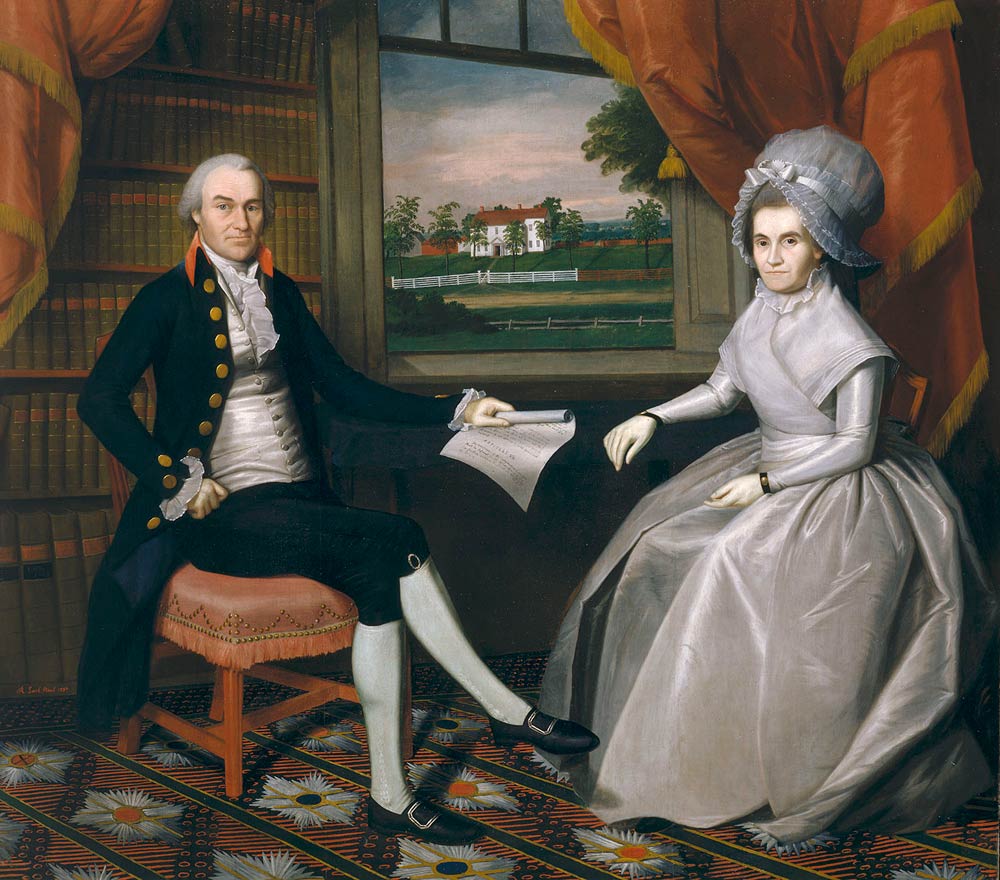
Oiver Ellsworth and Abigail Wolcott Ellsworth. Oil on canvas by Ralph Earl, 1792. Wadsworth Atheneum, 1903.7
Mrs Ellsworth was born in 1756, so she’s a little bit older. Different ages, different styles (yes, styles have also changed between 1792 and 1796). But some constants: long, slim sleeves. White caps and handkerchiefs, layered at the neck. Silk–though that won’t be me–in solid, slightly muted colors.
There’s another Connecticut painter worth looking at: John Brewster, Jr. In this New Republic period, I think it’s really critical to look to American sources for clues to how people projected themselves, how they were seen and wanted to be seen. This is pretty high-falutin’ stuff for a maid, but I’m presuming that I know how to read (because John Brown and his brothers placed an emphasis on education in their own families, and on public education). And if I know how to read, and I work in a house with books and political discussions, chances are good that even in the late 18th century, I have eavesdropped on the discussions and I have read at least the newspapers. I’m living in a certain atmosphere, and how I dress and what I think about will reflect the world around me.
John Brewster and Ruth Avery Brewster. Oil on canvas by John Brewster, Jr. ca. 1795-1800. Old Sturbridge Village.
Dr. John Brewster, seen here with his second wife, Ruth, descended from William Brewster. His wife, Ruth, is obviously literate. These people are signaling education and sensibility to us: sober, well to do, respectable. Brewster is not as good a painter as Ralph Earl, so fabric is harder to read. What is her gown made of? Could be fine wool, could be silk: hard to tell. But see that little edge of shift peeking below that three-quarter sleeve? That’s old school for 1795. But I like the neckline and the color. Burnley & Trowbridge have a light-weight wool that color…
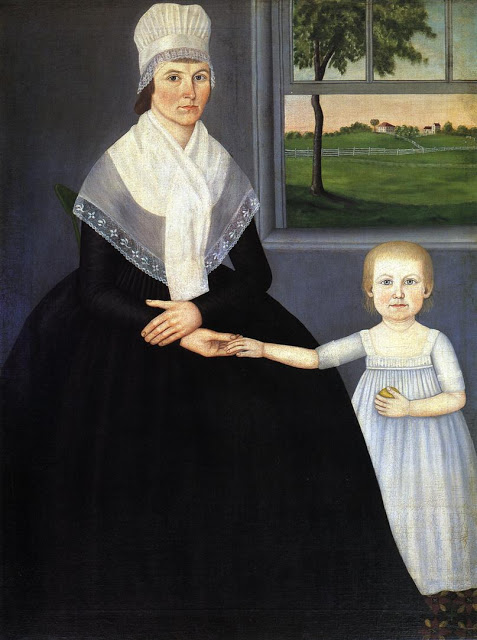
Mother with Son (Lucy Knapp Mygatt and Son, George), 1799. Oil on canvas by John Brewster, Jr. Palmer Museum of Art, Pennsylvania State University
Brewster’s portrait of Lucy Knapp Mygatt and her son, painted in 1799, does, I think, help push the date for the Brewster double portrait earlier: by 1799, the painter in more accomplished and bolder in the full-length portrait. He’s also learned to render fabric somewhat more convincingly.
Long sleeves, white cap and kerchief, high waistline: the styles are consistent, but as you move through the subtleties of class, the expression of the style shifts. Front-closing round gown with a waistline that’s high, but lower than what I’ve made in the past, with long sleeves: settled. Now all I need to decide upon is fabric: probably a lightweight, dark-colored wool, though I haven’t found exactly what I want yet.
I started on the HSF#15 Color Challlenge: White, but haven’t finished the white petticoat yet. It’s a bit short, and pieced in the back, but having seen Sew18thCentury’s curtain along petticoat online, I wanted a bordered petticoat. (There are extant examples in museum collections, and one in Fitting and Proper, if you’re keeping score.) Now that I’ve seen the petticoat in person, I will definitely stick it out for a border….all in good time.
Native Meltons: she’s out there in plain and colored lithographs
I did originally think that I might get this gown completed for HSF # 15, but I did not. I came close, became disheartened, and stopped work on it for a time. Not only did I think I could not adequately document the fabric, I worried about style, fit, and fabrication. At some point, though, I rallied, and finished the gown. Yes, it looks a lot like Emily’s, because it is based on the same print.
Finished! Another garment in the “Am I Blue” Ocean State Line
Fabric:
Indigo Cross Bar Light-Weight Check Irish Linen from Burnley & Trowbridge.
I collected images of checks and “plaids” on a Pinterest board. Remember that plaid doesn’t mean the same thing in the 18th century, but I used the term to help people know what the board included.
Pattern:
My own, based on a fitted lining and draped to the dummy, tried on and tweaked. You can see some construction progress here. Yes, that’s a center-finding ruler. Yes, it has extra pleats. Call it bling for the linen-wearing.
Matching crossbars is crazy, but fun.
Year: Let’s call it 1760. It’s an open robe with robings and cuffs suitable for 1765, but I’m old enough to keep wearing that style. Actually, the double-lapped robings (which I really like the look of) are earlier– see this Pinterest board–but I like the way the fold creates a decorative element in linen and wool. The probable 1750s date for the double lapped robing caused another round of heartache in the documentation land. Oh, well. Carrying on wearing the older style…
Notions:
Does thread count? That’s all this takes.
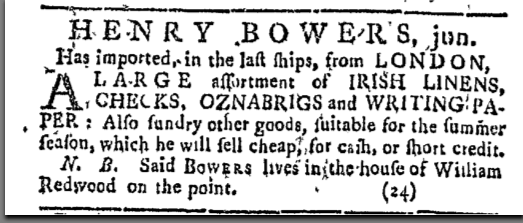
Newport Mercury, 7/11/1774Boston Post Boy, 3/11/1771
How historically accurate is it?
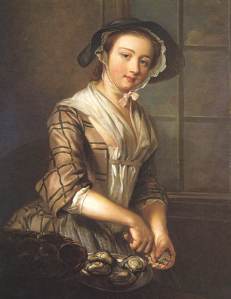
Well…In the right circles, one could argue that for some time. Is that not the circle one wishes to be in? Consider this, then: The gown is hand-sewn using period techniques as much as I can muster. It is based on pictorial examples from the 1750s through the 1760s. I have found newspaper advertisements for “CHECKS” in Newport (Newport Mercury, July 11, 1774) and “checks of all wedths” in Boston (Boston post Boy, March 11, 1771). Wedths means of fabric in all likelihood, not widths of the checks, so while one can find evidence of people wearing what we’d call plaid, mostly silk but the oyster seller is likely linen or cotton…we don’t know exactly what every “checks of all wedths” fabric looked like. I’ll go with 75% accurate and 25% conjecture and choose my wearing venue with care. Yes, I can over-think and rationalize anything.
Hours to complete:
I did this many, many times. It’s like being a carpenter with fabric and pins.
Actual sewing? 16 to 18 hours, I think; it’s a lot of hemming. The body of the gown, the draping and the lining were constructed in about a day while the guys were out doing musket-related things. The agonizing and over-thinking consumed more time. Documentation took, on the whole, perhaps 2 or 3 hours of museum collections and newspaper searching.
First worn:
Not yet! I’m not sure when I will, now that the weather has turned. I meant to have this done for Sturbridge but despaired of the design and fabric. It’ll be wool for Saratoga, so who knows? I’d like a photo, though.








 Kirsten Hammerstrom
You must be logged in to post a comment.