Jonkheer Gijsbert Carel Rutger Reinier van Brienen van Ramerus (1771-1821), met zijn vrouw en vier van hun kinderen, Adriaan de Lelie, 1804
Perhaps because I just finished Longbournand have just startedYear of Wonders, servants are on my mind.
In the family portrait at left, the servants are visible (just) to the right of the tree.
The man and woman almost literally mirror the main subjects, Carel Rutger Reinier van B can Ramerus and his wife, positioned as they are in opposite relationship to each other. The servants, too, are surrounded with life, carrying a child and dogs and game.
The woman is holding the infant of the van Ramerus couple, and even without Google Translate (that’s “four of their children”) we can figure this out. How? Because the child is held away from her body, and faces forward. It is a slightly odd arrangement, with the infant so peripheral to the main image, but we’re fortunate, because this composition allows us to see the servants.
Class distinctions are clear in the dress: the female servant wears a cap, kerchief and short gown, the male servant-gamekeeper, perhaps–wears breeches and a jacket from the pervious century, as well as a cocked, and not a tall, hat.
It does remind me strongly of the imperative to continue a family line, and the lot of women to breed and produce male heirs. For all that I love the past, I know I could not live there easily.
The Chocolate Girl is adapted for the cover of Jo Baker’s new book
On Sunday, I read the NYT review of Jo Baker’s new book, Longbourn. As soon as I finished the review, I ordered the book, which arrived Wednesday evening. By 2:00 AM Thursday, I had finished it.
I like Austen, but my favorite Austen novel is Mansfield Park, not Pride & Prejudice. The BBC and other adaptations sometimes make the world of her novels seem too cloistered, too precious, and too refined to me. (Mrs Hurst Dancing can be a helpful corrective.) So of course I was captivated by the premise of Longbourn: “The world of the people who laid the fires, cooked the meals and fetched the horses for Jane Austen’s Bennet family.”
The story was engaging–heck, I stayed up until 2:00AM to find out how it ended–and while I found it slightly romantic for my taste, on the whole, the world was believable.
For one thing, there is plenty of mud. And Sarah the housemaid must clean the mud off the Bennett girls’ petticoats. The hauling of water, laying of fires, and the chill and exhaustion the maids feel is pretty well rendered. Baker addresses the question I’ve always had, How did servants tolerate servitude? by portraying Sarah’s struggle with resentment and resignation to her lot.
I thought, too, that the way Baker described women as “breeding” was also good; she referred as well to Elizabeth Bennett’s “dark, musky” armpits, and that seemed a nice way to slip in historical hygiene information. But women in English gentry were valued for their breeding capabilities: the need for a male heir didn’t die with Henry VIII, and it is much of what drives, or drove, the plot of Downton Abbey. For women, the past was a smaller world, and Sarah’s life is particularly small. Her carriage rides help define the very real confinement of her world.
There are a few slips: backpack instead of knapsack once or twice, but not many. It feels well-researched, well imagined, and believable. I don’t want to wreck it for you, so I won’t go into too much…there are some classic plot twists and devices that I put up with because they’re so typical of the literature of the period. I particularly enjoyed that Sarah reads from Mr Bennett’s library, including Pamela. It was a nice way to reinforce Wickham’s creepiness, and the echoes between the novel derived from a novel, in which fictional characters read real novels, delighted me. (Being a fictional character myself.)
Jo Baker’s not Hilary Mantel-– this isn’t the kind of writing where the language stops you cold and sentences leave you breathless with awe, but for historical fiction derived from Jane Austen, Baker’s book is excellent and well-written.
1. The Cross-Barred Gown is Too Big. I will have to take it apart and make it smaller as it is too wide across the back in general and the shoulders. This is fairly simple.
2. The stays are Too Big. I can lift them up and do the shimmy inside them. Seriously. Eighteen months ago, when they were made, I had a two inch gap at the back and the front did not lace closed. Now I can lace them shut front and back.
Whether I have some body image issues or am just a crack-addled monkey can be debated among impolite company some other time, but to solve these problems, here’s the half-baked scheme plan I have in mind:
I re-cut and re-fit my bodice block for an open robe and made it smaller. (For the sacque, I need only trim the sides of the back because I haven’t gotten any farther than that, thank goodness! Now I have a better sense of the shoulder width I need to fill with pleats, also good.) For the Cross-Barred Gown, dis-assembly and re-construction can happen in the spring. Simple enough, and adjustable, too but…
Stay pattern mock-up, measured.
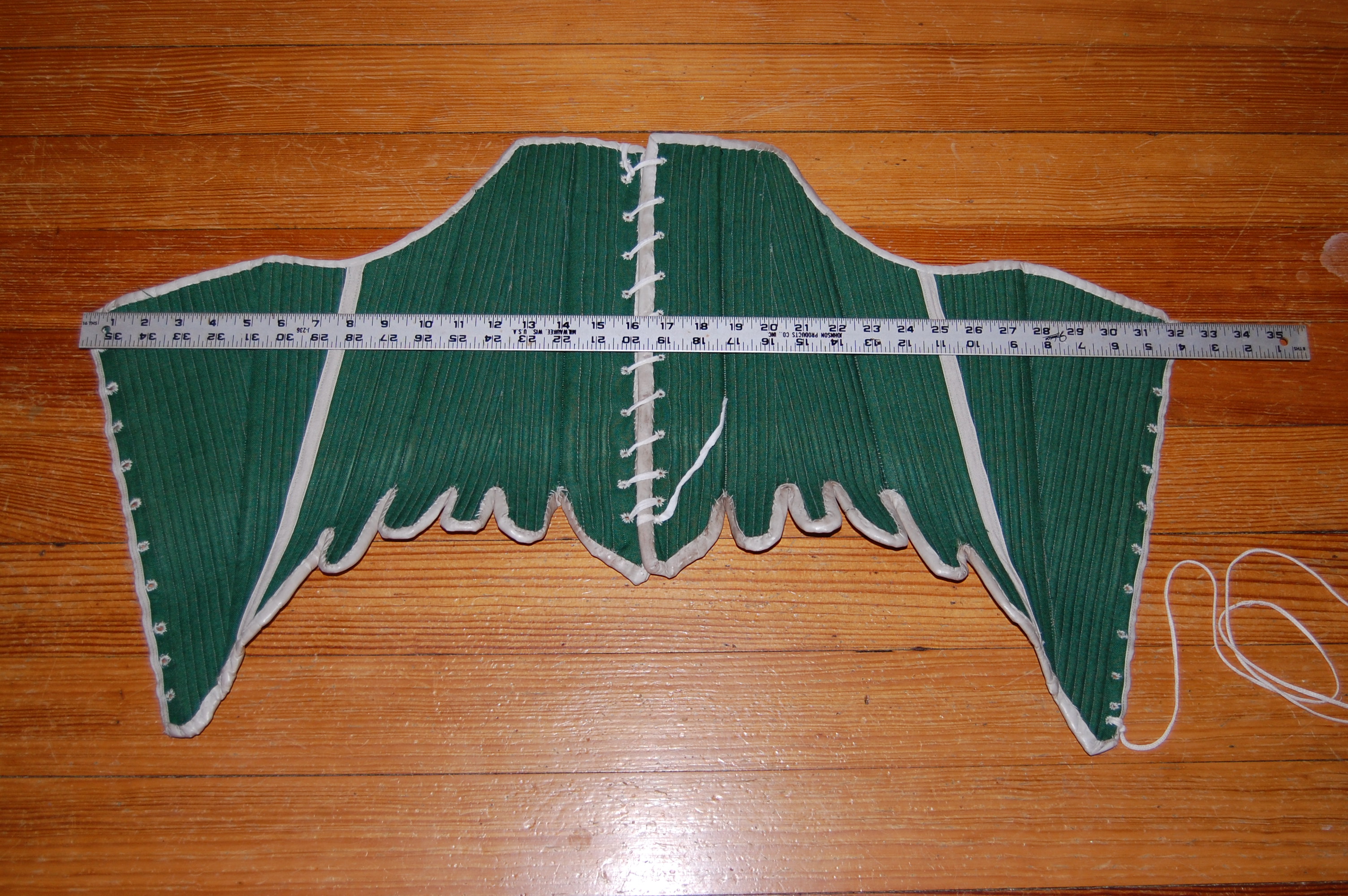
The stays are a little different, and much more serious. I’m not yet sure what to do. I could unstitch the binding and the panels and remove some bones, re-stitch the seams and re-apply the binding…or I could start all over, but make the stays a size smaller. The cardboard mockup measures 33 inches across. With a tape measure snugged up, I measure 37 inches around. Seems like all should be well, no? Two inches, front and back?
32 inches, but they don’t fit.
It is not. Here you can see the green stays and the yard stick: 32 inches. I should have five inches altogether, right? No. These lace shut front and back (see the back lacing, kindly trust me on the fronts).
How did I not notice this drop before? (The pale line is the tide line of petticoat waistbands & ties)
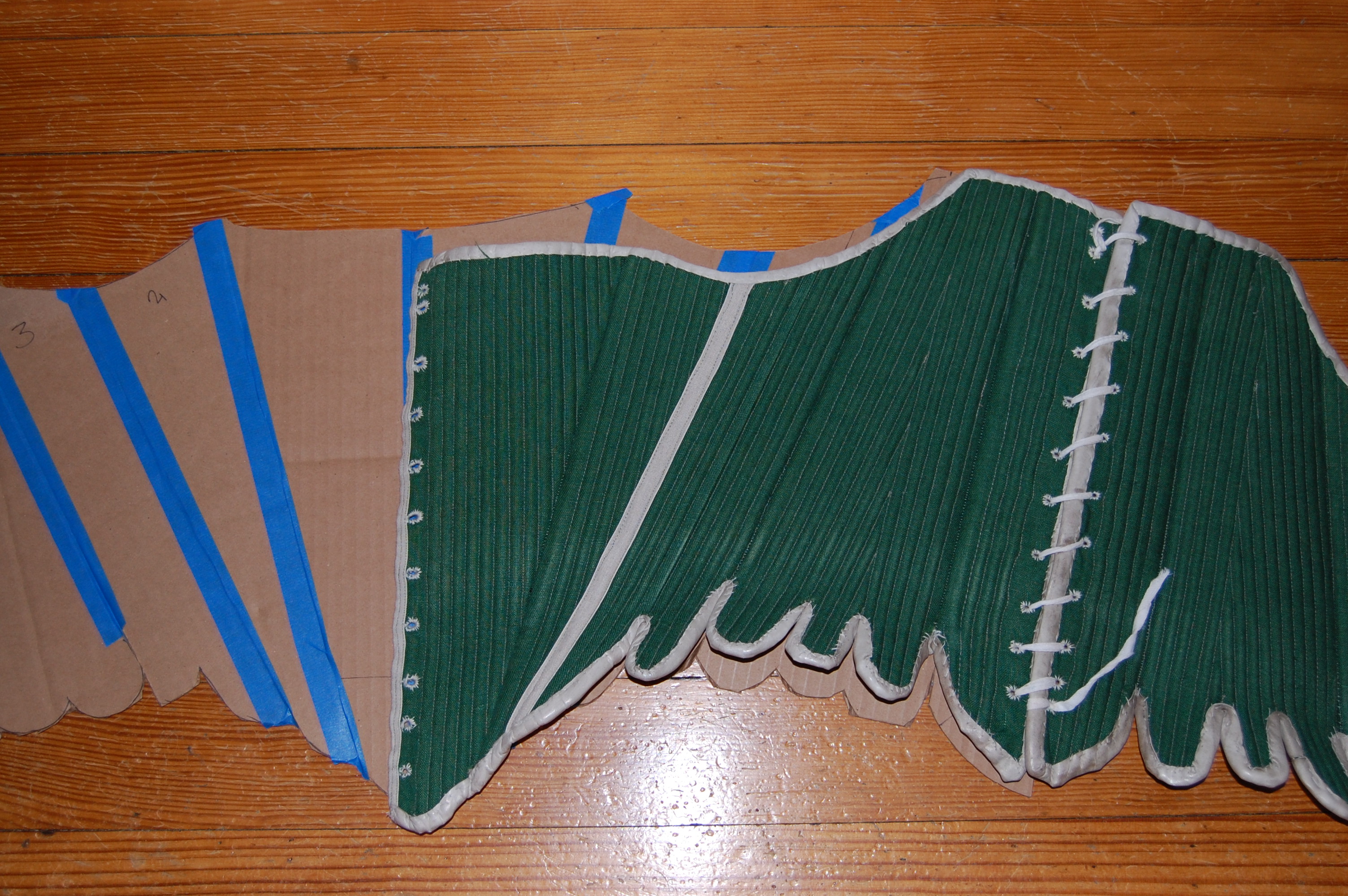
Then I compared the mock up and the stays. Curiouser and worser!
Somehow when I assembled this hot mess, I mis-aligned the pieces,and the fronts are lower than they should be. This explains much about the increasingly poor quality of fit as these slide down my ribcage…as you can imagine, the stays can’t do their job when they’re not in the right place to do their job.
If I am to reclaim these and my decorum, the first step will have to be dis-assembly simply to get the various panels into the their proper places. I think it would be fairly simple to do to the fronts, and then I could end some of the madness by sewing the front panels shut and converting these to back-lacing stays. It might be only a temporary fix, but that alone would be worth the effort. Fortunately, I won’t require these until November 23, and in the meantime, I know which gowns are too big, and need to be smaller. With open fronts, at least they’re pretty adjustable.
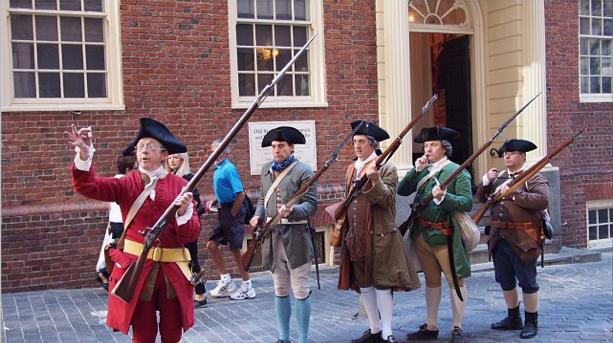
That’s last Saturday, outside the Old State House, for the “People of 1763” event. Sew 18th Century and I provided a material culture/ladies’ clothing presentation in the Hands on History room. The guys drilled outside, had their photos taken, and represented the militia. The Bostonian Society had over 1200 people in the museum last Saturday, which is a pretty respectable number for a small place. It can also leave you feeling somewhat overrun. (All my photos turned out fuzzy: all I had was a shaky hand and my phone. Chalk it up to needing more sleep.)
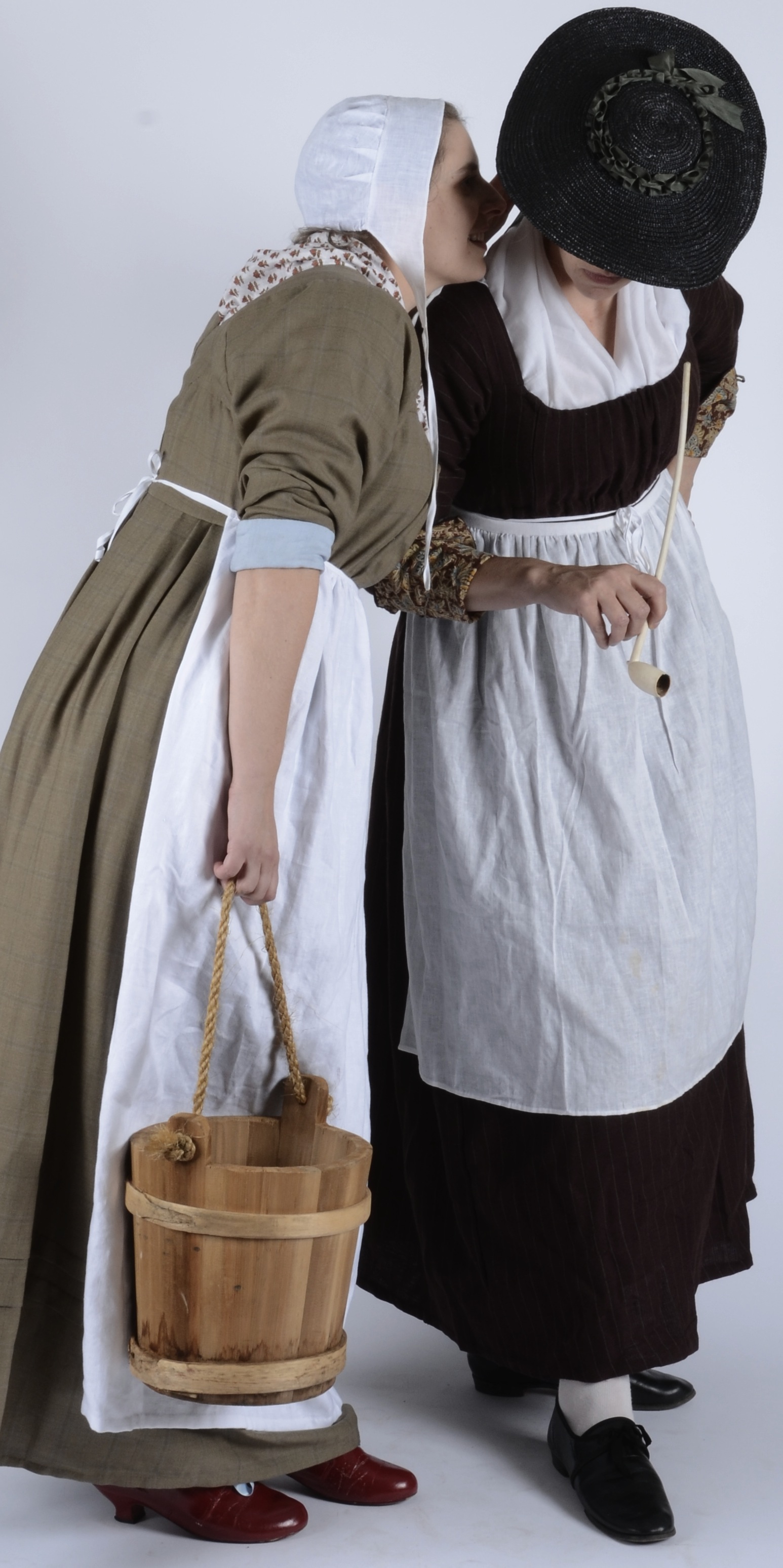
Gossip!
This coming Saturday is What Cheer Day at the John Brown House Museum, and my sewing and research and house prep continues, if not apace, at a steady pace. Mannequins have been put away, furniture moved, and the accents practiced. By the time we were trying to say, “These are not the droids you’re looking for” with 18th century Maine vowels, we knew it was time to go home. Why this and not “I’ll put the kettle on to boil,” I do not know.
It’s still hard for me to get a handle on my character, and not so much her background as her attitude. I’m not very good at being servile or lady-like, which is why, if I’m still working for the Browns, I must be a relative of some kind.
My husband’s dead; he died in 1788, not long after the Browns moved into their new house; wounded in the Revolution, he never quite recovered and despite the best ministrations of Dr Bowen, Mr S succumbed at last. My son, now 18, was born not long after Mr S returned from the war (Mr S enlisted ‘for 3 years or the war’). Curiously, the chaplain of his regiment is also the pastor at the Congregational church in Providence.
I am a nearly non-observant Anglican, but I recognize Reverend Hitchcock, and know the work he has done in support of free public education. Mr Brown and his brother disagree on many things, but they have at least agreed upon the importance of free public education. My son and I can read, but if Tom had been better educated, perhaps he would not have gone away to sea.
Next I have to think about my cousin from Newport, and the Brown women, and what I think about them.
And there’s still the small matter of sewing two hems, three buttons and three button loops and hoping the whole business will fit properly. At least my friend finished my cap for me. I get just so far, and then I hate caps.



 Kirsten Hammerstrom

You must be logged in to post a comment.