A Cloak for the Cold

January 11
January 11, 1777. Providence Gazette

We’ve had a bit of snow and cold, which kept me at home (when there’s a parking ban, most businesses have to close, as most parking is on the street here). We have plans in another century this evening, so I thought a second cloak would be in order. The first cloak I made was based on one in the collection at work as well as on a Rhode Island runaway advertisement.
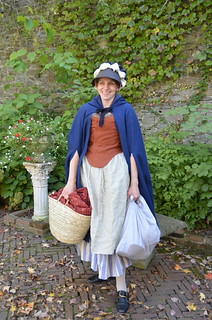
Long blue cloak, in 2012

Although I’m not displeased with the cloak, the length can be annoying and I knew that the blue cloak for a runaway was not what I wanted to wear with the sacque. So I sacrificed some yardage from the Strategic Fabric Reserve, read up on cloaks, and got out my scissors. A cloak is a fairly simple thing to make, so I don’t know why it took all day, beyond getting distracted, making dinner, shoveling, re-learning high school geometry, and trying to do a very careful job.

Hood, with lining, pinned to the body of the cloak

Because I’m tall and have long arms, I made the new cloak a little longer than I would have for a true short cloak: it is easier to trim than to add, though this is pieced on the fronts and on the hood and on the hood lining.
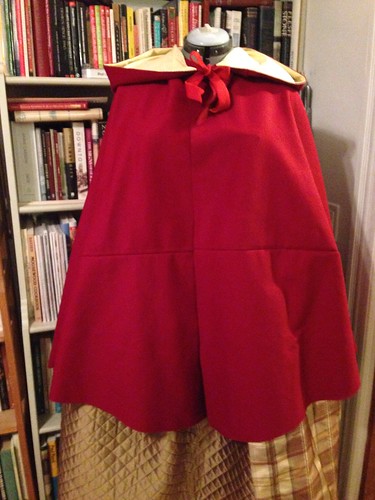
Pieced across the front.

The front piecing is more noticeable than I really like, but that’s how this came out and how cloaks often work out. I won’t really care, as long as I am warm and able to move my arms. When it’s really cold, as it is today, I can wear both red and the blue cloaks with a wool gown and petticoats and wool kerchief. Or perhaps I should just wear a sheep.
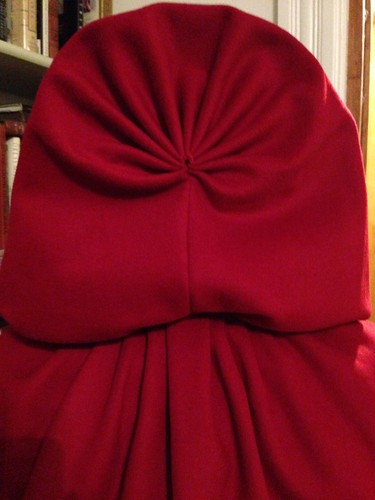
Back pleats. By a third cloak, I might get them really right.

I found the trick to getting the pleats/gathers on the hood to flip correctly was to work from the outside, or right side, once the back seam had been sewn up partway. It took three tries to figure that out, but somehow working the pleats/gathers from the right side worked. I did backstitch the pleats/gathers on the inside to hold them in place.

Inside the hood. with lining in place.

In all, this took less than a yard of yellow silk Persian, about half a yard of red wool twill tape, and two yards of crimson broadcloth, all from Wm Booth, and all but the Persian purchased as remnants. There’s a fair amount of broadcloth left, so a yard and a half with aggressive piecing might work, especially if you want a shorter cloak, and are not as tall as I am.

Les Oublies

Les Oublies. Le Bon Genre Plate 79: three ladies and a child look at a sundial in a garden, watched by a man. August 1815 Hand-coloured etching. British Museum 2003,U.14

I was first attracted to this image by the gentleman and his shapely legs, as you might expect, since tight buttoned gaiters or overalls do turn my head. This plate doesn’t make much sense to me: I can’t really grasp the satire, I can only guess. The explanation given for the series doesn’t help immensely. “The series is devoted to costume, mostly set in fashionable interiors, but the plates are treated in a semi-caricatural, humorous way that links them with French social satire.”

My best guess is that this plate from 1815 is showing off the latest filmy white fashions and tiny pink Spencers in contrast to the forgotten origins of the classical influence, personified by the gentleman in common dress at left. His hat and the gaiters suggest the French revolution, now forgotten (see “oublier” though the reference is also to the small cakes being eaten by the woman under the tree). The clock provides a reference to the passing of time, and forgetting, but I don’t think it is actually a sundial. The strap makes it look as if the man can carry it, and that’s a needle, not the fixed vane of a sundial.

Whatever it all means, I do find this more interesting for the man’s clothing than the women’s; after a while, the subtle differences between white columns is lost on me, but that’s a pretty interesting buff-colored waistcoat.

Ironing on Grass

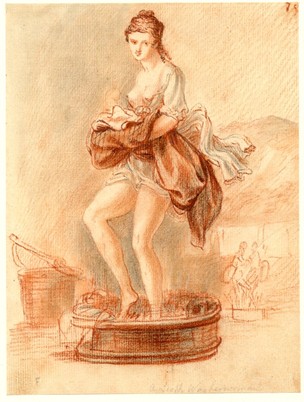
Paul Sandy, The Laundress, 1780. British Museum, 1904,0819.624

This print makes me think of Gertrude Stein, “Irons on the grass alas” because I think I would be pretty alas if I were ironing on grass. Still, I’m glad to know that ironing in camp is plausible, because it’s one more thing I can do, though also one more heavy item to pack.

I continue to chase laundry in my spare time, with a Pinterest board of collected images, which will give you a sense of the timeless drudgery of washing clothes. There will be stooping.

A Washerwoman, by John Varley (1778-1842). Tate Britain, T08695

In this sketch by John Varley, he has helpfully given notes to supplement the lines.

“neckhandkf
spots Drab stays
blue check apron”

The symbol in front of ‘spots’ suggests the neckhandkerchief’s pattern, a dot in a square, much like the ones you can today from Burnley & Trowbridge.  “Drab stays” suggests a very utilitarian pair of wool stays, and that the washerwoman has stripped off her gown or bodice, and is working in shift, stays, and petticoat(s). This seems to be the same woman is in the “Woman with Wash-Tubs” drawing, and I’d guess her hat is straw.

A Scotch Washerwoman. Crayon drawing by Pauil Sandby after 1745. British Museum, Nn,6.61

There’s a remarkable consistency in the English drawings, though Varney and Sandby are about two decades apart. The tubs, the tools, the stooping: laundry is hard and unglamorous work, Sandby’s Scottish laundress aside. I can guarantee you that the 10th Massachusetts would have to outsource laundry in that style. (In any case, Scotland typified poverty and backwardness for late-eighteenth century Englishmen, so Sandby’s drawing, in addition to being titillating, is perpetuating English stereotypes of Scottish dress and practices and is, thankfully, not a reliable source.)

HSF # 24: Re-Do (Thank goodness it’s done!)

Shirt, view number one

Like a zombie, I’ve returned to the Historical Sew Fortnightly with an undead shirt. I was working on it in August 2012, and at long last, it is really complete. So I offer it up as the Re-Do for HSF #11: Squares, Rectangles and Triangles, as it has no curves at all. (Well, aside from any wonky cutting I may have done.) It would also work for HSF #15, White, as it is actually white. Things happened in the basket along the way to getting done, and the half-made body had to washed.

The thing about shirts is that they don’t look like much unless they’re well photographed, preferably on a human or a mannequin with arms. I lack the latter, and the former specimens were not worth asking, since they’d been made to work all weekend.

So, some facts are in order. right?

The Challenge: #22, Re-Do. (# 11 and/or #15)

Fabric: White Linen, 5.3 ounce, I think. It was a while ago.

Pattern: This would have been cut from the Kannik’s Korner shirt pattern, though more by using the pieces to mark and measure and make sure I had all the small squares and bits the pattern takes.

Year: 1770-1790, depending. At their class level, the guys can keep wearing this kind of shirt for a long time. (It will be the Young Mr’s.)

Notions: Two thread buttons, one bone button; all three from my strategic reserve as the new selection of thread buttons has vanished (I blame the cat).

How historically accurate is it? Well, let’s give it 75%. It’s all linen, but the selvedges aren’t right, the stitching is variable and the insides are not all finished correctly. Patience, Iago, patience…there will be time for the last felling over whipstitching. I suppose for the common shirt it is, the coarser linen and variable stitching might boost the accuracy a bit. 82% for intentions, points still taken off for knowing what’s wrong with it.

Hours to complete: Freaking endless. I lost count, but in the end, probably five hours to finish button holes, felling, hems, and side gussets. The problem is that it’s repetitive and boring: back stitch, prick stitch, slip stitch, hem, all in straight lines. And this was shirt number three (four is right behind for Mr S) so the thrill’s gone out a bit.

First worn: Rejected in nearly-finished but unhemmed state by the Young Mr at Fort Lee, thoughit would have stayed in his trousers better than his too-small-clothes, he’ll wear this shirt in February at a celebration of Washington’s birthday.

Total cost: $17.74 for the fabric, I forget for the buttons and there’s always thread in the house. Call it $20 all told.