Ceci n’est pas une assiette

Historic American Buildings Survey, George F.A. Palmer, Photographer, 1937 DETAIL OF PARLOR FIREPLACE. – Jeremiah Dexter House, 957 North Main Street, Providence, Providence County, RI

Last weekend, Drunk Tailor and I delivered the Giant to his new life as a college student back in New England, and paid a call on of my oldest friends, a 96-year-old former OSS agent and descendent of the Dexter family. My eldest friend had something she wanted to give me: a souvenir of the Dexter House, in recognition of the hours I’d spent working with her identifying and organizing several hundred years of family papers.

In the photo at left, the coffee pot on the mantle is now in a museum collection, as are the miniatures, the bellows, and the pipe box (which is now on display in a historic house museum). What my eldest friend gave me is not in the image of the house, but resembles the plate to the left of the fireplace: a Staffordshire transferware “Village Church” pattern plate with a wild rose border, ca 1825.

Transferware soup plate ca. 1825. Unknown maker, Staffordshire, England.

I’m a fan of blue and white china, and while I prefer earlier Canton ware, this plate is more special to me than the ones I’ve bought at auction or in New Bedford antique shops: because of course it’s not a plate, it’s memory, or an emotion, made solid.

Drunk Tailor and I spent an early Sunday afternoon on my friend’s porch listening to stories about her children, in particular about her daughter Mary, now an artist living in Mexico. Is it a comfort or an annoyance to learn that schools have been misjudging children since schools were invented, trying hard to fit round pegs into square holes? Mary, always more interested in drawing than in lectures, once left a classroom when the teacher said, “If anyone doesn’t want to hear this lesson, then they can leave now.” Out Mary went, three other girls following her out to play on a beautiful spring afternoon.

That story, and many others, aren’t apparent in the plate with its crazed face and discoloration. Only my memories (and anything I write down and keep with the plate) make the associations. But it is always the stories about the objects that make them important (even big-ticket dec arts items, like Plunkett Fleason easy chairs.)

Last night, before Drunk Tailor and I watched The Maltese Falcon, we watched Adam Savage’s TED talk on his obsession with objects. The TED talk is worth a watch for anyone interested in material culture and objects. Our human fascination with things goes beyond the shiny surface of new things (tabernacle mirrors or iPhones) as they become repositories of memory, symbols of feelings or moments.

War correspondents and personnel of the Office of Strategic Services, leaving from the Railhead, Camp Patrick Henry, Virginia, enroute overseas. NARA. National Archives Identifier: 542171 Local Identifier: 336-H-17(E8671)
Creator: War Department. Army Service Forces. Office of the Chief of Transportation. 3/12/1943-6/11/1946

This: In my desk drawer, I have a buckeye Drunk Tailor picked up and handed to me in a garden in New Jersey. It’s useless: inedible, too light to be a paperweight, but it reminds me of that November afternoon, the soft green of the garden, and how shy I felt. Anyone cleaning out my desk would toss that bit of organic matter, even as I keep it as a talisman of one of our first dates: the places, the smells, and the feelings.

And this, too: My friend is 96. I may never see her again, though when I left her, she was healthy and cheerful, making plans for the fall with her children, grandchildren, and great-grandchildren coming to visit. Given my reticence and her old-fashioned New England reserve, I may never be able to tell her how much she means to me (I try), or how interesting I think she is. (“I’m not interesting, dear, I just worked hard,” is what she says when I try to convince her to donate her personal papers to an archive.) But I have a plate that was in a house that had a great deal of meaning to her, and my best guess is that her gift of that plate to me means she knows how much I like and admire her. It reminds me of her, and reminds me of how little time there is before all that’s left is the plate and my memories.
The Landscapes of Things

Or, you never know where things will end up.

New post, Old post, Cataloger

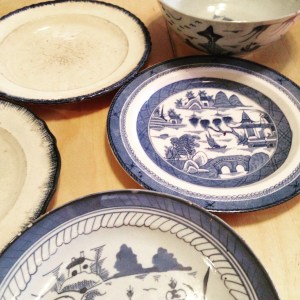
You can learn a lot about a place by visiting its antique and junk shops. Here, where the China Trade was A THING, you can practically fall over Chinese export porcelain (and its imitators) of a variety of types every day. It can become a bad habit. You can become an enabler.

IMG_7449

Elsewhere, the objects for sale tell a different story. I’m fond of the haphazard antique malls museum of things world, and while on a tea pot delivery mission to Maryland, went to one in Mount Vernon. It was astonishing.

Mid-century modern furniture, the Arabia Anemone tableware of my childhood, and shelves of geisha dolls, Kabuto, ceramics, and the occasional sword confused me at first until I realized these were probably the jumbled contents of a prior generation of military and civil servants’  homes emptied by their children. The aesthetics were markedly different from what I typically encounter in southeastern New England, where I am accustomed to reading subtle variations between the states I frequent.

14

Local variations occurred in Vermont as well, though the general flavor was more familiar.

Some things are universal: chaotic piles of partially-identified snapshots can be found anywhere, stacks of pelts and dog-like foxes, not so much. Origins debatable, ethics questionable, the late mammals tempted the tourist trade in St. Johnsbury, where we stopped as we headed south for home.

12

We influence our landscape more than we credit: from changes in the land wrought by farming to climate change to the differences in what we cast off and what we collect, the visible human influence is undeniable. Material culture can be about place as much as it is about thing.

The Museum of Crap

After an intense three days spent thinking about museums, we went to the antique mall on Sunday. It did not disappoint, being stuffed with a variety of material goods.

image

We had not gone past the first round of booths when it occurred to me that what I was walking past a series of touchable period rooms or installations, a kind of non-judged science fair of historical displays, each one trying to convince me to literally buy its message.

This came home when I saw the booth on the left, arranged much the way a period room in a museum is arranged, with the desk suggesting that someone has just walked away from it.

I’d seen this at a house in Boston, and I’ve seen it at home: it’s not enough. At least at antique mall, you can touch everything. At the museum, unless that desk and room are jam-packed*, we are not going far enough.

image

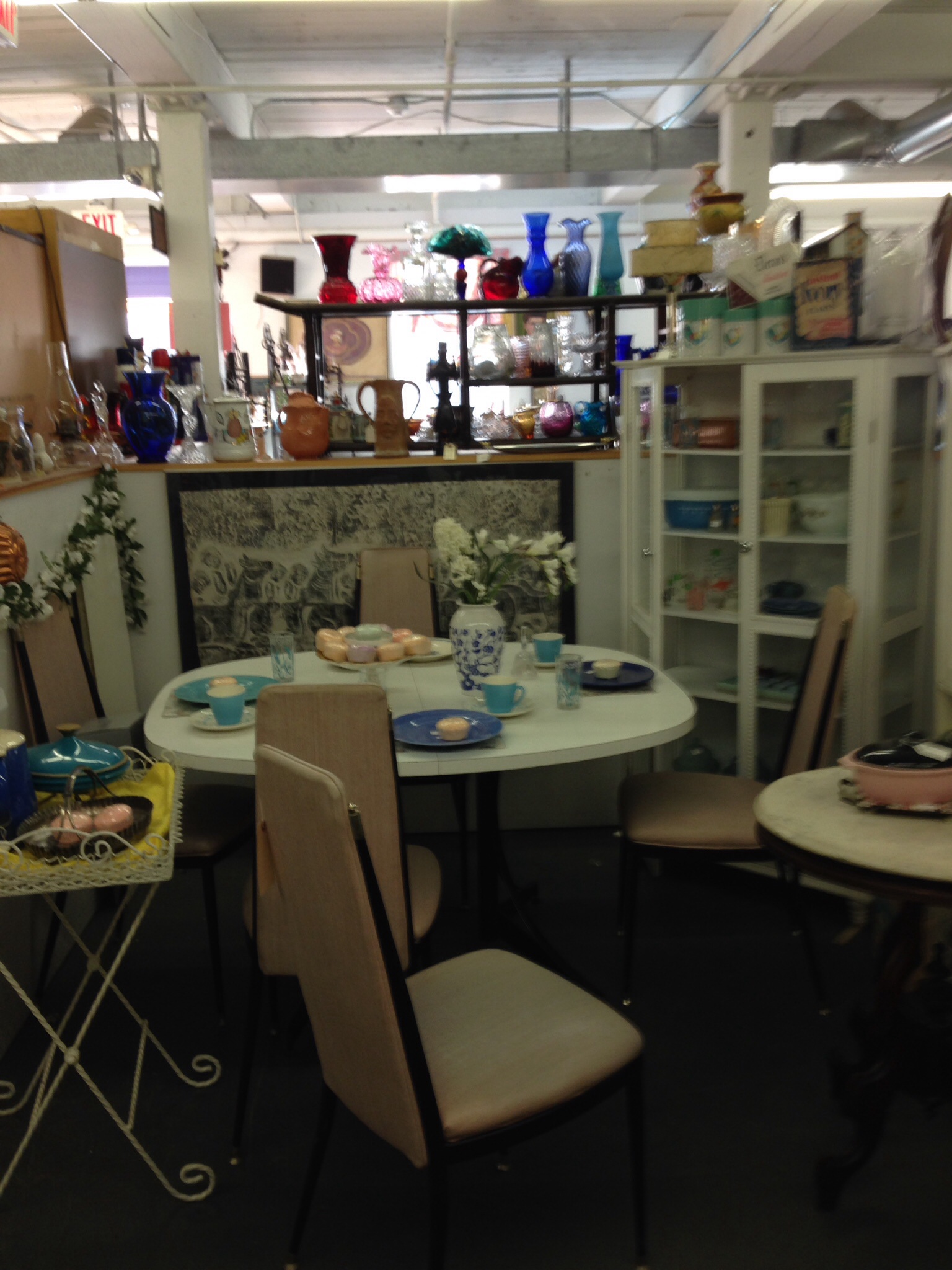
In this vignette, you can step into a dinette and sit at the table. Feel the linens, touch the dishes (I’d avoid the glittery cupcakes, myself) and pretend you are home.

This kind of interactivity is reserved for children’s museums, with varying degrees of success, often oversimplified based on an assumption that children need streamlined displays to “get” the exhibit message. Sometimes I feel a similar lack of sophistication in the presentations at the Museum of Crap, a lack of deep consideration– it is, after all, just a booth at a mall.

image

There are also the booths that really capture the deathly “Sunday dinner with the stiff relatives” feeling of some historic house museums and bad summer vacation memories, or perhaps for you it’s “tense Thanksgiving dinner with the in-laws,” or even “happy birthday tea with auntie,” and it’s a pleasant memory.

Antique malls clearly offer an array of display techniques, just as an major (large) museum with a variety of galleries.

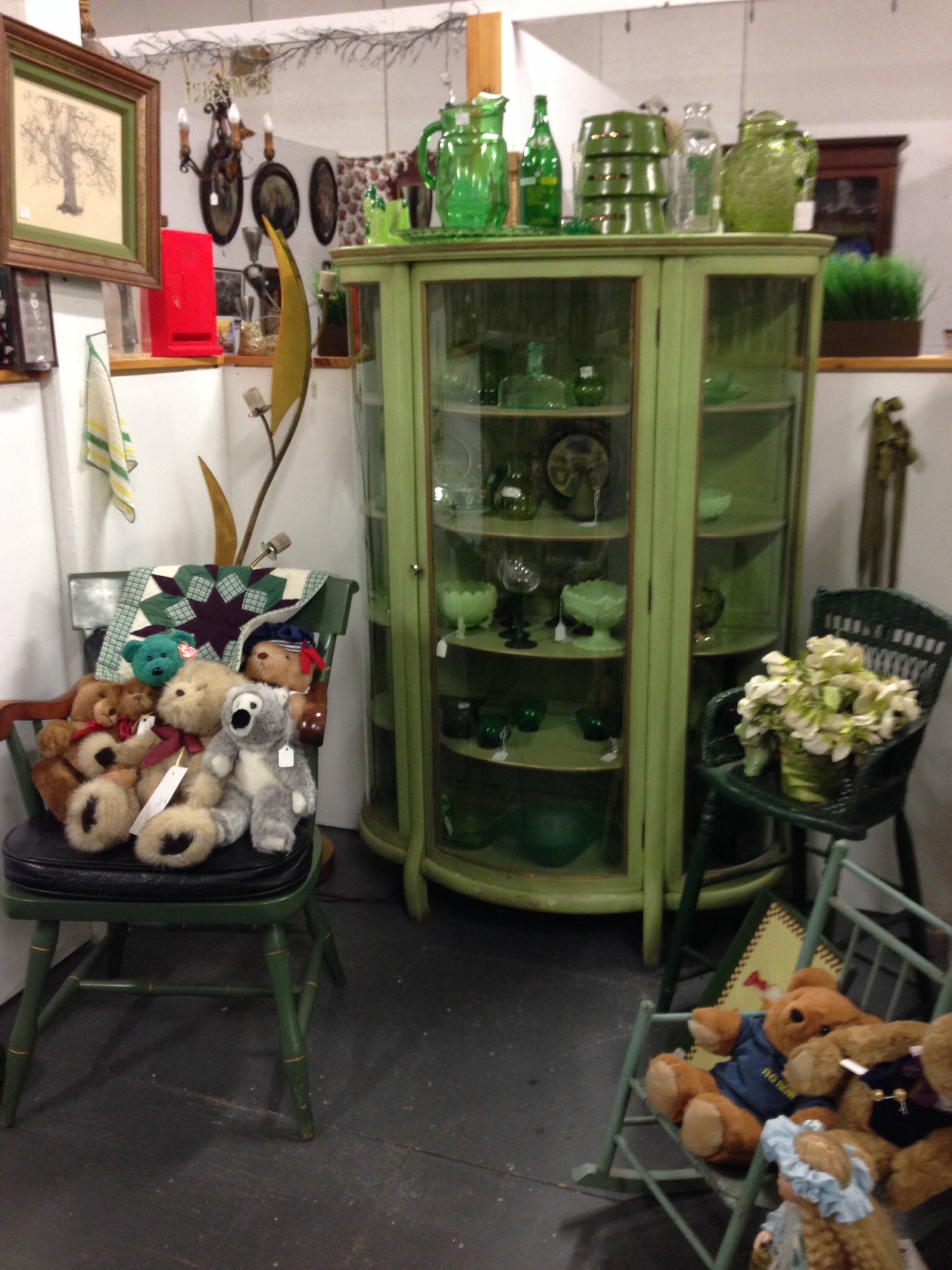
Martha Stewart Living taught us about sorting things by color back in the 1990s, and it also taught us about the power of similarity: grouping like with like can create powerful visual displays and be quite attractive. Here’s the Gallery of Green. There was even an faux spongeware cat figurine, with a green sponge glaze. Details matter: difference stands out: that’s why the teddy bears pop in this booth.

image

image

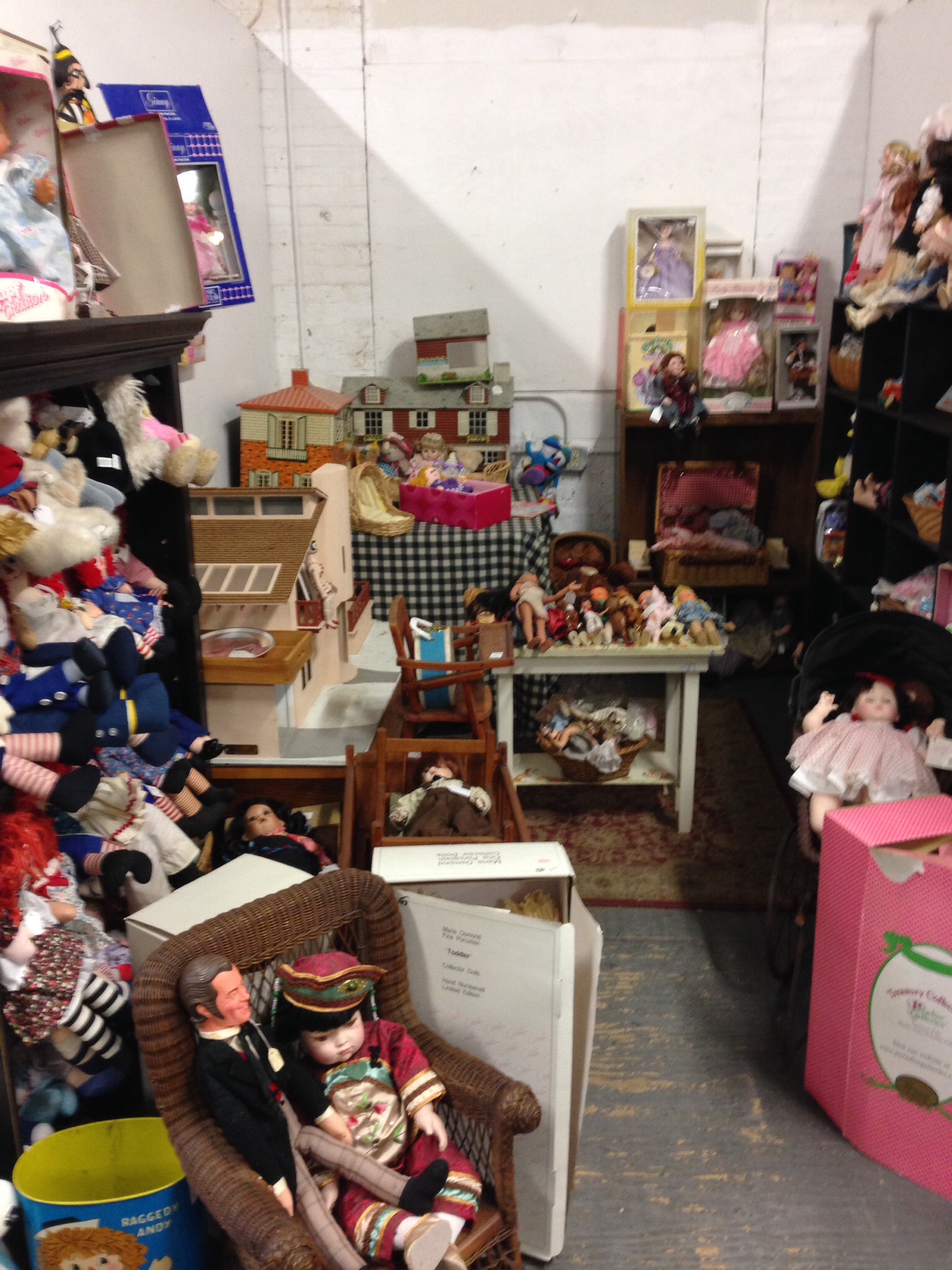
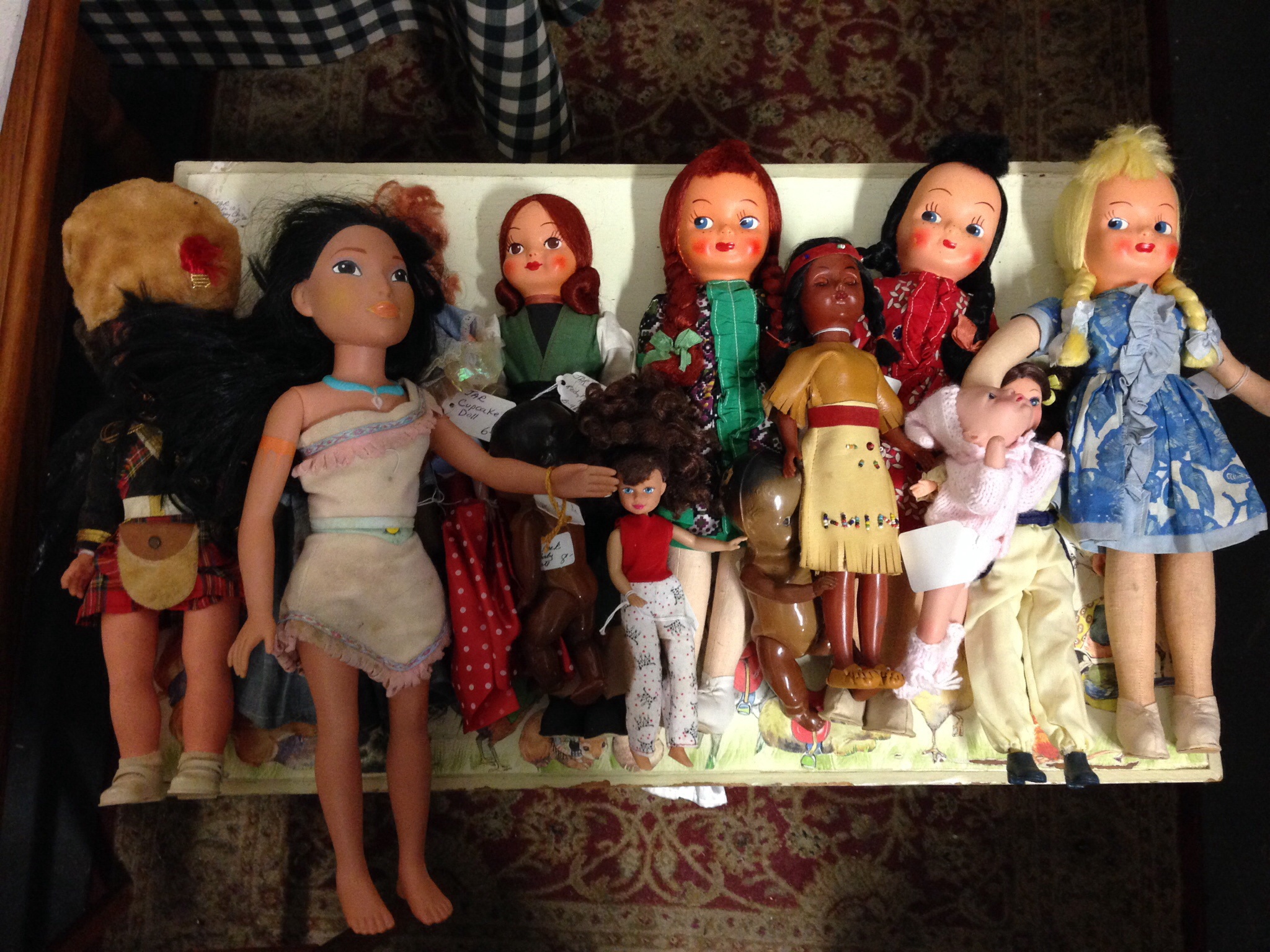
Perhaps you prefer the natural history museum, or a medical museum? There are doll morgues for you folks. This proved quite popular with women of a certain age, thankfully still a little older than I.

image

There are displays for (almost) every taste. Couples go through these emporia, often at a similar pace (Mr S and I usually split up, and come together only occasionally to compare and share reactions) but not necessarily in unison.


Here’s an entire case that might come to life in an episode of Futurama, but it’s full of stuff for nostalgic guys: G.I. Joe in Crash Team suit, Planet of the Apes figures, Captain Kirk, and the Indian Scout Rifle and Bandolier. Cars, trucks, a flying circus: here’s a man’s past for him to admire without the responsibility of keeping it up. These are social experiences, where people wander through and talk about their objects, the things they owned, or coveted, the memories they have, the future they imagine.

image

We’re consumers: our lives are all about stuff these days (having it, getting it, curating it, getting rid of it– even minimalists are about stuff) and whether you think that’s sad or not, it’s true. We express ourselves through things. Antique malls give us access to the things of the past in immediate, tangible ways. We can talk, remember, and play in these compendia in ways that we cannot in museums.

There are some unlikely display techniques. This is not an arrangement I would have come up with, but I enjoy it. It caught my attention. I can imagine that I know some folks who would have come up with this display, and had they done so in a museum under my purview, I would have undone it. Maybe that wouldn’t be right. It certainly stopped me and Mr S, and we both made certain the other saw it.

image

The carriage, while heavy, had an amazingly smooth suspension system unlike any pram I’ve ever pushed at home or elsewhere. I couldn’t tell you what Mary and Jesus and a plush Persian cat were doing in a pram, but I do recognize the care with which they have been arranged, and the whiteness of the display, which speaks perhaps to the universal innocence of this trio. Someone chose this, deliberately. This isn’t art, or hipsterism, this is as genuine as the doo-wop songs on the 1950s radio station chosen by the antique mall.

It’s all so sincere: the nostalgia, the Everly Brothers crooning through the ceiling speakers in the converted mill, the soft, smoothing touches of consumers handling the goods. As sincere as we are in museums, we’re missing something by keeping all of our collections out of reach, and by cloistering all of our galleries in silence.

I’m a huge fan of silence, but what would happen if we did play music in galleries? Would removing the silence allow people to talk more, between their companions and even strangers? I get the marketing spin of doo-wop soundtrack, and I get how wrong it would sound in Nathan Hale’s homestead…but wouldn’t it be interesting to try it now and then? Exile on Main Street resounding in the halls of the period mansion is how the staff sometimes experience it, and we love the places where we work. Why not show the public how we see the houses sometimes, instead of insisting on a false, and silent, objectivity?

*Exceptions made for displays of minimalist architects’s homes, with documentation. What would Corbu’s house musuem look like?

Why Do We Buy Things?

The Sunday, November 9th Guardian had a series of short articles on collecting, including one on why people collect things. This was similar to the New York Times’“Room for Debate” series on Why We Collect Stuff.

Chair, table, chair.

I liked the Guardian’s “Love, anxiety or desire?” question, and asked it of myself: why do I collect?

Collecting is something that I had given up for a while, given that so much of what Mr S and I had collected was stashed in boxes in our basement after an apartment move nine years ago. Nine years! If you haven’t unpacked in that time, do you really even care about those things?

No, not really. Many the things I unpacked recently as we went through the basement again are destined for Etsy: McCoy pottery vases, colorful Pyrex, FireKing glassware. I bought it at a time when I liked green pottery—it was an outgrowth of the blue and yellow creamware I’d begun collecting when I first lived in Rhode Island.

But now, I’m done with it: done with the mid-century modern, and going back to the early American things. There’s an aesthetic quality I like in both styles: simple lines, bright colors.

The most recent acquisition is a drop-leaf table in a very country Sheraton style, with a tiger maple skirt. I watched this table for months before finally committing to it, and dragging Mr S up there late Saturday afternoon. He was game, and in the past day the table has grown on him.

Why did I want it? For one thing, it reminds me of a maple drop-leaf Sheraton-style table my mother has, so perhaps there’s an element of nostalgia, or a desire for approval. I also imagined it exactly where it is, though it will require some adjustment in lighting. Did I buy a piece not only of the American past, but of my own? Is this what adulthood looks like? Or am I just responding to shape and color?

The table and chairs are low, and not comfortable in the way that modern furniture is: I wouldn’t want to sit in the chairs or work at the table every day, but these things give me pleasure, whether bought for love, anxiety, or desire.