Milliner’s Shop Redux: A big, visual project

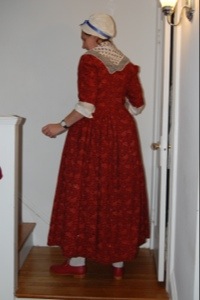
The complete ensemble, under supervision.

When I first moved to Providence, I lived in Fox Point, a slightly fringy-dingy neighborhood of Portuguese and Cape Verdean immigrants and their descendants that was cheap enough for students (and even today remains imperfectly gentrified: Providence, I love you dearly). As my then-boyfriend and I walked my dog, we passed a man whom I later came to know as the Block Captain, who remarked to my boyfriend, “Beeg wooman.” Any project I take on is, therefore, big, since I am nearly six feet tall.

Although I have schemes for a Big New Century Project (a complete 1585 ensemble), I’ll take a shortcut instead to my current enthusiasm and write about last weekend and the 1811 fashion plate reconstruction, which happily includes one of my favorite visual sources, early 19th century fashion plates — thanks to Scene in the Past’s albums and Ackemann’s Repository on the Internet Archive.

I’ve written about the canezou plate before, but not since I (mostly) completed it on the trip up to Salem. This 1811 plate appealed to me first because of the bonnet (checks!) and the necklace (lapis!), but then realized that the canezou and its petticoat were within my ability to complete.

The ensemble also seemed suitable for a summer day in Salem, which, while usually more humid than hot, calls for cool, lightweight, clothing that can withstand a potentially sweat-drenched day without melting.

From start to finish was three weeks: canezou, bodiced petticoat, necklace, bonnet, and shoe trims, all a vernacular rendition of a high-fashion image, adapted to the materials at hand– though I did have to order bonnet taffeta from India, which arrived just in time– much faster than I could have expected in 1811 Salem!
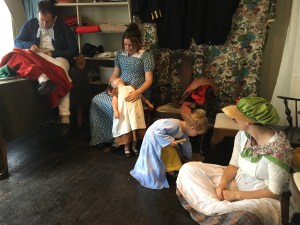
Setting up the shop for the fourth time was as much fun as the first time, and a little easier, given the practice I’ve had. I shared the shop with a tailor, Mr. B, of hat-making renown which made for a nice contrast interpreting men’s and women’s fashions and purchasing habits.

Packing up hat stands, bonnets, accessories, and furniture and driving them 470 miles is a kind of madness, but interpreting women in business and early shopping is one of my favorite historical enterprises.

To Name a Thing is to Know theThing: Vocabulary Exercises

Today’s CoBloWriMo prompt is vocabulary, which in my case usually means blue, NSFW, or unprintable in the New York Times according to their Style Guide, (but now OK in the New Yorker, thank you Tina Brown).

Captain Haddock proclivities aside, I find myself trying to remember to use period-correct terms as I work, which means trying to figure out what the terms mean. It isn’t always easy, but there are number of printed and online sources.

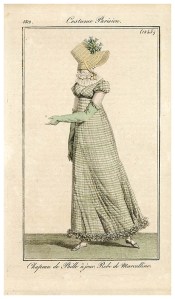
Here, for example, is the Robe de Marcelline fashion plate I’ve been obsessed with since at least 2011, when Sabine made hers. I finally tracked down some dark green gingham fabric in Framingham, but, d’oh! It’s cotton and not marcel(l)ine.

Google Books provides many useful lookups, through dictionaries and, best of all at the moment, The Dictionary of Fashion History, which helpfully illuminates marceline as “a brilliant but slight kind of sarcenet.” That helps narrow down “lining fabric for women’s clothes,” and confirms that this is a lightweight, probably plain weave, silk.

That doesn’t solve my fabric issue, but given that I am still lack full-time work outside the house, Imma stick with my remnant table cotton. But at least I know what I *should* be using, and have expanded my vocabulary along the way.

Wrap it Up, I’ll Take it: Made for Someone Else

Banyan, 1750-1775. T.215-1992, V&A Museum
Banyan, 1750-1775.
T.215-1992, V&A Museum

Disclaimer: This is an adaptation of an earlier post, so if you think you’ve read this before, you probably have.

Banyan or wrapping gown: both terms are used,  but the wearer and I call this a banyan for brevity’s sake. Despite its simplicity, this project took longer than I wanted, mostly because I have a tendency to take on too many things at once and promptly get sick. I like to think of this ability as a very special talent.

In any case, this simple garment was made more fun by piecing– it’s the challenge that keeps you awake, when the majority of the work is in teeny-tiny back stitches.

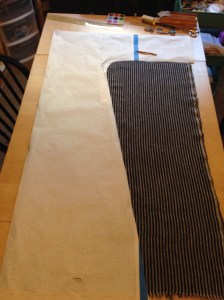
I took the subject’s chest, arm and back length, and bicep measurements, and made up my own pattern, using the chintz banyan in Fitting and Proper and this one at the V&A as models.

img_6554

Measurements in hand, the patterning was straightforward: you know how wide to made the body, the center back length you need to achieve, how wide to cut the neck hole, and how wide and how long the sleeves need to be. Really, not that hard.

You can use a diagram like this to start you off. I did wing the bottom width, guessing at the angle to give the garment a fullness similar to the chintz at the V&A.

I didn’t have quite enough fabric to accommodate the recipient’s full height, nor could I get enough of the red print lining material; I had to piece both the stripes and the lining.  Trying to match up the stripes was remarkably satisfying, both when I succeeded and when I was  little off. Life Goal: Dizzying, please.

It contrasted well with a blue woven coverlet, making a nice bright note as I prepped rooms for What Cheer Day 2016. This was the effect I had hoped to achieve waaay back in April 2016 when I failed to finish anything I wanted for the After Dark program thanks to a bout of strep throat.

Jimmie and Billie, unwell and unable to dress themselves without Gideon’s aid. Photograph by J. D. Kay

By October, though, I was able to finish the entire item and make a matching cap, allowing Billie Bowen to recuperate in style from an evening at the Cold Meat Club. I’ve drifted away from making things for other people (except to sell) in part because the Giant, heading to college, has drifted away from living history and thus occupies far less of my sewing time.

Styles Style: Book Recommendation

Please forgive the watch– a test shot of a gown from a runaway ad.

This is a quick one, because I’m writing in advance of a trip to New England, but for me, the best secondary source I’ve read that helped me understand the people I was clothing is John Styles’ The Dress of the People. That’s not to say that I haven’t read more, and found period resources and collections of resources equally useful. If you’re doing a poor woman in America, Don Hagist is your man, with Wenches, Wives and Serving Girls (now Wives, Slaves, and Servant Girls. Read Good Wives, Nasty Wenches, and Uneasy Patriarchs for more on period terminology).

I like Styles because he helps us understand the why of people’s clothing, and their wants. For me, context is key (I harp on this a lot) so insight into how many shifts are usual, the fashion for pocket watches, and the activity of the second hand clothes market is really helpful. So despite my love of shiny satin gowns and fashion of all eras, among the few books I didn’t send to storage when I moved was The Dress of the People. I think that’s a strong recommendation.

(researc