Smibert Smitten

John Smibert made me laugh. He’s been dead since 1751, so it wasn’t easy.

The day I went to the MFA and walked into the gallery with Mrs Tyng on wall, I laughed, and said, “I know her!” while my son died a small interior death. Then I pulled up the record and image for Mrs Browne, and showed him how I knew Mrs Tyng.

Follow Smibert’s pictorial advice if you’re reenacting an American woman of means between 1729 and 1732, and you’re wearing blue silk. You may have a red silk wrapper/shawl. Your shift will show at the center front and sleeves to show off your fine linen. You look like you might be a little cold, but perhaps that explains the “I store oranges in my bodice” look.

See for yourself:

MMA, Mrs Brinley & her son
MFA, Mrs MacSparran
RIHS, Mrs Browne
MFA, Mrs Tyng
MFA, Mrs Dudley
Smith College- Mrs Erving


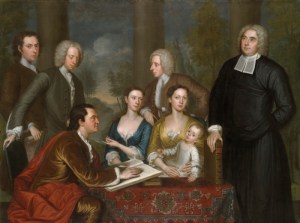
Yale- The Bermuda Group

After a while, you start to wonder if there was only one woman in the colonies in 1730… And then you wonder how she got into every painting

I know, style and conventions helped create these portraits as much as Smibert’s skill. And the portraits only get weird when you do the thing that was never supposed to happen. We were never meant to see all of these portraits all together, all at once, anywhere.
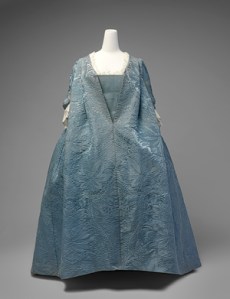
h2_2010.148-1 So, what’s she wearing? Probably this dress. No, not this exact dress, though if it was same woman in all those paintings, maybe the Met does have her actual dress. (Sometimes I have these weird museum-y ideas, and that’s generally when I need a vacation or come up with a new program idea.)

The robe volante shows up in paintings of women dressing, and in informal scenes, as below. She’s clearly wearing stays, which is helpful to know, because while I knew the women in the Smibert paintings ought to be wearing stays, and they had conical torsos, the orange-smuggling look was confusing.
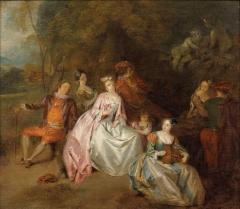
Galerie Dreyfus- Scène galante dans un parc, ca 1725

In fact, it confuses me still.

Seriously, the 18th century was a pretty sexy place, if you like oranges and silk.

Yale- Mrs Tyng
Yale- Mrs Tyng

Look, there’s Mrs Tyng again! She’s left the MFA and taken a chair at Yale.

My House Stinks

I said to the B&G guy at work, “My house smells funny.”

He asked, “Funny good, or funny call the police?”

“Like black powder and wood smoke,” I said.

“Oh, call the police!” and we had a good laugh. Ed is a black powder hunter and camper, but not (yet) a reenactor.

We spent the weekend at the BAR event at the Nathan Hale Homestead in Coventry, CT, about 1.5 hours from Providence. It’s Route 6 all the way, twists and hills, lovely in the fall colors, but pokey.

I did get several apologies from the Captain of the Bail-Out British, so visited no mischief upon them. To be honest, I think they were into mischief enough themselves, judging by the aroma of the liquid in their mugs.

Saturday started foggy and party cloudy in Rhode Island, mist hanging over the reservoir in Scituate, framed by gold and red leaves. It was warmer and clearer in Connecticut, and lucky me, Sew 18th Century was there, too! She was cooking in the house, and I was in camp.

On Sunday, the Young Mr came out, too. Through machinations on Saturday, he was convinced to drum on Sunday, though he has been much afraid to since Fort Lee last year, and the SOI. He did just fine for a novice musician, and perhaps most importantly, learned he was wanted, needed, and would not die if he drummed in public.

And yes, I wore another gown.The fit, or perhaps the position of my stays, or both, need tweaking. I lay awake early this morning obsessing about the fit and whether i would need to move the sleeves, and should I undo it all now, and how all my fitted patterns were wrong, when I realized I had gone down the dangerous road of Dressmaking Doom.

I will lace up again, and try the gown again, at least once, before officially freaking out. Does this mean I need to put a wool gown on hold? Perhaps. The better time investment might be in a second wool petticoat and a short cloak for greater maneuverability. Also, some long underwear for the boys who wear linen. There’s no way a regimental for any regiment is getting made by November…and now there will be more than one. Who says men aren’t into clothes? Mine are, as long as they’re complicated styles of several centuries ago.

More pictures on Flickr.

Just Keep Stitching

It is going to take a long time to finish, and longer because I’m doing it alone, have little room for the frame in our apartment, and have a family to sew garments for. But if I just keep stitching, it will get done.

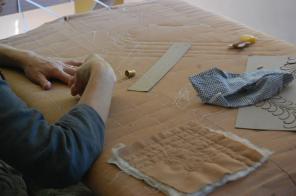
The photo is from Sunday at Coggeshall Farm, and gives an idea of the set up. The frame worked well, though the pegs did fall out in the drier weather. No wobbles, though. It’s a little tricky to stitch from different angles and to maneuver around, but I’m accustomed to lap quilting even large pieces. This needs a frame, so I’ll just adapt.

The sandwich is comprised of a linen backing, wool batting, and a plain-weave silk and wool top. I’m quilting with some silk twist from Wm Booth Draper that matches pretty well. This is a compromise, given that I can no longer buy tabby and calamanco, or fine plain weave wool. The wool (calamanco/tabby) originals in the RIHS Collection are lined with wool, not linen (the silk petticoat that belonged to the Browns is lined in a fine white linen plain weave), but I could not find materials that satisfied my requirements for weave, sheen, color or fibre. The compromises I made I will have to live with—one hopes without recriminations—but they are balanced by the panels I stitched at about 13 to 13.5 inch intervals to match the dimensions of the originals. I’ve also laid the petticoat out in the same proportions as the originals.

Now all I have to do is keep stitching…

Some hat!

I was looking for something else, and found instead Sally Sanford Pert, 1790. That is surely a fantastic hat, but the painting itself is quite interesting, too.  I was chasing Sanford Mason, which is how Sally came up in my search, though she was painted by Reuben Moulthrop (1763-1814).

She’s on display at the Met right now, and if I had the time, I’d get on the Acela and see her myself. Is she really that blue? Does her hair really look like she made a wig from a grenadier’s cap? What exactly is happening with the gown? And who, oh who, is shown in the portrait miniature she proffers? I’d guess her child, perhaps deceased, but it is only a guess. If you click through to the Met’s catalog record, you can zoom in on the portrait. The neck of the gown seems to be edged in printed or embroidered fabric different from that of the gown itself. It isn’t really a zone gown, and the “flaps” or “lapels” remind me of the robings of earlier gowns, or even a robe volant typical of the early 18th century.

Atop this all sits the hat, with its corkscrew ribbon ringlet, the whole thing looking like it was made of paper. In a way the painting raises more questions than it answers, about dress, painting style, the artist, and who Sally was. The best projects seem to start with a question. I don’t know where Sally might lead, but I’m glad I found her.