Laundry!

James Malton, 1761-1803, A Military Encampment in Hyde Park, 1785, Watercolor with pen in black ink, with traces of graphite on moderately thick, moderately textured, beige, laid paper, Yale Center for British Art, Paul Mellon Collection

I’ve been thinking about laundry, and not just because I did wash yesterday, but also because I’m committed now to learning more about the women of the 10th Massachusetts (dude, it’s on paper). Since I won’t be able to get up to the Mass Archives or MHS until the holiday break, one place I can start is with the material culture of army women’s lives. This is also helpful as I am thinking about asking for a laundry tub for Christmas. (I had an aunt who got a toilet seat for Mother’s Day, and my husband once gave his siblings fire extinguishers for Christmas, so you cannot deny that we have a proud history of gift-giving.)

There’s a lot to love in the detail above, and while there are some things I don’t think you’d find in the 10th Mass camp — from red coats to chairs, even broken–we can still find useful information. After all, if your chair is broken, you have more of a leg to stand on for having a chair.

The buckets and washtubs have wooden hoops: that’s a fine detail, and one I appreciate, with my very particular bucket. That means, though, that the washtubs I have in mind might not work, as they have metal bands. My bucket man took a long time to get my bucket right, and he doesn’t make washtubs…but maybe the local man would consider trying a smaller tub. Hard to know, but size will be an issue. It appears there may be two sizes of tub in the image above: a larger tub on the makeshift table at left, and a smaller one on the broken chair.

Detail, James Malton, 1761-1803, A Military Encampment in Hyde Park, 1785, Watercolor with pen in black ink, with traces of graphite on moderately thick, moderately textured, beige, laid paper, Yale Center for British Art, Paul Mellon Collection

The improvised clothesline is a reassuring detail, being pretty much what I have in mind for our camps, pending some riverbank logging. These taller sticks would then join our kettle or musket-rack sticks as part of the permanent equipage carried by the Subaru baggage train.

We’d been talking about doing a cold wash at work, where a friend was advocating NOT digging a pit and boiling laundry on the lawn, so these washing women intrigued me: none of them are boiling clothes. In fact, there’s no fire to be seen! But look again at where those kettles are. In the detail above and again at left, note a large kettle adjacent to every washtub. Could it be that water was boiled in a larger (enormous) kettle, and dipped into these smaller kettles? The other thing to note is that this seems to be family-based washing  and not regimental-scale washing. Given that I’d probably only have two shifts and four shirts to wash on a good day (they’re wearing their shirts, you see), could this model work?

None of the reenactments we see achieve anything like the scale of the events or activities we’re trying to recreate. Very few of us can cook with five pounds of flour, and there are never enough guys to make up a full brigade in the field. Those truths don’t mean we should skimp or cut corners, but they do mean that we should cut our coat to our cloth. Smaller scale washing could still convey the hassle, necessity, and gender division of the work.

Behind the Scenes, Below Stairs

Jonkheer Gijsbert Carel Rutger Reinier van Brienen van Ramerus (1771-1821), met zijn vrouw en vier van hun kinderen, Adriaan de Lelie, 1804

Perhaps because I just finished Longbourn and have just started Year of Wonders, servants are on my mind.

In the family portrait at left, the servants are visible (just) to the right of the tree.

The man and woman almost literally mirror the main subjects, Carel Rutger Reinier van B can Ramerus and his wife, positioned as they are in opposite relationship to each other. The servants, too, are surrounded with life, carrying a child and dogs and game.

servants

The woman is holding the infant of the van Ramerus couple, and even without Google Translate (that’s “four of their children”) we can figure this out. How? Because the child is held away from her body, and faces forward. It is a slightly odd arrangement, with the infant so peripheral to the main image, but we’re fortunate, because this composition allows us to see the servants.

Class distinctions are clear in the dress: the female servant wears a cap, kerchief and short gown, the male servant-gamekeeper, perhaps–wears breeches and a jacket from the pervious century, as well as a cocked, and not a tall, hat.

It does remind me strongly of the imperative to continue a family line, and the lot of women to breed and produce male heirs. For all that I love the past, I know I could not live there easily.

Citizens of Boston

John Collet, May Morning, 1761-1770. Museum of London

I find myself involved in an event scheduled for August 10 in Boston, though I know this could go awry because I worked for a number of years with DC, the organizer of this extravaganza. He’s got a style all his own, and for a taste of the madness, you can see him here (~5:26) with unmistakable and inimitable mannerisms, at Louisbourg.

While the Adjutant is arranging and training the militia, the event still needs civilians, and as the interpretive consultant, my task is to create the context of the day and hammer into DC’s head that when organizing something like this, you can hardly over-communicate, though having been on the receiving end of his phone calls, actually, you can… but that’s where I come in with the editor’s sharpened pencil and cut, cut, cut.

Mr S has signed right up for this event, though he lacks suitable garb, and thus it will soon be time to break out the wool broadcloth. I really liked Sharon’s waistcoat-conversion suggestion, and happily Wm Booth had a lovely dark-green wool remnant of just enough yardage for a skinny man’s frock coat that very morning. Add the brass buttons in the stash, and I thought we were off and headed for 1770 with a regression to 1763.

Except… in doing more looking at 1760/1763 images, I began to wonder if it was better to beat the green linen into an earlier coat, consider it a lesson learned, and move on, since it is only a one-day event. (I saw some small remnants of that same green linen in the Adjutant’s stash, and perhaps I can get them for cuffs.)

My logic is this: it can be tricky to walk a coat backwards in time, especially in sleeve width, and Mr S is in serious need and want of a lovely coat for Battle Road. (Except yes, heh heh, he needs it by July 14 for an event at Washington’s HQ in Cambridge. There’s not even time for gnashing of teeth!) I don’t think it means more sewing, really, it only means penance with alterations and begging for fabric scraps. It also mean focusing, and letting the Monmouth-acquired cuts on my fingertips heal.

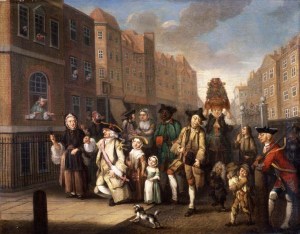
John Collet, Scene in a London Street, 1770. YCBA, B1981.25.110

Mr S will be just one of a number of men who will be militia in the morning and civilians in the afternoon. In thinking about the Boston street of 1763, I’m reading the Boston Gazette and Country Journal (which DC had not done beyond the main articles…) and looking at images from London. Maybe the scene won’t be as chaotic, since it is a happy celebration, but it needs to be busy, and populated with men, women, and children of various ages, races, and class levels. There’s a nice way to search for “street” at the Yale Center for British Art, and you get a sense of the crowds and busy-ness of the 18th century street.

To that end, I have asked my silk-gown friends, and I plan to be the cherry seller. (I should so like to have that done by Sturbridge to acquire some patina, but doubt I shall.) For the Young Mr, I see runaway apprentices as a possibility. In the Boston Gazette of August 8, 1763, There is a 16 year old mulatto fellow, “large of his age,” who had on “a brown camblet coat with red lining, a white linnen and a mixt colour’d flannel vest” as well as a blue great coat with yellow metal buttons and leather breeches. There won’t be leather breeches by August, but a camblet coat lined in red may be possible.

I came, I saw, I sewed

The usual view: the backs of the bellowers.
My usual view: the backs of the bellowers.

Last weekend was the BAR School of Instruction at the New Windsor Cantonment in Vails Gate, NY. April is an interesting month for travel: changeable weather can land you in a serious fog/cloud, some places aren’t open yet, but the crowds are, mercifully, small.

The meetings and discussions were interesting, and I think its useful for reenactors to continue to ask themselves questions about what they do, and how they do it–questions beyond authenticity. I still think there are great unspoken truths in the Temple Building: in the 21st century, a male dominated, volunteer-run organization will not thrive in its current form.

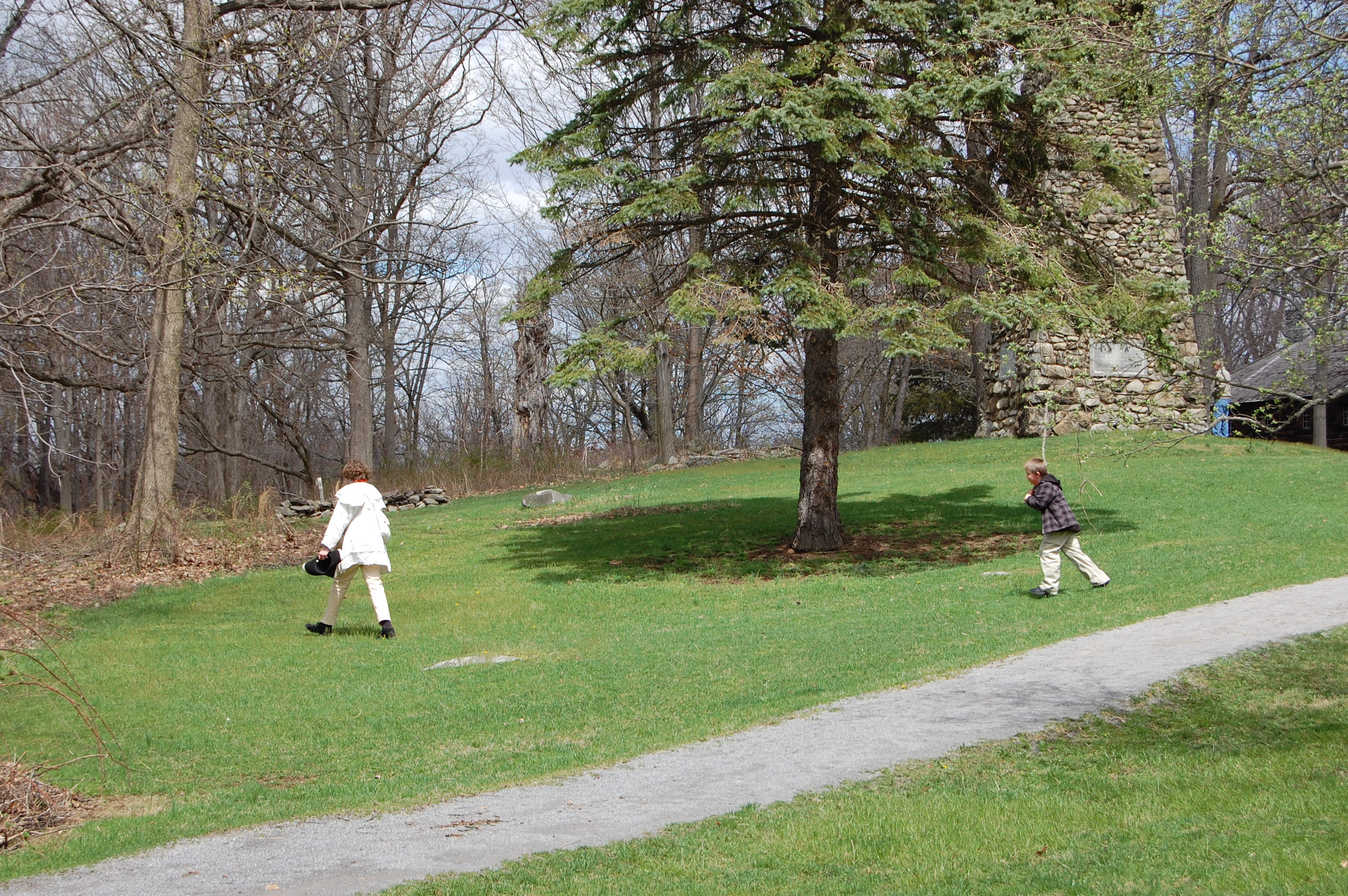
Chase with sticks.
Chase with sticks. He needs drum instruction.

Movement towards demonstrations that make effective use of the actual numbers of soldier who turn out makes sense. as do roles for men retired from the field. More formal interpretive roles for women might strengthen the organization … but for now, I’ll try to learn as much as I can. Laundry: that’s something to work on.

Patina, not dirt.
Patina, not dirt.

Of course, they don’t want their clothes washed. That’s not dirt, that’s patina. I have this for a time to help me figure out how to put together one for the Young Mr, and eventually, for Mr S. It’s less crunchy now that it has hung up for a while, and I do understand the desire for patina. Mr S likes to get his overalls filthy, and his hunting frock. But where would that leave the washer woman?

Mending, I suppose, though I know women were employed by RI state troops to make shirts (there are receipts). We don’t need shirts right now, we need hunting shirts, which it turns out were probably actually hunting frocks, tied at the front with tapes.

Alterations ahead?

Alterations will be ahead for this, though can you call them alterations before the thing is even finished? I started on Wednesday with just the cut pieces, and got this far, plus a completed but not attached sleeve, by mid-day Sunday. (Photos here.) As one of the women at the SOI said, “Without us, they’d be naked and hungry. You think they’d learn to appreciate it.” Probably not until they are actually naked and hungry…

Les Fleur d' Inde
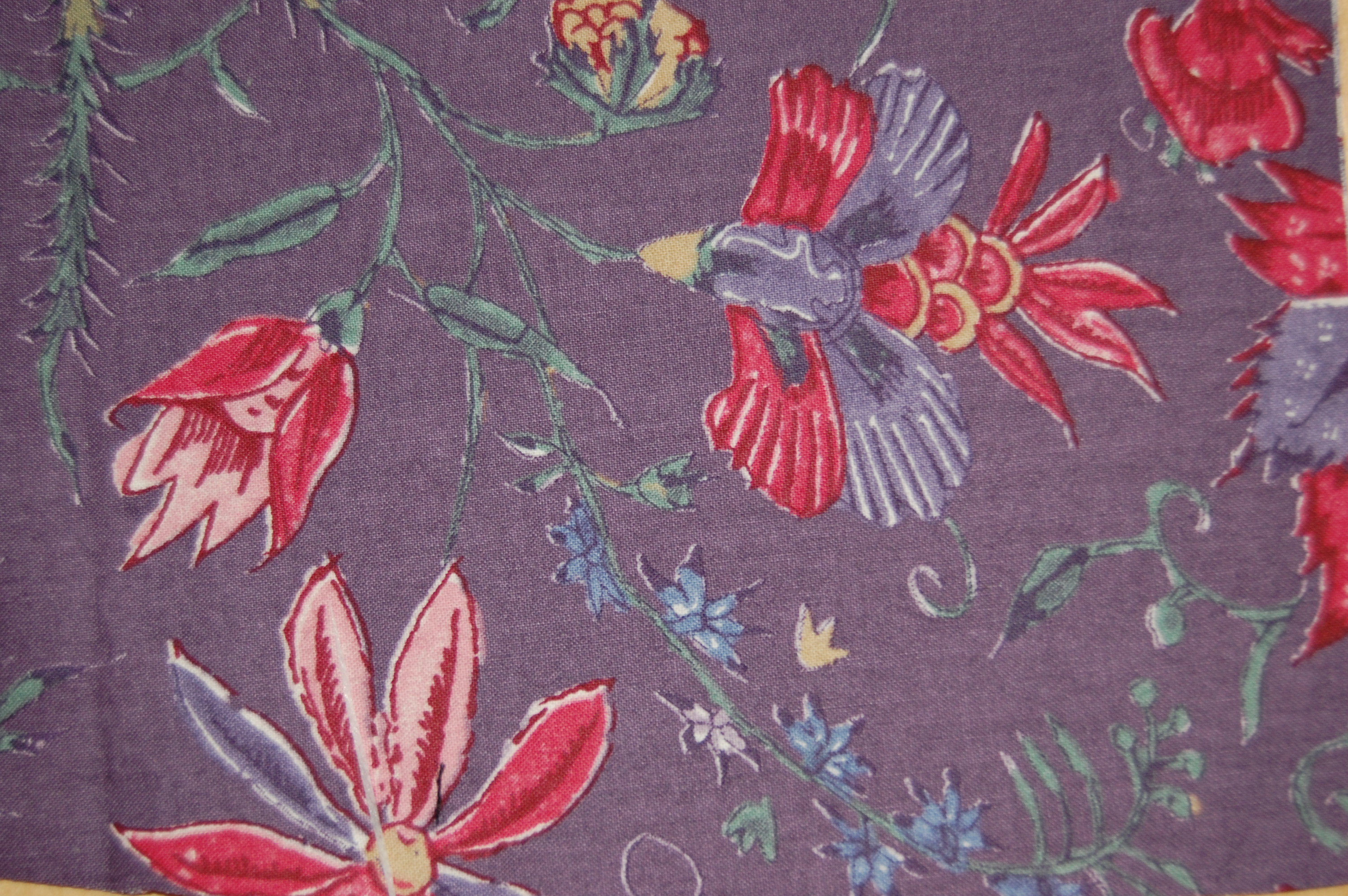
Les Fleur d’ Inde

For relief from the plain linen, I cut out a chintz jacket; the remnant was just enough to get a front-closing short jacket cut. It shouldn’t take too long to make, and will be a nice thing to have in warmer months. And it’s just enough pretty fabric that I might have been able to afford it.