We all have those Hamlet-like moments, don’t we? How weary, stale, flat, and unprofitable | Seem to me all the uses of this world!
But in this case, I can attest to being and not merely feeling flat: lo, I am cutout exhibition furniture.
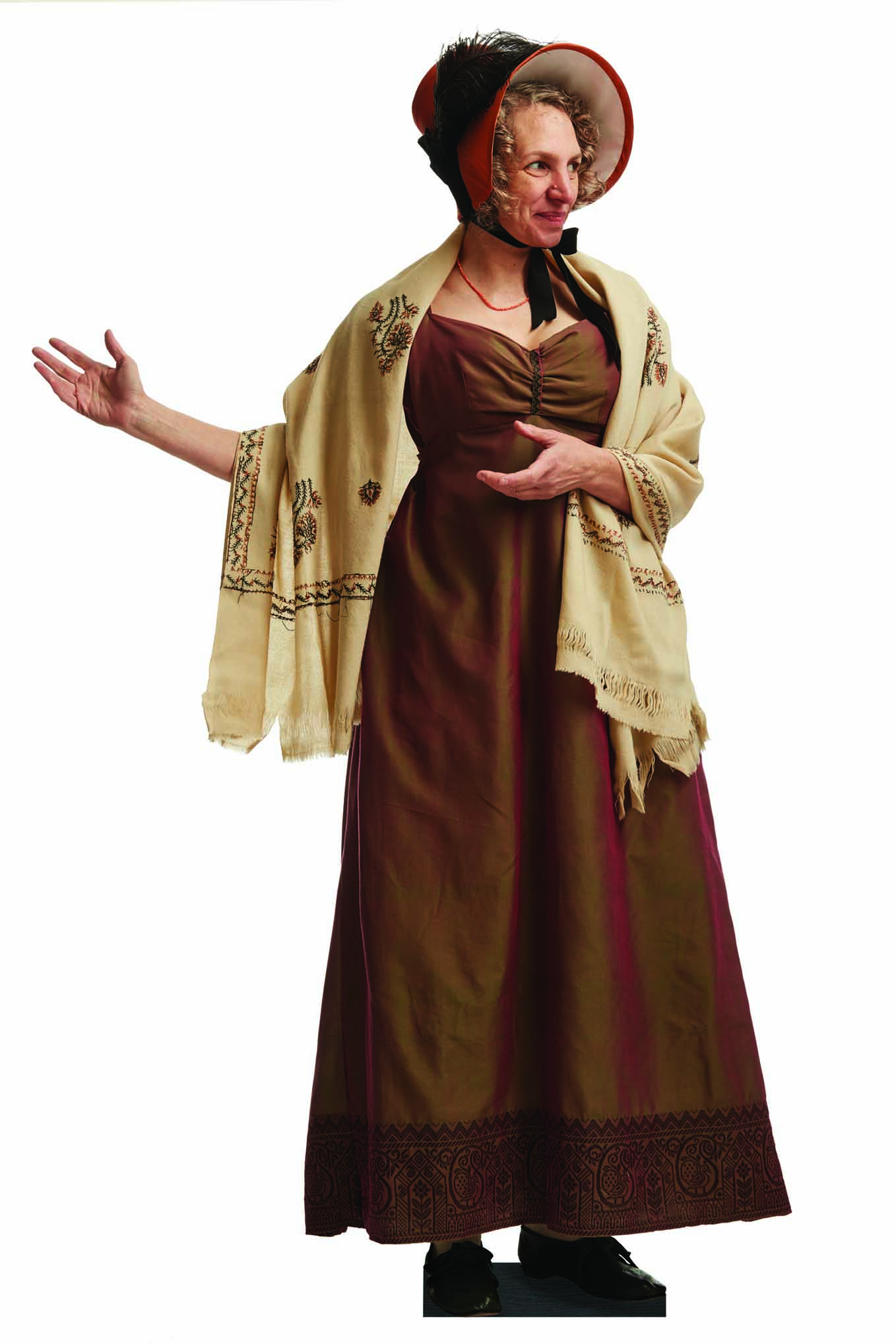
Thanks to Mr B’s casting call on behalf of the New-York Historical Society, a number of friends and acquaintances and I are now part of the scenery of the new exhibition, Saving Washington, up through July 30.
The behind the scenes of being a prop is pretty entertaining.
Mr H
Steaming my shawl
The changeable green-red sari gown was made for this photo shoot; we were asked to wear strong colors, and since the exhibit was meant to represent one of Dolley Madison’s “squeezes,” dressing up was in order– and hard for me to do, since most of my gowns are day dresses at best.
I started this November 22, and carried it on airplanes several times.
November 22: the madness begins
Sleeve salvation
The sleeves appeared to be a complete failure at first, until I figured out I could pleat the design to form a smaller, graphic band at the bottom. Sometimes I start without knowing how a thing will turn out…including most days when I get out of bed.
December 9 completion level: wearable.
At least it was finished enough to wear to the photoshoot, and it appeared again, with a real hem and a ribbon to keep it on, in Salem last month. I’m pleased enough with the color, and how well it doesn’t go with most things to call this a success– and finished!
It’s auction season again, the best one of all: the major Americana sales and the Winter Antiques Show in New York. I won’t be at any of the exhibitions or sales, which is just as well for me; my friends know the twitchy “must-touch” finger motion that means I need to leave my wallet and checkbook in wiser, saner hands.
Still, even if we can’t buy, we can learn. This time around, I was delighted by the juxtaposition of two pre-1750 paintings in the Sotheby’s sales.
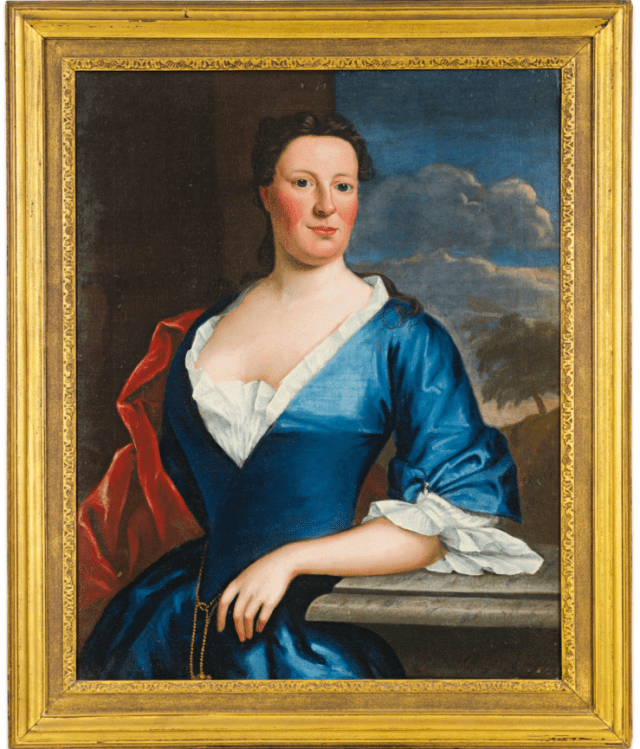
Robert Feke (1707 – 1752) PORTRAIT OF MRS. TENCH FRANCIS In what appears to be the original frame; Bears a label on the back of the frame: Mr. Willing, Bryn Mawr. Painted circa 1746. Label on the back of the stretcher: Philadelphia Museum of Art, Robert Feke, Portrait of Mrs. Tench Francis, 11-1969-2. Lender: Mr. E. Shippen Willing, Jr. Oil on canvas 36 by 28 1/2 in. Sotheby’s Sale N09456 Lot 1595
Francis. Shippen. Willing. This thing is DEEP in the history of Philadelphia, and by my fave 18th century RI painter.
It was a THING, that blue silk gown business with a red silk wrapper. Better yet? This one:
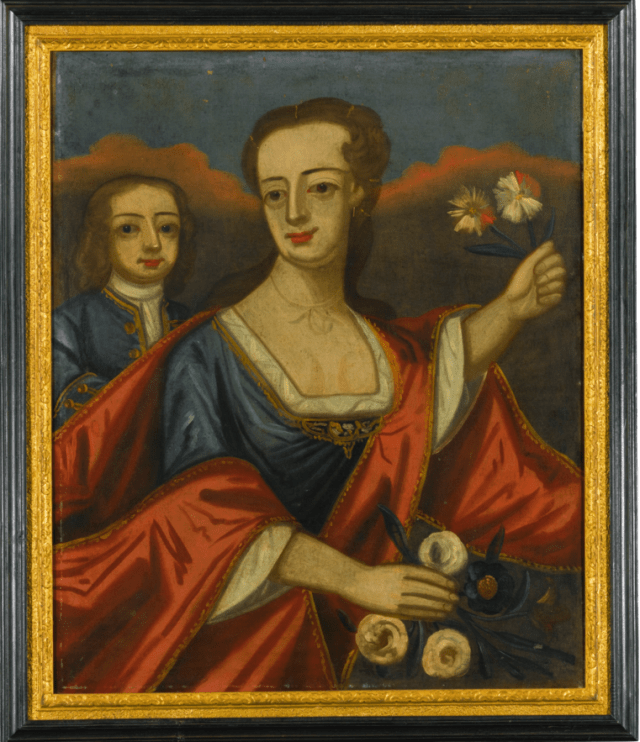
Attributed to J. Cooper 1685 – 1754 WOMAN WITH YOUNG BOY Appears to retains its original frame attributed to J. Cooper. oil on canvas 30 in. by 25 in. CIRCA 1715. Sotheby’s Sale N09466, Lot 398
What I love about the J. Cooper is how crude it is: that painting looks more like a woolwork picture than a painting. But that vernacular adaptation tells us how prevalent this portrait style was, and how desirable.
What do you see and remember at events? At every event I go to, I see a range of impressions, or historic expressions.
unknown artist, 18th century, The Encampment in the Museum Garden, 1783, Aquatint, hand-colored, Yale Center for British Art, Paul Mellon Collection
There are Good things: a chintz bedgown that’s actually becoming; a checked suit I wish the kid would wear; the Ugly Dog Coat Mr S wants, the umbrella I want to make just for its lines.
The Bad and the Ugly are present, too.
Drawstring shift necks, makeup, infernal bodices, Birkenstocks, sofa-size prints… “light” troops with dining flies, tables, and tin roasters. Stores tents packed with plastic packaging. White “trews” baggy as painters pants, breeches reaching below the knee, haversacks as man-purses, tube socks, sneakers, peacock feathers on women’s hats, girls with undressed hair and no caps.
What is the meaning of these bodices and tube socks: are they the disease, or a symptom? I think they’re a symptom, telling us about a deeper problem.
If “authenticity” is a journey and not a destination, everyone starts this journey at a different point, and some people are more sophisticated consumers of knowledge than others. Hard as it is to fathom, some people—even with decades of time in this— don’t know any better. I’ve encountered half-correctly dressed wives of men who’ve been to Battle Road who didn’t even know workshops are available to help them with stays and gowns. The ignorance is not always willful, even if it seems that way.
Why are some women such a mish-mash of reasonably accurate jacket with acceptable petticoat worn without stays, a drawstring shift, an OK cap, modern glasses, and a purse?
Paul Sandby RA, 1731–1809, British, Washerwomen, between 1790 and 1805, Graphite and brown wash on moderately thick, cream, rough laid paper, Yale Center for British Art, Paul Mellon Collection
Do they not see the return on investment for stays and a gown and shoes and a cap and glasses and no makeup? Perhaps they don’t feel pretty when they venture out of their normal realm, and they’re only visiting, anyway. Is this the reason for the half-baked costume approach?
Or could it be that the unit commanders have set no standards for the women? That they don’t consider the women to really be unit members? Or that the women don’t consider themselves members? That they don’t matter the way the muskets do?
Could some women’s lack of authenticity—and by “authenticity” here I mean “period appropriate clothing”—be rooted in the phallocentric/musket-centric culture of the hobby? In some units, men and women seem to engage in parallel play, like toddlers, where the men field in the foreground, and the women cook in the background (women on the field is an issue I will not take up here). The men are in charge, making the decisions: the women, and what they wear, appear not to matter, and are nearly invisible. I think this is rooted in basic misogyny and the riptide of the hobby’s boys-club attitude.
If misogyny is part of why women perpetuate inauthentic impressions, then having women invested in their units and roles, with more research and more care, might be threatening to men who want weekends for themselves and their ‘war games.’ But I believe that without a significant investment by women, and by units in women’s roles, this hobby won’t survive, and it’ll be a lot less fun and educational for everyone.
That means, of course, that I think units will have to allow women a voice, and develop standards for women as well as men. Those units with the farthest to “travel,” authenticity-wise, will need to build up stores of wearable, authentic women’s clothing to loan, or include women’s workshops in their schedules. If they don’t want women and/or families participating, then that has to be clear, too, and women who do want to participate will have create their own civilian units. (I don’t have solutions for all of these issues.)
attributed to Hubert-François Gravelot, 1699–1773, French, active in Britain (1733–1745), Matrimonial Fisticuffs, with a Portrait of the Pugilist John Broughton, in the Background, undated, Watercolor, pen and black ink and graphite on medium, slightly textured, beige laid paper, Yale Center for British Art, Paul Mellon Collection
When the men around them don’t value or encourage their participation, and when units do not have men and women as equal members with clear standards for both, I think you end up with poor impressions—particularly women—and camps full of crap. These are symptoms of a larger problem of misogyny and silence.
Anthony Highmore, 1719–1799, British, Group of Three Ladies, undated, Watercolor, pen and brown ink, and graphite on medium, blued white, moderately textured laid paper, Yale Center for British Art, Paul Mellon Collection
In recent years there have been calls for greater attention to standards for women by unit commanders. But I think that we should go further, and call for greater participation of women in real leadership roles in the hobby. That’s when you will see real change, not just in clothing, but in presentations.
And that is where I think the future of this hobby lies: in recognizing that living history events are mobile museums, not just mobile monuments.
To get more complete, inclusive and, I think, authentic, experiences will take more inclusive leadership structures, from unit memberships to the boards of umbrella organizations. That would be one small step towards bringing leadership and management into line with the modern world and current best practices in management for cultural and historic organizations. Because that is what the umbrella organizations have become. The boys’ historic shooting clubs have grown up, and it’s time to let the girls play for real, and to value women’s roles past and present.
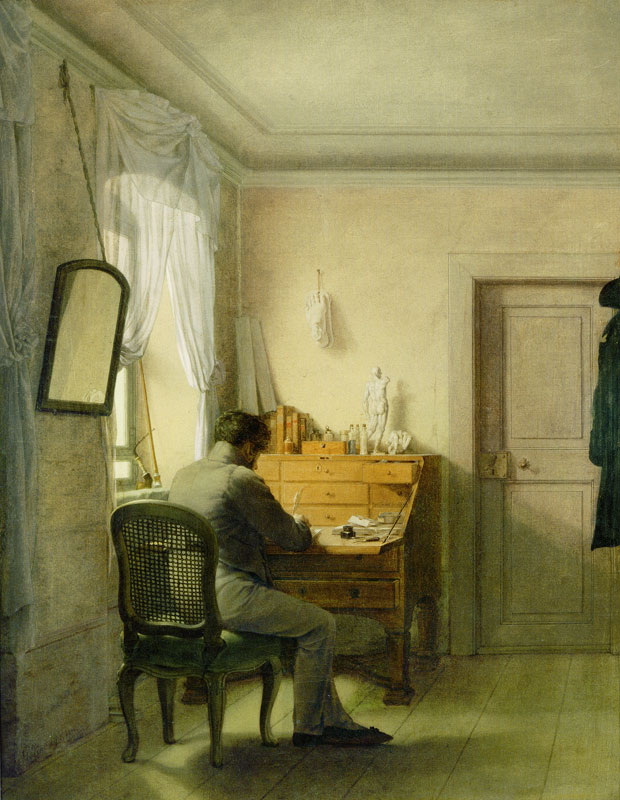
Georg Friedrich Kersting, A Man (artist) at His Desk. 1811. Klassik Stiftung Weimar, Goethe Nationalmuseum
1811 caught my eye and stopped my Twitter scrolling. Kersting never fails to please, luminous watercolors and delicate details. Summer is here, along with events in so many years I feel quite distracted.
1780 this weekend (L’Hermione in Boston). 1775 a few weeks later. 1814 in August. 1833 in September. You could get whiplash looking at waistlines and sleeve silhouettes.
What I need is to take the time to sit, like Kersting’s man, to reflect and to write and to make a plan. I’ve fallen behind on the garment-a-week program, and need to catch up quickly. The faster I sew, the less like the Young Mr can outgrow the garment before it’s finished.







 Kirsten Hammerstrom
You must be logged in to post a comment.