Mopping Up

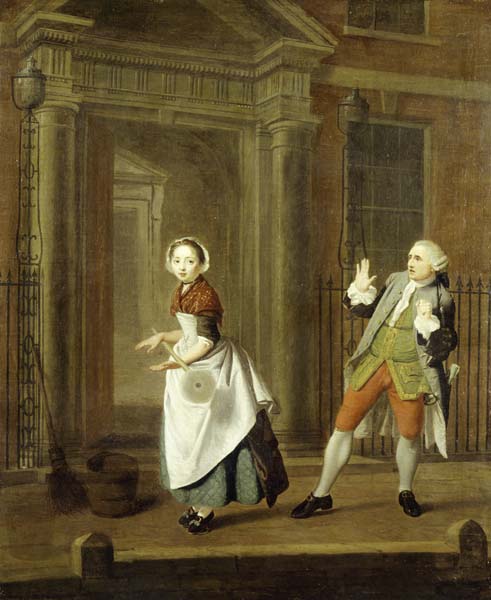
A City Shower. Oil on canvas by Edward Penny, 1764. Museum of London

Springtime sadness is best remedied by scouring[1], so in the best Scandinavian fashion, I have been looking into 18th century cleaning. Dem barracks, right?

First of all, were you wondering about what exactly they “smoked and cleansed” smallpox victims’ rooms with? Brimstone and frankincense.[2] Now you know what Edward Langford would wake up smelling when the house next door was free of smallpox.

But what about those floors? They need to be cleaned. Swept, yes, and scrubbed with sand. But also mopped, and the doorstep mopped.

Tit for Tat. stipple etching, London, Printed for R. Sayer Map, Chart & Printseller N° 53 Fleet Street, as the Act directs Novr 24. 1786. British Museum 1861,0518.958

I have a broom and a whisk broom, and can substitute a kettle for my sad bucket[3] but I lack a suitable mop. Lack never deterred me, whether of skills, knowledge, or supplies, so off to the interwebs and library I went.

I started with Foul Bodies, the 2009 monograph by Kathleen M. Brown. Nothing on floors, sadly.

I remembered the 10th Massachusetts Orderly book from 1782, that was more helpful.

Some part of the Camp and about the long Barracks in particular is relaxing into nastiness. Regimental QuarterMasters have been ordered to have them Clean and keep them so. An Officer of each Company has been ordered to visit the Barracks every day and to Confine & Report those who throw bones of meat Pot Liquor or filth of any kind near the Barracks. Yet all this has been done and no report has been made. it is hatefull to General Howe to Reitterate orders as it ought to be shamefull those who make it necessary.
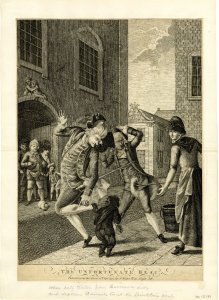
The Unfortunate Beau, etching, Publish'd as the Act directs 12th Sept 1772, by S.Hooper, No.25 Ludgate Hill. British Museum 1991,1214.20
The Unfortunate Beau, etching, Publish’d as the Act directs 12th Sept 1772, by S.Hooper, No.25 Ludgate Hill. British Museum 1991,1214.20

Nastiness. Those barracks sound noisome, don’t they? We can’t have that.

So let’s cast out the bones, sweep the floors of the branches and dirt and grit the men have brought in, and mop them, too, now that it’s spring.

Mop, you say?

What did mops look like the in 18th century?
And how on earth will we acquire one?

Tune in next time for another exciting installment of “historical cleaning instead of cleaning my own house.”


[1] Dude, I have scrubbed baseboards with a toothbrush. Not one of my finer moments, but a memorable one.

[2] Kathleen Brown, Foul Bodies: Cleanliness in Early America. (New Haven: 2009) p. 129

[3] Really really: I meant it when I said keep the bucket wet.

Sweeping Clean

Sweeper 1746, Etching with some engraving Harris Brisbane Dick Fund, 1953 MMA 53.600.588(56)

This is how we’ve spent our time off: quite a bit of cooking, though I did much in advance (the oven is large enough to cook only a turkey and nothing else, at one time), and even more cleaning and clearing and rearranging. After all, my mother will arrive in three weeks, which is not very much time at all when you have working weekends along the way.

with any luck, there will be a tidied up office/ironing room in which I could sew out of the way of certain felines, but at this point I’d settle for folded laundry and calmer cats. They remain convinced that cleaning is an exercise in cat assassination, though they can offer no proof that any cats have ever succumbed to death by vacuum cleaner.

Servant Girl Plucking a Chicken
Follower of Nicolas Bernard Lépicié, French, 1735–1784
MFA Boston, 65.2650

Living history, reenacting, historic costuming: whatever you want to call what we do most weekends, it runs to a lot of gear, in the end. The year we took my mother to Fort Lee, she remarked on how much baggage we had. “You’ve got lives in two centuries,” she said, and it’ true. We just about do. So how to store all that stuff, while making more and improving what you do have, is a challenge. Most reenactors I know have somewhat cluttered houses, or at the least houses where the historical items are integral to the decor. That is probably the most rational tactic, since most of us love what we do and enjoy how chairs or mugs remind us of fun, if challenging, weekends.

We have tried to be ruthless this weekend chez Calash, channeling deaccession rules (duplicate? unrelated? irrelevant? away it goes!) and hoping that when we are done we will have only what is necessary, useful, and beautiful. Or, at the least, a clean house to survive my mother’s eye.

All that glitters…

An Old Woman Cooking Eggs, Diego Velazquez, 1618. National Gallery of Scotland, NG 2180

…could be pewter. Or do I mean tin? Carolina had excellent points about pewter being, yes, that shiny, though we think it is not. Our perception is probably based in large part upon the extant items in museum collections. And museums don’t polish their pewter–at least we don’t, and I don’t know anyone who does. Is it because we’re so unaccustomed to using pewter daily that we no longer know how to care for it?

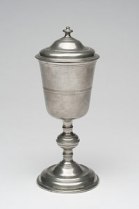
Covered chalice, pewter, c. 1756-1780. Philadelphia Museum of Art, 2008-110-1a,b

I thought it could be interesting to experiment with polishing pewter (not in the collection) so I turned for advice to that touchstone of housework past, Hannah Glasse.  In The Servants Directory, Part V: The Scullion Mrs Glasse lays out To clean Pewter, Tin, and Copper.

Take a pail of wood-ashes (either from the baker’s dyer’s, or hot-pressers; the latter is the best) half a pail of unslack’d lime, and four pails of soft water; boil them all in a copper together, stirring them; when they have boiled about half an hour, take it all together out of the copper into a tub, and let it stand until cold, then pour off the clear, and bottle for use.

When you clean your pewter, lay a flannel on the dresser; set your dishes one on another by themselves, the plates to likewise; then heat liquor according to the quantity you have to clean, pour some on the uppermost plate and dish, and as you use them pour it on the other. Take a piece of tow to rub them with, then having two little basons of red sand, pour some of the liquor on each; with the first scour your plates well, and rince them in cold water; with the second clean them, rince them into two waters, set them to dry, and they will look like new. Thus you may clean them at any time with very little trouble.

Very little trouble for you, Hannah Glasse! The red sand is definitely something museums won’t do: we have this prejudice about not abrading the collections, or applying chemicals, so the lime/ash/soft water mix probably won’t appear in our workroom either.

Willem Claesz.Heda, Still life with gilt goblet, 1635. Rijksmuseum, Amsterdam

I also took a look in my books for paintings that showed pewter with sheen, and for objects. I suspect that pewter’s softness will not allow it to achieve the high-gloss shine of tin, but that it can be brought to brightness. I do think the best way to find out is to start polishing, so I’m in the market for some wood-ashes from the hot-pressers, and a good place to lay a fire and boil some chemicals. Who wouldn’t volunteer for open-fire chemical boiling?