With a brief, sort-of-break from school, I have time to think about the research and making I’ve done recently, if “recently” can encompass the past two-ish years.
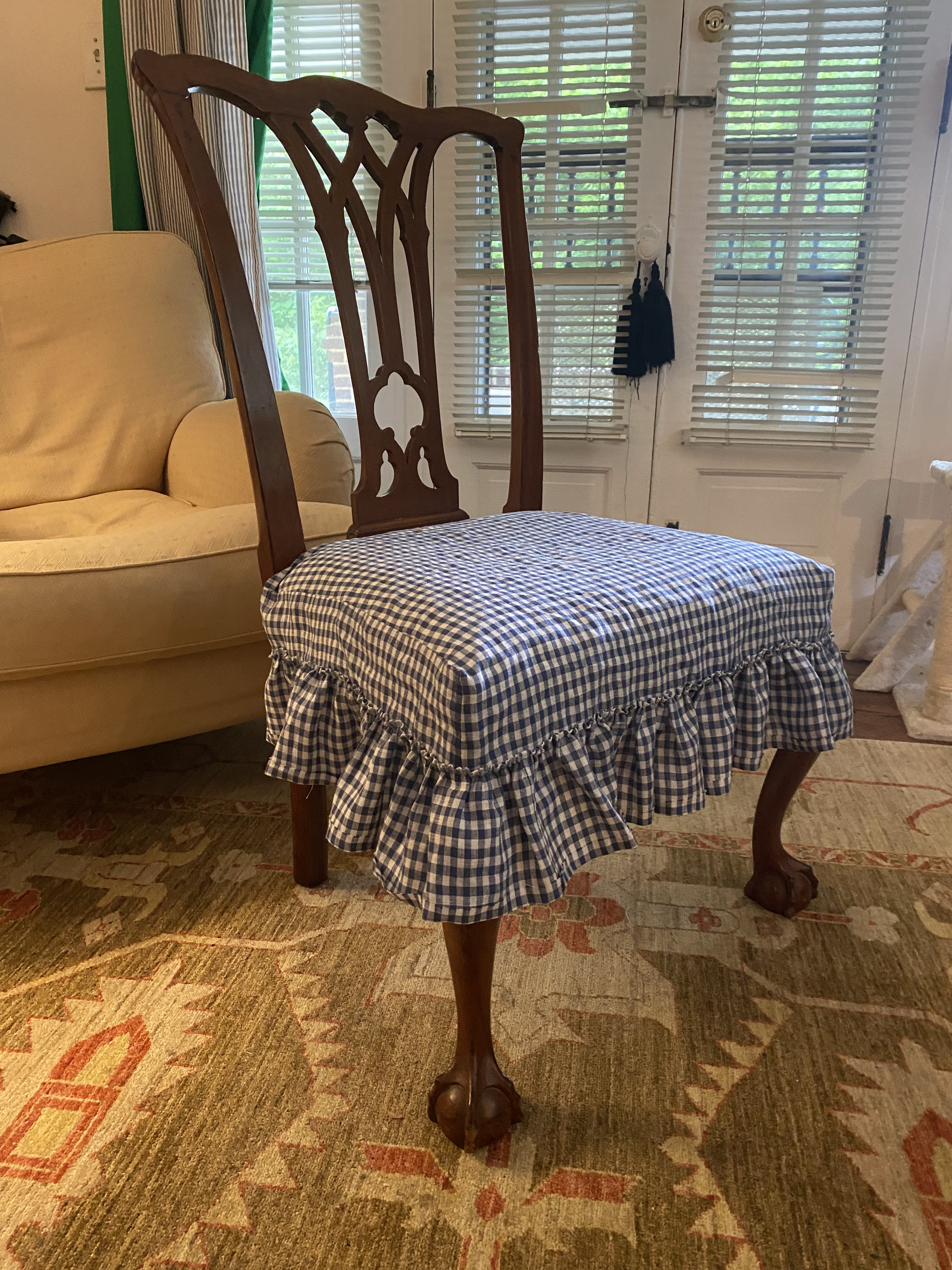
Last May, I made a slipcover or case cover for a Chippendale side chair. I love this chair very much and while I have not (yet) recovered the slip seat in something more appropriate, a case cover seemed appropriate.
I am under no illusion that this chair is Cadwalader quality, but it offers the opportunity for crossover between my upholsterer and Cadwalader obsessions. When John Cadwalader was outfitting his townhouse on Philadelphia’s South Second Street in 1770-1772, he ordered covers in fine Saxon Blue check, with fringe, for his chairs.
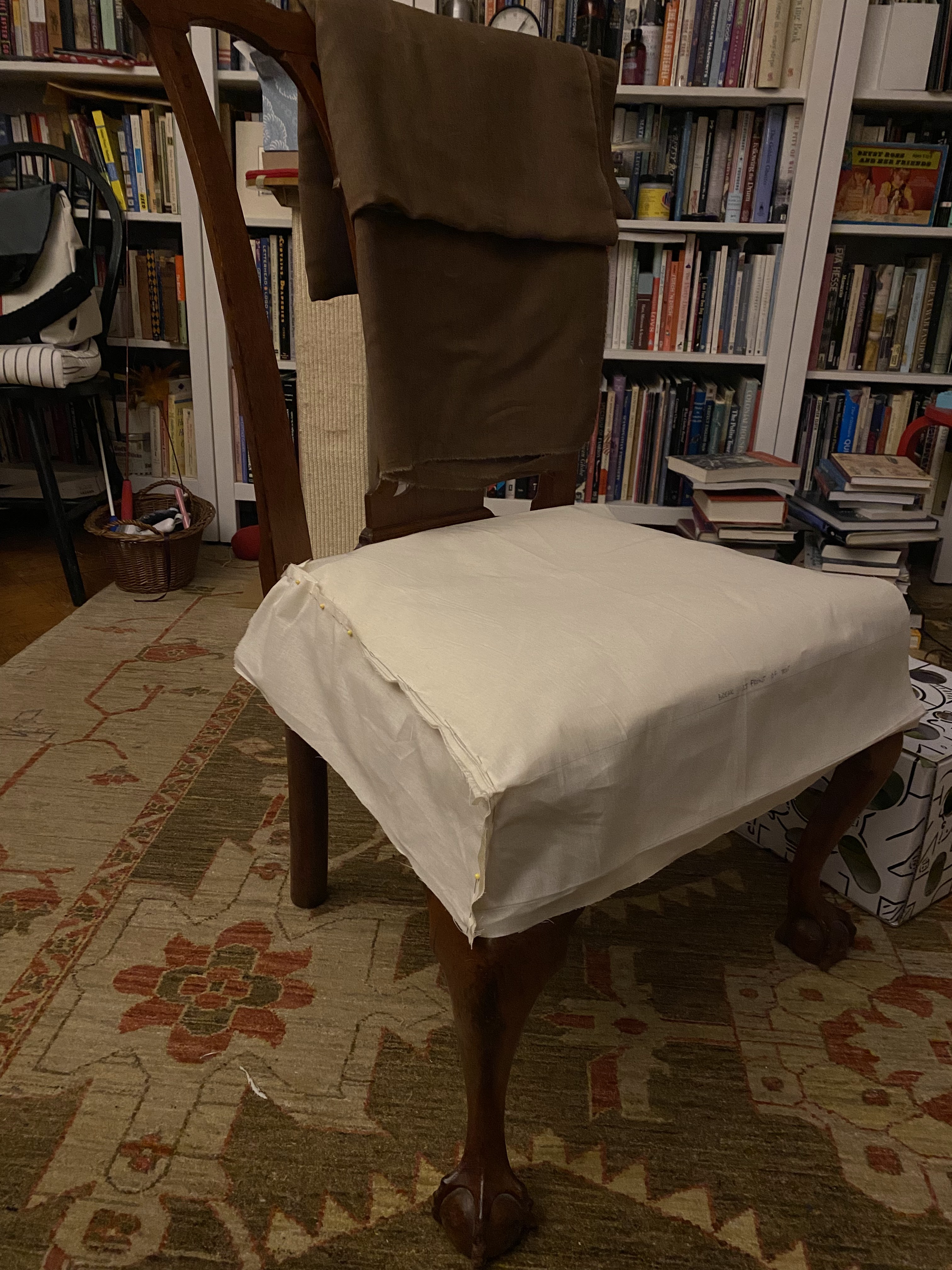
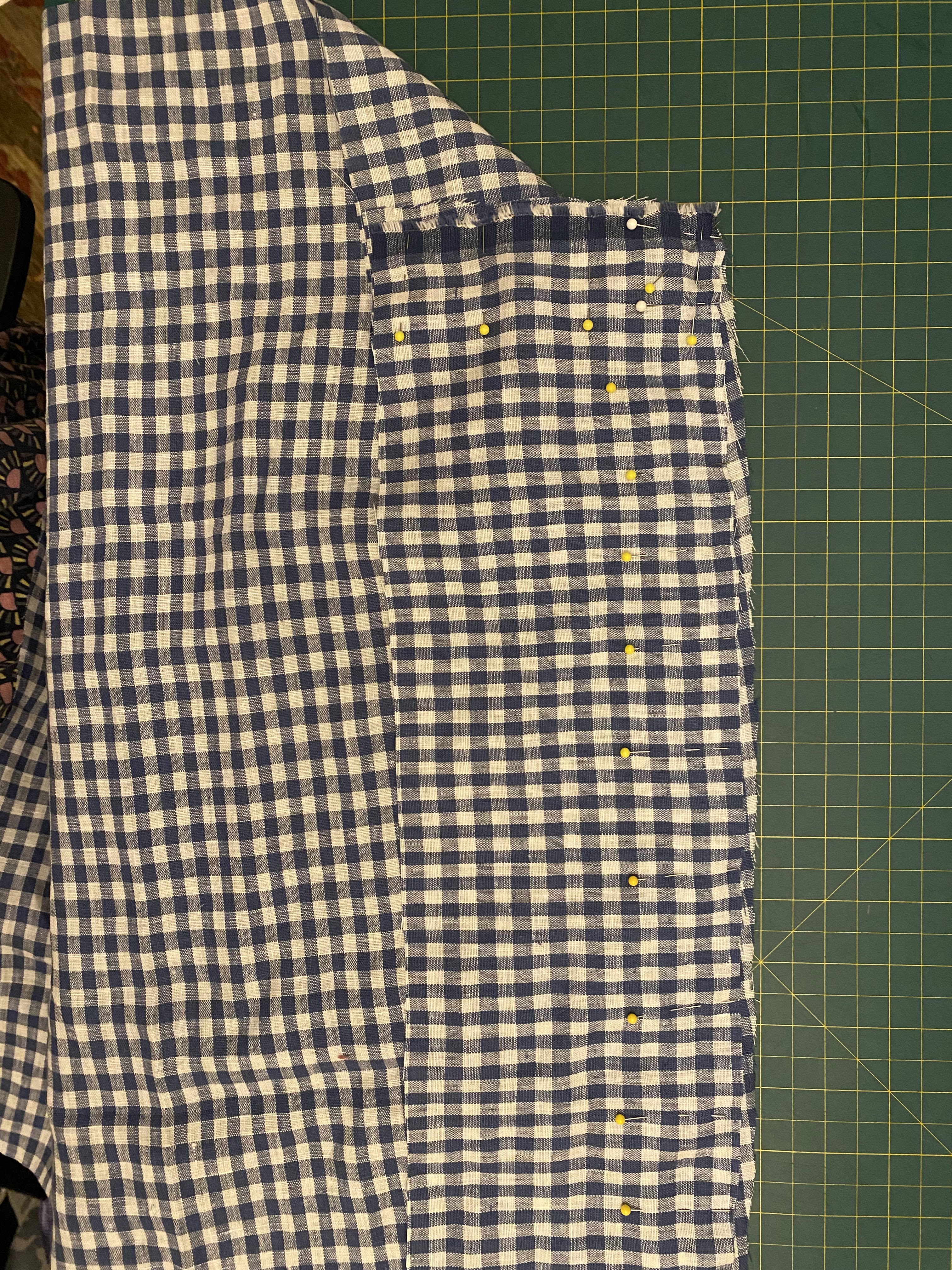
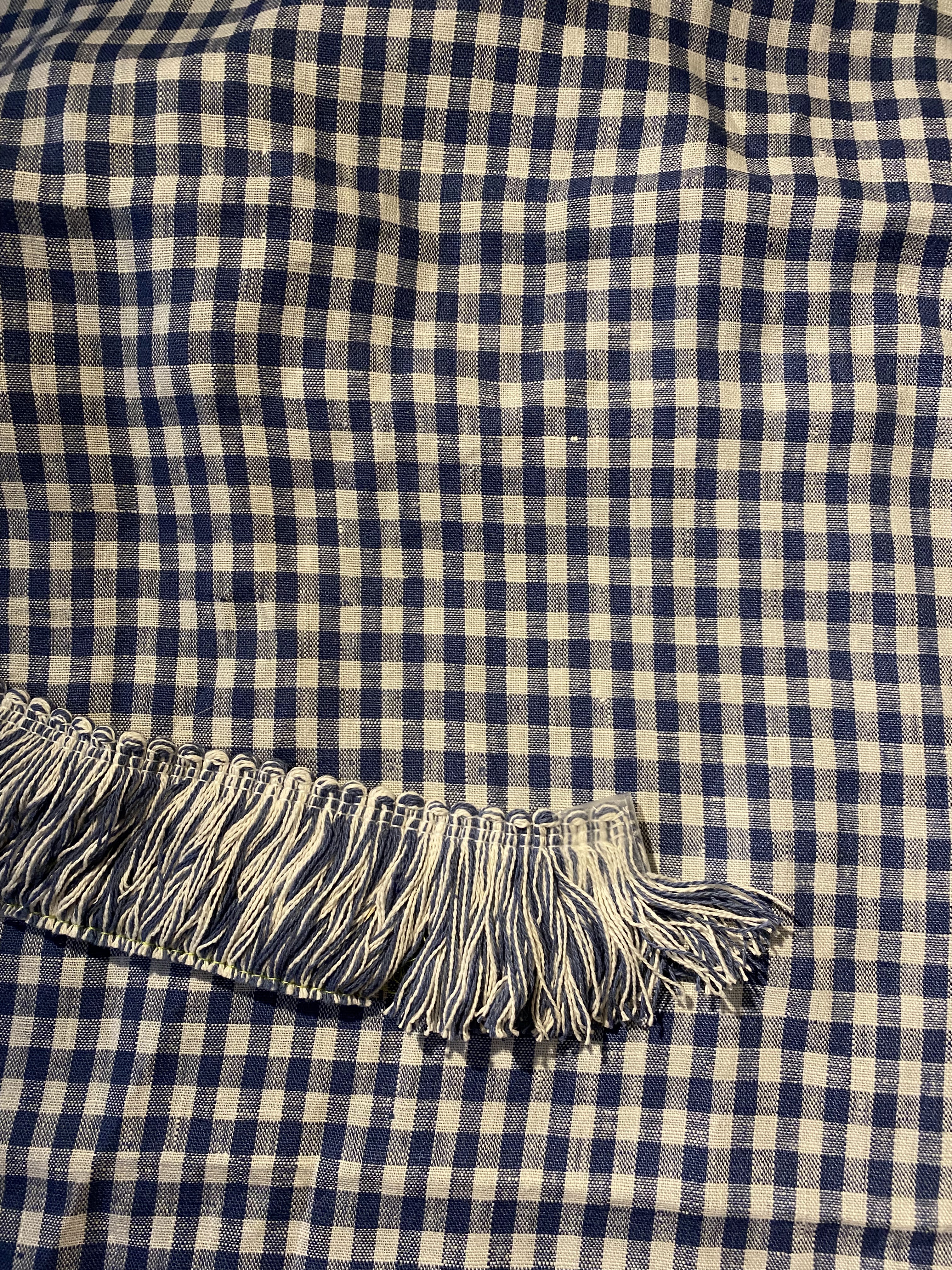
I started by making a muslin to create a pattern; this seemed like a better idea than just using measurements. It’s really a simple design: a top (the seat), front and sides, and a ruffled skirt. I based this on an original at Colonial Williamsburg. The cover attaches at the back with quarter-inch linen tape. I ordered fringe, but not enough, so for now, the cover remains fringe-less.
Checked or striped linen was a common material for covers, durable and easily washable. Yes, this is where “furniture check” comes from: the large-scale checks used for these and other covers. (Samuel Johnson’s are particularly bold.)
Linen covers protected expensive upholstery (wool or silk damask, for example) from wear and light damage. Covers could be switched seasonally, but they were almost always made “en suite,” that is, in the same color as the wall coverings and/or curtains. The Cadwaladers had a blue room and a yellow room, both of which must have been like walking into a jewel, with shimmering silk damask on the walls, as curtains, and upholstering the furniture. My cover may be simpler, and my house un-jewel-like, but I love it just the same. (It also fits other chairs, like this one at Historic Lewes.)
The antiques I own stretch back in time, objects passed from hand to hand, connecting me to the past. It is particularly fine when they connect me to America, a place my people came to more than a century after these things were made. A paste shoe buckle. A chair. A portrait. There was once a fad for fake ancestors, buying a past you did not inherit, and the objects I collect are something like that, only less ostentatious– if only because the portrait is a miniature and not full size.
Let’s start with the chair, the most expensive piece of furniture I’ve ever bought. (My bicycles cost more, and were, for a long time, the nicest and newest things I’d ever owned. It’s weird to talk about money and things, and what those things cost; we’re taught not to. That makes it even more important to be honest about context, even if I never tell you what I’ve paid.)
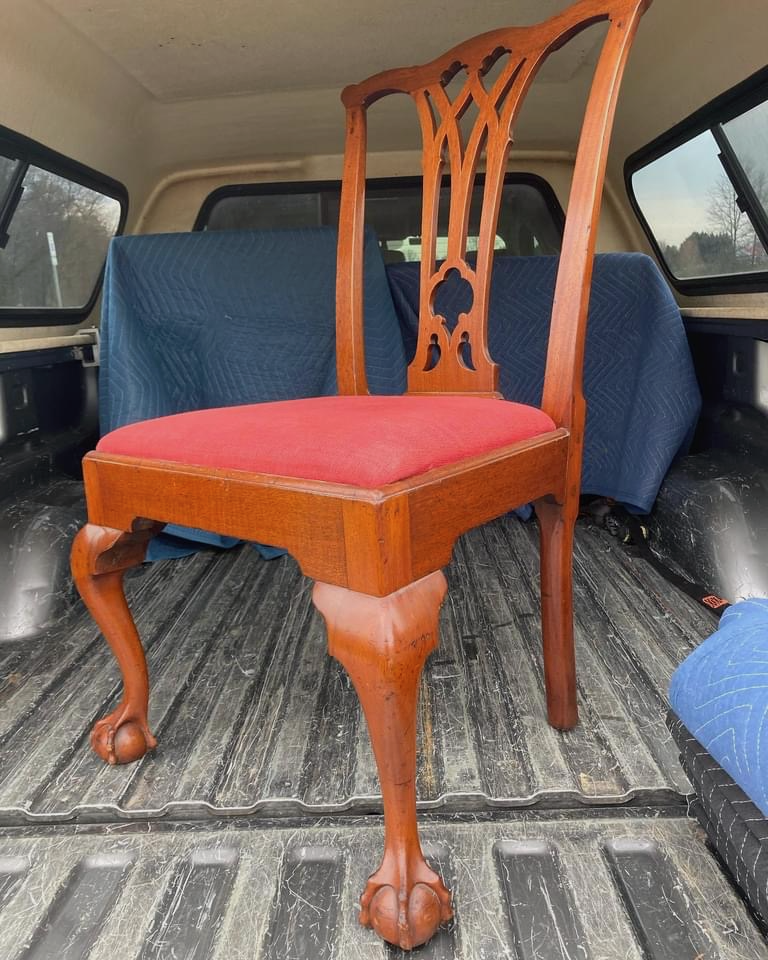
The chair as I first saw it.
The chair.
I follow an antique dealer on Facebook, and in the spring of 2023, he posted a photo of a chair he’d just picked up from a collector in Delaware. It was a handsome chair, mahogany cabriole legs, ball-and-claw feet, shaped rear legs, pierced center splat, curved crest rail. It was marked on that crest rail: W. Hall.
This was a Philadelphia chair, with classic signs in the shape and tension of the feet, the raised line around the arched piercings of the splat, the rhythm of the crest rail. It was simpler, plainer, cheaper, than a Thomas Affleck–the knees on those chairs— but the ogee (cyma) curves stepping down from seat rail to leg spoke of an eye for balance and for structure. There was elegance in the way that chair was built, an adherence to the style books but with a local flair. That was a Philadelphia chair. Delaware being close to Philadelphia, W. Hall was probably a Philadelphia man.
There were not many candidates for W. Hall, despite the anodyne name. A few were laborers– they were unlikely to manage the fine, typographical incision on the crest rail, even if they’d once been able to afford a mahogany chair. Even less likely given that chairs like these were typically sold en suite, a set, two armchairs plus four or six or eight side chairs. Probably six; this wasn’t a Cadwalader-quality chair resplendent from the shop of Thomas Affleck with carving by James Reynolds and covers from the shop of Plunket Fleeson.
So not a laborer’s chair.
There was Richard Hall, a whitesmith, whose estate owned a lot on the east side of Second Street between Chestnut and Market Streets, on what was called Hall’s Alley, in 1777. There was Charles Hall, probably also a whitesmith, in Hall’s Alley, also in the Chestnut Ward.
In the 1774 tax lists were James Hall, an innkeeper, and John Hall, a tanner.
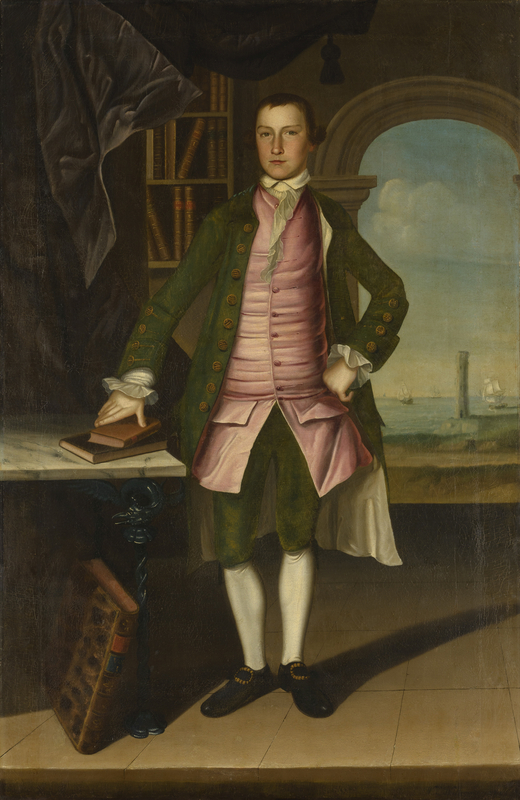
William Strahan Hall, by William Williams, 1766. Winterthur Museum 1959.1332 A
Because there is another W. Hall, William Strahan Hall, the son of printer David Hall. If David Hall seems familiar, that is probably because he was Benjamin Franklin’s partner. Franklin hired Hall in 1743 as a journeyman printer; by 1748, Hall was Franklin’s partner. Hall bought Franklin’s portion of the business in 1766, and established Hall & Sellers with Wiliam Sellers. After David Hall’s death in 1772, his sons William Strahan and David Jr. assumed his part of the business, maintaining government contracts and printing, among other things, Continental currency.
1766. The year David Hall bought Franklin’s portion of the business. The year David Hall commissioned portraits of all three of his children (William, David Jr., and Deborah) from William Williams. Was this flush, banner year when David also ordered a suite of chairs from a Philadelphia maker? Were the chairs then bequeathed to William, the eldest son, who inscribed one, claiming ownership? Maybe. Maybe this chair was someone else’s chair, some other W Hall somewhere among the years it traveled from Philadelphia to Delaware to Maryland to Baltimore.
The story is the thing that makes the chair, however you imagine it. I know enough to know that calling this chair “in the style of William Savery, possibly from the family of David Hall, printer,” stretches every truth I know. But that sentence lifts the curtain on the past, on the webs of kinship and friendship that connected makers, buyers, and users in late-18th-century Philadelphia. David Hall, on Market Street near 2nd Street in the High Street Ward, was around the corner from William Savery on the east side of 2nd Street in the Chestnut Ward. These wards were packed with milliners, ship captains, merchants, and artisans, all aware of fashion and change, all aware of the ways that consumer goods expressed their refinement and sophistication, whether chairs, paintings, books, or bonnets. This is the story the chair can tell, populated with real people and places.
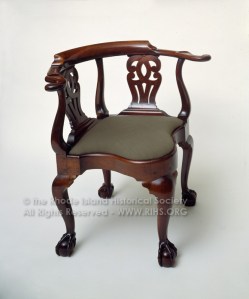
Corner chair. Mahogany with fabric-covered slip seat. John Goddard, 1763. RIHS 1990.36.1 RHix5136
I’ve had more alone time than usual at work, which is to say, I’ve been the only living creature in 16,000 SF for multiple consecutive days, which allows me both time to get lots of work done but also permits my mind to wander more than it might otherwise. One of the ideas I continually return to is about the objectification of objects. That’s a terrible phrase, isn’t it? What is the essential thingness of any given thing?
Let’s take chairs: I really like chairs, which is to say that I have, at last, succumbed to the seductive qualities of chairs.[i] But what makes a chair a chair?
Most simply, a chair is to be sat upon. Keeps your rump off the cold, cold ground. Supports your legs and back. Sometimes a chair is for lolling. Sometimes it’s for working. Sometimes it’s for projecting power. But essential, a chair is for sitting.
If use– specifically human use[ii]– is what chairs are for, what happens when a chair is removed from use, and placed on display in a museum?[iii] And what difference does it make whether that chair is on a white plinth in an art museum, or in a historic house, or in the historic house where it was used? When is a chair most a chair, other than the times you are sitting in one?
As I said: a lot of alone time.
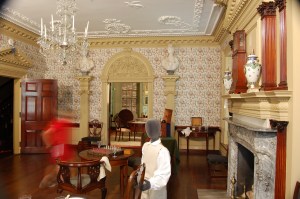
That’s no ghost, that’s my kid. Corner chair just in front of the ghost.
Within a historic house, it seems that the ideal situation is the chair in the room in the house.
That would seem to maximize the “realness” of the thing, right? But we don’t always have the chair, and even when we do, we may not know which room it was used in most often.
The way a chair is displayed and understood in an art museum: Object of Beauty is very different from the way a chair is displayed and understood in a history: Who Sat Here? It’s a conundrum though, because just as the chair become Beautiful Thing in an art museum, it can become Story from the Past in a history museum. Neither presentation/interpretation really gets at Chairness, which is really best experienced by sitting in the chair yourself.
Did I mention I spend a lot of time alone with objects?
Storeroom, Rhode Island Historical Society. RHix17 399
The way that I think these questions about Chairness relate to living history is by realizing that just as museums fetishize objects on white pedestals, living history interpreters/reenactors sometimes fetishize objects without contextualizing them. You know: Muskets. Clothes. Spinning Wheels.[iv]
Putting the chair in the room where it was used gives it context, and the visitor a new perspective that wouldn’t be gained from a white pedestal, or from the curb. The same is true of the things that we carry as interpreters. Context matters. It’s how meaning is derived and understood. Like repetition, isolation can rob an object—or a person—of meaning. Not that I’m lonely. I have all those chairs, after all.
____________________________
[i] Not to get too weird, though: I won’t rhapsodize (yet) about the sensual curve of a chair leg, or a delicate, finely-turned ankle, as I have heard some (fetishistic?) curators so. Yet: there’s still time.
[ii] Sorry cats: chairs were not actually made for you. Now get down!
[iii] If you know anything about art history and theory, you can probably guess which decade I was in graduate seminars.
[iv] My *favorite* thing to see in a military setting.
I liked the Guardian’s “Love, anxiety or desire?” question, and asked it of myself: why do I collect?
Collecting is something that I had given up for a while, given that so much of what Mr S and I had collected was stashed in boxes in our basement after an apartment move nine years ago. Nine years! If you haven’t unpacked in that time, do you really even care about those things?
No, not really. Many the things I unpacked recently as we went through the basement again are destined for Etsy: McCoy pottery vases, colorful Pyrex, FireKing glassware. I bought it at a time when I liked green pottery—it was an outgrowth of the blue and yellow creamware I’d begun collecting when I first lived in Rhode Island.
But now, I’m done with it: done with the mid-century modern, and going back to the early American things. There’s an aesthetic quality I like in both styles: simple lines, bright colors.
The most recent acquisition is a drop-leaf table in a very country Sheraton style, with a tiger maple skirt. I watched this table for months before finally committing to it, and dragging Mr S up there late Saturday afternoon. He was game, and in the past day the table has grown on him.
Why did I want it? For one thing, it reminds me of a maple drop-leaf Sheraton-style table my mother has, so perhaps there’s an element of nostalgia, or a desire for approval. I also imagined it exactly where it is, though it will require some adjustment in lighting. Did I buy a piece not only of the American past, but of my own? Is this what adulthood looks like? Or am I just responding to shape and color?
The table and chairs are low, and not comfortable in the way that modern furniture is: I wouldn’t want to sit in the chairs or work at the table every day, but these things give me pleasure, whether bought for love, anxiety, or desire.










 Kirsten Hammerstrom
You must be logged in to post a comment.