A Six Word Story

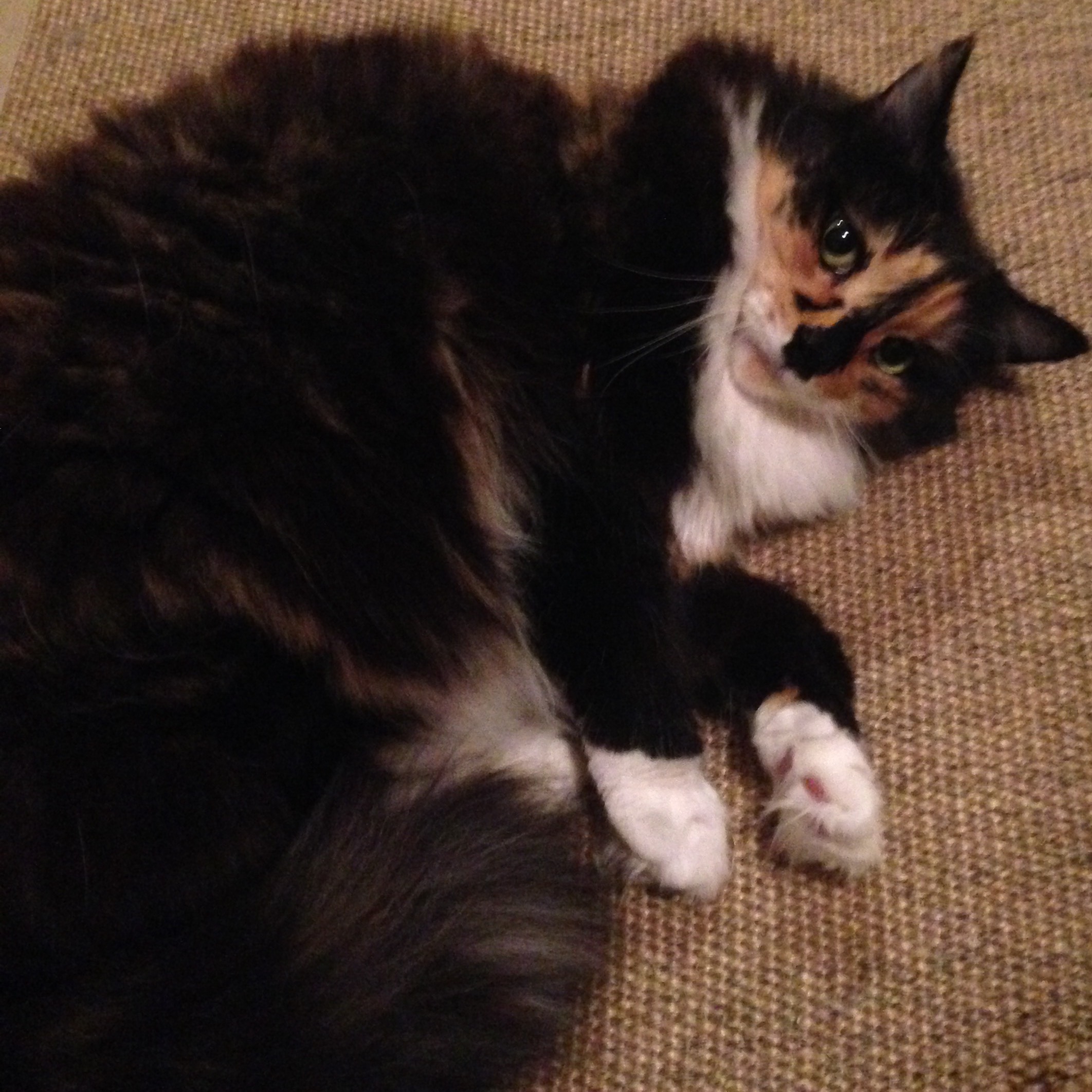
Lady Cat, AKA Lucky Edie, in her floofy prime

Six word stories. They’re foundation exercises in many writing classes, especially flash fiction classes. The most famous is probably Hemingway’s: “For sale: baby shoes, never worn.” So much packed into those six words, eight syllables. You can imagine a family, a room, clothes, a place of worship, a coffin, emotions. (Or a family, a room, an angry child, bare feet, and a pair of rejected multi-coloured sneakers if you’re me, who had a child who channeled his great-grandmother and thus was incredibly picky about his shoes at 16 months and refused to wear anything except solid red Keds.)

But I digress.

I have a six word story for you: My cat is dying of cancer.

Lady Cat on Sunday

Lady Cat, Lady Bird, Flirty Birdie, Lady Fat, Lucky Lady, Lucky Eatie: She has had many names since we scooped her up from the back yard of our Smith Street 3-decker in 2005 and brought her on up to the East Side (it is possible to literally re-enact The Jeffersons’ theme song in Providence). She was born under a sheet of plywood against a garage behind our house, one of three fluffy kittens born to a short-haired calico mother. She and her litter mates were like a dessert tray: one fluffy and biscuit coloured, warm, light brown; one, vanilla-cream coloured, soft ecru; and Lady, rocky road ice cream, pastry, caramel, cream, and chocolate, with a stripe down her nose like a monkey.
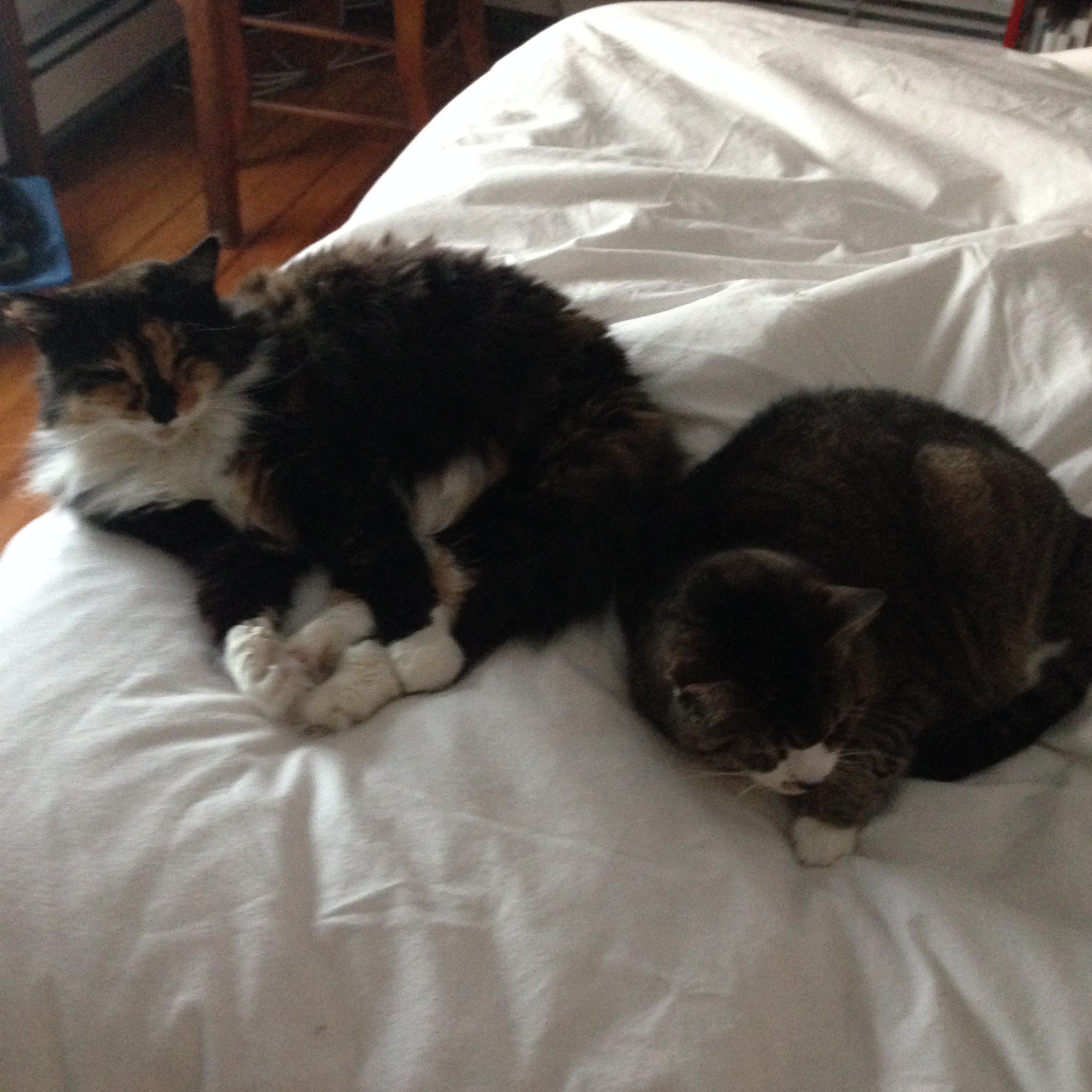
Lady and Socks: prelude to peace

She wasn’t easy to catch, but I managed, on the very last day we would ever be in that apartment, caught her and wrangled her into a cat crate where she spun around like the Tasmanian Devil in the Bugs Bunny cartoons. Eventually she settled down to watching me and the movers hustle the last pieces out of basement on onto a truck, and made the trip over the river and up the hill to a new, larger house.

As my son struggled with spelling homework, Lucky Lady and her arch-nemesis Whiskers (the cat who lived in the house behind us) became the stuff of legend– Whiskers more than Lady, but every week, as Whiskers stole doughnuts from dinosaurs, was stopped by the police, or generally misbehaved, Lucky Lady would often save the day, once by socking Whiskers with her powerful paw. Whiskers and Lucky saved us from second grade.

Dignity. Like Gene Kelly– and just as acrobatic.

Found feral, she was never fully tame, though she made decisions about not venturing outside in the snow again (after a night out in the cold) and she learned not to jump against the screens trying to get at Whiskers (she fell out of the first floor window once). We brushed her, and she adapted after the first few times, when she hissed and bit at the brush. She loved catnip, and eating feathers (I learned to keep my millinery supplies in a cupboard), and chewing wool (I learned to keep my wool in a cupboard). She learned, and we learned, and she is ours and we are hers.

One year, she got lasers for Christmas.

Now that she is terminally ill, we do what we can for her. She eats Trader Joe’s tuna for cats because she can keep it down; she drinks CatSure (she prefers premixed to powder mixed); we give her catnip. Sunday night she did not know what to do with the catnip, and ultimately fell asleep in the catnip without enjoying it.
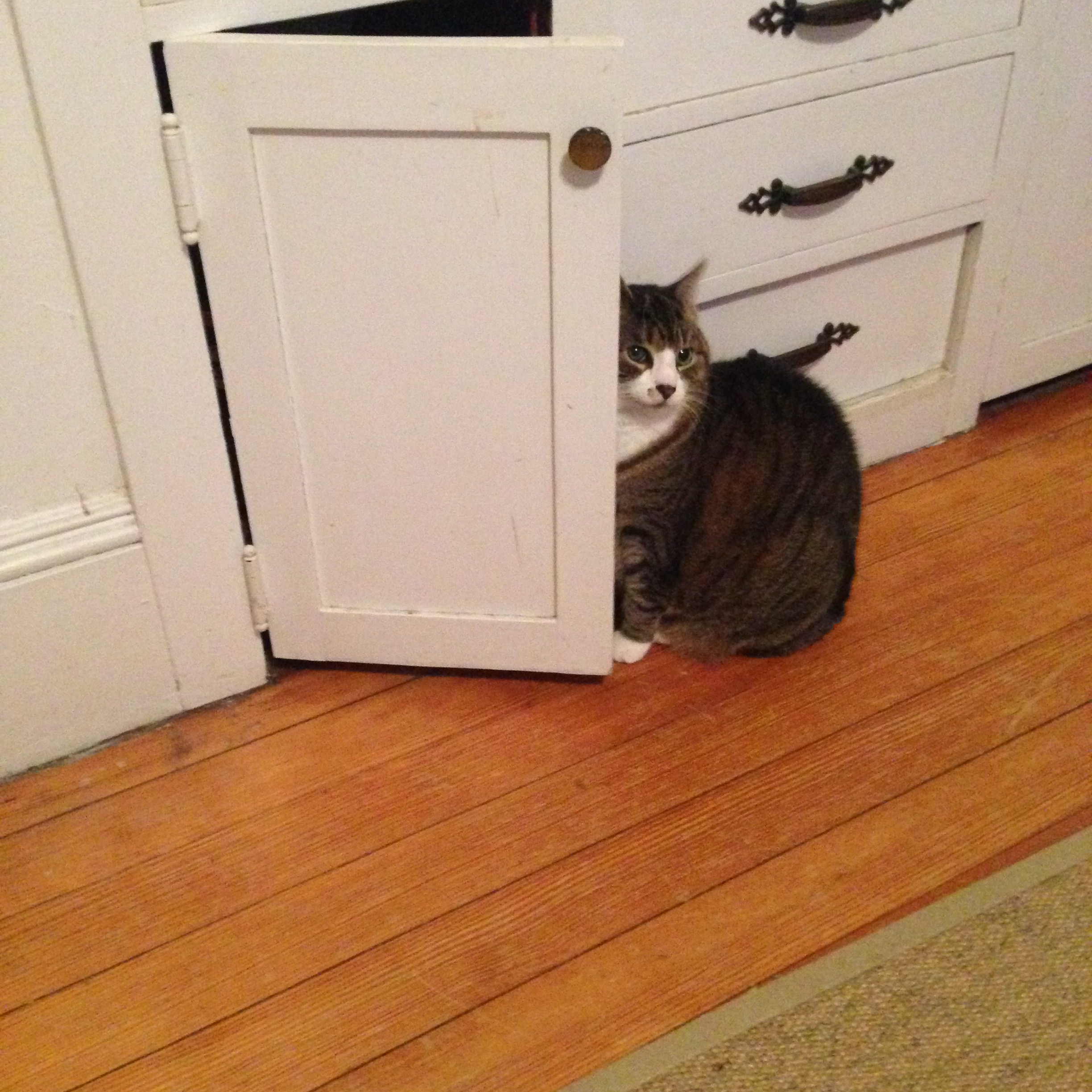
Socks, checking on the Time Machine

Her adopted sister Socks (the one-eyed, wobbly, film noir-loving, Nazi-hating tabby cat known as the Howling Assistant) died last summer. Lucky Lady will die soon, too, though we will keep her as comfortable as we can as long as we can. It’s hard to say how long it will be, and I feel wrenched and torn as I contemplate what Lady must endure and how much I will miss her, the last living connection to Providence I have with me in Alexandria. She’s more than a symbol, of course; she’s an independent being. But when Lady dies, a little part of me will go, too, and the past, and New England, will seem even farther away.
On the Street Corner

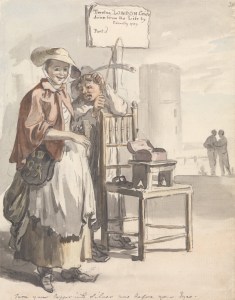
Paul Sandby RA, 1731–1809, British, London Cries: "Turn your Copper into Silver Now before Your Eyes" (Title Page Design), 1760, Watercolor, pen and gray and brown ink over graphite on medium, cream, slightly textured laid paper, Yale Center for British Art, Paul Mellon Collection
Paul Sandby RA, 1731–1809, British, London Cries: “Turn your Copper into Silver Now before Your Eyes” (Title Page Design), 1760, Watercolor, pen and gray and brown ink over graphite on medium, cream, slightly textured laid paper, Yale Center for British Art, Paul Mellon Collection

Not everyone who’s standing on the corner is up to no good. Some have legitimate business.

In the London of the past, just as in, say, the Manhattan of today, street vendors hawked a variety of goods. Having gone through multiple versions of Cries of London, I’ve come up with a basic list of the items sold on the street.

Love songs
Stationery
Oranges
Boot laces
Reeds for chair mending
Saloop See also salop.
Gingerbread
Muffins
Hot cross buns
Doormats
Cats’ and dogs’ meat
Coal
Lavender
Ribbons

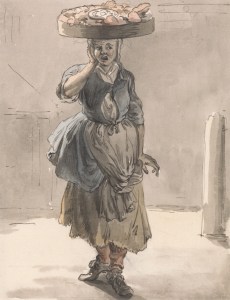
Paul Sandby RA, 1731–1809, British, London Cries: A Girl with a Basket on Her Head ("Lights for the Cats, Liver for the Dogs"), ca. 1759, Watercolor, pen and brown ink, and graphite on medium, cream, slightly textured laid paper, Yale Center for British Art, Paul Mellon Collection
Paul Sandby RA, 1731–1809, British, London Cries: A Girl with a Basket on Her Head (“Lights for the Cats, Liver for the Dogs”), ca. 1759, Watercolor, pen and brown ink, and graphite on medium, cream, slightly textured laid paper, Yale Center for British Art, Paul Mellon Collection

Boot black
Brushes
Flounders
Rhubarb
Walnuts to pickle
Cucumbers
Bandboxes
Baskets
Brooms
Rabbits
Pins
Mops
Wash balls (soap)
Strawberries
New peas
Rosemary and bay
Strings of onions
Turnips and carrots

There’s seasonality to this, of course. Strawberries and cucumbers are not being hawked on the streets of London, Boston, Newport or New York in February. I’ll tell you: being a Cat’s-meat-[wo]Man is practically a childhood dream, since I knew I could never really learn to speak to the animals, and as it happens, Sandby depicts one. It seems there was gender equity in supplying food for pets and stinking of meat.

Paul Sandby RA, 1731–1809, British, London Cries: A Milkmaid, ca. 1759, Watercolor, pen and brown ink with graphite on medium, cream, slightly textured wove paper, Yale Center for British Art, Paul Mellon Collection

I’ve long been fond of the milkmaid, probably because she’s relatively clean, has a cloak for warmth, and I can understand what she does. As much as I love “Turn your copper into silver,” I lack real skill at charlatanry. And gambling. I don’t play poker: my face is too easy to read. Still, if you’re doing this right, there’s a lot to invest in being a milkmaid: kettles (likely pewter), measuring cups (tin? or possibly pewter), and a yoke. It’s a commitment. Cat’s meat– if you’re good with stank and have the right basket*, you’re pretty okay.

If not stank or drank, then gaming. It looks like the object of the game is to knock down the three balls at left in the background by hitting another ball, or perhaps a stone, with the stick. Ha’penny a throw? Maybe you just throw the stick.

Paul Sandby RA, 1731–1809, British, London Cries: Throws for a Ha'penny Have You a Ha'penny, undated, Brown wash, gray wash, graphite, and black chalk on medium, cream, slightly textured laid paper, Yale Center for British Art, Paul Mellon Collection
Paul Sandby RA, 1731–1809, British, London Cries: Throws for a Ha’penny Have You a Ha’penny, undated, Brown wash, gray wash, graphite, and black chalk on medium, cream, slightly textured laid paper, Yale Center for British Art, Paul Mellon Collection

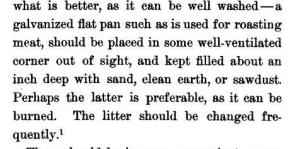
This is another instance wherein I am faced with historical things I don’t know nearly enough about: gambling and street games, pet care and keeping. Cat boxes: when we were they invented? We know cat litter is a 1947 invention, and that sand or ashes were used in cat boxes when cats were kept inside, but for the most part, they went in and out, and mostly out, until cat boxes and neutering became common, though an 1895 manual recommended that “the cat in civilization must be fed, looked after, and guarded in its moments of freedom.“**

cat care
Yes, I went there. I looked it up.

It’s more than 100 years after the time I’m investigating, but I don’t want to fall too far down this cat’s meat rabbit hole– but this does tell me that the historical images of indoor cats come with oat or straw filled baskets in sunny corners, and recommendations for galvanized pans filled with sand, clean earth, or sawdust, which may be ideal, as it can be burned.

Right, I need to focus and not entertain myself with children’s books about Old Dame Trot and her cat…dressed up. In 1810.

My point is, there’s a lot to sell on the streets of any town, images to support the material culture and reference books from which we can derive contextual clues to the impression of something as random as a cat’s meat man or woman. I don’t know that I’m leaping to be a Cat’s-meat-Woman, but it leads to a lot of interesting interpretive points about domestic life, pets, and families that visitors can relate to much more easily than street sales. Of course, if you choose to be the Cats-meat-Man, I won’t stop you from calling yourself Mr Friskies.

*See that flat do-da? I have a similar basket. It does appear one could hawk oysters from a basket like the one I have. Mmmm good.

**Huidekoper, Rush Shippen, 1854-1901. The cat, a guide to the classification and varieties of cats and a short treaties upon their care, diseases, and treatment. 1895: New York, D. Appleton and company

Upgrading Reenactor Mouse

When all else fails, sew. And if that fails, sew something else. After a mad rush to get the gents into their new clothes for Saturday’s Battle Road business, I found myself at loose ends Sunday morning. I toyed with sleeves on the Space Invaders gown, and stitched a shoulder seam on the coat Mr B gave me last weekend. (It does not fit his shoulders, but his guess that it might work for the Young Mr was correct: somehow, Mr B cut a man’s coat to a boy’s frame.)

Original mouse and upgraded mouse (now with whiskers!)
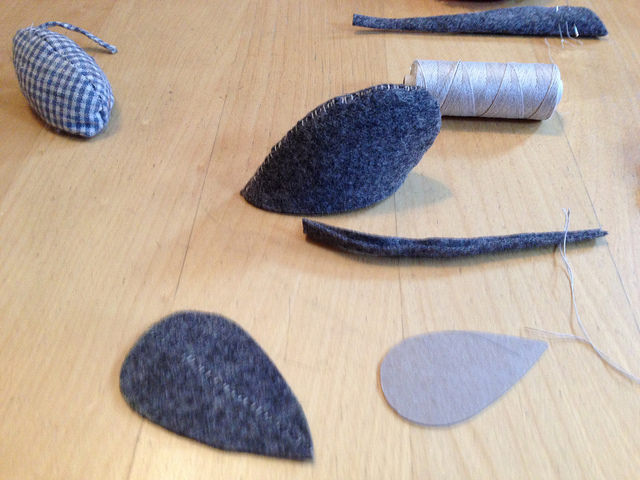
mouse parts
mouse parts

The bonus of this, aside from my amazed gratitude at a lovely coat well on its way for the boy, was an upgrade to reenactor mouse. Poor reenactor mouse was made at the farm from clumps of wool and scraps of check linen. New reenactor mouse is far fancier, being made of cleaned wool batting, catnip, and a scrap of broadcloth that is probably the $65/yard mixed grey wool I think it is. Lucky kitty, no?

The pieces are simple: two mousey-shaped backs, a roughly oval pasteboard base, a strippy scrap for a tail, wool batting, and catnip. Linen thread for stotting, whipstitching, and whiskers. Stitch the backs together (I had to piece the base from a scrap, so stotted bits to look like a mouse hide. Why not?)

Nearly stitched up mouse

When the backs are stitched, turn and press. Pin the base to the body on one side. Stitch to near the center back seam.

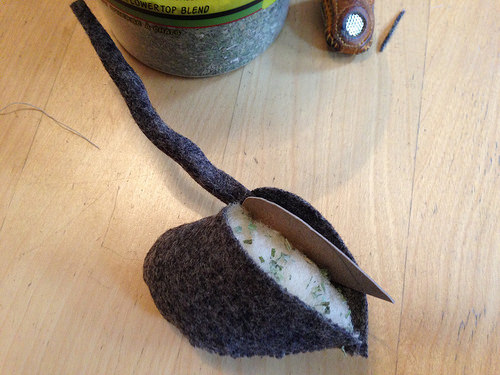
Whip stitch the tail to the inside of the mouse base. At this point, you’re ready to stuff the mouse. I rolled the wool batting in the catnip and stuffed the back, poured a little more straight catnip in, and then finished off with another bit of catnip-rolled batting.

This is where the little pasteboard or chipboard base comes in. You slide this in to the mouse sandwich before closing the last base seam. (It helps stabilize the mouse, so that it skitters across the floor more satisfactorily when batted.)

nearly there. full of wool & catnip.

Stitch the final seam. Make sure the seams are sturdy, as they’ll be going up against claws. I like to thread doubled linen thread through a large-eye needle to make whiskers; be sure to knot on both sides of the mouse’s nose.

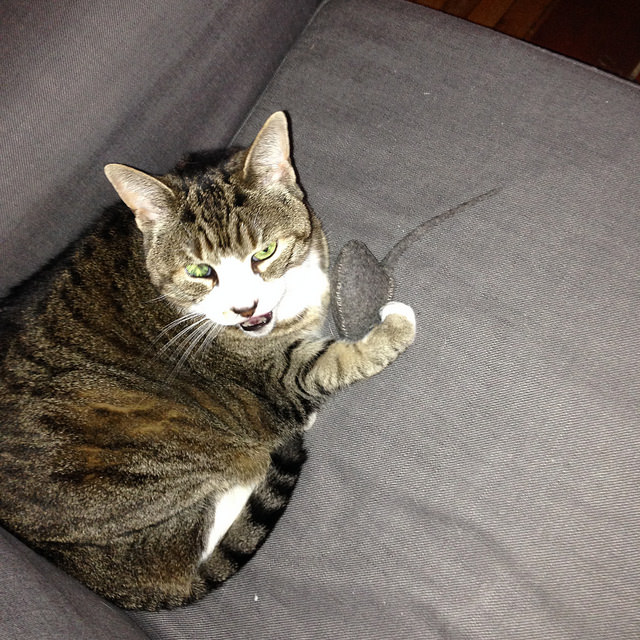
All you need to do now is hand the mouse over and back away. Kitty requests some privacy with her new mouse. There’s a flickr album if you want to see the progress photos of a quick and silly project and make your own Wooly Mouse for Progressive Pussy Cats.

a little privacy, please?

Frivolous Furry Friday

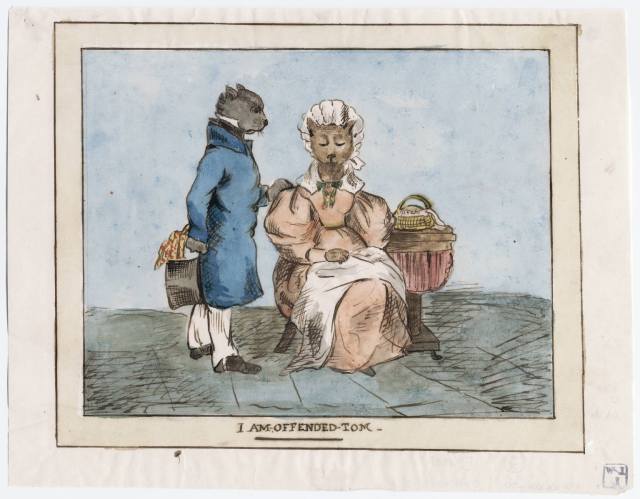
I am offended Tom. Watercolor, 1830s. Lewis Walpole Library, Drawings Un58 no. 29 Box D108

I don’t know the backstory here, but the summary is satisfying: A standing cat attired in men’s 19th century fashion rests his paw on the shoulder of a sitting cat attired in women’s 19th century fashion. The latter declares “I am offended Tom” while engaged with a sewing project.

Really, the lolcat is a historic tradition, and it’s research I’m doing when I wander over there on lunch break, honest. So, let’s research this up:

Judging by the lady’s sleeves, we’re probably looking at ca. 1830 for a date- circa gives you so much leeway–but the details of collar and cap are quite nice. Tom has a nice blue coat, straps on his trousers, and a spotted neck or handkerchief in his paw; I think we’re seeing a black waistcoat lapel under the large blue coat collar. The pedestal work table is a nice touch, and not extremely common in collections today.

Whatever has happened between these two (I don’t need to tell you about a tom cat’s reputation), the watercolor does a nice job of depicting a fairly common domestic scene in which only the trappings change. Those anthropomorphic emotions have played out, and will play out, in many a parlor, drawing room, chamber, living room and studio.

Let us hope we all avoid domestic stresses this weekend, except when truly warranted.

Many thanks to Sew 18th Century for the image link!