 Sew 18th Century had a great comment about the striped linings on the quilted petticoats: are they linen? The catalog record doesn’t say. I think they are, and I remember feeling linen on the insides of the petticoats, but I lay awake wondering: what if those linings are linsey-woolsey? I know women are running away in “lincey” petticoats in 18th century Rhode Island, what if…what about that blue silk? Is that superfine wool in the lining?
To relieve my mind, I did some searches at the Met and the MFA and discovered a familiar inconsistency: quilted petticoats described as being made of silk. Silk and cotton. Silk, cotton, linen. Sometimes the lining was called out, sometimes not. The MFA Boston has some of the best catalog records: major thanks to the creator of the record calling out the ribs in the cotton and linen petticoat with polychrome crewel work.
What does all this mean? It means, when you are lucky enough to be able to ask the collections person for more detail, do! Because the records up in museum online catalogs are in process. Sometimes that process is drawn out over a series of years. The catalog record created for the calamanco petticoat in the RIHS collection was made in 2006 by a young woman working on a grant. her major interest was fine art, but she needed a job, was smart and conscientious, so I talked her into doing the textiles inventory. Along the way, the Registrar and I tried to help her, but the museum was draped in workmen, the Library in open revolt, the basement flooding, and I think that was the summer there were two serious accidents in the Registrar’s family–unless it was the summer she had mono. Not ideal conditions.
We were also cataloging in a home-made, twice-modified Access2003 database, so data entry was entirely manual. That requires even more will power on the part of the cataloger–you’re typing it twice. In the database we use now, the description can contain such lovely phrases as “calamanco exterior with wool batting and plain weave linen lining, pieced from two striped fabric lengths.” You can get poetic in the description. Then in materials you can select straightforward “fibre, wool,” and “fibre, linen” but you’re not typing it again. This makes me want to spend more time on the description, because I know that someone will get the basics in the material field.
So those petticoat records are early, based in some cases on information I know is not quite right, and they need to be edited. What I find so useful is knowing people are interested! That means that I can justify taking the time to go over a block of records, improve them, and upload them again. It won’t be as soon as I like, but I can think of this as a winter project that will give me great pleasure and make up for whatever super dull administrative tasks I have, and benefit a wider population.
As for the Curatorial Assistant, she’s teaching English and Art History at the high school level now, and it’s just me, the Registrar and the Assistant Registrar/Photographer, all of us only two days a week in the museum; the balance of time is at our library. We are responsible for all of the displays in the museum, all new exhibitions at the museum, temporary exhibits in our satellite museum, environmental monitoring, new gifts, old gift untangling, research and reference requests, disaster planning and response, loans, oversight of construction projects, actual hands-on gallery renovations, exhibit object preparation, mount making, and installation, database administration, collections digitization…some just for the 30,000 museum objects, some of that for all of the collections.
That’s an extreme case, but most museums have similarly pressed staffs and that’s reflected in the level of detail in the catalog records. When we’re finished with the NEH Sampler Archive Project, we’ll have the best sampler records ever–because the grant pays for us to spend the time counting threads in the backgrounds, and for new photography of all the samplers. It takes that level of commitment to get very high quality records with images for all objects.
Most of the time, I don’t get into this kind of discussion, because I don’t want to sound defensive or whinging. But the hard truth is that money talks, and we focus cataloging where there is money to support the cataloger, or the rehousing of cataloged objects, or the digitization of the objects. Priorities have to be set, and for now, they’re set by funding. As the man says in The Right Stuff, “No bucks, no Buck Rogers.”
Still, that doesn’t mean I won’t find a way to indulge my love of quilted petticoats come December, pull them from the drawers, and revise the records.

 Ah, the Met. You have to love them, so much wonderful material available online, and free. Collections of immeasurable depth and wealth, an incredible professional staff–this is the pinnacle, right? And yet…
 Catalogers, I implore you: subject headings. If not subject headings, the date, please, when it is on the item. That makes the collections not only sortable, but searchable.
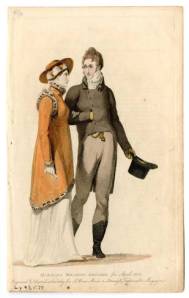 And, since we’ve been on the topic of men’s wear, here’s a well-dressed gentleman and his lady in Morning Walking Dress for April 1807.
 Kirsten Hammerstrom
You must be logged in to post a comment.